AI Data Enrichment: What a Model Must Not Supply
Ask a model for a work email and it will give you a well-formatted one. That behaviour is the whole boundary between what AI adds to enrichment and what it destroys.

AI data enrichment uses a model to improve records rather than to look them up. The useful split is retrieval against judgement: finding or verifying an address is a database and a mail server question, while normalising a messy field or judging a company against a written definition is a classification task a model handles well.
Key takeaways
- A model may read, normalise, classify and judge, and must never be the source of a fact you will send against, because it produces a plausible answer rather than no answer when it has no basis for one.
- Fabrication fails silently: a blank field announces itself and gets checked, while an invented one renders into copy and reaches the prospect. Grounding in fetched source text, with a required quote behind each claim, is the control.
- Every judgement step needs an explicit option to abstain and a counted abstention rate, since a step that cannot say it does not know will invent instead.
- The prompt encoding your targeting is the only version of that rule that decides anything, so a stale one rejects a whole approved segment and the thin batch it produces is indistinguishable from a genuinely weak pool.
Reviewed and updated September 1, 2026
Ask a language model for a prospect's work email address and it will give you one. It will be correctly formatted, it will match the company's apparent naming convention, and there is no reliable way to tell from the output whether the mailbox exists. That single behaviour is the whole boundary between what a model adds to an enrichment pipeline and what it quietly destroys.
The vendor category called AI data enrichment blurs that boundary, because it covers two genuinely different jobs under one phrase. One of them is a database lookup with a model bolted to the front. The other is a judgement task that no database can perform. Knowing which one you are buying is most of the decision.
Teams evaluating vendors in this category against a specific vertical's compliance needs can compare options in the roundup of enrichment tools built for legal services.
The hard boundary: retrieval against judgement
Some enrichment questions have a single correct answer that exists somewhere as a fact. Does this mailbox accept mail. What is this company's registered domain. How many people work there. A model does not know these things. It produces text that resembles the answer, drawn from a distribution rather than from a record, and when it has no basis for an answer it produces a plausible one anyway.
Other enrichment questions have no lookup table at all. Does this company match a written definition of our ideal customer. Is this string a person's name or a job title that landed in the wrong column. Does this business sell to consumers or to other businesses. These are classification problems over messy text, they have defensible rather than provable answers, and they are precisely what a model is good at.
The practical rule that follows is short. A model may read, normalise, classify and judge. It may not be the source of a fact you will act on. Finding an address is retrieval, so it belongs to a provider database and a verification step. Deciding whether a row belongs in the campaign is judgement, so it belongs to a model with the evidence in front of it.
Choosing which provider handles the retrieval side of this split is its own decision, and a comparison of enrichment tools built for agencies helps narrow the field.
- Finding a work email address
- Confirming a mailbox accepts mail
- Resolving a company's real domain
- Headcount, funding, registered entity
- Anything you will send to or bill against
- Does this company match a written ICP definition
- Is this company name actually a person's name
- Normalising a name or company string for use in copy
- Classifying a business from its own site text
- Drafting a line grounded in evidence you supply
Fabrication is a silent failure, and it is the reason for grounding
The failure mode of a model in a data pipeline is not an error. It is a confident, well-formed, entirely invented value that flows through every downstream check without tripping any of them.
A blank field announces itself. Somebody notices it before writing to that person. A fabricated field does not announce anything: it renders into copy, it reads naturally, and the first person to discover it is the prospect who receives an email describing a product their company does not sell.
Salesloft Connect's Chrome extension review examines how cadence enrollment and contact updates sit inside Gmail and a CRM once enrichment data lands there.
The control is grounding. Give the model the actual source text and require it to answer only from that text, rather than asking it what it knows about the company. In practice this means fetching the prospect's own site and passing the content in, so the model's job becomes reading comprehension over evidence rather than recall from training. Our documented policy for grounded copy generation works this way for exactly this reason, and the anti-fabrication check that goes with it is a verbatim-quote requirement: the model must point at the span of source text its claim came from, so a claim with no span behind it is caught mechanically rather than by somebody reading the output.
Two design consequences follow. A model with no evidence must be allowed to return nothing. An enrichment step that cannot express "I could not tell from this page" will invent rather than abstain, because abstaining was never one of the options you gave it. And the abstention must be counted, because a step whose no-answer rate you do not track cannot be distinguished from a step that is quietly answering everything.
- Step 1Resolve the company's real domain
A lookup, not a guess. Everything downstream inherits this key.
- Step 2Fetch the source text
The company's own pages, passed into the model as evidence
- Step 3Ask a closed question
Judge against a written definition, with an explicit option to abstain
- Step 4Require a span, not just a verdict
The quote the answer rests on, so an unsupported claim fails a check
- Step 5Count the abstentions
A no-answer rate you do not track is a fabrication rate you cannot see
Where a model earns its place: the normalisation pass

The least glamorous use is the one that pays for itself most reliably, because it fixes a class of defect that reaches live copy.
Real lead data is full of strings that are technically populated and unusable. A first-name field holding Info or a single initial. A company field holding Freelance, Self-employed or Independent, which are employment statuses rather than companies. A company field carrying a tagline, an ALL CAPS brand styling, an unclosed parenthesis left by a truncation, or the person's own surname misspelled. None of these are empty, so an emptiness check passes them. All of them interpolate straight into a merge field.
A model reading each row and returning a normalised display form catches most of this cheaply, and the ones it flags rather than fixes are exactly the rows a person should look at. The employment-status case is worth naming specifically because it is more dangerous than it looks: upstream resolution can turn a status like Independent into a real and entirely unrelated company's domain, at which point a domain-agreement check scores the row as maximally safe while the address points at a stranger.
This is also where the model's output should stay advisory. Keep the normalised value in its own field beside the original rather than overwriting it, and promote it by an explicit rule. Every team that skips this eventually overwrites something a person knew to be true. The write-back mechanics are covered in CRM enrichment, and the identity question underneath them in record matching.
ICP judgement, and the failure that reads as a weak list
The second high-value use is deciding whether a company belongs in the campaign at all, judged against a written definition rather than a firmographic filter. This works well, and it fails in a specific way that is worth knowing before it happens to you.
The prompt holding the definition is the executable version of your targeting. An agreement, a spreadsheet and a wiki page can all say the segment is companies above 1,500 employees, and none of them decide anything. If the prompt still says 5,000, every company in the band between those numbers is rejected, nothing errors, and the run finishes with a thin batch that looks exactly like a genuinely weak pool. The symptom is indistinguishable from bad sourcing, which is what makes it expensive.
Two habits close it. When a targeting term moves, change the prompt in the same sitting as the record of the decision. And when a batch comes back disappointing, read the prompt's own criteria against the targeting you believe is agreed before concluding the list was poor. Guidance on writing a definition tight enough to judge against is in ideal customer profile.
The related trap is the disposition of a borderline row. A judgement step that can return an "unclear" verdict needs somewhere for that verdict to go. If unclear rows are silently dropped rather than escalated to a second, better-evidenced pass, then a whole segment that legitimately sits on the boundary disappears from the campaign without ever appearing in a rejection count.
What the model does not make cheaper
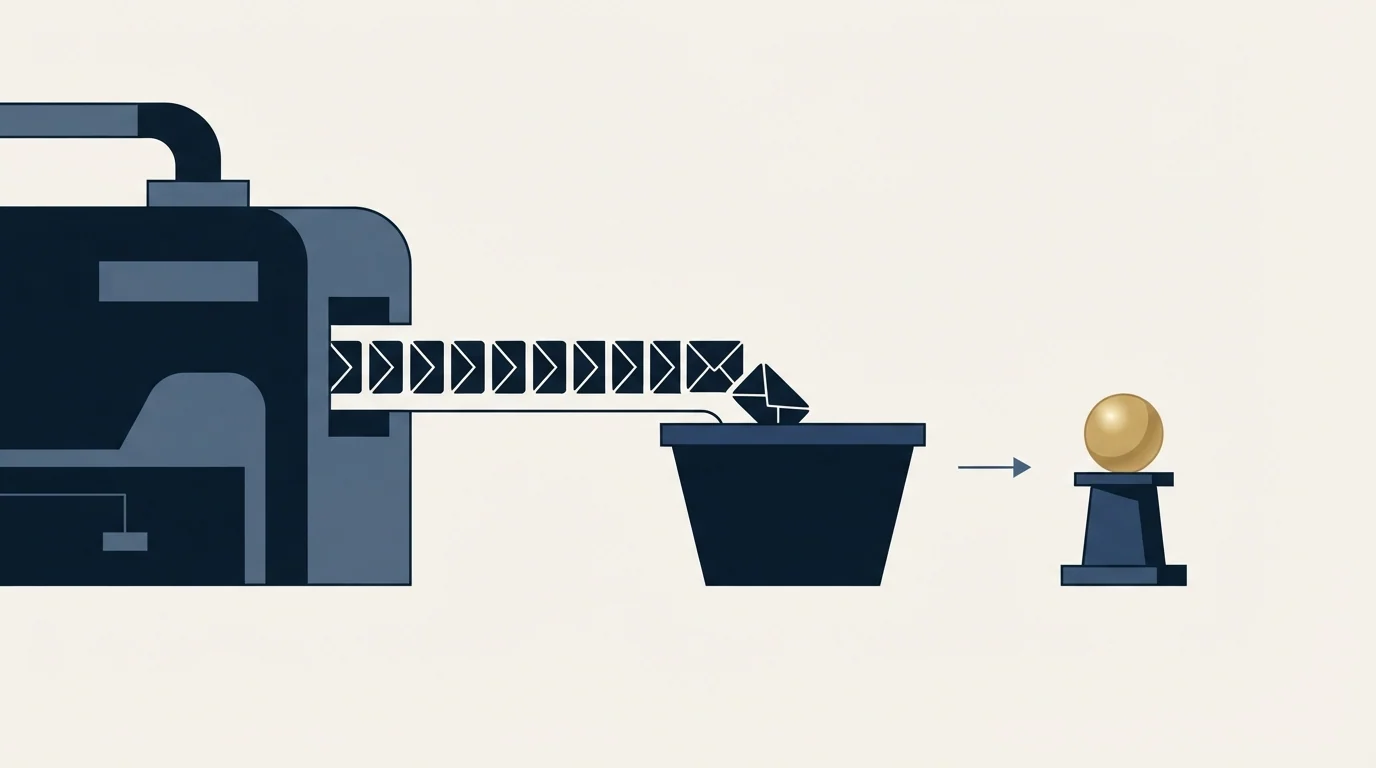
Model output is cheap enough that it invites use everywhere, and two costs do not move.
Verification still costs what it costs, and still has to happen. No amount of model confidence substitutes for asking the mail server. A generated address is a guess with good grammar.
Because a scraped contact database loses the continuous verification that gave it value in the first place, it is worth reading why scraping ZoomInfo data rarely holds up as a shortcut.
The expensive defect is unchanged. A valid mailbox belonging to the wrong person passes verification, delivers cleanly, and reaches somebody's previous employer. A model in the pipeline does not help with this and can make it more likely, because a model asked to resolve a company from an ambiguous string will confidently pick one. The audit is the same as ever: compare each resolved address's domain against the company on the row, split the result by which provider resolved it, and read the mismatches by hand rather than trusting the rate. Corporate parents and legacy domains are usually legitimate, which is why they need reading.
- Yes: Judgement steps receive fetched source text as evidence
- Yes: Every judgement step can return no answer, and abstentions are counted
- Yes: Normalised values live beside the originals, promoted by an explicit rule
- Yes: The ICP prompt is updated in the same sitting as the targeting decision
- No: A model supplies an email address, a headcount or a funding figure
- No: Verification is skipped because the model was confident
- Depends: Borderline verdicts escalate to a better-evidenced pass rather than being dropped
Model choice is a per-step decision
The cheapest adequate model for a mechanical step is usually a small one, and the step that arbitrates quality should not be. Classification against clear criteria, string normalisation and page selection run perfectly well on a small model. Judging whether a piece of copy is any good is not a place to save tokens, because a weak judge approves weak output and the whole point of the step was to catch it.
The useful diagnostic is to run a deliberately weak model as the generator during development. A strong model will paper over a vague prompt; a weak one will fabricate the moment the instructions leave room for it, which is what you want to discover before the prompt goes near a client's prospects.
For a vendor's implementation of model-driven enrichment inside a workflow tool, Clay's agents is the worked example, and the enrichment waterfall covers the retrieval half of the pipeline that no model replaces.
The short version

Let a model read, normalise, classify and judge, and never let it be the source of a fact you will send against. Ground every judgement in fetched source text, require a quote behind each claim, and allow the step to abstain while counting how often it does. Keep normalised values beside the originals rather than overwriting them. Update the prompt that encodes your targeting in the same sitting you change the targeting, because that prompt is the only version of the rule that decides anything.
If you would rather see a campaign built on a list that has been through this, you can see what a campaign would look like for your market.
Frequently asked questions.
Frequently asked questions- Can AI find email addresses?
- It can produce strings that look like email addresses, which is a different thing. Finding an address is retrieval from a maintained database, and confirming one is a conversation with the recipient's mail server. A model asked for an address returns a pattern-shaped guess with no evidence the mailbox exists, and nothing in the output distinguishes a good guess from a bad one.
- What is grounding in data enrichment?
- Grounding means passing the model the actual source text and requiring it to answer only from that text, rather than asking what it knows about a company. In practice you fetch the company's own pages and pass the content in, so the task becomes reading comprehension over evidence. Requiring the model to quote the span its answer rests on makes an unsupported claim mechanically detectable.
- Where does AI genuinely help with lead data?
- Normalising fields that are populated but unusable, such as a company value holding an employment status or a first name holding a role word, and judging a company against a written ideal customer profile using its own site text. Both are classification over messy input, both have defensible rather than provable answers, and neither has a lookup table a database could consult instead.
- Does a model reduce the need for verification?
- No, and treating confidence as evidence is how unverified addresses reach a campaign. Verification cost is unchanged and so is the defect verification cannot catch, which is a valid mailbox belonging to the wrong person. A model in the pipeline can make that more likely, because one asked to resolve a company from an ambiguous string will confidently pick one.
About the author.

B2B cold email experts helping companies generate qualified leads through done-for-you outreach campaigns.
RevenueFlow Team
Explore more.
Ready to scale your outreach?
We build GTM engines that book real meetings. See the receipts.
Related articles.
Seamless.AI Email Finder: How It Works, What a Credit Buys
How Seamless.AI's email finder resolves a contact in real time, what one Universal Credit buys, the Total AI score on every address, and what the Chrome extension reads.
Is Clay Free? The Free Plan, the Trial and Where Each Stops
Clay's free plan, its 14-day trial and the no-charge-on-a-miss rule are three different things. What each holds and where it stops, from clay.com on 19 September 2026.
Autobound Pricing: One-Time Credit Packs, Not Seats
Autobound's pricing page sells one-time credit packs for a signal data API, not seats. The six packs, the per-endpoint meter, and what a company costs.
TexAu Pricing: Four Tiers, Billed Only on a Match
TexAu charges credits only when a lookup succeeds. The four tiers at both billing states, the rollover cap, and three places the page disagrees with itself.
Firmographic Data Providers: What Six of Them Publish
Six firmographic data providers read from their own pages: the fields each sells, the coverage each states, how the data is delivered, and who prints a price.
Apollo Integrations: What Connects, and on Which Plan
Apollo's integrations marketplace sorted by job: what its own pages say each CRM sync moves, which plan ticks which integration, and what a sync costs.