Best CRM Tools for Enterprise (2026)
The five CRM tools worth comparing for Enterprise in 2026, with every price attributed to the page it came from and the unverifiable ones marked.
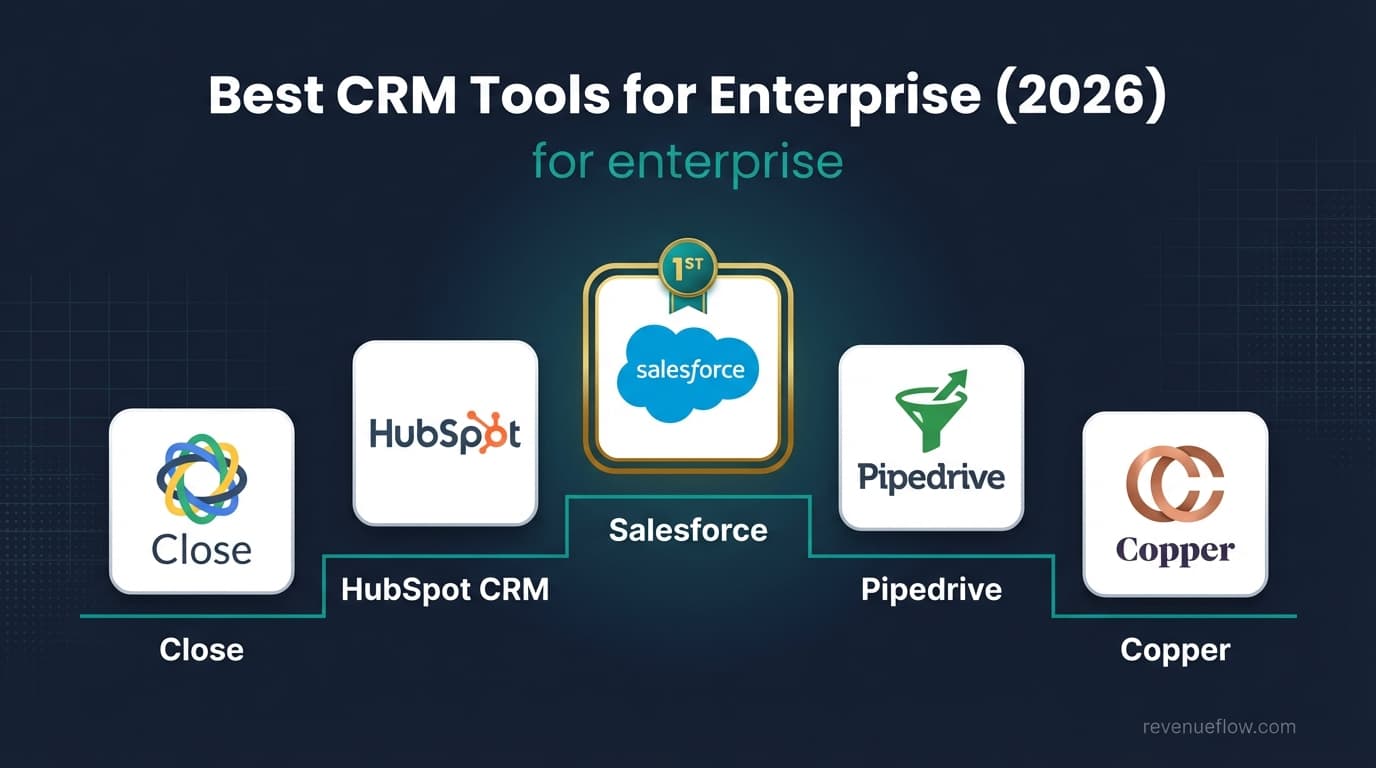
Enterprise CRM software is bought for governance as much as selling: single sign-on, audit logs, field-level permissions and sandboxes. Salesforce publishes the fullest ladder, from $25 to $550 USD per user per month. Freshsales lists permissions, audit logs and sandbox on Enterprise at $59, and HubSpot lists single sign-on on Enterprise from $75 a seat.
Key takeaways
- Salesforce's pricing page now names five plans, Starter Suite, Pro Suite, Core, Advanced and Max, at $25, $100, $195, $395 and $550 USD per user per month, with every tier above Starter billed annually.
- Freshsales lists field-level permissions, audit logs and sandbox on its Enterprise plan at $59 per user per month billed annually, and has no free tier, only a 21-day trial.
- HubSpot's CRM product page lists single sign-on and field-level permissions on Enterprise, starting at $75 a month per seat, above a free CRM for up to two users.
- Pipedrive's plan comparison table lists SAML single sign-on on every plan, and keeps security rules, the audit log and a sandbox account for Ultimate.
Reviewed and updated September 18, 2026
Enterprise CRM selection is rarely won on features and is frequently lost on two questions from security and procurement: where the data lives, and what happens to it when the contract ends. The published plans describe a product; the negotiated contract describes what you actually buy. That is why a shortlist of enterprise CRM software built from entry prices misleads, and why this guide to enterprise CRM platforms names, for each vendor, the tier that carries the controls an enterprise would actually deploy.
Vertical shortlists carry a different trap, since three products sold as medical sales CRM are bought by three different people for three different jobs.
What Is Enterprise CRM Software?
Enterprise CRM software is a customer relationship platform bought for governance as much as for selling: single sign-on, audit logs, field-level permissions, sandboxes and negotiated contract terms, on top of contact, deal and pipeline management. On most enterprise CRM platforms those controls sit on the upper tiers, so the tier that carries them, rather than the entry plan, is the real price.
Five vendors are covered here: HubSpot CRM, Zoho CRM, Freshsales, Salesforce and Pipedrive. Every price below is taken from the vendor's own page and attributed to it. Two of those pages served a currency other than dollars to the network they were read from, Zoho in rupees and Pipedrive in pounds, and those ladders are given in the served currency rather than converted.
What Enterprise Need From a CRM Tool
- SSO and security
- Custom pricing
- Dedicated support
- API access
- Compliance features
Single sign-on, audit logging, sandboxes and field-level permissions are the gate, and on this list they mostly cluster at the top of the published ladders. That has a direct budgeting consequence: the entry price is rarely the relevant number, and an evaluation that compares entry prices across five vendors is comparing five products nobody in an enterprise would deploy. The exception worth knowing is Pipedrive, whose plan comparison table lists SAML single sign-on on every plan and keeps the audit log and sandbox for the top one.
| Vendor | Controls its page names | Tier and price |
|---|---|---|
| HubSpot CRM | Single sign-on, field-level permissions | Enterprise, from $75/month per seat |
| Freshsales | Field-level permissions, sandbox, audit logs | Enterprise, $59 per user, billed annually |
| Salesforce | Enhanced security | Advanced, $395 USD per user, billed annually |
| Pipedrive | Security rules, audit log, sandbox | Ultimate, £79 per seat, billed annually |
Custom pricing follows from that, and it is where the leverage sits. When the price is negotiated the specification is the lever: seats, sandboxes, API limits, retention periods and data location are all agreed at once, and a pilot bought on a published plan and expanded later gives that leverage away.
API access is the third demand and the one that decides whether the deployment is maintainable. An enterprise CRM is integrated into billing, support and product systems, so the practical question is rate limits and sandbox availability rather than whether an API exists. Both are commonly tier-gated, and both are the sort of thing discovered late.
Top 5 CRM Tools for Enterprise

No lab test sits behind this list. Nobody here ran five CRM implementations side by side, so the guide makes no claim about which is fastest to deploy. What it does judge is what each pricing model rewards and which shape of team the published plans were drawn for.
1. HubSpot CRM
An all-in-one CRM platform with a free tier covering contact management, deal pipelines and a reporting dashboard, plus separate Hubs for marketing, sales, service and content.
From HubSpot's CRM product page: Free, then paid editions starting at $15, $50 and $75 a month per seat.
| Plan (HubSpot CRM product page) | Price | What the page lists |
|---|---|---|
| Free | Free, up to two users and 1,000 contacts | Contact management, deal pipelines, reporting dashboard |
| Starter | Starts at $15/month per seat | A footnote says the discount is for new customers only |
| Professional | Starts at $50/month per seat | Custom reporting, calculated properties, duplicate management |
| Enterprise | Starts at $75/month per seat | Custom objects, single sign-on, field-level permissions |
Integrations: Gmail, Microsoft Outlook, Slack, Salesforce, Zapier, Shopify, WordPress, Zoom
Deployed at enterprise scale largely where marketing and sales want one platform. Single sign-on and field-level permissions arrive at Enterprise, and each Hub is priced separately, so take the full specification into the negotiation rather than reading one page.
2. Zoho CRM
A broad, low-cost CRM from the Zoho ecosystem, with sales automation, multichannel communication, analytics and the Zia AI assistant, integrated across the rest of the Zoho suite.
From Zoho's CRM pricing page, which served rupees: a free edition for 3 users, then ₹800 to ₹2,600 per user per month with its Annually toggle selected. No dollar ladder is quoted because that page did not serve one here.
| Plan (Zoho CRM pricing page, served in rupees) | Price |
|---|---|
| Free | Free for 3 users |
| Standard | ₹800 |
| Professional | ₹1,400 |
| Enterprise | ₹2,400 |
| Ultimate | ₹2,600 |
Integrations: Zoho Suite, Google Workspace, Microsoft 365, Slack, Zapier, Mailchimp, Shopify, QuickBooks
Chosen at scale mainly on cost, particularly where the wider Zoho suite is in use. Its page lists the Zia AI sales assistant and territory management on Enterprise, and names a developer sandbox and field-level encryption among its features. Ask for the quote in your own billing currency.
3. Freshsales
A CRM from Freshworks combining contact and deal management with chat, email and phone on its entry plan, and the Freddy AI Agent sold as an add-on.
From the Freshsales pricing page: $9 /user/month, billed annually on Growth, up to $59 /user/month, billed annually on Enterprise.
| Plan (Freshsales pricing page) | Price | Billing basis |
|---|---|---|
| Growth | $9 /user/month | billed annually |
| Pro | $39 /user/month | billed annually |
| Enterprise | $59 /user/month | billed annually |
Three details from that page change the arithmetic. Those are the page's annual prices, shown with a Monthly and an Annually toggle at Save 20%, so a monthly commitment costs more. There is no free tier, only a 21-day trial. And the page prices two add-ons separately: Branded documents at $19 /user/month, and the Freddy AI Agent at $49 /100 sessions.
Integrations: Freshworks Suite, Gmail, Microsoft Outlook, Slack, Zoom, Zapier, Segment, Shopify
Its published Enterprise tier at $59 /user/month, billed annually is where field-level permissions, audit logs and sandbox appear, which is the number an enterprise evaluator should compare.
4. Salesforce
The largest CRM platform, with sales, service, marketing and commerce products, deep customisation and the AppExchange ecosystem. Its pricing page now calls the sales product Agentforce Sales.
From the Salesforce pricing page: $ 25 USD/User/Month on Starter Suite, up to $ 550 USD/User/Month on Max.
| Plan (Salesforce pricing page) | Price | Billing basis |
|---|---|---|
| Starter Suite | $ 25 USD/User/Month | Billed monthly or annually |
| Pro Suite | $ 100 USD/User/Month | Billed annually |
| Core | $ 195 USD/User/Month | Billed annually |
| Advanced | $ 395 USD/User/Month | Billed annually |
| Max | $ 550 USD/User/Month | Billed annually |
Three things there are worth carrying into a plan. The page's own FAQ names the plans as Starter Suite, Pro Suite, Core, Advanced, and Max, so older comparisons that quote Enterprise and Unlimited editions are describing a ladder that page no longer shows. Only Starter Suite is offered billed monthly or annually; every tier above is billed annually. And the page publishes several currencies in one document, with pounds beside dollars at £ 20, £ 80, £ 156, £ 316 and £ 440, the cleanest currency disclosure on this list.
Integrations: Slack, Google Workspace, Microsoft Outlook, Mailchimp, DocuSign, Zapier, Tableau, MuleSoft
The default enterprise answer and the only ladder here published in full in several currencies. The page describes Advanced as the CRM for sales with enhanced security, and lists partial and full sandboxes among the rows of its edition comparison. It also offers a free 30-day trial for all editions.
5. Pipedrive
A sales-first CRM built around a visual deal pipeline and activity-based selling. Its billing help article names four plans, Lite, Growth, Premium and Ultimate, which retires the five-tier ladder older comparisons carry.
From Pipedrive's pricing page, which served pounds with VAT excluded: £14 per seat per month, billed annually, on Lite.
| Plan (Pipedrive pricing page, served in pounds) | Per seat per month | Billed annually |
|---|---|---|
| Lite | £14 | £168 per seat per year |
| Growth | £39 | £468 per seat per year |
| Premium | £59 | £708 per seat per year |
| Ultimate | £79 | £948 per seat per year |
Integrations: Google Workspace, Microsoft Outlook, Slack, Zoom, Zapier, Mailchimp, Trello, Asana
Rarely the enterprise choice, though its governance story is better than its reputation: the plan comparison table lists SAML single sign-on and two-factor enforcement on every plan, custom permission sets and teams from Premium, and security rules, a device history and audit log, and a sandbox account on Ultimate.
What the CRM Actually Has to Do With Outbound
A CRM does not send cold email and does not improve deliverability, so the reason it belongs in an outbound stack is narrower than a feature list suggests: it is the record of truth that outlives every other tool in that stack.
Sending platforms get replaced, warmup subscriptions lapse, sequences get rebuilt. What survives is who was contacted, when, and what they said, because that record stops the same person being pitched twice and settles a dispute about whether a meeting counted. So the practical test of a CRM in an outbound context is whether activity arrives intact and attributable, which is a question about the write-back path rather than about features.
Two consequences follow, both cheap now and expensive later. Decide which system is the record of truth before integrating anything, because a team treating both as authoritative reconciles them monthly. And agree the qualification criteria in writing before the first campaign, in the CRM's own fields, so a meeting is judged against a definition rather than a memory. Budget, timing and authority are never among those criteria.
The house rule follows: one message per campaign, no bumps and no thread replies. A CRM will happily record a five-touch sequence, and recording it does not make it a good idea.
Entry Price Against the Tier That Carries the Controls
| Tool | Entry price | Tier that carries the controls | Currency served |
|---|---|---|---|
| HubSpot CRM | Free | Enterprise, from $75/month per seat | US dollars |
| Zoho CRM | Free for 3 users | Enterprise ₹2,400 or Ultimate ₹2,600 | Rupees |
| Freshsales | $9 /user/month, billed annually | Enterprise, $59 /user/month | US dollars |
| Salesforce | $ 25 USD/User/Month | Advanced, $ 395 USD/User/Month | Several, labelled |
| Pipedrive | £14 per seat | Ultimate, £79 per seat | Pounds |
Recommendation by Budget
The lowest published governance tier. Freshsales lists field-level permissions, audit logs and sandbox on Enterprise at $59 /user/month, billed annually, with Save 20% on annual against monthly. HubSpot's CRM product page starts Enterprise at $75/month per seat.
The full published ladder. Salesforce publishes $ 25 USD/User/Month for Starter Suite billed monthly or annually, then $ 100, $ 195, $ 395 and $ 550 USD/User/Month billed annually. It is the only page here showing a whole ladder in one place and in your own currency.
The free tiers. HubSpot's free CRM covers up to two users and 1,000 contacts, and Zoho's free edition covers 3 users. Freshsales has none at all, only a 21-day trial, which is easy to miss when comparing entry prices.
Before budgeting, open each page from the country you will be billed in. A CRM is a multi-year commitment with migration costs at both ends, and the last place to plan against a number nobody checked this week.
How to Choose
Price the tier that carries the controls rather than the entry tier. SSO, audit logs, permissions and sandbox sit high on most ladders here. Comparing entry prices compares products you would not deploy.
Settle data location, retention and deletion in writing. Contract terms rather than features, and the questions that stall enterprise rollouts after the tool is chosen.
Ask about API rate limits and sandboxes rather than API existence. Every vendor has an API. The limits are what determine whether your integrations survive scale.
Negotiate the specification before the discount. Seats, environments, retention and support are agreed once. A pilot on a published plan spends that leverage before you use it.
Name who owns the record of truth across business units. The enterprise failure mode is three units contacting one account with no shared suppression, and no CRM fixes that by itself.
Getting It Adopted
The order matters, and the step teams reliably skip is the first. Define first: write the stage definitions and the qualified-meeting criteria before configuring anything. Model the account: decide what an account is and how contacts hang beneath it, before the first import. Set permissions while the CRM is still empty, because retrofitting means auditing every record. Then integrate: test write-back with real records and real owners, and name one system as the record of truth.
Agree the governance terms and the tier that carries them before the pilot, then pilot on one business unit with real volume rather than broadly and shallowly. The failure modes that matter at enterprise scale are permissions, ownership and reporting integrity, and none of them appear in a low-volume test.
Keep outbound activity writing back into the same record and hold the line on one message per campaign. At enterprise scale an uncoordinated bump becomes a brand problem, and the complaints arrive at a switchboard rather than at the sender.
Where the Tool Stops Mattering
The tool stops mattering at governance and ownership. Three business units mailing the same account is the enterprise failure, and it is solved by a policy with an owner rather than by a platform.
The second limit is adoption. Enterprise CRM projects fail on reps not using them far more often than on capability, and every feature above that line is theoretical until they do.
Final Thoughts
Full published ladder and the deepest governance: Salesforce. Lowest published price for permissions, audit logs and sandbox: Freshsales Enterprise at $59 /user/month, billed annually. Marketing and sales on one platform: HubSpot, with single sign-on at Enterprise. Cost-led at scale: Zoho. Pipedrive is rarely the answer here, though its single sign-on on every plan is worth knowing.
Related Reading
- Best HubSpot CRM Alternatives in 2026
- Best Zoho CRM Alternatives in 2026
- Best Salesforce Alternatives in 2026
- Best Pipedrive Alternatives in 2026
- Best Freshsales Alternatives in 2026
- Email sending tools for enterprise teams
If you would rather have this run for you, RevenueFlow books qualified meetings on a pay-per-meeting basis and publishes client results.
Pricing and features are taken from the vendors' own pages. Verify current terms with the vendor before relying on them.
Frequently asked questions.
Frequently asked questions- What is an enterprise CRM?
- An enterprise CRM is a customer relationship platform that adds governance to selling: single sign-on, audit logs, field-level permissions, sandboxes for testing changes, and contract terms covering data location and retention. Those controls usually sit on a vendor's upper tiers, so the honest way to compare enterprise CRM platforms is by the tier that carries them rather than by entry price.
- Which CRM is best for enterprise companies?
- Salesforce is the default, with the fullest published ladder and the deepest customisation. HubSpot suits companies that want marketing and sales on one platform, with single sign-on on its Enterprise edition. Freshsales has the lowest published price for permissions, audit logs and sandbox, at $59 per user billed annually. Zoho is the cost-led choice where its wider suite is already in use.
- How much does enterprise CRM software cost?
- Published governance tiers run from $59 per user per month on Freshsales Enterprise, billed annually, and from $75 a seat on HubSpot's Enterprise edition, up to $395 USD on Salesforce Advanced and $550 USD on Max. Real enterprise prices are negotiated, so treat those as the starting specification: seats, sandboxes, API limits and retention are all agreed in the same conversation.
- Do I need the top tier to get single sign-on?
- Usually a high one, though it varies. HubSpot's CRM product page lists single sign-on on Enterprise. Pipedrive is the exception on this list, since its plan comparison table lists SAML single sign-on and two-factor enforcement on every plan, while its audit log, security rules and sandbox account wait for Ultimate. Check each control separately rather than assuming they arrive together.
About the author.

B2B cold email experts helping companies generate qualified leads through done-for-you outreach campaigns.
RevenueFlow Team
Explore more.
Ready to scale your outreach?
We build GTM engines that book real meetings. See the receipts.
Related articles.
CRM Report Template: Four Reports, Field by Field
A CRM report template is four saved queries: pipeline by stage, activity by owner, conversion by source and stale deals, each with its filter, fields and formulas.
Which CRMs and Tools the Outbound Stack Connects To: Integration Data From 342 Sales Tools
HubSpot is named as an integration by 52.3% of 342 verified sales tools, Zapier by 50.3% and Salesforce by 43.3%. Here is the full map by category.
Best CRM for Google Workspace: What Lives in Gmail
Working with Google Workspace covers four separate integrations, and most of the category ships as a browser extension. What five vendors publish about theirs.
Best Time to Cold Call: What the Studies Counted
The best time to cold call figures traced to their originals: one inbound study from six companies, three vendor call datasets, and what survives the read.
Best Time to Send a Sales Email: What Was Measured
The send time studies behind the midweek morning answer, what each one actually counted, and why a broadcast finding does not transfer to a sales email.
Social Selling Tools by Job, and the Account-Risk Line
Fourteen social selling tools sorted into six jobs, split by whether each acts through your LinkedIn account or beside it, from the vendors' own pages.