Cold Calling for Payroll Companies: The Employer's Calendar
What changes when a payroll company cold calls employers: who picks up, the IRS quarterly calendar, what a caller may claim about tax liability, and when not to dial.
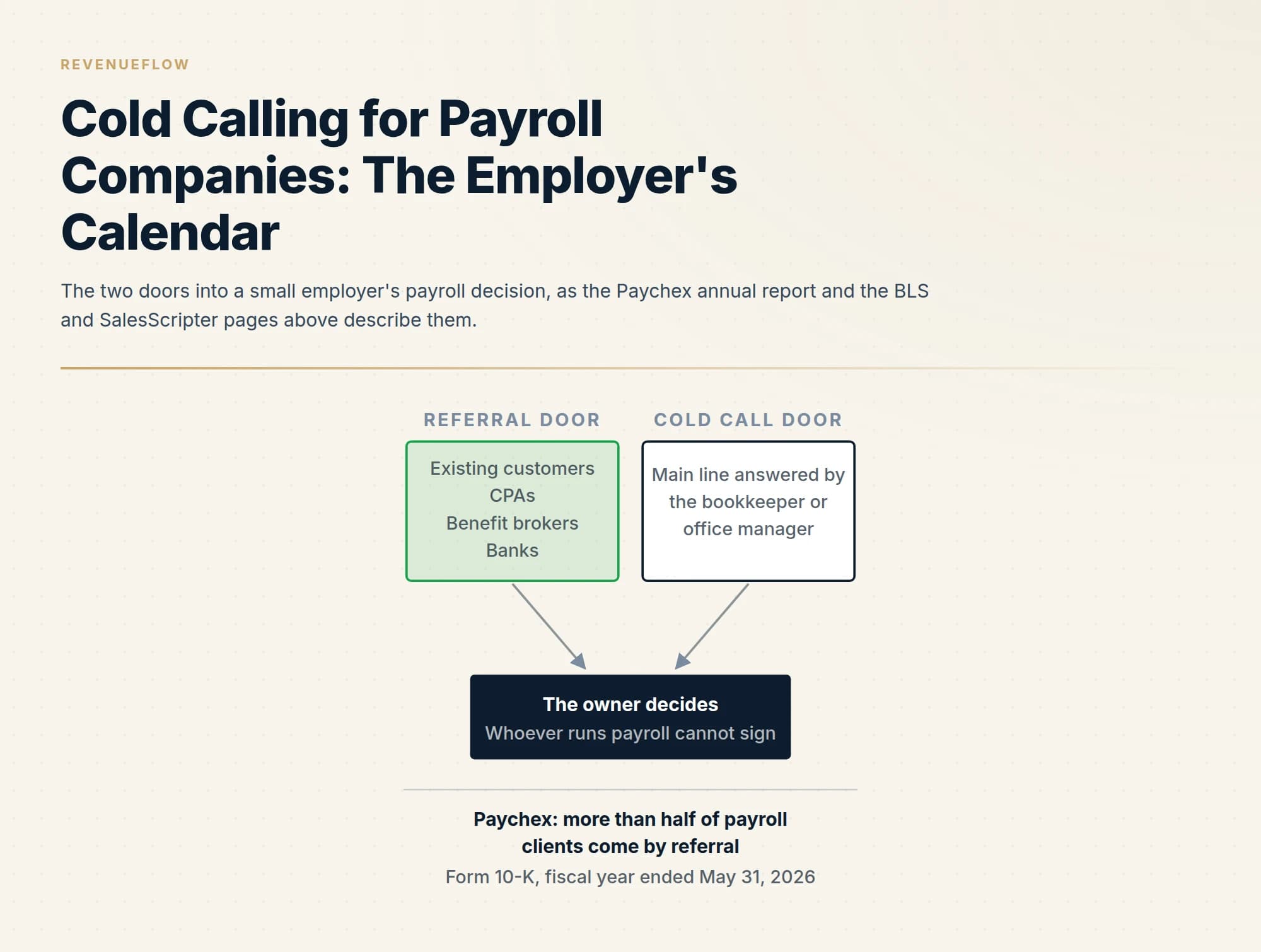
A payroll cold call usually reaches the bookkeeper or office manager who runs payroll, while the owner decides. IRS quarterly due dates of April 30, July 31, October 31 and January 31 mark the weeks not to call, quarter end and year end are the clean switching moments, and the IRS says employers stay liable with most providers.
Key takeaways
- Paychex's Form 10-K for the fiscal year ended May 31, 2026 says more than 50% of its payroll clients come from referral sources such as existing customers, CPAs, benefit brokers and banks.
- The IRS lists quarterly employment tax filing due dates of April 30, July 31, Oct. 31 and Jan. 31, which are the weeks a small employer's bookkeeper is least able to take a call.
- The IRS third party arrangement chart says the employer, not the payroll service provider or reporting agent, remains liable for timely returns, deposits and payments.
- Providers' own pages name end of year and end of quarter as the better moments to change payroll companies, so a January start is decided in the autumn.
Reviewed and updated September 18, 2026
Paychex, a listed payroll provider with a direct sales force of field and inside representatives, tells its shareholders where its clients come from, and the answer is mostly not the phone. In its annual report for the fiscal year ended May 31, 2026, Paychex says it uses "referrals from existing customers, certified public accountants", benefit brokers and banks, and then gives the figure: "More than 50% of our payroll clients come from these referral sources." (Paychex Form 10-K, read 18 September 2026.)
This guide is for a payroll company, a professional employer organization or a payroll software seller whose reps phone small and mid-size employers cold. It is written for the people inside the payroll business, not for vendors selling to them. The general method of a cold call lives on other pages. What follows is what the payroll market changes: who picks up at a small employer, which weeks of the year an employer can move and which weeks nobody will talk, what the Internal Revenue Service's own pages let a caller claim, and when the call is the wrong tool.
Who picks up at a small employer
Payroll at a small company rarely has a payroll department behind it. The Bureau of Labor Statistics describes bookkeeping, accounting and auditing clerks as workers who "may take on additional tasks, such as payroll, billing, purchasing, and keeping track of overdue bills" (BLS Occupational Outlook Handbook, read 18 September 2026). So the person who runs payroll is often the bookkeeper or office manager who also answers the main line, and the person who decides is the owner. On a small employer's number the gatekeeper and the user can be the same person, which is unusual and useful: they know exactly what is wrong with the current arrangement, and they cannot sign.
A recorded example shows how that plays out. Michael Halper of SalesScripter received a cold call from a payroll software salesperson and published his notes on it on July 11, 2019. He picked up himself, and he is direct about what would have happened otherwise: "Most gatekeepers are given the responsibility to keep salespeople who are trying to sell something out." The rep in his example qualified fast, learned the company was under the vendor's floor of 40 employees, and ended the call. Halper counts that as the thing the caller did well (SalesScripter, read 18 September 2026).
The voice that is missing from the call is the one the Paychex filing names: the outside accountant. A small employer's CPA is usually the adviser the owner asks first about anything that touches tax deposits, which is why an incumbent courts that channel. Paychex's filing says it has "a long-standing partnership with the American Institute of Certified Public Accountants" and that the current agreement "is in place through September 2027". A cold caller is competing with a recommendation from that adviser, and the honest response is to treat CPAs as a second list, not as an obstacle.
The employer's calendar: when they can move, when they cannot talk
Our guide to HR lead generation makes the general point that the buying clock belongs to the account. In payroll the clock is unusually public, because the IRS sets it.
The IRS page on employment tax due dates lists the quarterly rhythm every employer lives by: "Forms filed quarterly with due dates of April 30, July 31, Oct. 31 and Jan. 31" (IRS employment tax due dates, read 18 September 2026). The same page puts the annual wage statements at year end: "At the end of the year, the employer must submit a Form W-2, Wage and Tax Statement". Those dates tell a caller two things. The weeks before each due date are when the bookkeeper is least able to talk. The days after a quarter closes are when a change is cleanest.
The providers say the same from the other side. CSI Accounting and Payroll, a firm that takes on clients from other payroll companies, tells employers that the better moments to change are "end of year and end of quarter", and explains the year-end case: "At the end of the year, your balances are all at zero, so no need to worry about historical data." It also names the catch, that year end is "the busiest time of year for payroll companies" (CSI Accounting and Payroll, read 18 September 2026). SurePayroll By Paychex tells small businesses the choice is theirs: "You can switch mid-year, at quarter-end, or in January." (SurePayroll, read 18 September 2026.)
Put those together and the calling year has a shape. A decision to start in January has to be made in the autumn, because the conversion itself lands in the provider's busiest weeks. A quarter-end switch has to be decided in the quarter before it. Calls placed in the last days before April 30, July 31, October 31 or January 31 reach a bookkeeper with a filing open on the screen. Payroll run days add a weekly version of the same problem, and they differ by employer, so ask in the first call and write the answer down.
What a caller can legitimately claim
The rules that govern any business call are covered in what cold calling is and which rules apply and in our reading of whether cold calling is against the law, including how the rules on dialers and mobile numbers apply whether or not a call is business to business. They are not repeated here. Payroll adds a constraint of its own, and it is about what the caller says the service does.
The IRS is blunt with employers on this. Its page on outsourcing payroll says providers can help, and then: "But remember, employers are ultimately responsible for the payment of income tax withheld and both the employer and employee portions of social security and Medicare taxes". It adds that "In the event of default by a third party, the employer remains responsible for the deposit of the federal tax liabilities and timely filing of returns." (IRS, outsourcing payroll and third party payers, read 18 September 2026.)
The agency's third party arrangement chart then sorts the sellers. A payroll service provider prepares returns and makes deposits under the client's own employer identification number, and on the question of liability the chart answers: "No. Employer/Client, not the PSP, remains liable for ensuring all tax returns are filed timely and all deposits and payments are made timely." A reporting agent, authorized on Form 8655, gets the same answer. An agent appointed on Form 2678 files aggregate returns using the agent's EIN and shares liability with the employer. A Certified Professional Employer Organization, identified on Form 8973, files aggregate returns using the CPEO's EIN, and only it gets a different line on liability: "Generally, the CPEO is solely liable for paying the customer's employment taxes", with conditions the chart spells out (IRS third party arrangement chart, read 18 September 2026).
For a caller, that chart is the script's boundary. A payroll service provider that tells an owner the tax liability moves to the provider has said something the IRS page contradicts. A certified PEO can describe a different arrangement, and should name the certification when it does. This section reports what the IRS pages say and is not tax or legal advice.
| Arrangement | Whose EIN is used | Who is liable, per the IRS chart |
|---|---|---|
| Payroll service provider | The client's | Employer remains liable |
| Reporting agent (Form 8655) | The client's | Employer remains liable |
| Appointed agent (Form 2678) | The agent's | Employer and agent both liable |
| Certified PEO (Form 8973) | The CPEO's | Generally the CPEO, with conditions |
The objections payroll callers hear
The first is the guarded number. In Halper's account, the rep asked how many employees the company ran payroll for and got what Halper calls "the objection that I did not want to share that information." Headcount is the payroll seller's qualifying question and the owner's private one. Halper's view was that the rep recovered well by making the question less invasive, which in practice means offering a range. If your floor is 40 employees, say so and let the owner tell you which side of it they are on.
The second is the switch itself. The owner's fear is a missed deposit during conversion, and the IRS sentence above explains why: the employer stays responsible if the provider defaults. Our HR lead generation guide covers the migration objection in general, so the payroll version is short. Do not argue that switching is easy. Name the quarter-end you would convert on and who checks the year-to-date figures, because those are the two things CSI and SurePayroll tell employers to care about.
The third is the accountant. An owner who says the CPA handles it may mean the CPA runs payroll, or that the CPA recommended the current provider. Either way the next conversation is with the accountant. The general craft of answering objections on a live call is in cold call objection handling.
Three openers, each tied to a public source
None of these names a real person or claims a result, and each rests on a page cited above.
After a quarter closes, grounded in the IRS due dates.
This is {{name}} with {{company}}. Your {{quarter}} filing went in by {{due_date}}, so this is the one stretch where changing payroll does not mean re-entering a half-finished quarter. Is payroll something you review at quarter end, or is it settled for the year?
It is a legitimate reason to call because the date is public and the clean-switch logic is the providers' own.
To the bookkeeper, grounded in the BLS description.
Hi, this is {{name}} with {{company}}. Our guess is that payroll is one of several things on your desk and not your whole job. What is the part of running it that takes the longest?
It respects that the person who answered does payroll among other tasks, and it asks about the work, not the contract.
To an accountant, grounded in the Paychex filing.
This is {{name}} with {{company}}. We work with employers between {{min}} and {{max}} staff in {{region}}, and most payroll changes start with the owner asking their CPA. When a client asks you who should run their payroll, what do you need to know about a provider before you would mention it?
It treats the referral door as the main one, which the largest provider's own filing says it is.
When the phone is the wrong play
If more than half of the largest provider's payroll clients arrive by referral, a payroll seller with no accountant, broker or bank relationships is fishing in the smaller pond, and adding dials does not change its size. The phone is also the wrong play in the week before each quarterly due date, against micro employers below your own floor, and for any pitch that depends on a liability claim the IRS chart does not support.
The phone does fit the days after a quarter closes, employers who have just crossed a headcount or state line that their current setup handles badly, and accountants themselves. Where calling sits next to written outreach is a question we answer as policy, not as a result: RevenueFlow runs email and LinkedIn for clients and does not make cold calls, and our comparison of email and cold calling sets out how the two channels fail differently. A written campaign reaches every employer on a list in the same clean week, with one message and nothing scheduled behind it. If you want that built around the filing calendar, see what a first campaign looks like.
The short version
A cold call to a small employer usually reaches the bookkeeper or office manager who runs payroll among other tasks, while the owner decides and the outside accountant advises. The IRS quarterly due dates of April 30, July 31, October 31 and January 31 mark the weeks not to call, and the providers' own pages name quarter end and year end as the clean moments to switch. The IRS says an employer stays liable when it uses a payroll service provider or reporting agent, so only a certified PEO can describe anything different. Paychex reports that more than half of its payroll clients come from referrals, which makes accountants a calling list of their own.
IRS, BLS, SEC filing and provider pages quoted above were read on 18 September 2026. Tax rules change. Confirm current requirements with the IRS and a qualified adviser before relying on any of this.
Frequently asked questions.
Frequently asked questions- Who answers when you cold call a small business about payroll?
- Often the person who runs payroll. The Bureau of Labor Statistics says bookkeeping, accounting and auditing clerks may take on additional tasks such as payroll, so at a small employer the bookkeeper or office manager who answers the main line can also be the payroll user. The owner usually decides, and the outside accountant is often asked for an opinion first.
- When is the best time to call employers about switching payroll?
- Just after a quarter closes, and in the autumn for a January start. The IRS lists quarterly filing due dates of April 30, July 31, Oct. 31 and Jan. 31, and the weeks before them are busy. CSI Accounting and Payroll tells employers the better times to change are end of year and end of quarter, and SurePayroll says mid-year, quarter-end or January all work.
- Can a payroll provider say it takes over the employer's tax liability?
- Not according to the IRS pages, unless it is a Certified Professional Employer Organization. The IRS third party arrangement chart says the employer, not the payroll service provider or reporting agent, remains liable for timely returns, deposits and payments. It says a CPEO is generally solely liable for the customer's employment taxes, with conditions. Read the chart before writing a script.
- Is cold calling the best way for a payroll company to get clients?
- The largest public evidence points elsewhere. Paychex's annual report for the fiscal year ended May 31, 2026 says more than 50% of its payroll clients come from referral sources, naming existing customers, certified public accountants, benefit brokers and banks. Calling still fits the days after a quarter closes and calls to accountants themselves, but referral relationships carry more of the market.
About the author.

B2B cold email experts helping companies generate qualified leads through done-for-you outreach campaigns.
RevenueFlow Team
Explore more.
Ready to scale your outreach?
We build GTM engines that book real meetings. See the receipts.
Related articles.
Cold Calling for Legal Tech Companies: Who Answers at a Firm
What changes when a legal tech company cold calls a law firm: which desks answer, why the billable hour hurts the pitch, the 2027 show dates, and what not to ask.
Cold Calling for EdTech Companies: Who Answers at a School
What changes when an edtech company cold calls a school: who picks up, the fiscal and testing calendars, district vendor contact rules, and when not to dial.
Cold Call Openers: Eleven Lines by Situation, and the Data
Eleven cold call openers sorted by what is true about the call, the four beats every opener has, and what Gong's 2018 opener study actually counted.
B2B Lead Lists for Collection Agencies: Fields and Sources
What a creditor prospect list needs for a collection agency: the fields that matter, the FDIC, NCUA, CMS and court sources behind them, and the rules that apply.
Outbound Sales for Food and Beverage Companies: Who to Reach
Outbound sales for food and beverage brands: the four buyers behind a yes, the public show calendar, what a message may claim, and when outbound is the wrong play.
Cold Calling for SaaS Companies: What Changes on the Call
The two calls a software company makes, who picks up in crowded and uncrowded categories, how the first thirty seconds go, and why a SaaS list is a mobile-number list.