Crossbeam Pricing: The Ladder and the Seat Inversion
Crossbeam publishes a platform fee, a seat rate and a credit rate. The trap is that the free plan includes three operator seats and the entry paid plan includes one.

Crossbeam pricing starts with a free plan of up to three full access seats, then Connector at a $4,800 annual platform fee including one seat, with extra full access seats at $1,800 per user per year. Supernode and Enterprise are quoted, and sales seats at $40 per user per month exist only there. Record exports and AI credits meter separately.
Key takeaways
- Crossbeam's free plan includes up to three full access seats, while Connector, the first paid plan at $4,800 a year, includes one, so a three person team pays $8,400.
- Sales seats are only available on Supernode and Enterprise; the comparison table prints them at $40 per user per month, while the Supernode card now reads Custom.
- Record exports count each unique record once per term, with 5,000 on Connector and 25,000 on Supernode, and the page publishes no overage rate.
- Crossbeam Credits are an annual AI pool granted at term start with no rollover, sold in packs at a flat $0.10 per credit, the 100,000 pack at $0.09.
Reviewed and updated September 21, 2026
Crossbeam is one of the few platforms in partner tooling that publishes a real number, and the number most teams quote back is the wrong one. Its pricing page carries a $4,800 a year platform fee on the Connector plan, a $1,800 per user per year rate for additional full access seats, a $40 per user per month rate for sales seats on the tiers above, and a credit rate the page states as "Flat $0.10 per credit". All of those are printed on crossbeam.com/pricing, the sales seat rate in its comparison table. The trap is not the headline fee. It is that the free plan hands you three operator seats and the first paid plan hands you one.
What follows is that ladder, the two meters running underneath it, and the questions left to a quote.
Crossbeam pricing: the four plans as published
The page lists Free, Connector, Supernode and Enterprise, and it describes itself as offering "Plans for every GTM team turning partner data into their most reliable source of pipeline".
Free is headlined "Build your partner ecosystem and map accounts for free" and published as $0 per year with no credit card, up to 3 full access seats, 50 Crossbeam Credits a year, 3 standard populations, single partner account mapping capped at viewing 50 records at a time, preview access to advanced multi partner mapping and to Deal Navigator and Pipeline Generation, shared lists by invitation only, one offline partner and one open data partner.
Connector is described as "For growing teams ready to turn ecosystem insights into action" and published at $4,800 a year as a platform fee. That fee includes exactly one full access seat, and the page prices additional seats at $1,800 per user per year. It carries 500 credits a year and 5,000 unique record exports, and it unlocks full single partner and advanced multi partner account mapping, Deal Navigator, Pipeline Generation, Net New Accounts, the CRM and Chrome Copilot, co-sell workflows, three custom populations, unlimited offline partners and greenfield reporting.
Supernode carries no rate. Its card lists three included full access seats and now marks sales seats as Custom, while the comparison table lower on the page still prints sales seats at $40 per user per month on Supernode and Enterprise. It carries 2,500 credits a year, 25,000 record exports, unlimited integrations including custom CRM objects, Copilot for Gong and Outreach, a performance dashboard, revenue attribution, unlimited custom populations, three open data partners, audit logs, SAML single sign on and a dedicated customer success manager.
Enterprise also carries no rate. It publishes 5,000 credits a year, a starting point of 100,000 unique record exports, ten open data partners, SCIM user provisioning, webhooks and advanced access controls.
Two billing rules sit in the page's own frequently asked questions and neither is visible on the plan cards. The page states that "Connector subscriptions are contracted annually" with options for monthly or annual payment, and that "Monthly payment incurs a 10% surcharge". It also states that "Sales seats are only available via our Supernode and Enterprise plans", which means the cheap rep facing seat does not exist on the only paid tier you can buy without a call.
Commitment terms hidden below a plan card are a category habit, and Ringover's add-ons carry the contract to its end once a single one is subscribed.
The seat inversion, which is the actual decision

Read the seat rows in order and the ladder goes backwards once.
Free includes up to three full access seats. Connector, the plan you upgrade to when the free tier stops being enough, includes one. A two person partner team that outgrows the free plan's 50 record mapping cap does not simply pay the published $4,800 and keep working the way it was working. It pays that published $4,800 plus $1,800 for the second person, and a three person team lands at $8,400 before anything else is added.
That is not a hidden fee, because every one of those numbers is printed where a buyer can read it. It is an ordering problem: the tier boundary that matters for capability, mapping without a 50 record ceiling, sits at a different place from the tier boundary that matters for headcount. An independent guide that read the same page, Partnerships.ai's Crossbeam pricing post as read on 2 September 2026, reached the same conclusion, noting that "the practical entry price is $4,800 a year on Connector" and that "a three-person partner team lands at $8,400 a year", which is a useful check on the arithmetic rather than a second source for the rates.
The sales seat rate makes the same point from the other end. A seller who only needs to see partner overlap on their own accounts, inside Salesforce or HubSpot rather than inside Crossbeam, costs $40 per user per month. That is the rate a rollout to twenty sellers runs on, and the page places it out of reach of Connector, stating that "Sales seats are only available via our Supernode and Enterprise plans". A plan to put overlap in front of a sales floor is a Supernode conversation, whatever the entry price on the page says.
| Published on the page | Left to the quote |
|---|---|
| Connector's $4,800 platform fee and $1,800 per extra full access seat | Any Supernode or Enterprise platform fee |
| Sales seats at $40 per user per month, on Supernode and Enterprise only | How many sales seats a Supernode contract starts with |
| Credit packs and a flat $0.10 per credit rate | What a record export costs past the included allowance |
Two meters, and only one of them is about people
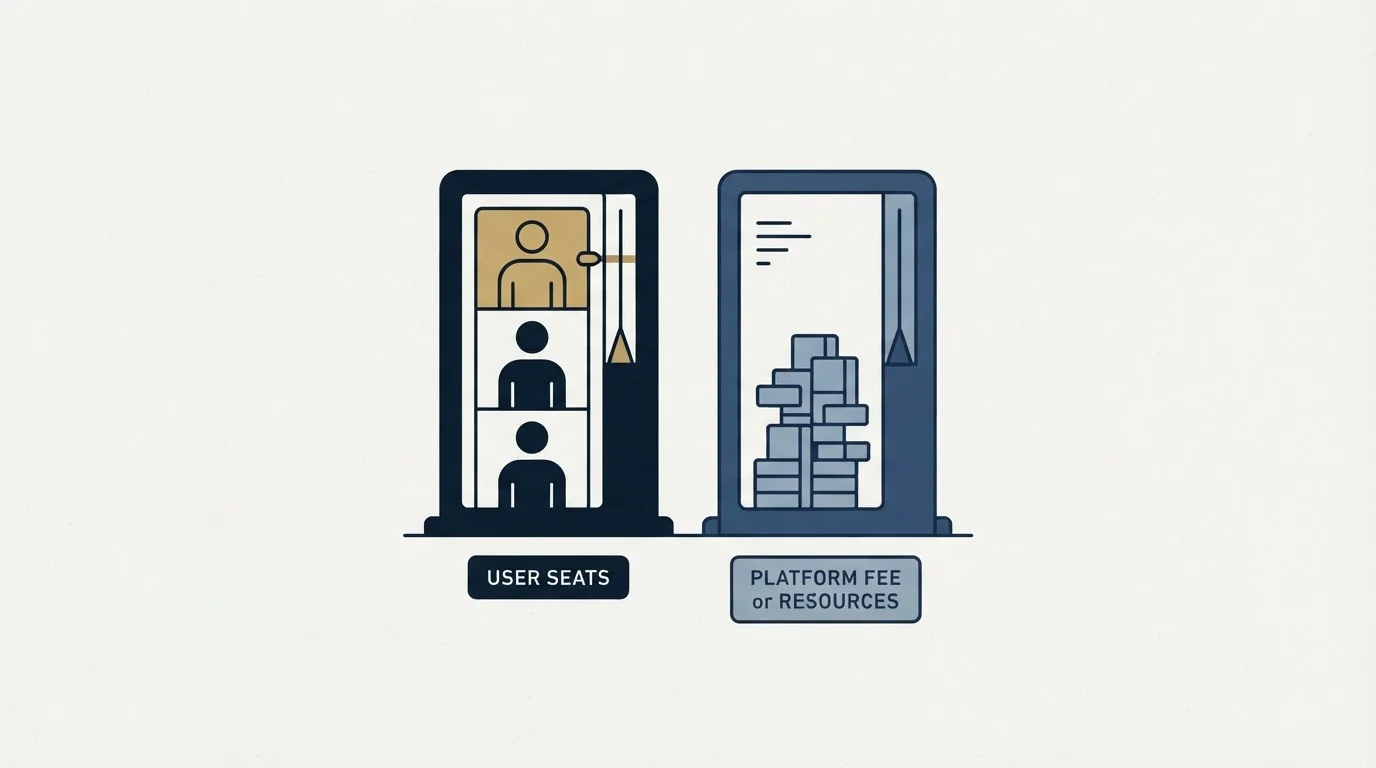
Underneath the seats, the page runs two separate consumption meters, and they measure different things.
Record exports are the data meter. Connector includes 5,000 unique records, Supernode 25,000, Enterprise a published starting point of 100,000. The page defines the unit tightly: "Each record is counted once per term". So the meter counts distinct accounts moved out of Crossbeam across the whole contract year, not export events, which makes it far more generous than a naive read suggests and far less elastic than a monthly allowance. Its own remedy when you hit the ceiling is that "You can optimize your Record Exports, or contact sales to upgrade to a plan with a higher Record Export limit", with no overage rate beside it.
Crossbeam Credits are the AI meter, and they are new enough that most published comparisons do not mention them. The page states that "Crossbeam Credits measure AI access to your Crossbeam data", that the pool is shared across the whole organisation rather than assigned per user, and that "Looking up your own account data or searching our help center is free" while larger data pulls cost more. Every plan carries an annual pool: 50 on Free, 500 on Connector, 2,500 on Supernode, 5,000 on Enterprise. Packs are published at $1,000 for 10,000 credits, $2,500 for 25,000 and $9,000 for 100,000, and the page states a flat rate of $0.10 per credit alongside them, although the largest pack is labelled "Save 10%", which works out to $0.09 a credit.
Three rules on that meter are worth carrying into a budget. The page states that "Credits are granted in full at the start of your term and reset at renewal" and that "Unused credits do not roll over". It also states that "AI activity does not count against your Record Export limit", so the two meters genuinely do not interact. And it states that "Using MCP requires an active Crossbeam seat and a paid platform fee", with requests through it drawing on the credit balance, which means the free plan's advertised MCP access is a preview rather than a working integration for an agent that runs all day.
Rollover terms differ sharply across data vendors, and HG Insights publishes meters, not a price, including the ceiling on credits that survive each month.
Record exports: the data meter
- Counts unique records moved out of Crossbeam, once per term
- 5,000 on Connector, 25,000 on Supernode, from 100,000 on Enterprise
- No overage rate: the stated remedy is to optimise or upgrade
- Unaffected by AI usage
Crossbeam Credits: the AI meter
- Measures AI access to your ecosystem data, pooled across the organisation
- 50, 500, 2,500 and 5,000 a year from Free to Enterprise
- Granted in full at term start, reset at renewal, no rollover
- Packs mid term on Supernode and Enterprise
Where the alternatives question actually lands
Shopping this category by feature list is close to useless, because the product is partly the network. Crossbeam's own site publishes a figure for that network, "30,000+ companies on Crossbeam", and the reason it matters is mechanical: account mapping only produces an answer when the partner on the other side has also connected their data. A cheaper tool that none of your partners uses maps nothing.
The comparison set the directories return for this query is not much help either. Searches for Crossbeam competitors return company data directories and software listing sites ahead of editorial comparisons, and their lists mix partner ecosystem tools with unrelated categories. That is a listing algorithm reaching for adjacency, not a shortlist.
The real substitutes divide on what they are for. PartnerTap sits closest on the account mapping question and takes the opposite commercial position: its pricing page, fetched the same day, publishes no rate at all and instead states that "Every paid edition includes UNLIMITED USERS, UNLIMITED PARTNERS, UNLIMITED DATA, and UNLIMITED REPORT DOWNLOADS", under the headline "No hidden data consumption fees. No pricing surprises at renewals". Where Crossbeam meters exports and AI calls and publishes both rates, PartnerTap meters nothing and publishes none.
Partner relationship management platforms are a different purchase rather than a cheaper one. PartnerStack publishes one commercial model and quotes the other, and what it runs is the programme itself: recruitment, tiering, commissions and payouts. Crossbeam does not pay a partner. It tells you which accounts a partner already touches. A team that needs both is buying two things, and the archetypes inside a partner programme decide which one is urgent. PartnerStack's own answers put the same boundary from the other side, stating that "Pricing is based on your partner program size, feature needs and level of support" for the programme it runs. Introw, one of the platforms that ranks for partner relationship management alternatives, lists a Crossbeam integration on its own pricing page rather than a Crossbeam replacement, which is the clearest available statement of how the two categories sit together.
What to take into the call

The published half of this ladder is unusually complete, so the quote conversation can be narrow. Ask what a Supernode platform fee looks like against the Connector fee you can already read, how many sales seats a contract has to start with, and what happens when the record export allowance runs out mid term, since the only published remedy is that "You can optimize your Record Exports, or contact sales to upgrade to a plan with a higher Record Export limit". Ask whether the credit pool is negotiable at contract time rather than only through the published packs.
One process note that applies to every vendor in this category rather than to this one. The Partnerships.ai guide, which reads the vendor's page carefully, gets the numbers right and warns that "Vendors in this category change plans without announcements, so confirm before you budget", and it is right to. Directory profiles and procurement marketplaces rank above the vendor's own page on this query and several of them describe plan names that are not on it. Read the page, note the date you read it, and treat everything else as a prompt to check.
Where partner sourced pipeline is a year away and the quarter needs conversations now, that gap is an outbound problem rather than a tooling one. RevenueFlow runs cold email and LinkedIn, one message per campaign with no bumps and no thread replies, against qualification criteria agreed in writing before launch. You can see what a first campaign against your market produces while the ecosystem side is being built, and deal registration is the mechanism that keeps the two from colliding once partners start sourcing.
The short version

Crossbeam publishes more of its commercial model than almost anything else in partner tooling, and the page opens with all four tiers, so the fair summary is that Crossbeam publishes four plans. Free is published at $0 with up to three full access seats and a 50 record mapping cap. Connector is a published $4,800 a year platform fee with one seat included and $1,800 per user per year after that, contracted annually with a 10 percent surcharge for paying monthly on the page's own terms. Supernode and Enterprise are quoted, and the published $40 per user per month sales seat lives only there. Two meters run underneath: record exports counted once per term, and an annual AI credit pool sold in packs at a published "Flat $0.10 per credit" with no rollover.
Budget the seats before the platform fee, because the free tier gives three operators and the entry paid tier gives one. And if a rollout puts overlap in front of sellers, price the Supernode conversation from the start rather than discovering it at the first upgrade.
Plan structures, seat rates, credit rates and billing rules above are taken from crossbeam.com/pricing and its own frequently asked questions; PartnerTap and PartnerStack terms are from partnertap.com and partnerstack.com. Verify current terms with the vendor before relying on them.
Frequently asked questions.
Frequently asked questions- How much does Crossbeam cost?
- Crossbeam's free plan costs nothing and includes up to three full access seats. Connector is a $4,800 a year platform fee with one full access seat, and extra full access seats are $1,800 per user per year. Supernode and Enterprise are quoted, and sales seats at $40 per user per month are only available on those two.
- Why does a small team pay more on Connector than the headline fee?
- Because the seats run backwards once. The free plan includes up to three full access seats, but Connector includes one, so a second person adds $1,800 and a third another $1,800. A three person partner team that outgrows the free plan's 50 record mapping cap lands at $8,400 a year on Connector before anything else.
- What are Crossbeam Credits?
- Crossbeam Credits measure AI access to your ecosystem data. Each plan carries an annual pool shared across the organisation, 50 on Free up to 5,000 on Enterprise, granted in full at term start with no rollover. Packs cost $1,000 for 10,000 credits, $2,500 for 25,000 and $9,000 for 100,000, the last marked as a 10 percent saving.
- Is Connector billed monthly or annually?
- Crossbeam's own answers state that Connector subscriptions are contracted annually, with the option to pay monthly or annually, and that monthly payment adds a 10 percent surcharge. The contract is a year either way, so the monthly option spreads payment rather than shortening the commitment, and it costs more for the same annual plan.
About the author.

B2B cold email experts helping companies generate qualified leads through done-for-you outreach campaigns.
RevenueFlow Team
Explore more.
Ready to scale your outreach?
We build GTM engines that book real meetings. See the receipts.
Related articles.
Ontraport Pricing: Three Plans and Five Other Meters
Ontraport now publishes three plans, not the four most pricing pages still quote. The rates are its annual state at the smallest contact band.
Best Time to Send a Sales Email: What Was Measured
The send time studies behind the midweek morning answer, what each one actually counted, and why a broadcast finding does not transfer to a sales email.
Best Time to Cold Call: What the Studies Counted
The best time to cold call figures traced to their originals: one inbound study from six companies, three vendor call datasets, and what survives the read.
Is Clay Free? The Free Plan, the Trial and Where Each Stops
Clay's free plan, its 14-day trial and the no-charge-on-a-miss rule are three different things. What each holds and where it stops, from clay.com on 19 September 2026.
Seamless.AI Email Finder: How It Works, What a Credit Buys
How Seamless.AI's email finder resolves a contact in real time, what one Universal Credit buys, the Total AI score on every address, and what the Chrome extension reads.
Video Prospecting Tools by Job: What Each One Is For
Ten video prospecting tools sorted by the job each vendor's own page describes: record and share, personalise at volume, avatars, hosting and interactive demos.