HG Insights Pricing: The Meters, Not the Number
HG Insights publishes no price on any of its own pages. It does publish the meters, the credit rollover ceiling and the contract term, which decide the bill.
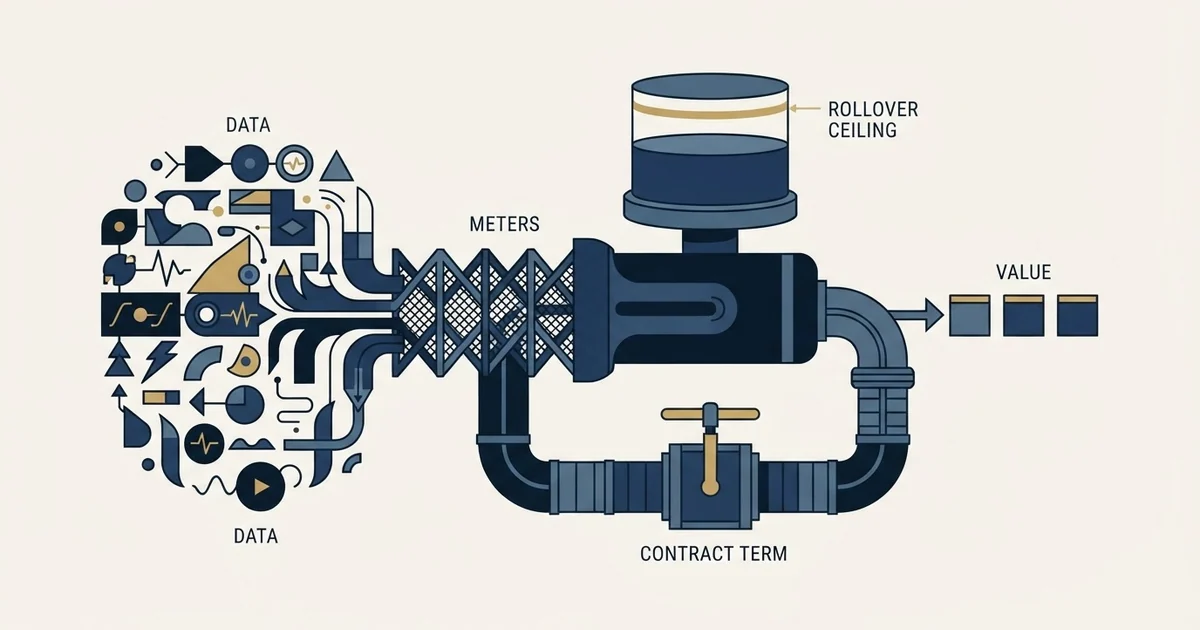
HG Insights publishes no price on its home page, its packaging page or its pricing guide, all read on 2 September 2026. It publishes the structure instead: three plans built on seats, credits and leads processed, two separate credit currencies, seat bundles, a rollover ceiling of a fifth of each month, and a two-year default contract term.
Key takeaways
- HG Insights publishes no price figure on its home page, packaging page or pricing guide, all three read on 2 September 2026.
- Its published credit rates differ thirty-fold between an account record and a buyer intent data point, so a consumption model built on accounts understates badly.
- Only a fifth of each month's distributed credits rolls over, so annual credit volume is the wrong number to negotiate against.
- The standard contract term is two years, which makes any third-party annual figure incomparable unless it states the term behind it.
Reviewed and updated September 2, 2026
Search the cost of HG Insights and the answers arrive with confident annual figures attached. None of those figures comes from HG Insights, and the pages that carry them disagree about whether a figure describes a module, a platform or a whole account. No price figure appears on any of the three company surfaces read for this piece, and a range that wide tells a budget holder nothing at all.
What HG Insights does publish is unusually complete, and it is more useful than a number would be. Its pricing guide names the units the bill is built from, the rule that decides whether unused capacity survives the month, and the contract length the standard quote assumes. Those are the things that move a renewal, and they are routinely absent from a category where the price itself is withheld.
What the pages actually say, and what they do not
Three HG Insights surfaces were read for this piece on 2 September 2026: the home page, the packaging page at /product/packaging/, and the pricing guide at /product/pricing-guide/. Every one of them returned in full and none carried a currency figure of any kind. That is an enumerated absence rather than a failed fetch, which matters because a blocked page and a page with no prices on it look identical from the outside.
The pricing guide, as published on hginsights.com on 2 September 2026, describes three plans: Starter, Growth and Enterprise. It says those plans are "structured around seats licensed, credits consumed and leads processed", and states the difference between the first two directly: "The Growth plan includes more credits, more seats, higher lead volumes, and access to premium intent signals in the platform".
The packaging page, read the same day, states the model in one line: "Pricing for the Platform and data Fabric is based on data consumption." It also confirms the modules can be bought separately, which is usually the first decision an evaluation reaches.
- Three plan names and what separates them
- Three meters: seats, credits, leads processed
- Two credit types with different jobs
- The credit rollover ceiling
- The default contract term
- That there is no trial
- Any figure in any currency
- A seat rate
- A credit rate in money
- A floor for the smallest purchase
- What a plan step costs
The three meters, and why the credit one is the awkward one
Seats and leads processed behave the way anyone expects. Credits do not, and they are where the estimate goes wrong.
HG Insights calls them Intelligence credits, and its pricing guide explains that they are consumed on export rather than on use: they "enable you to harness information such as technology installs, firmographics, contact intel and so on via exports". The guide then gives the two anchor rates that let you model anything else. As published on 2 September 2026, "an entity with firmographics & hierarchy cost 0.1 credits while a buyer intent data point costs 3 credits".
That is a thirty-fold spread between the cheapest and the most expensive thing you can pull, and it is the single most important sentence on the page. A team modelling its consumption on account records will underestimate by an order of magnitude the moment intent data enters the workflow, because intent is the expensive meter and it is also a common reason for evaluating the product in the first place. The guide adds that credits "get cheaper to purchase as your plan scales", so unit economics improve with commitment rather than staying flat.
There is a second currency underneath. The guide separates Intelligence credits from AI action credits, and the distinction is worth reading twice: "Intelligence credits are used to export HG's data from the platform. AI action credits are used to run actions on the platform and represents the compute power required to perform actions like generating a research brief or enriching a CRM row." Export and compute are metered separately, so an agentic workflow that enriches records in place draws down a different balance from an analyst pulling a list.
The rollover rule is the term most people miss

Credits are not a pool you own outright. The pricing guide states that they are "allocated annually but distributed monthly", and then applies a ceiling: "A maximum of 20% of the monthly distributed credits, if unused, will roll-over to the next month."
Read that carefully, because it is a use-it-or-lose-it rule wearing the clothes of a rollover. A quiet month does not bank into a busy one at anything close to parity. Four fifths of whatever went unused in a slow month is gone, and a team whose consumption is lumpy by design, quarterly campaign builds rather than steady enrichment, will pay for capacity it structurally cannot reach.
The practical consequence is that annual credit volume is the wrong number to negotiate against. The number that decides whether the allocation fits is the monthly distribution against your worst month and your best month, and a workflow with a four-to-one ratio between those two is buying for the peak and burning the trough.
- Yes: Which of the three modules you actually need
- Yes: Your monthly credit draw at peak and at trough, not the annual total
- Yes: Whether intent data is in the workflow, because it is the thirty-times meter
- Yes: Whether you want a one-year term and can absorb the premium for it
- Yes: How many seats, and whether a bundle boundary lands near your headcount
- No: What a seat costs
- No: What the smallest viable contract is
Seats come in bundles, and one bundle is gated
Seat expansion is not linear either. The guide says additional seats can be bought "anytime in the Sales Copilot and Market Analyzer modules", offered "in bundles of 5, 10, 25 and 50", with one restriction stated plainly: "The 50-seat bundle is only available for Growth plan users." Individual seats are available "at a premium".
Two things follow. A team that needs twelve seats is buying either ten plus two at a premium or a bundle of twenty-five, and the gap between those two routes is not a figure the guide gives. And a large team on the entry plan cannot reach the largest bundle at all, so headcount can force a plan upgrade for reasons that have nothing to do with features.
Seat packaging traps buyers in other categories too, and the seat inversion on Crossbeam's ladder hands three operators to the free plan and one to the first paid tier.
The modules themselves are sold separately, which is the flexibility the packaging page leads with. Market Analyzer covers what its page calls "ICP Design, TAM/SAM/SOM analysis, whitespace analysis and competitive analysis". Data Studio holds "account targeting, CRM enrichment, inbound marketing qualification, account scoring". Sales Copilot, in the guide's words, "Allows signal based account prioritization and AI-driven sales plays". A buyer who only wants the market-sizing half is not obliged to fund the seller-facing half, which is a genuine difference from the platforms in this category that sell one bundle.
The term is two years, and that is the quiet part

The sentence with the largest financial consequence on the page is not about credits at all. As published on 2 September 2026: "The standard contract term is two years. A one-year term is available at a higher price. Quarterly billing is also available at an additional premium."
A two-year default changes what every other number means. A per-year figure quoted against a two-year commitment is not comparable to a per-year figure from a vendor selling twelve months at a time, and any third-party page reporting an annual cost without stating the term behind it has dropped the term that makes the number legible.
The guide is also explicit that there is no way to try it first: "Currently, there is no pilot or free trial plan available." So the evaluation happens in demos and in a proof of concept negotiated inside the contract, rather than in a sandbox, and the buyer carries the risk of a mis-sized credit allocation into a two-year term.
- Step 1Pick the module
Market Analyzer, Data Studio or Sales Copilot, or the Fabric for direct data access. They are sold separately.
- Step 2Model the monthly draw
Peak and trough, in credits, with intent data priced at the rate the guide publishes rather than at the account rate.
- Step 3Check the rollover
Only a fifth of an unused month survives, so a lumpy workflow needs the allocation sized against its quiet months.
- Step 4Check the seat bundle
Headcount near a bundle boundary, or above the entry plan's largest bundle, changes the plan you can buy.
- Step 5Settle the term
Two years is the default. Ask for the one-year number and the quarterly-billing number before comparing anything.
Where this sits against the rest of the category
HG Insights is a technographics and intent business first. Its own pages describe the data set as covering "firmographics, technographics, IT spend, buyer intent, and contact intelligence", and the thing it is bought for is knowing what a company runs and what it spends on it. That is a different purchase from a contact database, even though both appear on the same shortlists, and what technographic data is and what it can honestly target is the distinction worth settling before the shortlist is drawn.
For teams comparing it against the contact-data providers, the meters are the comparison rather than the feature grids. A provider metered on records exported and a provider metered on data points consumed produce bills that respond to completely different behaviour, and how enrichment APIs meter credits, rate limits and caching covers that mechanism in the general case. The same question inside a CRM sync is where ZoomInfo's enrichment credits go.
If the shortlist is still open, the enrichment tools worth comparing for an outbound team is the wider field, and the targeting decision that should precede any of these purchases is an ideal customer profile written so a list can be built from it. Buying intelligence before the segment is decided produces expensive confirmation of a guess.
Where we differ from the usual advice
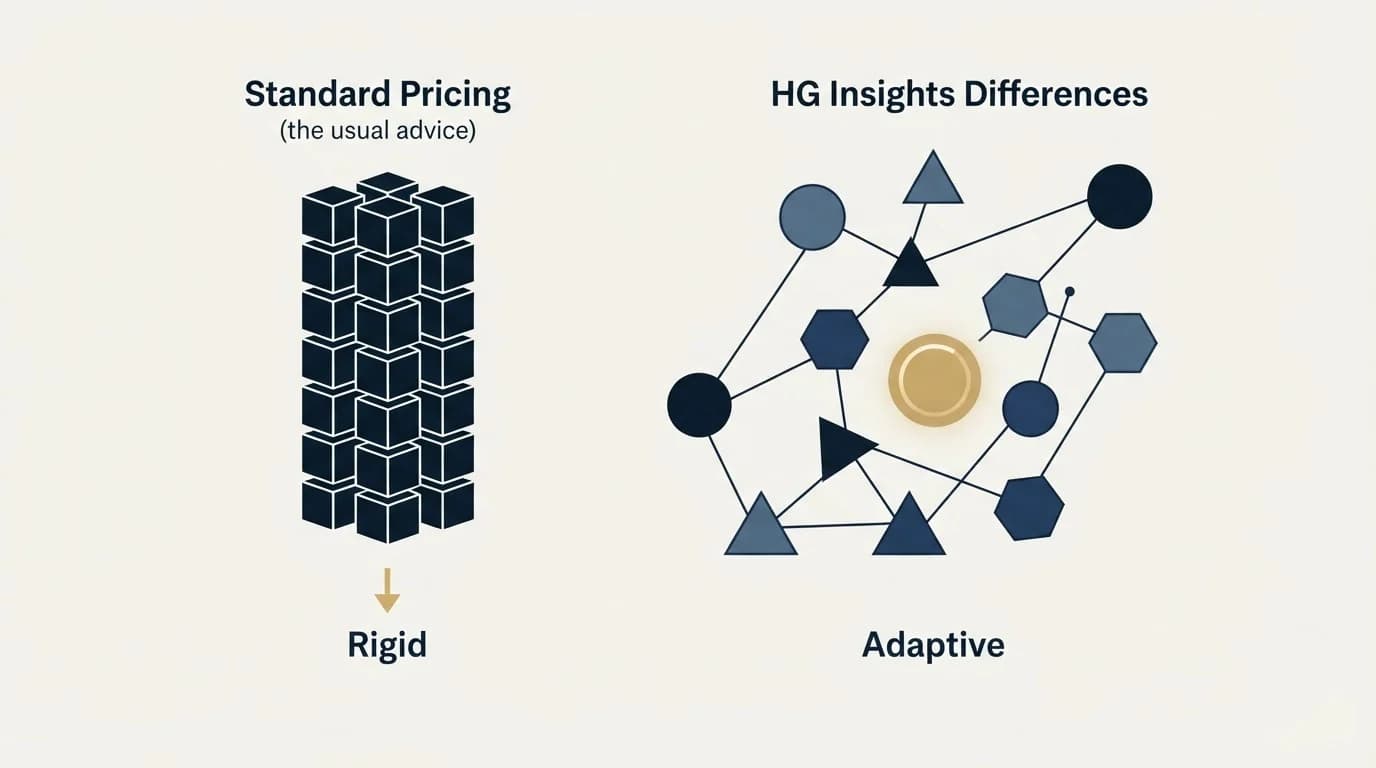
The standard recommendation for a vendor whose pages carry no price is to collect third-party estimates and average them. We think that is worse than useless here, and the HG Insights case shows why. The published estimates span roughly an order of magnitude, none of them names a term, and none of them says which modules or which credit mix produced the figure. An average of numbers whose units are unknown is not an estimate, it is a number with no meaning that a budget conversation will treat as evidence.
The opposite case is easier to evaluate, and PlusVibe publishes its whole ladder in both billing views, with an enrichment credit slider stepping the rate on every tier.
The better move is the one the vendor's own pages support: go into the call knowing your monthly credit draw at both extremes, the module you need, the seat count and the term you want, and ask for the quote to be broken down along exactly those axes. A vendor that publishes its meters this openly can be asked to price them line by line, and a quote that arrives as one annual number can be sent back.
Our own position on this class of tool is narrow. RevenueFlow runs cold email and LinkedIn, and nothing above comes from operating HG Insights; it is read from the company's own pages and dated. What we do have a view on is the order of operations. Intelligence bought before a segment is written down gets used to justify the segment somebody already had, and the spend lands as a data subscription rather than as a change in who gets contacted. If the open question is whether a defined segment produces enough qualified conversations to justify the stack around it, we will build the first campaign and show you the reply volume it produces.
The short version
No price figure appears on the HG Insights home page, packaging page or pricing guide, all three read on 2 September 2026. What it does publish is the shape of the bill: three plans, three meters, two separate credit currencies, seat bundles of five, ten, twenty-five and fifty with the largest gated to the Growth plan, a rollover ceiling of a fifth of each month's distribution, and a two-year default term with a premium for anything shorter. Model the monthly credit draw rather than the annual total, price intent data at its own rate rather than the account rate, and ask for the one-year and quarterly-billing figures before comparing the quote to anything else.
Every plan name, meter, credit rate, seat bundle, rollover term and contract length above was read on the hginsights.com pricing guide and packaging pages on 2 September 2026, and neither page carried a price figure. Packaging changes, so check the current terms with the vendor before budgeting.
Frequently asked questions.
Frequently asked questions- How much does HG Insights cost?
- HG Insights does not publish a price. Its home page, packaging page and pricing guide were all read on 2 September 2026 and none carried a currency figure. Third-party pages quote annual figures ranging across roughly an order of magnitude, none of which names the contract term or the module mix that produced it, so none of them is comparable to another.
- What are Intelligence credits and how do they get used up?
- They are consumed on export. HG Insights' pricing guide says they let you harness information such as technology installs, firmographics and contact intel via exports, and gives two rates: an entity with firmographics and hierarchy costs 0.1 credits while a buyer intent data point costs 3 credits. AI action credits are a separate currency covering compute rather than export.
- Do unused HG Insights credits roll over?
- Partly. The pricing guide states that credits are allocated annually but distributed monthly, and that a maximum of 20 percent of the monthly distributed credits will roll over to the next month if unused. Four fifths of an unused month is therefore lost, which matters most for teams whose consumption is lumpy rather than steady across the year.
- Is there a free trial of HG Insights?
- No. The pricing guide states plainly that there is currently no pilot or free trial plan available. Evaluation happens through demos and whatever proof of concept is negotiated inside the contract, which is worth knowing because the standard contract term is two years and a mis-sized credit allocation is carried for that whole period.
About the author.

B2B cold email experts helping companies generate qualified leads through done-for-you outreach campaigns.
RevenueFlow Team
Explore more.
Ready to scale your outreach?
We build GTM engines that book real meetings. See the receipts.
Related articles.
Is Clay Free? The Free Plan, the Trial and Where Each Stops
Clay's free plan, its 14-day trial and the no-charge-on-a-miss rule are three different things. What each holds and where it stops, from clay.com on 19 September 2026.
Seamless.AI Email Finder: How It Works, What a Credit Buys
How Seamless.AI's email finder resolves a contact in real time, what one Universal Credit buys, the Total AI score on every address, and what the Chrome extension reads.
Airscale Pricing: Three Plans, One Credit, Four Rates
Airscale prints a different credit cost on every plan, and its advertised per-email price belongs to the custom one. The dated ladder and the rollover rules.
LeadIQ Salesforce Integration: What Syncs, What Blocks It
How LeadIQ's Salesforce integration works, from LeadIQ's own help centre: per-user OAuth, Lead or Contact, domain matching, duplicates, API calls and plan gates.
Snitcher Pricing: The $49 Table Is the Annual Rate
Snitcher's visible price table is the annual-billing ladder. The ten bands at both billing states, the unique-company meter, and the rules on a help page.
Firmographic Data Providers: What Six of Them Publish
Six firmographic data providers read from their own pages: the fields each sells, the coverage each states, how the data is delivered, and who prints a price.