Demandbase Competitors: Who Is Left After the Consolidation
Two names on the standard Demandbase competitor list are now redirects. Who remains, what each one actually sells, and how to compare vendors who publish no prices.

Demandbase vs RollWorks is now Demandbase vs AdRoll ABM, because every rollworks.com address redirects to adroll.com. Terminus merged into DemandScience in November 2024, and HockeyStack sells attribution more than ABM orchestration. The live competitor set is 6sense, DemandScience, AdRoll ABM and ZoomInfo, and none of the platform vendors publishes a price.
Key takeaways
- Every rollworks.com address redirects to adroll.com, so Demandbase vs RollWorks is a comparison with AdRoll ABM, whose pricing page lists four account-based packages.
- Terminus merged into DemandScience on 12 November 2024 and terminus.com now redirects to DemandScience, yet Demandbase still publishes a Demandbase vs Terminus page.
- HockeyStack's homepage leads with multi-touch attribution and lists ABM platforms among its integrations, so it measures programmes that a platform like Demandbase runs.
- No platform vendor here prints a price: Demandbase publishes a model of a platform fee plus a flat fee per user, and AdRoll's retargeting package has no fee to get started.
Reviewed and updated September 19, 2026
Demandbase still publishes a page headed "Demandbase vs Terminus", inviting you to see why the world's smartest companies choose it over that competitor (Demandbase). Terminus stopped being a competitor in November 2024, and anyone searching Demandbase vs RollWorks runs into the same wall, because rollworks.com now redirects to AdRoll. DemandScience's own announcement states that "Terminus has merged into DemandScience" and that "the newly combined company will operate under the DemandScience brand" (DemandScience, 12 November 2024).
That is the state of the Demandbase competitor list most buyers are handed. It contains at least two brands that no longer exist as things you can buy, and the vendors themselves have not updated their comparison pages. Before you can evaluate alternatives you have to establish which of them are still alternatives.
Demandbase vs RollWorks, Terminus and HockeyStack
Demandbase vs RollWorks is now a comparison with AdRoll ABM, because every rollworks.com address redirects to adroll.com. Demandbase prices a platform fee plus a flat fee per user and sells one platform. AdRoll's pricing page lists four account-based packages: three say "Request a Demo", and Account-Based Retargeting says "No fee to get started and pay only for media."
The redirects are specific. The rollworks.com root lands on AdRoll's account-based marketing solution page, and rollworks.com/pricing lands on adroll.com/pricing with an ABM anchor, both confirmed by following the redirects with a browser user agent. The RollWorks brand still appears in third-party comparison articles as a standalone ABM platform. It is a redirect. The head-to-head between the two, including the rename from RollWorks, is in Demandbase vs RollWorks.
Demandbase vs Terminus
Terminus is inside DemandScience. The merger was announced on 12 November 2024; DemandScience's CEO Peter Cannone continued as CEO, and Terminus CEO Rich Howarth became CTO of the combined company. The terminus.com address itself now redirects to DemandScience's homepage. If a comparison grid you are reading still scores Terminus as a separate product, that grid predates November 2024 or was copied from something that did.
Demandbase's vs-Terminus page is still worth reading for what it says about Demandbase. It argues on two things: that Demandbase has "the only demand side platform (DSP) built specifically for B2B advertising", and that it sources "more than 1 trillion intent signals every month" from that DSP. Those are Demandbase's claims about itself. The comparison they now set up is against DemandScience, which sells the Terminus platform alongside demand generation.
Demandbase vs HockeyStack
HockeyStack sells a different thing. Its homepage leads with "Modern Attribution that captures the complete buyer journey", with multi-touch attribution and lift reports, and lists Account Intelligence as a second product. Its FAQ says HockeyStack "integrates with leading CRM, ABM, Marketing Automation, Sales Outreach, and advertising platforms", which puts an ABM platform on its integration list rather than in its place. The pricing page carries no figure: it lists what every plan includes, from integrations to hands-on support and real-time ROI tracking, above a contact form.
So the comparison is measurement against execution. A team that wants to know which programmes produce pipeline is shopping for what HockeyStack describes; a team that wants to run account-based advertising and orchestration is shopping for what Demandbase describes, and may end up needing both.
There is a general point in the Terminus and RollWorks cases. A vendor's own comparison pages are marketing assets rather than maintained records, and they are updated when someone gets round to it. Demandbase's vs-Terminus page is the clean demonstration: the merger is public, dated and announced by the acquirer, and the page inviting you to choose between the two is still live well over a year later. Treat any competitor list, including a vendor's, as a claim with a date on it.
Who is actually left
Four platform-shaped options and one route that is not a platform.
6sense. The closest direct comparison to Demandbase in scope and in purchase shape, and the one every evaluation puts alongside it. Demandbase runs a dedicated comparison page against it, which tells you where it thinks the fight is. Note for anyone researching this the way we did: 6sense.com returns HTTP 403 to an ordinary fetch, so its pages have to be read in a browser rather than pulled programmatically. That is a retrieval quirk and says nothing about the product. Read that way, its pricing page lists Sales Intelligence packages, with Data Credits or Predictive AI added, and a demo booking, with no price; the credits are "used to unlock and export emails, phone numbers and enriched contact and company records".
DemandScience. Now carrying the Terminus platform alongside its own demand-generation and content-syndication business. This is a different kind of purchase from the other three: the services and the data are part of what you buy, rather than a platform licence you then have to staff. If your gap is that nobody on your team is going to operate an ABM platform, that shape matters more than the feature grid does. Its homepage carries no price, and its /pricing address resolves to a small icon image rather than a page.
AdRoll ABM. The advertising-led option, and the one with the clearest published packaging of the four. Its pricing page names four account-based packages: Account-Based Advertising, Account-Based Marketing plus Advertising, Account-Based Marketing, and Account-Based Retargeting (AdRoll pricing). Three of the four say "Request a Demo". The fourth, Account-Based Retargeting, publishes an actual commercial term: "No fee to get started and pay only for media."
ZoomInfo. Demandbase runs a comparison page against it too, which is a fair indication of who shows up in its deals. Buyers usually arrive here when the real gap is contact data and coverage rather than orchestration.
ZoomInfo's contact-data focus versus Demandbase's account-based platform gets a fuller side-by-side treatment in Demandbase vs ZoomInfo comparison, including how each vendor prices what it sells.
The assembled route. Data and enrichment plus your CRM plus your existing ad and email execution, with no ABM platform licence at all. This is the one option in the set where the prices are public: Clay publishes its plan prices on its own pricing page, which is itself a differentiator in a category where nobody else does. Whether this route fits is mostly a question of whether you need account-level orchestration and reporting, or whether you needed a target list and better data all along.
Nobody publishes a price, so compare the purchase shape

Platform licence
Demandbase
A platform fee covering the essential software and services, plus a flat fee per user, sold as one platform.
Grows with headcount
Services included
DemandScience
The Terminus platform alongside demand generation and content syndication, so the vendor supplies operating capacity.
Grows with volume delivered
Media-led
AdRoll ABM
Four account-based packages; Account-Based Retargeting has no fee to get started and charges only for media.
Grows with spend
Demandbase's own pricing page is the most useful document in this comparison, and not because it has numbers. It has none. What it publishes is the model: "a clear platform fee that covers all the essential software and services" plus "a flat fee per user" (Demandbase pricing). It also states that the platform is not split into standalone Marketing or Sales editions. Two facts about the shape of the bill, with no number attached, which is more than most vendors in this category disclose.
The practical consequence is that a feature-grid comparison between these vendors tells you very little, because you cannot put a price against any row of it. What you can compare, before any sales call, is how each vendor's bill grows. A per-user model grows with headcount and stays flat as you widen the account list. A media-led package grows with spend. A services-inclusive purchase grows with volume delivered. Decide which of those curves you want to be on, because that decision survives contact with the demo and the feature comparison does not.
Our fuller read on what Demandbase itself is worth to whom sits in the Demandbase review, and the deeper mechanics of that per-user model are in Demandbase pricing. If you are comparing more than two products, ABM platforms compared covers the set side by side and 6sense alternatives approaches the same category from the other incumbent.
The switching test
Scoring vendors on feature grids before settling these is the step that costs money. Most ABM platform switches we see described start with a comparison grid and end with the same problem on a different logo, because the failing part was never the platform. If nobody has agreed which accounts you are actually pursuing, no vendor in this category fixes that, and all four will happily bill you while you work it out.
Two of the reasons buyers give for leaving Demandbase are worth separating, because they point at different replacements. Cost pressure driven by seat count points at a different pricing model, which means AdRoll's media-led packaging or the assembled route. Cost pressure driven by low usage points at something else entirely: a platform fee being paid for two people who log in monthly is an adoption problem, and moving it to a cheaper platform reproduces it at a lower price. The account-based marketing tools comparison is organised around what each product replaces, which is the more useful axis when the diagnosis is unclear.
What to ask on the first call
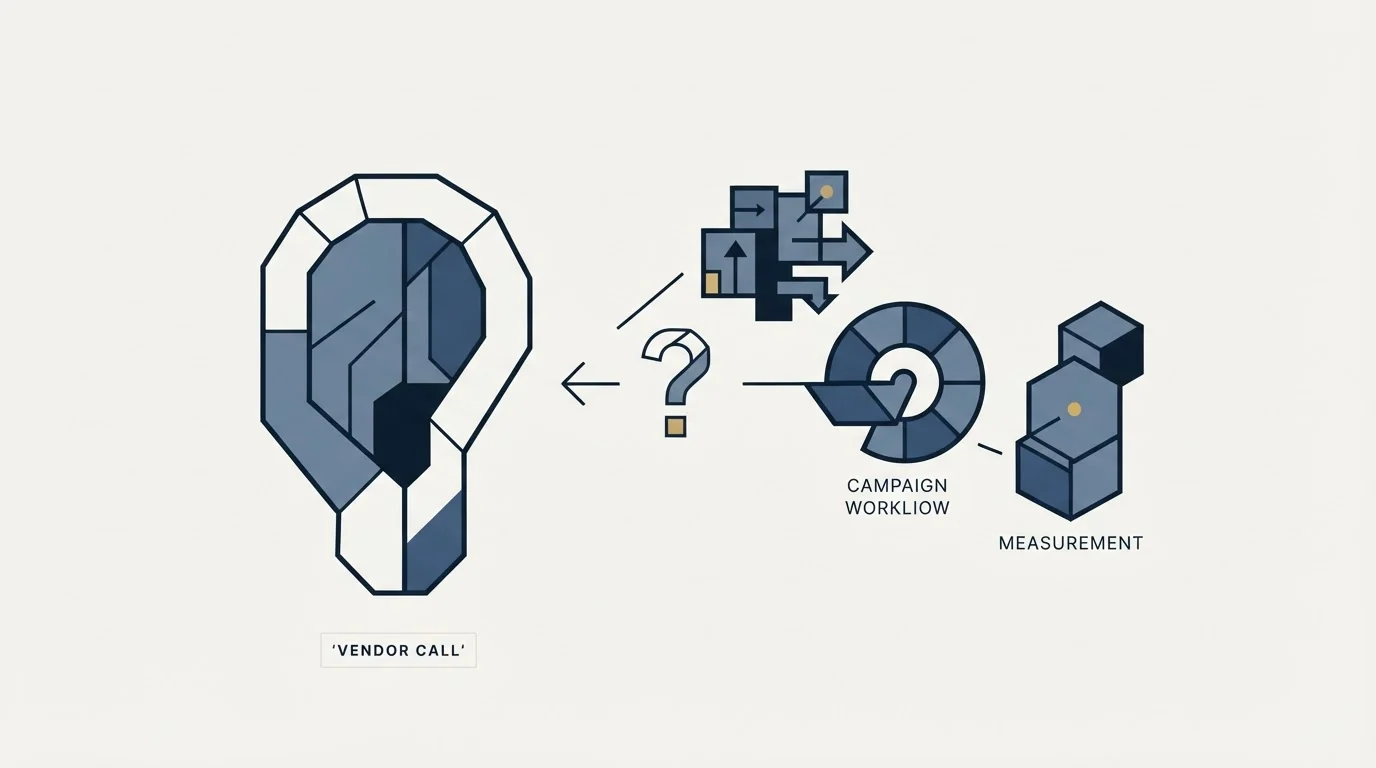
Since no price is published by any of the four, the first call is where the evaluation actually happens. Four questions do most of the work, and they are the same four whichever vendor you are talking to.
What is the platform fee before any users, which separates the fixed cost from the variable one and makes two quotes comparable. Which components are yours and which are resold, intent data especially, because knowing whose data you are buying tells you whether two vendors are genuinely differentiated. What is the minimum term, which sets how long a bad fit costs you. And what does the number look like at twice today's seat count, because that is the version of the bill you will actually be paying in year two.
It separates the fixed cost from the variable one.
Intent data especially: it shows whether two vendors really differ.
It sets how long a bad fit costs you.
That is the bill you will pay in year two.
If the answer turns out not to be a platform
A reasonable share of ABM evaluations end with the buyer concluding they needed a defined account list and consistent contact into it, rather than a licence. That outcome is not a failure of the evaluation. It is the evaluation working.
Where that is the conclusion, the work is the target list, the buying group inside each account, and one clear message reaching them. We run that as outbound rather than as software: one message per campaign, no bumps, and meetings qualified against criteria agreed in writing before anything sends. The case studies show the shape of it, and a free campaign runs against your own account list so you can see what the list produces before you commit to tooling around it.
The short version

The Demandbase competitor list in general circulation is out of date. Terminus merged into DemandScience in November 2024 and RollWorks now redirects to AdRoll, leaving 6sense, DemandScience, AdRoll ABM and ZoomInfo as the platform options, plus the assembled data-and-CRM route. None of the platform vendors publishes a price, so compare the shape of the bill instead: per-user, media-led, or services-inclusive. And settle the target list before the shortlist, because no vendor here fixes an unagreed account list.
Pricing and features are taken from the vendors' own pages. Verify current terms with the vendor before relying on them.
Sources: Demandbase pricing, Demandbase vs Terminus, DemandScience and Terminus merger announcement, AdRoll pricing, Clay pricing, HockeyStack, HockeyStack pricing, 6sense pricing.
Frequently asked questions.
Frequently asked questions- Is RollWorks still a Demandbase competitor?
- Not as a separate product. Every rollworks.com address now resolves to adroll.com, with the root landing on AdRoll's account-based marketing solution page and rollworks.com/pricing landing on AdRoll's pricing page. The capability still exists as AdRoll ABM, so evaluate it under that name and read AdRoll's own packaging rather than older RollWorks material.
- What's the difference between Demandbase and Terminus now?
- Terminus no longer exists as a separate vendor. DemandScience announced on 12 November 2024 that Terminus had merged into it and that the combined company operates under the DemandScience brand, and terminus.com now redirects to DemandScience. Demandbase's own vs-Terminus page is still live, arguing on its B2B demand side platform and intent data, so the real comparison is Demandbase against DemandScience.
- How does Demandbase compare with HockeyStack?
- They solve different problems. HockeyStack's homepage leads with attribution that captures the complete buyer journey, multi-touch models and lift reports, and its FAQ lists ABM platforms among the tools it integrates with. Demandbase sells account intelligence, advertising through its own B2B demand side platform, and orchestration. Neither publishes a price, and a team can run HockeyStack to measure what Demandbase executes.
- How do you compare ABM platforms when none of them publishes pricing?
- Compare how the bill grows. A platform-fee-plus-per-user model grows with headcount and stays flat as you widen the account list. A media-led package grows with advertising spend. A services-inclusive purchase grows with delivered volume. That decision survives the demo, and a feature grid you cannot attach a price to does not.
About the author.

Ben Carden is CRO at RevenueFlow, which builds and operates outbound revenue engines for B2B companies. Previously at Gartner Enterprise. Studied at London School of Economics.
Ben Carden · CRO
Connect on LinkedIn →Explore more.
Ready to scale your outreach?
We build GTM engines that book real meetings. See the receipts.
Related articles.
5 ABM Campaign Examples and How Each One Is Built
Five worked account-based campaign examples, each built on the same five fields: account set, tier, plays in order, owner and handoff, and the exit condition.
ABM Metrics: Coverage Decides Every Other Number
Every published ABM metric is a ratio whose denominator somebody chose. Six numbers, the denominator each one needs, and the comparison that settles it.
Lead Generation as a Service: What the Service Part Changes
Most vendors selling lead generation as a service have productised the scope and kept the price bespoke. What that trade buys you, and how to tell which half is fixed.
How Much Do Lead Generation Companies Charge: The Structure
A rate is one payment. The structure decides how many there are, when the first lands, what you owe if you leave early, and what you have to re-buy afterwards.
Lead Verification: What Each Check Actually Proves
Lead verification covers two different jobs. One asks whether a mailbox will accept mail, the other asks whether the person behind the row is real and lawful to contact.
ABM vs ABX: What Demandbase Added to the Model
One of these terms belongs to a vendor. What Demandbase says ABX adds, the three things that genuinely change, and the three that stay identical.