Demandbase vs RollWorks: Now AdRoll ABM, Compared
RollWorks is now AdRoll ABM. How it compares with Demandbase on positioning, data sources and the shape of the purchase, read from both vendors' own pages.
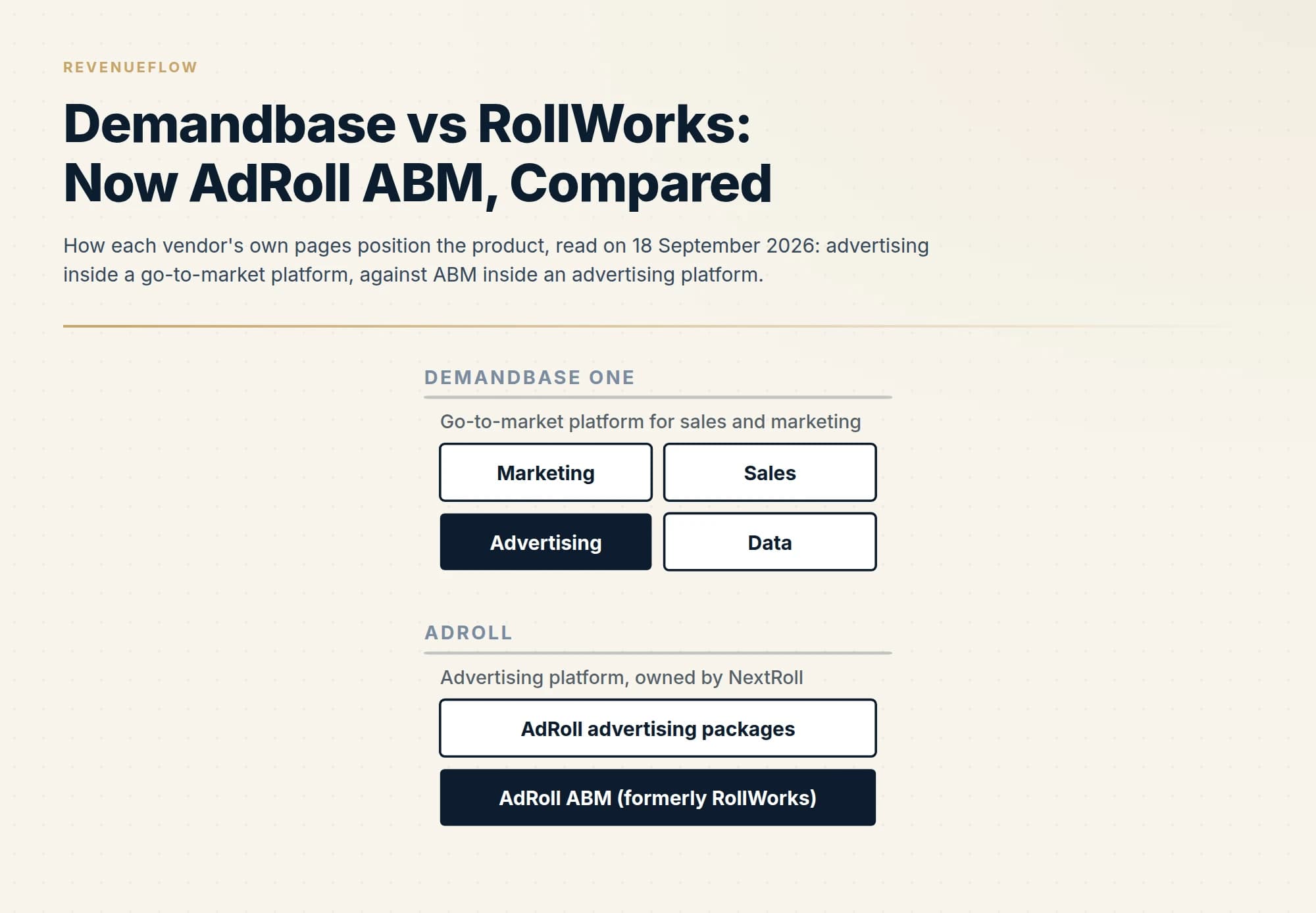
RollWorks is now AdRoll ABM, according to AdRoll's own help centre, and rollworks.com redirected to adroll.com on 18 September 2026. Demandbase wraps advertising inside a go-to-market platform priced on a platform fee plus a flat fee per user. AdRoll ABM wraps ABM inside an advertising platform and names one entry package with no fee to start. Neither prints a price.
Key takeaways
- AdRoll's help article, updated 27 August 2025, states that RollWorks is becoming AdRoll ABM with no change to functionality, pricing or packaging.
- Demandbase's pricing page states a platform fee plus a flat fee per user and says Demandbase One is not split into separate Marketing and Sales products.
- AdRoll's pricing page lists four ABM packages; only Account-Based Retargeting carries a published term, with no fee to start and payment for media.
- Demandbase documents its intent sources in a help article, including bidstream access through its own B2B DSP; AdRoll describes an identity graph and a Command Center.
Reviewed and updated September 18, 2026
Comparison posts still line up Demandbase against RollWorks as two ABM platforms with two websites. One of those websites is gone. On 18 September 2026, rollworks.com redirected to AdRoll's account-based marketing page and rollworks.com/pricing redirected to the ABM section of AdRoll's pricing page. The product is now sold as AdRoll ABM.
AdRoll's own help centre explains the change in an article titled What is AdRoll ABM?, last updated on 27 August 2025: "RollWorks is becoming AdRoll ABM, a change in name that brings even more power to the platform you already trust." The same article says the platform's functionality, features and interface stay the same, answers the pricing question with "No changes to your pricing or packaging", and notes that customer agreements are contracted with the parent company, NextRoll, Inc. Our guide to RollWorks as AdRoll ABM covers the rename and the packages in detail.
So the honest version of this comparison is Demandbase vs RollWorks, now AdRoll ABM. This page reads what each vendor's own product, pricing and help pages said on 18 September 2026 and compares the two on the things a buyer can actually establish before a sales call: what each product is built around, where its data comes from, and what shape the purchase takes. Neither vendor publishes a price for its ABM product, and that fact shapes everything below.
Two products with the same engine and opposite wrappers
Both vendors own a demand-side platform, the machinery that buys ad impressions, and both sell account-based marketing on top of it. The difference is which of the two is the parent.
Demandbase presents a go-to-market platform that happens to contain advertising. Its products page splits Demandbase One into four blocks, Marketing, Sales, Advertising and Data, and describes the advertising block this way: "Use intent data and a B2B-native DSP to run smart campaigns that drive pipeline, not just clicks." The sales block gets equal billing, with a promise to "Surface in-market accounts, map buying groups and automate outreach so sellers close deals faster."
AdRoll ABM is the reverse: account-based marketing offered from inside an advertising company. The FAQ on AdRoll's ABM page says the product "seamlessly combines a precise B2B audience segmentation and targeting solution with a cross-channel demand-side platform into a single application." AdRoll's pricing page lists the ABM packages beside its general advertising packages, under one navigation, and the help article describes the rename as uniting RollWorks under the AdRoll brand so that B2B and B2C marketers share one connected platform.
That difference in parentage predicts most of what follows. Demandbase's pages talk about sales teams, buying groups and CRM data as much as about ads. AdRoll ABM's pages talk about audiences, campaigns and channels, with a hand-off to sales at the end.
Where the data comes from
An ABM platform is only as good as its answer to one question: how does it know which accounts are interested? Both vendors answer on their own pages, and the answers are different in kind.
Demandbase's help centre has an article, Understanding Demandbase Intent, updated on 31 July 2026, that names the mechanism: "Demandbase collects intent signals through direct access to the bidstream via our B2B DSP." It lists four sources behind its intent data, which are public business registries for basic firmographics, B2B content consumption observed through its publisher and advertising network, B2B content production crawled from the open web, and engagement on your own website. The same article says Demandbase provides up to 13 months of historical intent data, depending on availability, and that the scoring is probabilistic. Demandbase's data page adds that its data "connects verified accounts, buyers, and person-level intent into one trusted foundation".
AdRoll's ABM page describes an identity graph: "Built on a foundation of 2.6 billion digital identities and 92 million contacts", with an AI engine it calls InIQ that defines an ideal customer profile and surfaces unknown target accounts. Signals feed what the page calls the AdRoll ABM Command Center, which "tracks buyer signals in real time and recommends your next best steps". Those steps, as the page lists them, are adding records to your CRM, building account and contact lists, or sending priority lists to sales.
Both sets of figures are the vendors' own descriptions of their own assets, and neither page says how the numbers were counted. What can be compared is the kind of evidence. Demandbase documents where intent comes from in a help article a customer can hold it to. AdRoll's public pages describe the size of the graph and the outputs, and the one help article read for this page covers the rename rather than the data. How intent signals of either kind should be weighed is the subject of our B2B intent data guide.
How you buy each one
Neither pricing page prints a currency figure for the ABM product. A search of the visible text of both pages as fetched on 18 September 2026 returns no dollar, euro or pound amount on either. What each page does publish is the shape of the purchase, and the shapes differ.
Demandbase's pricing page states the model in a sentence: "Our pricing model features a clear platform fee that covers all the essential software and services. In addition, there's a flat fee per user". It also states what you cannot do, which is buy Marketing or Sales separately: "That's why we don't split Demandbase One into separate solutions." Two smaller entry points are named on the same page. It says "We also offer our Advertising solution as a starting place" and that its Data solutions "can be used on their own". The mechanics of the per-user model are covered in our Demandbase pricing guide.
AdRoll's pricing page lists four ABM packages, and one of them carries a published commercial term. Account-Based Retargeting reads "No fee to get started and pay only for media." The other three each end in a demo request: Account-Based Advertising, which the page sums up as "Bring your own data and activate multi-channel digital advertising", Account-Based Marketing, and Account-Based Marketing plus Advertising. The page's FAQ states the media model for the advertising side: "AdRoll does not have a minimum spend amount", and pricing is dynamic, "based on CPM (cost per thousand impressions), which means the cost can vary depending on demand."
Demandbase
AdRoll ABM
Read as bills rather than as feature lists, these are two different growth curves. A Demandbase contract has a fixed platform fee and a line that grows with headcount, so widening the account list costs nothing extra in licence and adding users does. An AdRoll ABM programme at its entry rung has no stated platform fee and a media line that grows with every impression, so adding users costs nothing and reaching more accounts does. Which curve you want depends on whether your plan is people-heavy or media-heavy, and that is knowable before any demo.
| Row | Demandbase | AdRoll ABM |
|---|---|---|
| Prints a price for the ABM product | No | No |
| States the pricing model | Yes | Yes |
| Names an entry option with no platform fee | Not stated | Yes |
| Sells advertising as a starting point | Yes | Yes |
| Sells data on its own | Yes | Not stated |
| Splits marketing and sales into separate products | No | Not stated |
What the sales team gets
This is where the wrappers show. Demandbase sells to the sales floor directly. Its platform navigation carries a Sales product described as focusing sellers on the right accounts and buying groups, and its pricing is partly per user because sellers are expected to log in.
AdRoll ABM's public pages describe sales as a recipient. The Command Center recommends next steps, and those steps end in a list handed over or a record added to the CRM. The ABM page does promise to "Unify marketing, sales, and revenue teams" through integrations with your data platforms, and the help article confirms that existing integrations carried over through the rename unchanged. Nothing on the pages read describes a seller-facing workspace of the kind Demandbase sells.
If your ABM plan depends on reps working from the platform every day, that difference matters more than any row in a feature grid. If the plan is a marketing team running account-targeted media and passing warm accounts across, it barely matters at all.
Which one fits
Three questions sort this pair, and the answers come from your plan, not from either vendor.
Will sellers log in? Demandbase is built and priced on the assumption that they will. If yours will not, you would be paying per-user fees for a marketing tool.
Is paid media the core of the programme? AdRoll ABM is an advertising product first, and its identity graph and channel list are its strongest published assets. A team with no media budget gets little from it, a point the ABM platforms comparison makes about the whole category.
Do you need to start small? AdRoll names a rung you can start on with no platform fee, paying for media as you go. Demandbase names advertising or data as starting places and prices the full platform as one product. Neither tells you the cost of the rungs above without a call.
Demandbase has other competitors than this one, and our piece on Demandbase competitors sorts the field after the recent mergers, while the Demandbase review reads the product on its own terms.
One boundary, since this is our page. RevenueFlow runs cold email and LinkedIn outbound, one message per campaign with no bumps, and we do not run paid media or either of these platforms. Everything above describes what the two vendors publish, not a recommendation to advertise at your account list. Plenty of ABM evaluations end with the buyer concluding that what they lacked was a defined list and consistent direct contact with it. If that is where yours is heading, you can see what a first campaign produces against your own target accounts before licensing anything.
The short version
RollWorks is now AdRoll ABM: AdRoll's help centre says so in an article updated on 27 August 2025, and rollworks.com redirected to adroll.com on 18 September 2026. Demandbase wraps advertising inside a go-to-market platform for sales and marketing, documents where its intent data comes from, and prices on a platform fee plus a flat fee per user. AdRoll ABM wraps account-based marketing inside an advertising platform, describes an identity graph and a Command Center, and names one entry package with no fee to start. Neither prints a price for its ABM product. Decide whether sellers will log in, whether media is the core of the plan, and how small you need to start.
Product positioning, packaging, pricing models and help-centre statements above were read from demandbase.com, adroll.com and the two vendors' help centres on 18 September 2026, from stored snapshots of the served pages; the redirects from rollworks.com were observed the same day. Neither vendor published a price for its ABM product on the pages read. Verify current terms with each vendor before relying on them.
Sources: Demandbase pricing, Demandbase products, Demandbase data, Understanding Demandbase Intent, AdRoll pricing, AdRoll ABM, What is AdRoll ABM?
Frequently asked questions.
Frequently asked questions- Is RollWorks still a separate product from AdRoll?
- No. AdRoll's help centre article What is AdRoll ABM?, last updated on 27 August 2025, says RollWorks is becoming AdRoll ABM, the same platform under a new name inside the AdRoll ecosystem, with customer agreements contracted through NextRoll, Inc. On 18 September 2026, rollworks.com redirected to AdRoll's account-based marketing page.
- How much do Demandbase and AdRoll ABM cost?
- Neither vendor printed a price for its ABM product on the pages read on 18 September 2026. Demandbase's pricing page states a platform fee plus a flat fee per user. AdRoll's page lists four ABM packages, three behind a demo request and one, Account-Based Retargeting, described as having no fee to get started with payment only for media.
- Which is better for a sales team, Demandbase or AdRoll ABM?
- Demandbase's own pages sell a Sales product for working accounts and buying groups and price partly per user, so it assumes sellers log in. AdRoll ABM's public pages describe sales as a recipient of priority lists and CRM records from its Command Center. If reps will work from the platform daily, that difference matters more than any feature row.
- Where does each platform get its intent data?
- Demandbase's help article says it collects intent signals through direct access to the bidstream via its B2B DSP, alongside public business registries, crawled B2B content and engagement on your own site, with up to 13 months of history. AdRoll's ABM page describes a foundation of digital identities and contacts analysed by an engine it calls InIQ.
About the author.

B2B cold email experts helping companies generate qualified leads through done-for-you outreach campaigns.
RevenueFlow Team
Explore more.
Ready to scale your outreach?
We build GTM engines that book real meetings. See the receipts.
Related articles.
Common Room Pricing: One Number and Two Custom Tiers
Common Room publishes its entry rung and quotes the two above it. The entitlements are published for all three, and two credit meters decide the fit.
Outbound Lead Generation Tools, Layer by Layer
Outbound tools do six jobs and price on different units: contacts, credits, seats, sends. Thirteen vendors read from their own pages on 18 September 2026, by layer.
Lavender Pricing: Two Products, No Pricing Page
Lavender has no pricing page. The Email Coach ladder per seat at both billing states, the free routes, and the separate per-agent price for Ora.
Gong Engage vs Salesloft Cadence: How They Differ
Gong Engage and Salesloft Cadence compared from each vendor's own pages: where each starts, six jobs side by side, and what the pricing pages disclose.
RingLead vs LeanData: ZoomInfo Operations Compared
RingLead is now ZoomInfo Operations. How it compares with LeanData on matching, routing, deduplication and enrichment, read from each vendor's own pages.
What Cold Email and Sales Tools Actually Cost in 2026: Pricing Data From 386 Vendors
RevenueFlow's verified dataset of 386 sales tools puts the median starting price at $39.98 a month. Here is the spread by category, tier and billing model.