RollWorks Is Now AdRoll ABM: The Packages and the Pricing
RollWorks has been folded into AdRoll ABM, and its old pricing URL now redirects. What the platform does, how the four packages split, and how it is priced.
RollWorks now redirects to AdRoll and is sold as AdRoll ABM, a NextRoll product combining account identification, buyer signals, multi-channel advertising and attribution. AdRoll's pricing page publishes no currency figure for any ABM package, states there is no minimum spend, and prices media on a dynamic CPM basis rather than a fixed licence.
Key takeaways
- RollWorks is no longer a standalone brand: its homepage serves AdRoll content with a canonical link to adroll.com, and its pricing URL answers HTTP 301 to AdRoll's pricing page.
- AdRoll's pricing page publishes no currency figure for any ABM package, so platform cost is negotiated in every case, and only the entry retargeting tier carries a published commercial term.
- The published pricing model is dynamic CPM on media with no minimum spend, which makes the media half of the budget calculable and the platform half a quote.
- Activation here is paid advertising, so an outbound-only team pays for an identity graph while leaving the part that justifies the architecture switched off.
Reviewed and updated September 18, 2026
Type rollworks.com into a browser and AdRoll's account-based marketing page loads instead. That is not a redirect chain gone wrong. RollWorks has been folded into AdRoll, and the merged product is sold as AdRoll ABM.
The evidence is on the vendor's own surfaces and it is unambiguous. The page served at www.rollworks.com declares a canonical link element pointing at https://www.adroll.com/solutions/account-based-marketing, which is a site telling search engines that another domain owns its content. Its visible copy names the product "AdRoll ABM (formerly RollWorks)", its page title reads "Account-based Marketing and Advertising Solution | AdRoll", and its trademark footer assigns the platform's two named engines, InIQ and BidIQ, to NextRoll rather than to RollWorks. A request to www.rollworks.com/pricing answers HTTP 301 to https://www.adroll.com/pricing#abm, so the old pricing URL does not resolve to a RollWorks page at all. Third-party listings on review sites and app marketplaces have picked the rename up in their own titles, though those pages block automated fetching, so the evidence cited here is the vendor's own.
This matters more than a brand note usually would, because comparison posts and vendor shortlists still recommend RollWorks as though it were a standalone company with its own pricing page, its own roadmap and its own commercial terms. It is a package inside an advertising platform owned by NextRoll, and that changes what you are actually evaluating and who you will be negotiating with. It also means that any figure you find attributed to "RollWorks pricing" predates the merge or was never on a RollWorks page in the first place, because there is no longer a RollWorks surface for a price to live on.
What AdRoll ABM does
Four things, in the order the platform performs them.
Account identification. The product page states it is "Built on a foundation of 2.6 billion digital identities and 92 million contacts", and that its AI "defines your ideal customer profile, surfaces unknown target accounts, and illuminates those who are most likely to make a purchase". The identity graph is the asset here, and its provenance is advertising technology rather than a publisher content co-op, which is the distinction the B2B intent data guide draws between the mechanisms behind third-party signal.
Deciding whether person-level resolution belongs in your stack is worth weighing against visitor identification pricing tiers, which routes similarly credit-metered packages through a sales call.
Audience and signal. Buyer signals feed what the vendor calls the AdRoll ABM Command Center, described on the same page as tracking "buyer signals in real time" and recommending next steps: adding records to a CRM, building account and contact lists, or sending priority lists to sales.
Teams weighing whether AdRoll's buyer signals are enough should compare them against Bombora's intent scoring methodology, which published its surge thresholds and package pricing outright until the pricing page was withdrawn in September 2026.
Activation, which is mostly advertising. Multi-channel ad campaigns across websites, apps, social and streaming. The pricing page's channel list includes display, connected TV, video, native, in-app mobile and social ads across Facebook, Instagram, TikTok and Pinterest.
Measurement. Attribution back to pipeline and closed-won, with the vendor's two named engines, InIQ for buyer insight and BidIQ for bid optimisation, both trademarked to NextRoll.
The vendor also publishes outcome claims on those pages, including an average of 16 percent more opportunities and several named customer results. Those are marketing claims made by the seller about its own customers, with no control group attached, and they should be read as such.
- Step 1Identify
An identity graph the vendor describes as 2.6 billion digital identities and 92 million contacts defines the ICP and surfaces unknown target accounts
- Step 2Detect
The Command Center tracks buyer signals in real time and recommends a next step per account
- Step 3Activate
Multi-channel paid advertising to those accounts across display, connected TV, video, native, mobile and social
- Step 4Measure
Attribution across the buyer journey, tied back to pipeline and closed-won in the CRM
The four ABM packages
AdRoll's pricing page splits the ABM side into four named packages, and the split is by how much of the platform you take rather than by seat count or account volume.
Account-Based Advertising is the bring-your-own-data tier: the page describes it as "Bring your own data and activate multi-channel digital advertising to reach precise audiences and measure your impact". You supply the account list, the platform buys the media. Note what that hand-off is in regulatory terms: passing your own list to an advertising platform for audience targeting sits inside California's definition of selling and sharing personal information, which is argued in CCPA compliance.
Account-Based Marketing is the other half without the media: "Build your ABM strategy with buyer insights, customizable journey stages, workflow orchestration, and advertising playbooks."
Account-Based Marketing + Advertising is both, for teams running "end-to-end ABM and advertising strategies".
Account-Based Retargeting is the entry point, and it is the only one of the four carrying a published commercial term: "No fee to get started and pay only for media."
Three of those four say "Request a Demo". One says "Get Started".
- Retargeting campaigns
- Free creative support
- AI Assistant insights
- Published term: no fee to get started and pay only for media
- You supply the account list
- Multi-channel digital advertising
- Impact measurement
- No price published, request a demo
- Buyer insights
- Customisable journey stages
- Workflow orchestration and advertising playbooks
- Advertising bundled in the combined package
- No price published, request a demo
What it costs, which is a harder question than it looks
AdRoll's pricing page publishes no currency figure anywhere. Not for the ABM packages, not for the advertising packages, not as a floor or a starting-at number. That is an absence claim, so here is how it was checked: the page at adroll.com/pricing was fetched with a browser user agent and the stored bytes searched for any dollar amount, returning zero matches in both the raw HTML and the visible text, and rollworks.com/pricing resolves to that same page.
What the page does publish is the pricing model, in its FAQ. "AdRoll does not have a minimum spend amount." And: "AdRoll offers dynamic pricing based on CPM (cost per thousand impressions), which means the cost can vary depending on demand." Managed services and the advanced package are gated behind "qualifying ad spend" rather than a licence fee, and ad credits are granted monthly against the package rather than sold.
So the honest answer to what AdRoll ABM costs is that the platform fee is negotiated and unpublished, while the media is bought at a floating CPM you do not control. Budgeting the second half of that is straightforward arithmetic once you accept the numbers are yours to supply. Reaching 500 target accounts with roughly 20 people each is 10,000 people, and at a hypothetical $12 CPM with 15 impressions apiece that is 150,000 impressions and about $1,800 of media. Those figures are invented to show the shape of the calculation and are not measured, quoted or published by the vendor; substitute your own account count, your own buying committee size and a real quoted CPM before treating any of it as a budget.
The absence of a published platform price is normal for this category, and it is also why the live guide's provider table quotes reported ranges instead of list prices.
Where it sits on the ladder
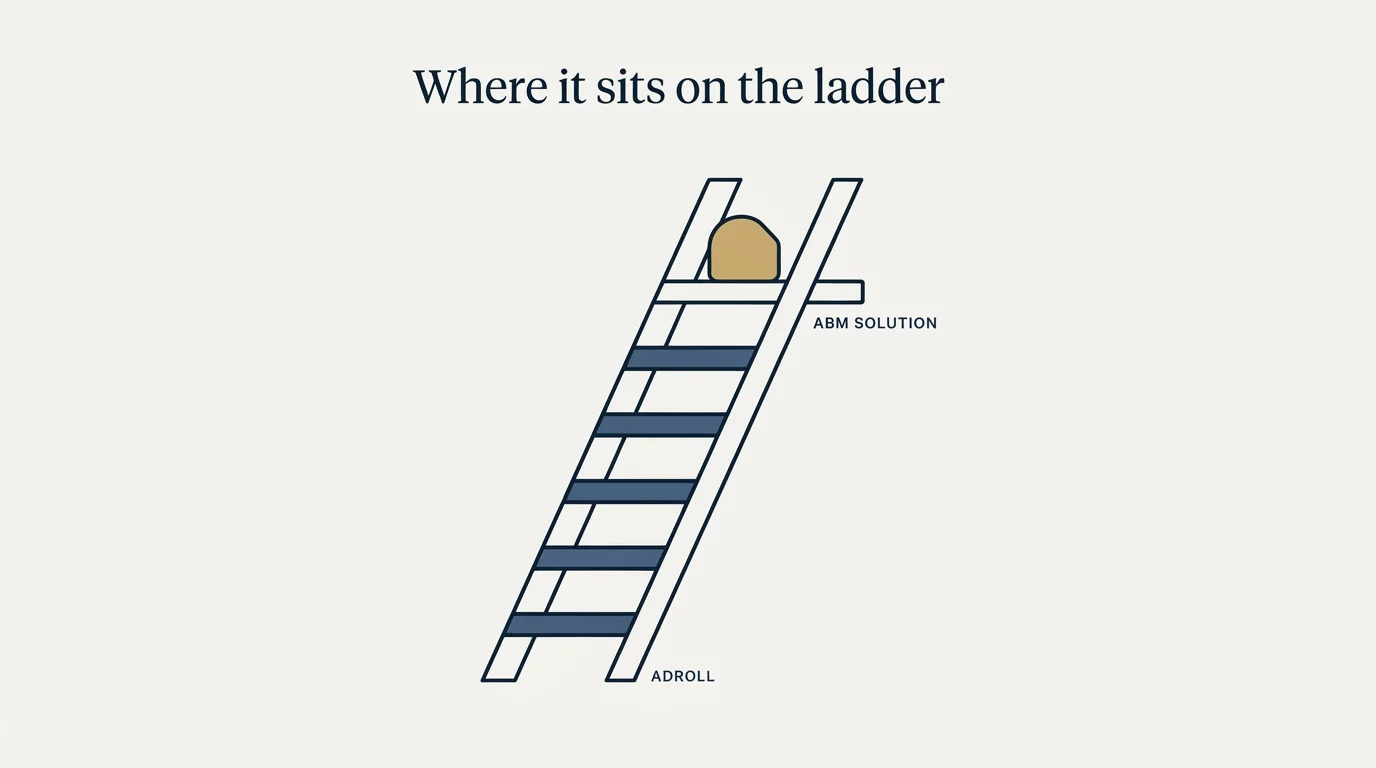
The live intent guide's landscape puts predictive ABM platforms in the $50,000 to $150,000-plus band, and names nothing below it on the activation side. AdRoll ABM's Account-Based Retargeting package is genuinely lower than that: a self-serve entry with no platform fee to start and media billed as you use it. For a company that wants some account-based advertising without an annual commitment, that rung exists and is worth knowing about.
The rung above it is where the honesty is required. The moment you want the buyer insights, journey stages and orchestration, you are into "Request a Demo", and nothing on the vendor's site tells you what that costs.
That gap is worth planning around rather than resenting. Go into the call with your account count, your realistic monthly media budget and the specific signals you intend to act on already written down, because a quote assembled around a vague description of your programme is the one that comes back highest. The published entry rung is also a legitimate way to test the identity graph's coverage on your own account list before committing to anything larger, and coverage on your specific accounts is the variable that decides whether the rest of the platform is worth buying.
The advertising part, said plainly
The activation layer here is paid media. That is what the product is for, and it is a real capability, well integrated with the identification layer that precedes it.
It is also not what we do. RevenueFlow runs email and LinkedIn outbound, not paid media, so treat everything above as a description of what AdRoll ABM does rather than a recommendation to run ads against your account list. If your plan is to turn account signal into direct outreach, the connection shapes and decay rules in intent signal APIs for outbound are the relevant reading, because the useful life of a signal is what decides whether it can drive a message at all.
One naming collision is worth clearing up. "Account-Based Retargeting" here means showing ads again to accounts that have already been reached, which is an advertising mechanic. It is unrelated to sending a prospect a second message after they ignored the first, which we do not do: campaigns carry one message, and on LinkedIn a follow-up lands under the message they already declined to answer, so it reads as a bump whatever the campaign structure.
- Yes: Paid media is already part of your go-to-market and you have a budget for it
- Yes: You have a defined target account list, or want the platform to build one
- Yes: You want advertising, account identification and attribution from one vendor
- Depends: You are comfortable evaluating a platform whose fee is quoted rather than published
- No: You need the vendor to name a person to email at a surging account
- No: Your entire motion is outbound email and LinkedIn with no ad spend
- No: You are buying primarily to identify your own website traffic
Who it does not fit

Teams with no paid media budget get the least out of this, because the activation layer is where most of the platform's value sits and it is bought in impressions. An outbound-only team is paying for an identity graph and a signal dashboard while leaving the half that justifies the architecture switched off.
It is also the wrong purchase if the goal is naming individuals on your own website. That is a separate category with different mechanics, different match rates and different legal exposure. And if what you actually lack is contact data quality rather than account prioritisation, an ABM platform will not fix it; the honest comparison there is against the enrichment layer in data enrichment tools for SDR teams.
Teams that still conflate account identification with naming individual site visitors will find website visitor identification coverage useful for sorting out that separate category.
The last caution is structural rather than about the product. A brand that has been absorbed into its parent tends to lose roadmap independence, and the pricing page now presents ABM as one section of an advertising platform's packaging. Ask directly what the support model and roadmap look like under the AdRoll brand before signing a multi-year term, and make sure your lead routing plan does not assume a product name that the vendor has already retired.
If you want the outbound motion built before the platform decision, get a free campaign plan and we will show you what your current list and message produce first.
Pricing and features verified as of mid-2026. Verify current terms with the vendor before relying on them.
Frequently asked questions.
Frequently asked questions- Is RollWorks still a separate product?
- No. The page served at rollworks.com is AdRoll's account-based marketing page, declaring a canonical link to adroll.com, and its visible copy names the product AdRoll ABM, formerly RollWorks. G2 and the Salesforce AppExchange have both renamed their listings. Comparison posts still using the old name are out of date.
- How much does AdRoll ABM cost?
- AdRoll's pricing page carries no currency figure for any ABM package. Its FAQ states that AdRoll has no minimum spend amount and that pricing is dynamic and based on CPM, so media cost varies with demand. Only the Account-Based Retargeting package publishes a term: no fee to get started, pay only for media.
- What are the four AdRoll ABM packages?
- Account-Based Advertising for teams bringing their own account data, Account-Based Marketing for the insights and orchestration layer, Account-Based Marketing plus Advertising for both, and Account-Based Retargeting as the self-serve entry point. Three of the four require a demo request; only retargeting has a Get Started button.
- Does AdRoll ABM work without an advertising budget?
- Poorly. The activation layer is multi-channel paid media and it is where most of the platform's value sits, so a team running only email and LinkedIn is buying an identity graph and a signal dashboard while leaving the rest idle. Evaluate an enrichment or signal provider against that use case instead.
About the author.

B2B cold email experts helping companies generate qualified leads through done-for-you outreach campaigns.
RevenueFlow Team
Explore more.
Ready to scale your outreach?
We build GTM engines that book real meetings. See the receipts.
Related articles.
Is Clay Free? The Free Plan, the Trial and Where Each Stops
Clay's free plan, its 14-day trial and the no-charge-on-a-miss rule are three different things. What each holds and where it stops, from clay.com on 19 September 2026.
Video Prospecting Tools by Job: What Each One Is For
Ten video prospecting tools sorted by the job each vendor's own page describes: record and share, personalise at volume, avatars, hosting and interactive demos.
Seamless.AI Email Finder: How It Works, What a Credit Buys
How Seamless.AI's email finder resolves a contact in real time, what one Universal Credit buys, the Total AI score on every address, and what the Chrome extension reads.
Social Selling Tools by Job, and the Account-Risk Line
Fourteen social selling tools sorted into six jobs, split by whether each acts through your LinkedIn account or beside it, from the vendors' own pages.
Autobound Pricing: One-Time Credit Packs, Not Seats
Autobound's pricing page sells one-time credit packs for a signal data API, not seats. The six packs, the per-endpoint meter, and what a company costs.
Sales Training Programs: 13 Providers by What They Teach
Thirteen sales training providers and three free sources, grouped by what each one teaches, from their own pages as read on 18 September 2026. No ranking.