Emailable Pricing: What One Credit Buys
Emailable's calculator opens on $38 for 5,000 credits and a toggle turns that into $32.30. Both are on the page, and only one is the price a visitor sees first.
Emailable prices verification in credits rather than plans. The pricing page opens on 5,000 credits for 38 dollars, and a toggle shows the same block at 32.30 dollars on a monthly subscription. One credit covers one verification through bulk, the API or the form widget. Unknown results and duplicates are refunded.
Key takeaways
- There are no verification plan tiers, only credits, on a slider running from 5,000 to 1,000,000 with a 5,000-credit minimum purchase.
- The default rendered price is 38 dollars for 5,000 credits, which is 0.0076 dollars per credit; the monthly subscription state shows the same block at 32.30 dollars.
- One credit covers one verification whether it runs through bulk upload, the API or the form widget, while inbox reports cost 100 credits and blacklist checks 5.
- Duplicates and unknown results are refunded, so the effective cost per usable verdict depends on your own list far more than on the published rate.
Reviewed and updated September 2, 2026
Emailable Pricing: What One Credit Buys and Which Price the Page Shows You
Emailable's pricing page carries two prices for the same thing, and which one you quote depends on a toggle. The default state of the calculator shows 5,000 credits at 38 dollars, a cost per credit of 0.0076 dollars. Flip the toggle to the monthly option and the same 5,000 credits read 32.30 dollars, which works out at 0.00646 dollars per credit. Both numbers are on the page. Only one of them is what a visitor sees first.
That is the whole shape of this pricing model in one paragraph: no plan tiers, no seats, one credit meter, and two billing modes sitting behind a switch. Here is what the meter counts and where the real cost of a B2B list actually comes from.
There are no plans, there are credits
Emailable does not sell a Starter, Pro and Enterprise ladder for verification. It sells credits, and the pricing page runs a slider across eight positions from 5,000 credits to 1,000,000 credits, with anything above that routed to a sales conversation.
Contrast that single credit meter with a tiered ladder, where Surfe's pricing tiers and credit pools split email and phone finder allowances by plan.
Two purchase modes share that slider. Pay-as-you-go buys a block of credits outright, and the page states that credits never expire. The monthly subscription reloads credits each billing cycle at a 15 percent saving, with unused credits rolling over into the next period and no long-term commitment.
The floor matters if you are testing. The pricing FAQ states that the minimum number of credits you can purchase is 5,000, so the smallest real transaction is the 38 dollar block. Below that there is a free allocation of 250 credits, which the page says never expire either.
- Yes: Default calculator state: 5,000 credits at $38, cost per credit $0.0076
- Yes: Monthly subscription state for the same 5,000 credits: $32.30, a 15% saving
- Yes: Minimum purchase is 5,000 credits
- Yes: Credits never expire, and subscription credits roll over
- Depends: Per-credit rates above the default slider position render in the browser, so they are not quotable from the page source
That last line is a real limit on this article rather than an omission. The slider's higher volumes are priced by a calculator that computes in the browser, so the only per-credit figure the page itself publishes to a reader arriving cold is the one at the default position. Volume discounts exist and the page says so. The exact rate at 250,000 credits is something to read off the calculator yourself before you budget, not something to take from any write-up including this one.
Browser rendered prices defeat scripted readers elsewhere too, and Navattic's rates are drawn by an animating component that a person reading the screen sees perfectly well.
One credit, four products
The pricing page prices every verification surface identically at one credit per verification: Bulk for uploaded lists, Verifier for single addresses, API for programmatic checks, and Widget for validating addresses in your own web forms.
This is worth pausing on, because it removes a decision that costs money elsewhere in the category. Some vendors price real-time API verification above batch verification, which pushes teams to batch things that would be better checked at the point of capture. Here the meter does not care, so you can validate an address on a signup form and re-verify the same address in a monthly list clean without arbitraging the price.
The deliverability side is metered on a different scale entirely. Inbox Reports cost 100 credits per report and Blacklist Monitors cost 5 credits per check. Those two lines are the ones to model separately if you plan to run continuous monitoring, because a monitor checking several domains several times a day consumes credits on a schedule rather than on a list.
Billing terms that change the commitment

Three details on the pricing page shift this from a subscription decision to a purchase decision.
There is no contract. The FAQ answers the question directly: Emailable offers a pay-as-you-go service with no long-term contracts or commitments required, and the subscription can be cancelled at any time. That removes the usual reason to over-buy a tier at signup.
Payment is broad. The page lists Visa, Mastercard, American Express, Discover and JCB Diners Club cards from customers in every country, plus PayPal, Apple Pay and Google Pay, with bank debits and transfers available on request. For a team that runs procurement through a bank transfer rather than a card, that last option is the one to confirm in writing before you plan a large purchase, since the page describes it as available on request rather than as standard.
Credits do not lapse. Both the pay-as-you-go blocks and the rolled-over subscription credits are described as never expiring, which means an unused balance is deferred spend rather than lost spend. That matters for outbound teams whose volume is lumpy, since a quarter with two campaign launches and a quarter with none can share one purchase.
How to read a toggle-priced page, generally
The gap between 38 dollars and 32.30 dollars in the opening paragraph is not an Emailable quirk. Any pricing page with a monthly-versus-annual or subscription-versus-one-off switch renders both states into the same document, so a summary written from a scraped page or a search snippet can quote whichever one its parser happened to reach, with no way to tell that a second price existed.
Pricing pages that redirect instead of publishing a rate card raise the same transparency risk, and Crayon's redirecting pricing page shows how quoted figures then come only from marketplaces.
The check takes seconds and is worth making a habit. Open the page, note the price before you touch anything, then flip the switch and note the second one. Quote the default state as the price and the toggled state as the discount, and say which is which. A number quoted without its billing mode is not a price, and in this case the two figures differ by roughly 15 percent, which is enough to change a volume comparison against another vendor.
The refunds are where the real rate lives
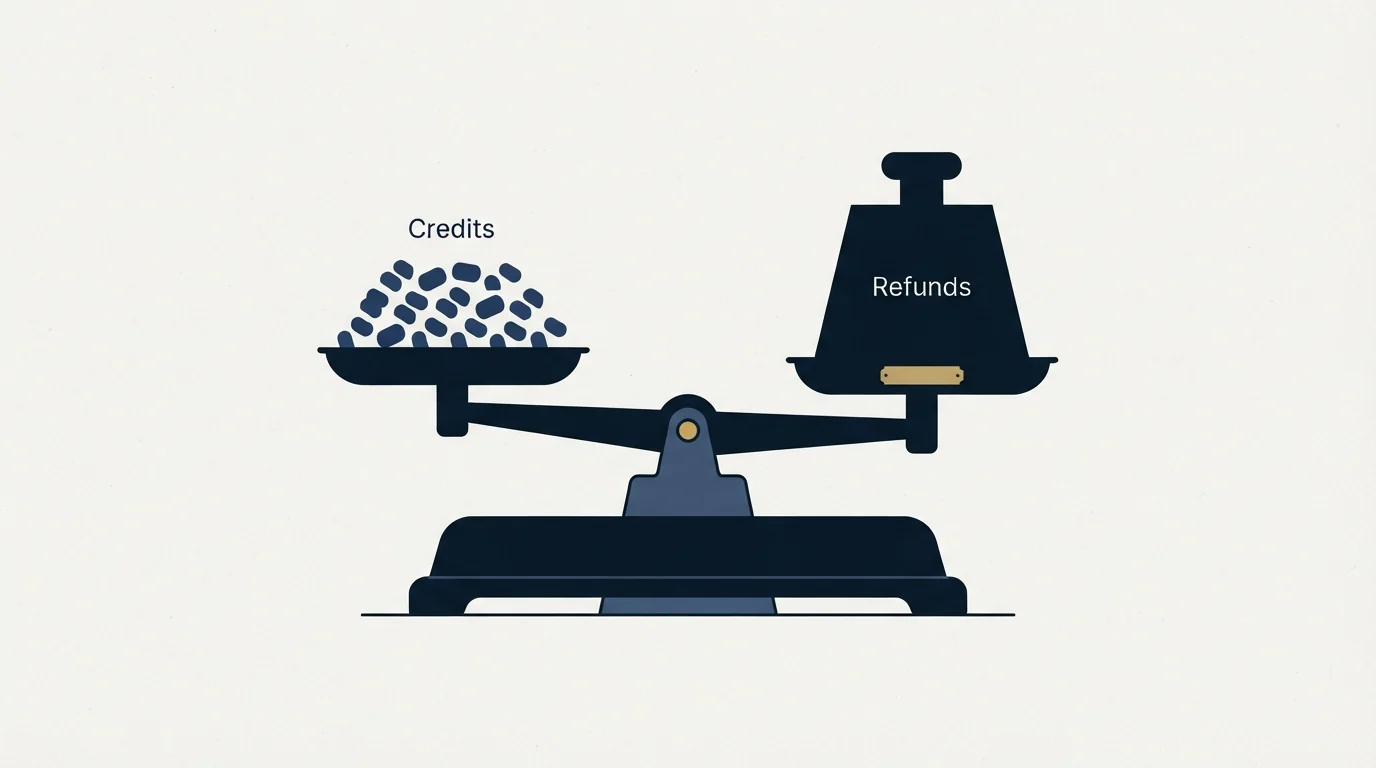
The published rate is not the effective rate, and the gap is in Emailable's favour here rather than against you.
A published rate and an effective one diverge in the other direction too, and Showpad moves features between tiers at renewal without changing any rate.
The pricing FAQ states that duplicates and Unknown results are refunded and credited back to your credit balance once a list finishes verifying, and the page's feature list says plainly that unknown results are free. An Unknown verdict is what the service returns when a receiving server times out, refuses a connection, greylists the probe, or answers unexpectedly.
For a B2C list of consumer mailboxes, that refund is a rounding error. For a B2B list weighted toward corporate domains behind security gateways, it is not. Those are precisely the servers that produce timeouts and unavailable-SMTP responses, so a list that looks expensive on paper can settle at a materially lower effective cost per usable verdict.
The corollary is the one to plan around. A refund on Unknown gives you your credit back. It does not give you a usable address, and it does not tell you whether the mailbox exists. Your list still shrinks; you simply are not charged for the part that shrank.
Illustrative arithmetic, with invented numbers
The following figures are invented for illustration. They are not a measurement of any client list, and no RevenueFlow campaign data is used anywhere in this article.
Take a hypothetical list of 5,000 B2B addresses bought at the default published rate of 0.0076 dollars per credit, so 38 dollars for the block. Imagine, purely as an example, that the run returns 3,500 deliverable, 700 risky, 500 undeliverable and 300 unknown.
The 300 unknown are refunded, so the charge covers 4,700 verdicts, giving an effective 0.0081 dollars per verdict you can act on. The 3,500 you would actually send to cost 0.0109 dollars each. The distance between the headline 0.0076 and that 0.0109 is entirely a property of the imagined list's quality, not of the vendor's price.
$38 at the default published rate
Unknown results are refunded per the pricing FAQ
Risky needs a policy decision before launch
Illustrative figure only
Run that same arithmetic on your own distribution and the per-usable-address number is the one to compare against other vendors, because the published per-credit rates across the category are measuring different denominators.
What the guarantee costs you nothing to read

Emailable's homepage carries a 99 percent deliverability guarantee, and the sentence beneath it scopes the promise: no more than 1 percent of emails verified as Deliverable will bounce upon sending.
For a pricing decision, the scope is the whole story. The guarantee covers one of five verdict states. It does not cover Risky, it does not cover Unknown, and it does not extend to the catch-all domains that Emailable's own documentation says can stay unresolved. If your list is mostly enterprise, the guaranteed share may be smaller than the invoice suggests, and that is a reason to price the guaranteed bucket rather than the list.
Where the money actually goes in outbound
Verification is the cheapest line in a cold-email budget and one of the highest-leverage. A block of credits costs less than a single sending domain, and an unverified list can cost you the domain.
The comparison that decides the budget is not price against price, it is price against the bounce rate you are buying down. Two habits keep the spend honest. Verify once, close to send, rather than repeatedly across a quarter, since list hygiene decays with time and a verdict from six weeks ago is a claim about a mailbox that may have closed since. And hold what comes back unresolved instead of sending to it, which keeps the bounce rate low enough that the rest of the infrastructure stays healthy.
For the wider budget picture, our cold email pricing guide puts verification alongside inbox costs, sending platforms and data, and the email verification tools comparison sets the per-credit rates here against the other vendors in the category. Read both before assuming the cheapest per-credit figure wins, because the refund policy and the accept-all handling move the effective rate more than the sticker does.
Want a campaign costed end to end, verification included, before you buy anything? Get a free campaign plan and we will show you the numbers on your own list.
Pricing and features verified as of mid-2026. Verify current terms with the vendor before relying on them.
Frequently asked questions.
Frequently asked questions- How much does Emailable cost?
- The pricing page's default state shows 5,000 credits for 38 dollars, a cost per credit of 0.0076 dollars. Switching the toggle to the monthly subscription shows the same 5,000 credits at 32.30 dollars, a saving the page states as 15 percent. Higher volumes are calculated in the browser, so read them off the calculator.
- Do Emailable credits expire?
- The pricing page states that credits never expire. On the monthly subscription the account is reloaded each billing cycle and unused credits from the previous period roll over. The page also says there is no long-term contract and that a subscription can be cancelled at any time, so an unused balance is deferred spend rather than lost spend.
- What is the minimum I can buy?
- The pricing FAQ states that the minimum number of credits you can purchase is 5,000, which makes the smallest real transaction the 38 dollar block at the default rate. A free allocation of 250 credits sits below that for testing, and the page says those never expire either.
- Am I charged for addresses Emailable cannot verify?
- No. The pricing page says duplicates and unknown results are refunded to your credit balance once a list finishes verifying, and lists unknown results as free among the account inclusions. That matters most on B2B lists, where corporate mail servers behind security gateways generate the timeouts that produce unknown verdicts.
About the author.

Tim Carden is CMO / CTO at RevenueFlow, which builds and operates outbound revenue engines for B2B companies. Studied at McGill University.
Tim Carden · CMO / CTO
Connect on LinkedIn →Explore more.
Ready to scale your outreach?
We build GTM engines that book real meetings. See the receipts.
Related articles.
ZeroBounce Pricing: The Three Things Buyers Miss
What the ZeroBounce pricing page actually publishes, which billing state it shows by default, and the credit rules that decide what a buyer really pays.
BriteVerify: What It Verifies and the Price to Ask For
BriteVerify checks email, phone and postal address under Validity, and publishes no rate card on any surface that returns a page. What that means for buyers.
NeverBounce Under ZoomInfo: What Buying Verification Changes
NeverBounce serves no pricing page to automated requests, so here is what its own surfaces do show, and what changes when your verifier belongs to a data platform.
Email Warmup Pricing in 2026: What 20 Tools Charge, and What 10 Mailboxes Cost
Email warmup tools start at a median of $29 a month, but warming ten mailboxes costs from $7.50 to $1,190 depending on how the vendor prices a mailbox.
EmailBison Pricing: One Plan, Priced by Sends
EmailBison publishes a single plan and no toggle. The dated price, what it includes, the unpriced send buckets above it, and the figure the vendor's blog still carries.
Kickbox Pricing: The Ladder and the Opt-In Rule
Kickbox publishes a complete thirteen-step verification ladder, and an anti-spam policy that rules out purchased and harvested lists entirely.