FindThatLead Pricing: Two Plans, Two Credit Definitions
FindThatLead prices Starter and Ultimate with yearly billing shown first. Every axis of both plans, the phone meter, and where the page contradicts itself.
As published on FindThatLead's pricing page on 4 September 2026, Starter is $37 a month billed yearly or $49 monthly for one user, one mailbox and 2,000 email credits a month, and Ultimate is $75 or $99 for unlimited users and credits under a fair use policy. A seven-day trial carries 50 credits. The yearly figure is shown first.
Key takeaways
- The page opens on yearly billing, so the first prices a visitor sees, $37 and $75 a month, carry a twelve-month commitment; the monthly figures are $49 and $99.
- Starter allows one user and one connected mailbox, so any team of two or more is on Ultimate regardless of how many credits it needs.
- Yearly billing turns the mobile phone allowance into an annual pool of 600 or 1,200 credits while email credits stay monthly, an asymmetry the page does not explain.
- The cards define a credit as a delivered verified email while the FAQ defines it as a search, and the FAQ still describes a ten-user Business plan that no card carries.
Reviewed and updated October 1, 2026
FindThatLead sells two paid plans and a seven-day trial, and the page that prices them opens on yearly billing. Starter reads $37 a month and Ultimate $75 a month before a visitor touches anything, with a badge beside the switch that states minus twenty five percent, and the monthly figures of $49 and $99 appear only when the toggle is moved. A buyer who compares the first number they see against a competitor's monthly default is comparing a twelve-month commitment with a one-month one.
The plans bundle more than a finder. Each carries email credits, mobile phone credits, a daily sending allowance for the vendor's own cold email sender, a count of sequences, connected email accounts and users, and the two paid tiers differ on every one of those axes at once. This page walks the three cards at both billing states, the comparison table beneath them, the page's own definition of a credit, and the places where the page disagrees with itself. Every figure is as published on FindThatLead's pricing page on 4 September 2026, read from the page's own bytes, which carry a dollar sign as the currency attribute on every checkout button.
The three cards
The pricing page renders three plans. The yearly figures below are what the page shows by default; the monthly figures are the alternate state of the same cards.
| Plan | Billed yearly | Billed monthly | Users | Email accounts | Email credits | Mobile phone credits |
|---|---|---|---|---|---|---|
| Free Trial | $0 | $0 | 1 | 1 | 50 | 2 |
| Starter | $37 a month | $49 a month | 1 | 1 | 2,000 a month | 50 a month, or 600 a year |
| Ultimate | $75 a month | $99 a month | Unlimited | 15 | Unlimited | 100 a month, or 1,200 a year |
Every unlimited entry on the Ultimate card carries the same qualifier, subject to FindThatLead's fair use policy, and the comparison table marks those cells with an asterisk pointing at the same policy. The policy itself is not printed on the pricing page.
The trial is seven days. Its card lists 50 email credits, 2 mobile phone credits, 150 daily sends through the sender, 10 sequences, restricted exports and basic support, and the FAQ states plainly that the free plan is a test of the platform's main features rather than a trial of Ultimate. Starter raises the sender to 400 a day and the sequences to 20 with unlimited exports. Ultimate lists the sender and the sequences as unlimited under fair use, and adds onboarding sessions the card values at $250 for two sessions and $500 for four, with the currency printed as a euro or dollar pair.
What the yearly toggle changes
Dividing each yearly figure by its monthly one gives 0.75 in both cases, $37 against $49 on Starter and $75 against $99 on Ultimate, which matches the twenty five percent the badge states. The mobile phone credits change shape as well as size. On monthly billing Starter carries 50 phone credits a month; on yearly billing the card prints 600 a year, which is the same allowance granted as an annual pool. Ultimate moves from 100 a month to 1,200 a year the same way.
Email credits do not follow that pattern on the page. Starter's 2,000 email credits are printed per month in both states, and Ultimate's are unlimited in both, so the yearly toggle changes the phone meter from a monthly quota to an annual one while leaving the email meter monthly. That asymmetry is not explained on the page, and a buyer who plans to front-load a year's prospecting into one quarter should ask which meters pool before choosing yearly.
- Yearly figure is three quarters of the monthly one
- The page opens on the yearly figure
- Twelve months of commitment for the discount
- Monthly billing grants a monthly quota
- Yearly billing grants twelve times that as one annual pool
- Printed on both cards in both states
- Starter stays at a monthly email allowance in both states
- Ultimate stays unlimited under fair use in both
- Daily send caps are unchanged by billing
What a credit is, in the page's two answers
The cards define the currency one way. Under email credits every card reads that each credit is a correct, verified email delivered to you, and under mobile phone credits that each credit is a good, verified phone delivered to you. That is a pay-per-result meter: a search that returns nothing costs nothing.
The FAQ lower on the same page defines it another way. It states that a credit is a search inside the tool, that every search deducts a credit, and that repeated leads searched within the same month are not charged. That is a pay-per-attempt meter with a same-month deduplication rule.
Both sentences are on the page on the same day, and they describe different bills for the same list. On a market where the finder resolves most rows the two definitions converge. On a hard market they diverge by the miss rate, because under the card's definition a miss is free and under the FAQ's definition it costs a credit. This page reports the disagreement rather than choosing a side, and a buyer whose list is hard should ask the vendor which one governs before sizing a plan. The way to measure the miss rate on your own rows is in this site's guide to email finder tools.
Two more places the page disagrees with itself
The FAQ carries two further answers written for a plan roster the cards no longer show. One states that plans accommodate up to ten users and names a Business plan on which ten users could each connect ten email addresses. The cards on the same page offer one user on Starter and unlimited users on Ultimate, and no Business plan appears anywhere on them. A second FAQ answer, apparently the newer one, answers the same user question with the current roster: Ultimate has no limit, the free plan is one user, and Ultimate allows fifteen email accounts.
So the page carries an older FAQ layer under a newer one. None of it changes the prices, but a buyer who reads a stale answer as current will expect a mid-tier that does not exist. Where the cards and the FAQ disagree, the cards are what the checkout button is attached to, and this page treats them as the current terms.
- Yes: Two paid plans at both billing states, with the yearly figure shown first
- Yes: Every card defines a credit as a delivered, verified result
- Yes: Phone credits pool annually on yearly billing while email credits stay monthly
- Yes: Unlimited entries on Ultimate are subject to a fair use policy
- No: The FAQ agrees with the cards on what a credit is
- No: The fair use policy is printed on the pricing page
- No: The FAQ's plan roster matches the cards
The sender inside the plan
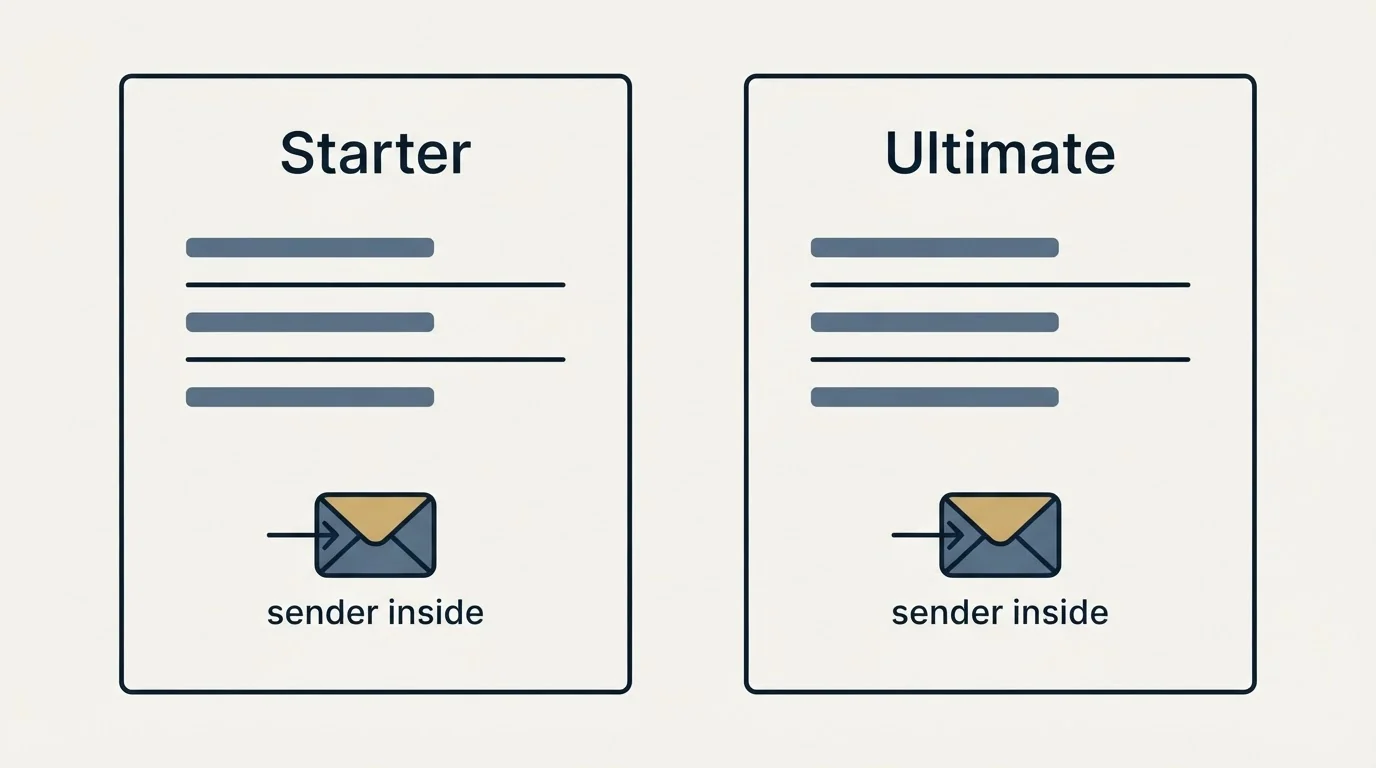
FindThatLead bundles a cold email sender with its finder, and the daily allowances on the cards are the ceiling on that product: 150 a day on the trial, 400 a day on Starter, and unlimited under fair use on Ultimate, from one connected email account on the two lower plans and fifteen on Ultimate. The sequences count works the same way: 10, 20 and unlimited.
Those figures describe what the vendor will let a customer send. They do not describe what a sending domain will tolerate, which is a separate ceiling set by the receiving providers and by the age and reputation of the domains behind the connected accounts, and this site's cold email tool stack guide sets out why the mailbox count rather than the platform allowance decides real volume.
One house note belongs here. The sequences feature exists to send several messages to one prospect over time, and that is a motion this site does not run: one message per campaign, no follow-ups in the thread. The allowance is reported here as a published term of the plan, and its presence on the card is not a recommendation to use it. Whether a data vendor should also be a sending platform is a separate question, and the argument for keeping the two apart is in the same stack guide.
Sizing the two paid plans
The two plans differ on six axes at once, so the cheapest way to choose is to find the one axis that binds for you.
A single operator who needs a few hundred verified addresses a month and sends from one mailbox is inside Starter on every axis: one user, one account, 2,000 email credits, 400 sends a day. A team of three cannot use Starter at all, because the card allows one user, and the jump to Ultimate is the only route the page offers. At the yearly figures that jump is $38 a month; at the monthly figures it is $50. A team that needs more than 2,000 verified emails a month, or more than one connected mailbox, or more than 50 phone numbers a month, hits the same wall.
That makes Ultimate less a premium tier than the first tier that fits any team, and its unlimited entries under fair use are the term to ask about before relying on them. A published unlimited with an unpublished policy behind it is a number the vendor sets after the sale.
- Step 1Count the people
More than one user rules out Starter on its own, before any credit is counted
- Step 2Count the mailboxes
Starter connects one email account, Ultimate fifteen
- Step 3Count the verified emails a month
Starter grants two thousand, Ultimate is unlimited under fair use
- Step 4Count the phone numbers
Fifty a month on Starter, a hundred on Ultimate, pooled annually on yearly billing
- Step 5Read the fair use policy
Every unlimited on Ultimate points at a policy the pricing page does not print
Where this vendor fits
FindThatLead is a finder, a verifier, a phone-number source and a sender in one subscription, sold to sales teams, B2B companies, recruiters and growth marketers by its own footer. The bundle is the pitch and the bundle is the thing to be careful with, because a finder's credit and a sender's daily cap are two different meters that happen to share an invoice.
For the finding half, the useful comparison is on cost per correct address on your own rows, which is a test rather than a table. The verification step belongs first in any sequence, at a fraction of a credit, before a finder is paid for the rows that remain, and this site's waterfall enrichment guide sets out why that order holds regardless of vendor. Whatever a verifier reports, it cannot confirm a specific mailbox on an accept-all domain, and the card's promise of a verified email is a promise about the server's answer rather than about who reads the inbox.
For the competitive set, the generated FindThatLead alternatives page carries the comparison table, and this page does not repeat it.
The short version
FindThatLead publishes a seven-day free trial and two paid plans, Starter at $37 a month billed yearly or $49 monthly, and Ultimate at $75 or $99, with the yearly figure shown by default. Starter is one user, one mailbox, 2,000 email credits a month, 50 phone credits a month or 600 a year, 400 daily sends and 20 sequences. Ultimate is unlimited users, credits, sends and sequences under a fair use policy the page does not print, fifteen mailboxes, and 100 phone credits a month or 1,200 a year. The cards define a credit as a delivered verified email while the FAQ defines it as a search, and the FAQ still names a ten-user Business plan that no card on the page carries. Ask which credit definition governs before sizing a plan on a hard market.
If you would rather see the whole motion running on your own ICP before committing to a bundle, start a free campaign and we will build the list, the copy and the sending infrastructure around it.
Pricing and features verified as of September 2026. Verify current terms with the vendor before relying on them.
Frequently asked questions.
Frequently asked questions- How much does FindThatLead cost?
- As published on its own pricing page on 4 September 2026, Starter is $37 a month billed yearly or $49 billed monthly, and Ultimate is $75 a month billed yearly or $99 billed monthly, with a free seven-day trial at $0. The page opens on the yearly figures with a minus twenty five percent badge, and every checkout button carries a dollar currency attribute.
- What is included in FindThatLead Starter versus Ultimate?
- Starter carries one user, one connected email account, 2,000 email credits a month, 50 mobile phone credits a month or 600 a year on yearly billing, 400 daily sends and 20 sequences with unlimited exports. Ultimate carries unlimited users, unlimited email credits, unlimited sends and sequences under a fair use policy, fifteen email accounts, 100 phone credits a month or 1,200 a year, and onboarding sessions.
- What counts as a FindThatLead credit?
- The pricing page gives two answers. Every plan card states that each email credit is a correct, verified email delivered to you and each phone credit a good, verified phone. The FAQ on the same page states that a credit is a search inside the tool, deducted on every search, with repeated leads in the same month not charged. Ask the vendor which definition governs before sizing a plan on a market with many misses.
- Does FindThatLead include a cold email sender?
- Yes. Each plan card lists a daily sending allowance for the vendor's own sender, 150 a day on the trial, 400 on Starter and unlimited under fair use on Ultimate, plus a count of sequences at 10, 20 and unlimited, from one connected email account on the two lower plans and fifteen on Ultimate. Those figures are the vendor's ceilings and say nothing about what a sending domain will tolerate.
About the author.

B2B cold email experts helping companies generate qualified leads through done-for-you outreach campaigns.
RevenueFlow Team
Explore more.
Ready to scale your outreach?
We build GTM engines that book real meetings. See the receipts.
Related articles.
The Real Cost per 1,000 Emails, Verifications and Data Credits in 2026
Unit prices computed from verified vendor plans: $1.00 per 1,000 emails sent, $2.00 per 1,000 verifications and $19.60 per 1,000 enrichment credits.
Free Tiers and Trials in Sales Tools: What $0 Gets You Across 386 Vendors
37.0% of 386 verified sales tools have a permanent free plan. The median free data tier gives 50 credits and the median free sending plan 2,500 emails a month.
Clearout Pricing: Never-Expiring Credits, Three Ways to Buy
Clearout renders its prices in the browser only. The three purchase routes, the three priced cards, the add-on rate card, and what a credit buys on each product.
SalesQL Pricing: Four Plans, Priced Per Credit
SalesQL publishes four plans on a monthly-first pricing page. Here is the dated ladder, the per-profile credit meter, the seat limits, and what the page leaves out.
PersistIQ Pricing: A Demo Form Where the Ladder Was
PersistIQ's pricing address serves a demo form and no platform price. What the site does publish, the Luka add-on ladder at both billing states, and how to read a quote.
GetProspect Pricing: Three Plans and Two Annual Figures
GetProspect prices Free, Starter and a three-position Growth plan, plus verification credits that never expire. Every figure, and the annual price the page gives twice.