GetProspect Pricing: Three Plans and Two Annual Figures
GetProspect prices Free, Starter and a three-position Growth plan, plus verification credits that never expire. Every figure, and the annual price the page gives twice.
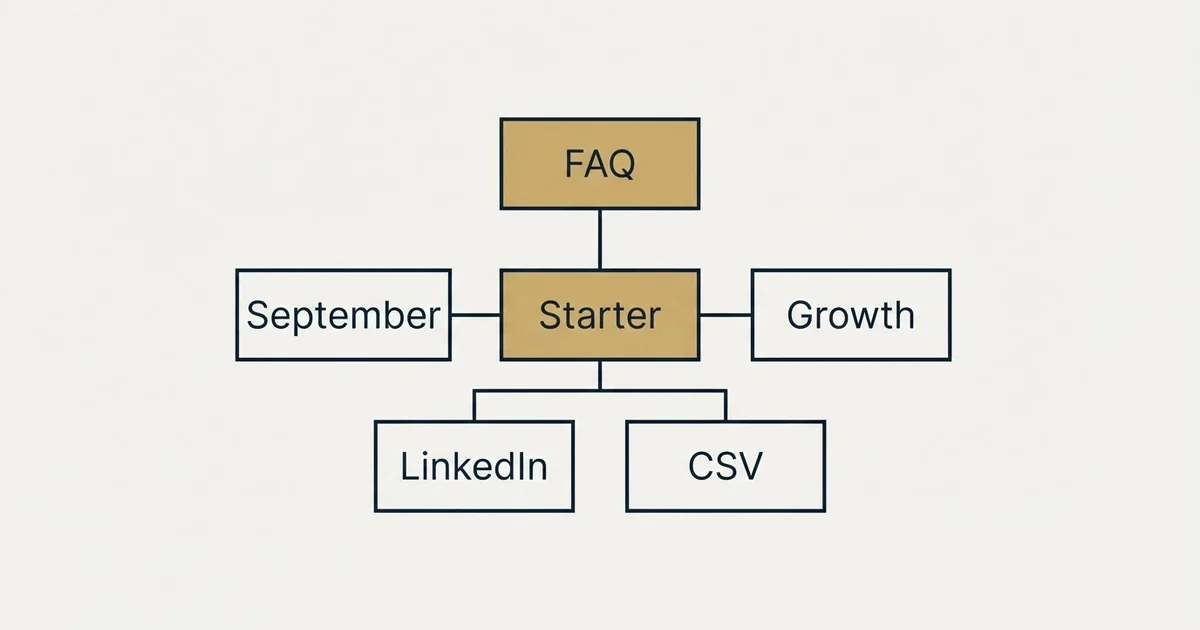
As published on GetProspect's pricing page on 4 September 2026, Free carries 50 valid emails a month, Starter is $49 a month for 1,000 valid emails and 2,000 verifications, and Growth runs $99, $199 or $399 by position. The card prints twelve monthly payments as its annual figure while the toggle promises thirty percent off. Verification blocks start at $29.
Key takeaways
- The Starter card prints $588 annual under $49 monthly, which is twelve payments with no discount, while the toggle label, the FAQ and the help centre all describe a thirty percent annual saving.
- A valid email credit is spent only when a verified address is found, already-found contacts and duplicates are free, and rollover is capped at one monthly allowance rather than unlimited.
- Pay-as-you-go verification credits never expire and run from $29 for 10,000 to $2,499 for 10,000,000, a curve that flattens almost immediately and competes with standalone bulk verifiers.
- The pricing page met a bot challenge on one fetch and served fully on another an hour later, so a blank read is a reason to retry rather than a fact about the vendor.
Reviewed and updated September 4, 2026
GetProspect's pricing page opens on monthly billing, prints an annual figure under each monthly one, and labels its annual switch as a thirty percent saving. Read the two figures on the Starter card together and they do not agree: $49 a month sits above $588 annual, and $588 is twelve times $49 with no discount in it. The FAQ on the same page says a thousand valid emails costs $49 a month or $34 with an annual plan, which is the thirty percent. So the page carries two different annual prices for the same plan on the same day, and a buyer has to know which one the checkout will honour.
That is the most important thing on the page and the reason this article exists. The rest of the page is unusually clear: three priced plans plus a free one, a dropdown on the top tier, a pay-as-you-go verification menu, and a set of terms that mostly favour the buyer. Every figure is as published on GetProspect's pricing page and its help centre on 4 September 2026, read from the pages' own bytes.
The plans as the page prints them
The monthly toggle is the active one in the served markup, so the monthly figures below are what a visitor sees first.
| Plan | Monthly price | Annual figure printed on the card | Valid emails a month | Verifications a month | Phone numbers |
|---|---|---|---|---|---|
| Free | $0 | none | 50 | 100 | none listed |
| Starter | $49 | $588 annual | 1,000 | 2,000 | 5 |
| Growth 5k | $99 | $1,188 annual | 5,000 | 10,000 | 5 |
| Growth 20k | $199 | not printed | not printed on the card | not printed | not printed |
| Growth 50k | $399 | not printed | not printed on the card | not printed | not printed |
The Growth card carries a dropdown with three positions, 5k at $99, 20k at $199 and 50k at $399 a month, and the card body shows the allowances for whichever position is selected. The served page has the 5k position selected, so the 5,000 valid emails and 10,000 verifications above are that position's figures and the two larger positions' allowances are not in the served text. The plan names suggest 20,000 and 50,000 valid emails; this page does not assert it. A fifth route, for higher volume or custom terms, is a talk-to-sales button, and the FAQ adds that the Growth 50k plan can be stacked up to ten times for a higher ceiling.
Every plan includes the same feature list as the page prints it: credit rollover, verified business emails only, a proprietary catch-all verification, no charge for duplicates, a LinkedIn extension, a bulk finder, CSV enrichment, filters, native CRM integrations naming HubSpot, Salesforce and Pipedrive, reverse email lookup, CSV and XLSX export, a Google Sheets integration, API access, team accounts and custom properties.
The two annual prices
The card figures first. Starter prints $588 annual beneath $49 monthly, and Growth 5k prints $1,188 annual beneath $99 monthly. Both are exactly twelve times the monthly rate.
The toggle's label reads Save 30% on annual subscription. The FAQ answers the cost of a thousand addresses as $49 a month or $34 with an annual plan, and $34 is $49 less the thirty percent the toggle states, rounded down. The vendor's help centre article on monthly and yearly plans, last updated 5 December 2024, states that yearly plans have a twelve-month commitment charged once, come with a thirty percent discount, and grant credits equal to the monthly allowance multiplied by twelve, available for the whole subscription period.
So three vendor surfaces, the toggle label, the FAQ and the help centre, describe an annual plan at 0.7 of twelve monthly payments, and the card's annual figure describes one at the full twelve. On the served page the annual figure sits in a container the script rewrites when the toggle moves, so the most likely reading is that the visible $588 is the un-discounted twelve-month total shown in the monthly state and the discounted figure appears once the toggle is flipped. That is a reading of the markup rather than a fact the page states, and this page does not resolve it. What can be stated is the pair: an annual Starter plan is either $588 or about $408, and a buyer should read the figure the toggle shows before paying.
- Printed beneath the monthly price in the served page
- Equals twelve monthly payments
- Sits in a container the toggle rewrites
- The toggle promises the saving on annual
- The FAQ prices a thousand emails at the discounted monthly rate
- The help centre states the discount and the twelve-month commitment
What a credit buys
GetProspect meters two things on every plan, valid emails and verifications, and it publishes the rules that decide when each is spent.
A valid email is deducted only when a verified, deliverable address is found; the FAQ states that you are not charged for the not-found emails. A verification is spent on an address you already hold, whether from an old record or another source. Requests for a contact already found are free. Unused credits roll over, and the feature list qualifies the rollover as up to one monthly allowance, so the balance can carry at most a second month forward rather than accumulate without limit. That is a tighter rollover than several vendors in this category publish, and a team with lumpy volume should size to a typical month rather than a quiet one.
The phone number allowance is five on each paid plan, and a separate add-on slider sells phone credits by the month. In the served state the slider sits at five credits a month for $0, which is the included allowance, and the page does not print the rate for positions above it.
The pay-as-you-go verification menu
Below the plans the page sells verification credits outright, with no monthly payment, no upfront fee and no expiry. That menu is the one part of the page with a full ladder in visible text.
| Verifications | One-time price |
|---|---|
| 10,000 | $29 |
| 25,000 | $39 |
| 50,000 | $69 |
| 100,000 | $119 |
| 500,000 | $249 |
| 1,000,000 | $369 |
| 5,000,000 | $1,419 |
| 10,000,000 | $2,499 |
On the published figures that runs from just under three tenths of a cent a verification at the smallest block to a quarter of a cent at the largest, which is division on the page's numbers rather than a rate the page prints. Two things stand out. The curve flattens almost immediately: 500,000 verifications cost less than nine times the 10,000 block for fifty times the volume. And the credits never expire, which puts this menu in the same class as the standalone bulk verifiers this site compares in its email verification tools guide, where the cheapest published rates sit in the same fraction-of-a-cent band.
- Step 1Find
A valid email credit is spent only when a verified deliverable address comes back
- Step 2Verify what you already hold
A verification credit is spent per address checked, from the plan allowance or a one-time block
- Step 3Repeat for free
A contact already found is not charged again, and duplicates are free
- Step 4Carry forward, once
Unused credits roll over up to one monthly allowance
The sender on the free plan
GetProspect includes a cold email product and prices sending in its FAQ rather than on the cards. A single email can be sent on the Free plan, one sequence can be created for a contact list on it, 200 emails can be sent at once on Free, Starter and Growth, and the FAQ recommends staying under a hundred a day from a single domain to protect its reputation. The cost of sending 10,000 emails is answered as starting at $99, which is the Growth 5k plan.
Those are the vendor's allowances and the vendor's advice. The sequence feature exists to send several messages to one prospect over time, which is a motion this site does not run: one message per campaign, no thread follow-ups, and a fresh campaign for anyone who did not answer. The allowance is reported here as a term of the plan rather than a recommendation, and this site's cold email tool stack guide covers why the domain and mailbox count, rather than a platform's daily cap, decides how much can actually be sent.
Terms worth reading before paying

The FAQ publishes the subscription mechanics in plain language. Plans can be upgraded, downgraded or reset at any time, the change applies immediately and a new monthly billing cycle starts. Subscriptions renew automatically and can be cancelled or paused at any time, with access to credits and collected data until the end of the paid cycle. The help centre adds that monthly plans renew thirty days from purchase to the minute, and that yearly plans renew automatically at the end of the year unless cancelled.
- Yes: A valid email credit is charged only on a found, verified address
- Yes: Already-found contacts and duplicates are free
- Yes: Unused credits roll over, up to one monthly allowance
- Yes: Pay-as-you-go verification credits never expire
- Yes: Plans change immediately and can be paused or cancelled at any time
- No: The card's annual figure matches the saving the toggle promises
A note on reaching the page
An earlier read of this pricing page on the same afternoon met a bot challenge, and this article's plain fetch an hour later was served the full page with every figure in its bytes. The block is intermittent rather than fixed, which is worth knowing for anyone re-verifying these figures: a challenge page reads like a vendor publishing nothing, and a second attempt a little later is the cheapest remedy.
Where this vendor fits

GetProspect's finder charges only on a found address and its verifier is sold separately at rates that compete with standalone bulk verifiers, which is the billing shape that rewards running verification first and paying a finder only for the rows that remain. That order, and the reason it holds across vendors, is in this site's waterfall enrichment guide. The vendor's catch-all verification is listed as a proprietary feature on every plan; whatever any verifier reports, it cannot confirm a specific mailbox on an accept-all domain, so treat that line as the vendor's claim about a hard problem and score it on your own rows. The protocol for that test is in this site's guide to email finder tools.
For the competitive set, the generated GetProspect alternatives page carries the comparison table, and this page does not repeat it.
The short version
GetProspect publishes a free plan with 50 valid emails and 100 verifications a month, Starter at $49 a month for 1,000 valid emails, 2,000 verifications and 5 phone numbers, and a Growth card with three positions at $99, $199 and $399 a month, the first of which carries 5,000 valid emails and 10,000 verifications. The card prints $588 and $1,188 as annual figures, twelve times the monthly rates, while the toggle, the FAQ and the help centre each state a thirty percent annual discount, so read the toggle before paying annually. Found emails are charged only on success, duplicates are free, credits roll over up to one monthly allowance, and a pay-as-you-go verification menu runs from $29 for 10,000 to $2,499 for 10,000,000 with no expiry.
If you would rather see the whole motion running on your own ICP before committing to a data vendor, start a free campaign and we will build the list, the copy and the sending infrastructure around it.
Pricing and features verified as of September 2026. Verify current terms with the vendor before relying on them.
Frequently asked questions.
Frequently asked questions- How much does GetProspect cost per month?
- As published on its own pricing page on 4 September 2026, with monthly billing active, Free is $0 for 50 valid emails and 100 verifications, Starter is $49 for 1,000 valid emails, 2,000 verifications and 5 phone numbers, and the Growth card offers 5k at $99, 20k at $199 and 50k at $399 a month, with the 5k position carrying 5,000 valid emails and 10,000 verifications.
- What does GetProspect annual billing cost?
- The page gives two answers. The Starter card prints $588 annual beneath its $49 monthly price and the Growth 5k card $1,188, both twelve times the monthly rate. The toggle is labelled as a thirty percent saving, the FAQ prices a thousand emails at $34 a month on an annual plan, and the help centre states a thirty percent discount with a twelve-month commitment. Read the figure the toggle shows before paying.
- Do GetProspect credits roll over or expire?
- Plan credits roll over, and the feature list qualifies that as up to one monthly allowance, so a balance can carry forward one extra month rather than accumulate indefinitely. Pay-as-you-go verification credits, sold in blocks from 10,000 for $29 to 10,000,000 for $2,499, carry no monthly payment and no upfront fee, and the page states they never expire.
- Does GetProspect charge for emails it cannot find?
- No. The FAQ states that the valid emails figure is the number of verified valid emails you can find and that you are not charged for the not-found emails. The feature list adds that every result is checked for deliverability before a credit is deducted, that requests for contacts already found are free, and that duplicates carry no charge, so the meter is spent only on new, deliverable addresses.
About the author.

B2B cold email experts helping companies generate qualified leads through done-for-you outreach campaigns.
RevenueFlow Team
Explore more.
Ready to scale your outreach?
We build GTM engines that book real meetings. See the receipts.
Related articles.
Clearout Pricing: Never-Expiring Credits, Three Ways to Buy
Clearout renders its prices in the browser only. The three purchase routes, the three priced cards, the add-on rate card, and what a credit buys on each product.
Icypeas Pricing: Four Tiers, Plus VAT, No Credit Expiry
Icypeas prices four finder tiers plus VAT, a credit menu on the top tier, and credits that never expire. Every figure at both billing states, and the per-action table.
Seamless.AI Email Finder: How It Works, What a Credit Buys
How Seamless.AI's email finder resolves a contact in real time, what one Universal Credit buys, the Total AI score on every address, and what the Chrome extension reads.
SalesQL Pricing: Four Plans, Priced Per Credit
SalesQL publishes four plans on a monthly-first pricing page. Here is the dated ladder, the per-profile credit meter, the seat limits, and what the page leaves out.
Zeliq Pricing: One Seat Rate and a Credit Meter
Zeliq prices one self-serve seat in dollars with a credit meter that never expires. Both billing states, the three credit rates, the top-up ladder and the Custom floor.
PersistIQ Pricing: A Demo Form Where the Ladder Was
PersistIQ's pricing address serves a demo form and no platform price. What the site does publish, the Luka add-on ladder at both billing states, and how to read a quote.