LinkedIn Lead Generation for EdTech Companies: Who Is There
How an edtech company should use LinkedIn: which school and campus buyers can be reached, why shared connections matter, event timing, and LinkedIn's own rules.
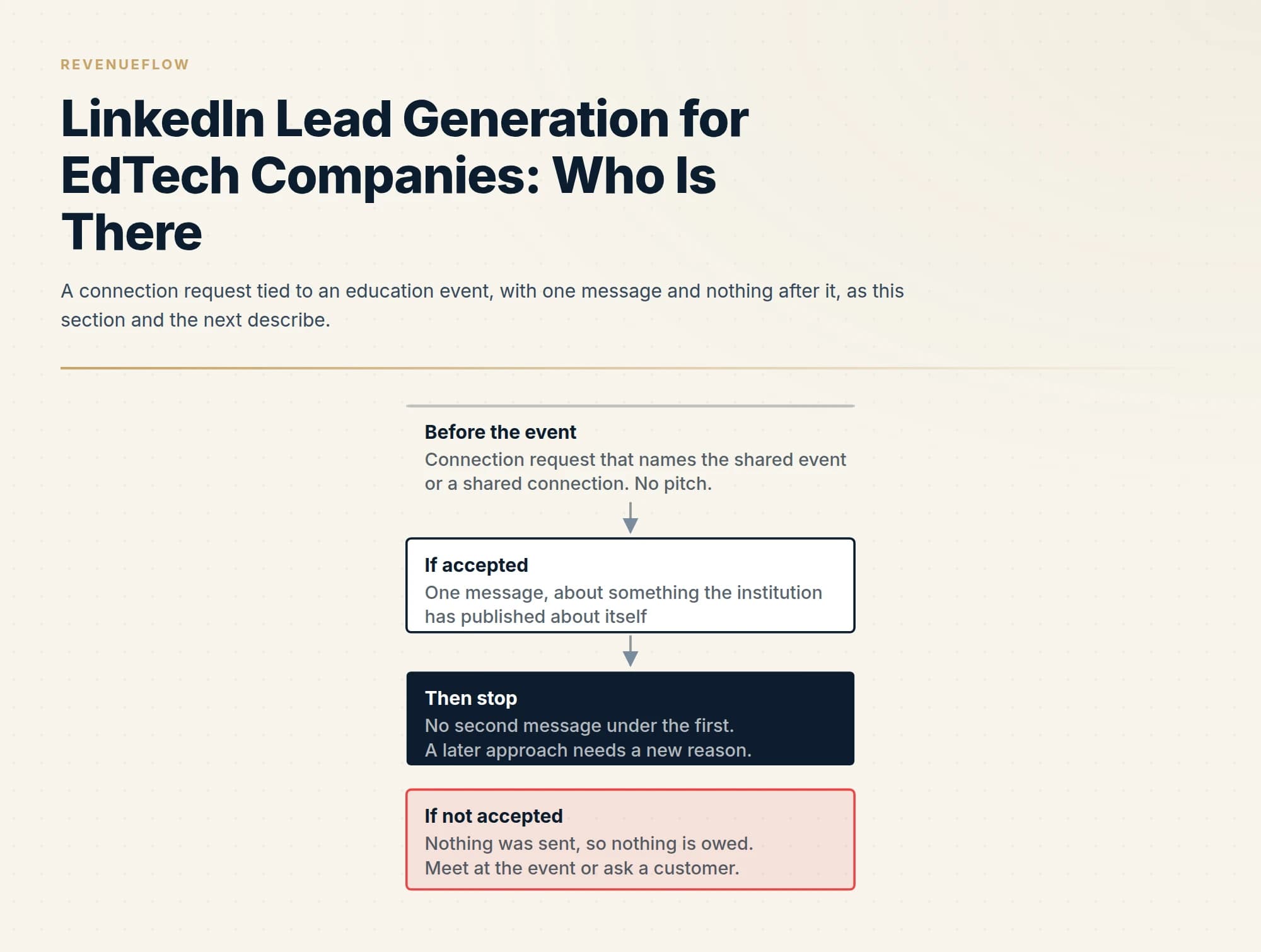
On LinkedIn, edtech companies reach school buyers through circles, not volume. Superintendents told NewSchools that vendors outside their circle struggle to break through and that recommendations from other administrators work. Connect around association events such as AASA's conference on February 25 to 27, 2027, send one message after acceptance, and follow LinkedIn's ban on automated messaging.
Key takeaways
- Superintendents convened by NewSchools Venture Fund in 2020 said a vendor outside their circle will find it hard to break through, and that they were amenable to recommendations from other administrators or educators.
- LinkedIn's User Agreement, effective November 3, 2025, bars bots or other unauthorized automated methods to add or download contacts or send or redirect messages.
- AASA lists its National Conference on Education for February 25-27, 2027 in Atlanta, a published date that gives a connection request to a superintendent a reason.
- A 2019 NewSchools and Gallup survey found more than 80% of educators trust teachers most when choosing digital learning tools, which makes teachers voices and users, not buyers.
Reviewed and updated September 18, 2026
When a group of current and former superintendents told edtech companies how to work with them, the advice they gave was about people, not platforms. NewSchools Venture Fund, which convened them, summarised it on June 30, 2020: superintendents "were amenable to recommendations from other administrators or educators", and "if a vendor isn't already in their circle, it will be hard to break through." (NewSchools Venture Fund, read 18 September 2026.) LinkedIn is a map of circles. For an edtech company that is both its use and its limit.
This guide is for an edtech company using LinkedIn to start conversations with the people who buy for schools, districts, colleges and universities. It is written for the vendor's own team. If you sell to edtech companies, cold email for edtech companies is the page for that reader. The platform's rules on automation and the question of what is safe to outsource are covered in our guide to LinkedIn lead generation services, and the method of choosing a route to a stranger is in LinkedIn prospecting. Neither is repeated. What follows is what education changes: which buyers can be sourced as present, where a connection request has a reason behind it, what the first message looks like for an educator, the rule LinkedIn itself sets, what a LinkedIn conversation cannot do in a public institution, and when the platform is the wrong play.
Which buyers are there, and what can be sourced
The honest starting point is that nobody outside LinkedIn can publish a count of superintendents who read their messages. What can be sourced is who the buying roles are, what those people say about being approached, and where their own communities gather. That is enough to decide who is worth a connection request.
| Role | What the source says | What it means on LinkedIn |
|---|---|---|
| Superintendent | NewSchools: hard to break through from outside the circle; open to recommendations from other administrators | Shared connections first |
| K-12 CTO | CoSN: the professional association for school system technology leaders | Reachable around CoSN events |
| Higher ed IT leader | Inside Higher Ed: deletes unknown senders; wants vendors in the community conversation | Be known before you write |
| District purchasing | Lead generation in education guide: issues the order, follows the process | A message does not replace the process |
| Teacher | NewSchools and Gallup: educators trust teachers most on digital tools | A user and a voice, not a buyer |
Superintendents. AASA, The School Superintendents Association, describes itself as "A professional community of more than 10,000 educational leaders" (AASA, read 18 September 2026). The NewSchools summary says these leaders were "currently receiving a deluge of outreach from ed tech companies", written in the first months of the pandemic. The durable part is the mechanism: a recommendation from another administrator opens the door. On LinkedIn that is a shared connection, so the search that matters is for superintendents who are connected to your existing customers.
District technology leaders. The Consortium for School Networking calls itself "the premier professional association for school system technology leaders" and certifies the role through its "Framework of Essential Skills of the K-12 CTO" (CoSN, read 18 September 2026). CoSN also runs a Certified Education Technology Leader (CETL) certification built on that framework. Together they give you the words to search for: the K-12 CTO title and the CETL credential.
Higher education IT leaders. Joshua Kim's Inside Higher Ed column from April 11, 2017 is the clearest statement of this buyer's rules. On cold email: "If I don't know the sender of the e-mail, then I will delete it without reading it." On where to show up instead, he tells companies to join the conversation "taking place online through Twitter and blogs and higher ed news sites" and "at conferences, events and symposiums" (Inside Higher Ed, read 18 September 2026). He does not name LinkedIn, and the column is from 2017, so check where the people on your own list are active now. The principle carries across any network: become a known name in the community first, and write second.
Teachers and faculty. The same NewSchools post cites a 2019 NewSchools and Gallup survey in which more than 80% of educators said they trust teachers most when deciding which digital learning tools to use. Teachers almost never hold a budget. They matter as users and as the recommendation a superintendent trusts. Asking a teacher to buy is the wrong ask; asking what they would want an administrator to know is a fair one.
The committee behind an education purchase, and the way a champion, the gatekeepers and the signer differ, is set out in our guide to lead generation in education, so it is not rebuilt here.
Where a connection request has a reason
A connection request from a stranger with no context is the LinkedIn version of the unknown sender Kim deletes. The education calendar supplies context, because the vertical's associations gather their members on published dates, and a shared event is a reason two people might know each other.
As read on 18 September 2026, AASA lists its National Conference on Education for "2027 February 25-27 Atlanta, GA", and describes it as "the premier professional development and networking event for school superintendents" and other administrators (AASA National Conference on Education). ISTE's conference page still carried the 2026 edition, "ISTELive 26 | June 28 - July 1 | Orlando", alongside a call to present at ISTELive 2027 (ISTELive). CoSN's site lists CoSN2027 among its conferences (CoSN), and ASU+GSV's site is headed "ASU+GSV Summit 2027" (ASU+GSV Summit); neither page gave us dates we could read, so check the organisers.
The sequence that respects both the buyer and the platform is short.
The stop is house doctrine, and the LinkedIn services guide explains why it is stricter on this platform than on email: a second message lands in the same thread under the one the person chose not to answer, so we send one message per campaign and do not retarget people who did not reply. In education that restraint costs little, because the calendar keeps producing new reasons: a budget adopted, a new director, the next conference.
What the request and the first message look like
An invented example follows. The person, district and product are placeholders, and no result is claimed.
Connection request, sent three weeks before the conference
We both know {{customer_name}} at {{neighbouring_district}}, who suggested a hello before the conference. 1
First message, only after the request is accepted
Your board's technology plan lists {{initiative}} for next year. 2
{{neighbouring_district}} ran the same initiative with us as a one-semester pilot, privacy review first. 3
Would it help to see their review packet before your budget build starts? 4
- 1The recommendation from another administrator is the route the superintendents named. It has to be true.
- 2Opens on something the institution published about itself.
- 3A comparable district and a bounded pilot, with the privacy review offered up front.
- 4The ask is a document, timed to the budget calendar, not a meeting.
Three reasons to write, each resting on a source in this article. To a superintendent: a recommendation from a named administrator who is a customer, which is the route the NewSchools group described. To a district technology leader: the shared event, since CoSN and AASA publish where and when their members gather. To a higher education IT leader: a reply to something they wrote or said in public, which is the community conversation Kim asked vendors to join. None of those is a results claim, and none works if the underlying fact is invented.
The rule LinkedIn sets
The regulation that touches this play is the platform's own contract. LinkedIn's User Agreement, in the version effective November 3, 2025, lists among the things members agree not to do: "Use bots or other unauthorized automated methods to access the Services, add or download contacts, send or redirect messages, create, comment on, like, share, or re-share posts, or otherwise drive inauthentic engagement" (LinkedIn User Agreement, read 18 September 2026). Its help page on prohibited software adds that "we don't permit the use of any third party software", and goes on to name crawlers, bots, browser plug-ins and "browser extensions that scrape, modify the appearance of, or automate activity" on the site (LinkedIn Help, read 18 September 2026).
What that means for a sender, and which parts of a programme can be handed to someone else without exposing an account, is the subject of the services guide linked above. The education-specific point is about scale. The population of district technology leaders and superintendents is small and fixed, and the people in it talk to each other, so there is no volume to be gained that would justify an automated approach even if the contract allowed one.
What a LinkedIn conversation cannot do
A superintendent who replies warmly has not bought anything, and in a public institution cannot. Purchases above a district's threshold go through the business office, a privacy review and often a board vote, and some run through a cooperative contract the district does not control. Our lead generation in education guide covers that road, including why the entity that signs may not be the one that uses the product. The practical rule for LinkedIn is to treat a good conversation as permission to start that process with the right office, and to ask in the conversation who that is.
When LinkedIn is the wrong play
It is the wrong play for reaching teachers as buyers, since they are users. It is the wrong play as a volume channel, for the reasons above. It is the wrong play for anyone whose own published words say they ignore unknown senders, unless you have a connection or a public exchange to stand on. And it is the wrong play as a way around procurement.
It fits a vendor with real customers whose administrators will lend their name, a short list of districts or campuses chosen for a published reason, and the patience to send one message. RevenueFlow builds that list and that message by email and LinkedIn, one message per campaign; if you would like it built for you, see what a first campaign looks like.
The short version
Superintendents told NewSchools that vendors outside their circle struggle to break through and that recommendations from other administrators work, which makes LinkedIn useful mainly for finding shared connections. District technology leaders are organised through CoSN and superintendents through AASA, whose 2027 conference is February 25 to 27 in Atlanta, so events give a connection request a reason. Send one message after acceptance and nothing beneath it. LinkedIn's User Agreement bars bots and unauthorized automated methods for adding contacts or sending messages. Teachers are users and trusted voices, not buyers, and no LinkedIn conversation replaces a district's purchasing process.
NewSchools, Inside Higher Ed, association, event and LinkedIn pages quoted above were read on 18 September 2026. Policies and dates change. Confirm them on the source's own page before relying on them.
Frequently asked questions.
Frequently asked questions- Are superintendents and district technology leaders on LinkedIn?
- Nobody outside LinkedIn can publish a reliable count, so work from what can be sourced. Superintendents are organised through AASA and district technology leaders through CoSN, which certifies the K-12 CTO role. Superintendents told NewSchools that recommendations from other administrators open doors, so the useful LinkedIn search is for leaders connected to your existing customers.
- What should an edtech company send on LinkedIn?
- A connection request that names a real shared connection or a shared event, with no pitch. If it is accepted, one message about something the institution has published about itself, offering a document such as a comparable district's privacy review packet. Nothing is sent beneath that message, because a second one lands in the same thread under the first.
- Does LinkedIn allow automated outreach tools?
- LinkedIn's User Agreement, effective November 3, 2025, lists using bots or other unauthorized automated methods to add or download contacts or send or redirect messages among the things members agree not to do. Its help page says it does not permit third party software that scrapes or automates activity on the site. The education buyer population is also too small to justify volume.
- When is LinkedIn the wrong channel for selling to schools?
- When the target is a teacher being asked to buy, since teachers are users. When the plan depends on volume. When the buyer has said publicly that unknown senders are ignored and you have no connection or public exchange to stand on. And whenever it is used to get around a district's purchasing process, which a message cannot replace.
About the author.

B2B cold email experts helping companies generate qualified leads through done-for-you outreach campaigns.
RevenueFlow Team
Explore more.
Ready to scale your outreach?
We build GTM engines that book real meetings. See the receipts.
Related articles.
Cold Calling for EdTech Companies: Who Answers at a School
What changes when an edtech company cold calls a school: who picks up, the fiscal and testing calendars, district vendor contact rules, and when not to dial.
B2B Lead Lists for Collection Agencies: Fields and Sources
What a creditor prospect list needs for a collection agency: the fields that matter, the FDIC, NCUA, CMS and court sources behind them, and the rules that apply.
Outbound Sales for Food and Beverage Companies: Who to Reach
Outbound sales for food and beverage brands: the four buyers behind a yes, the public show calendar, what a message may claim, and when outbound is the wrong play.
Outbound Sales for Higher Education Vendors: Which Door to Use
Outbound for higher education vendors, built on universities' own purchasing policies: three doors, the ask that fits each one, and a dated accessibility review.
Cold Calling for Legal Tech Companies: Who Answers at a Firm
What changes when a legal tech company cold calls a law firm: which desks answer, why the billable hour hurts the pitch, the 2027 show dates, and what not to ask.
Sales Prospecting for Cloud Services: Dated Triggers
How a cloud services company builds a prospect list: co-sell with platform sellers, partner-to-partner routes, and the end-of-support dates Microsoft publishes.