LinkedIn Sponsored InMail (Message Ads): How It Works
Sponsored InMail is now Sponsored Messaging. How the ad product is priced, who it can reach, the tighter creative limits, and when organic InMail beats it.
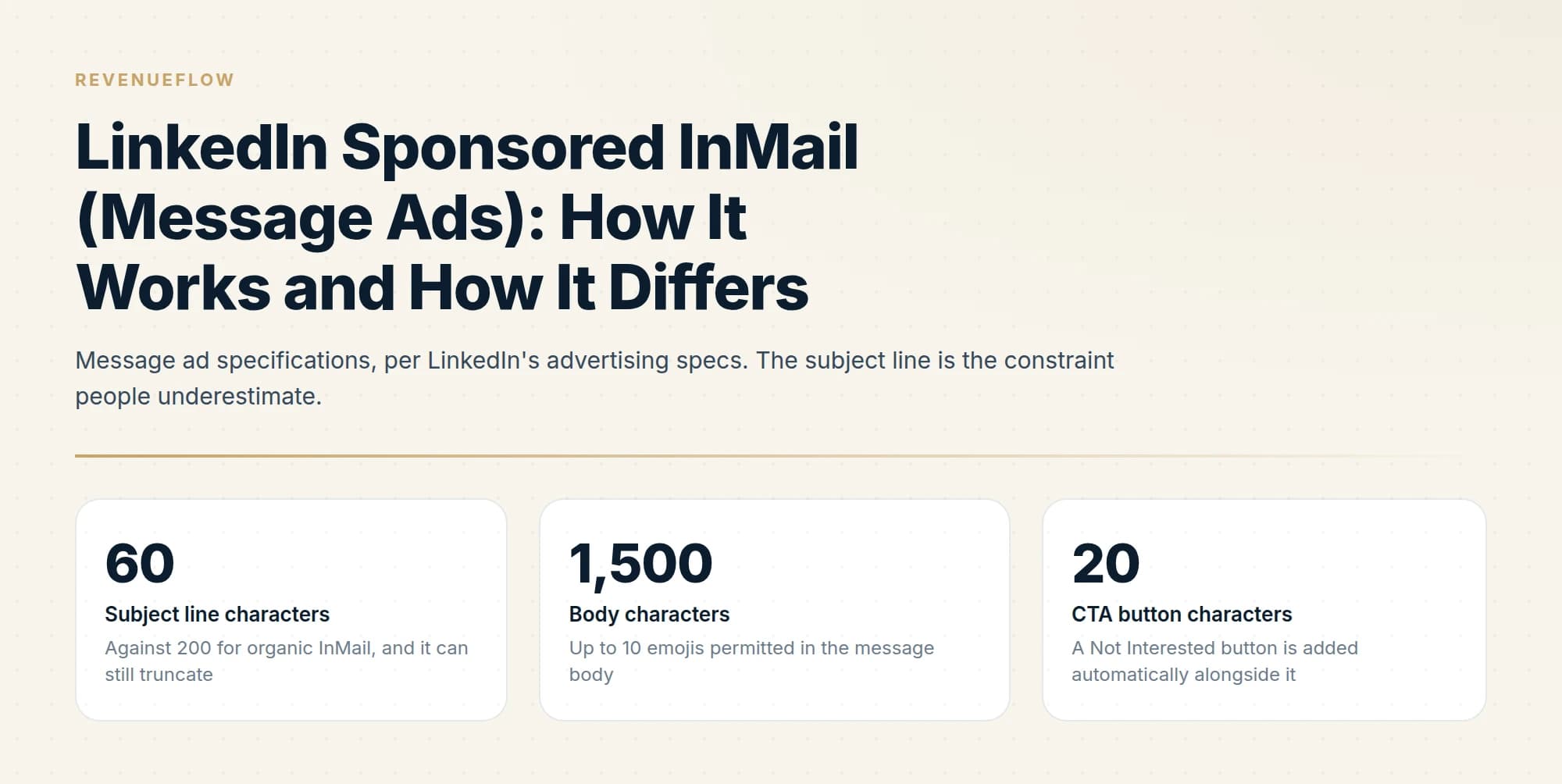
Sponsored InMail is now called Sponsored Messaging, covering message ads and conversation ads bought in Campaign Manager. It is charged per message delivered at auction rates, uses no InMail credits, offers no refunds, caps subjects at 60 characters, and requires opt-in for EEA and Switzerland members.
Key takeaways
- Sponsored Messaging is charged on a cost-per-send basis at auction rates, so you pay for delivery whether or not the message is opened.
- Message ads cap the subject line at 60 characters and the body at 1,500, against 200 and 1,900 for organic InMail.
- A Not Interested button is added automatically beside your call to action, letting recipients delete or archive the ad in one click.
- Only EEA and Switzerland members who opted in to Sponsored Messaging can receive these ads, which changes reach forecasts for European audiences.
Reviewed and updated September 1, 2026
Sponsored InMail is the old name. LinkedIn now calls the product Sponsored Messaging, and it splits into message ads and conversation ads, both of which land in the LinkedIn inbox and neither of which has anything to do with your InMail credits.
That distinction matters more than the naming does. Organic InMail is a seat feature with a fixed monthly allowance and a refund when someone replies. Sponsored Messaging is advertising: bought through Campaign Manager, priced by auction, charged per message delivered, and subject to a set of rules about who can receive it that do not apply to organic sending at all.
People looking for LinkedIn message ads examples usually want a structure rather than a gallery: a 60-character subject, one clear ask, macros carrying detail rather than sentence structure, and a call to action that still reads well beside the Not Interested button LinkedIn adds automatically. LinkedIn own Create successful Message Ads help page is the primary source for its format guidance.
How the two products differ
- Paid for with credits from a monthly allowance
- Credit refunded if they respond within 90 days
- 200-character subject, 1,900-character body
- Sent from a person, to a named individual you chose
- Sent to anyone who has not opted out of InMail
- Paid for in advertising spend, charged per send
- No refund mechanism of any kind
- 60-character subject, 1,500-character body
- Sent from a sender profile, to a targeted audience
- EEA and Switzerland members must have opted in
What it costs
LinkedIn charges Sponsored Messaging on a cost-per-send basis. You pay when the message is delivered to the member's inbox, not when it is opened or clicked.
The rate is set at auction. LinkedIn ads are sold through an auction where your bid competes with other advertisers targeting the same audience, and what it takes to win depends on your bid and on how sought-after your target audience is. A senior technical audience in a competitive category costs more per send than a broad one, and no published rate card would survive that.
Third-party blogs quote per-send figures with great confidence. LinkedIn does not publish one, so treat those numbers as someone else's account data rather than as pricing. Campaign Manager will forecast your own costs against your own audience during setup, and LinkedIn's advertising pricing page is the authoritative description of how the auction works.
Automating that Campaign Manager forecasting or reporting instead of doing it by hand means confronting LinkedIn's tiered API access model, where most marketing endpoints sit behind separate approval.
The structural point about cost-per-send pricing is worth sitting with: you are charged for delivery, so a poorly targeted campaign pays in full for every message nobody wanted. Organic InMail refunds the credit when someone responds. This does the opposite, which flips the economics away from the precision advantage that makes organic InMail worth running.
The rules that decide whether it works for you

European audiences must have opted in. LinkedIn supports European Economic Area and Switzerland targeting for Sponsored Messaging, and only members who opted in to receive Sponsored Messaging in their LinkedIn inbox can be reached. If your ICP is substantially European, your addressable audience is the opted-in subset rather than the market, which materially changes the reach forecast.
Frequency is capped by LinkedIn, not by you. LinkedIn strictly controls how often a member can receive Sponsored Messaging in a given period, deliberately, to protect the inbox experience. The practical effect is that you cannot buy your way to repetition. It also means delivery pacing is partly outside your control.
Language targeting behaves differently here. Targeting English in a Sponsored Messaging ad set reaches only members whose profile language is set to English. In Sponsored Content, targeting English includes everyone regardless of profile language. Copy the targeting from a working content campaign and your reach quietly collapses.
The creative constraints are tighter than organic
The specifications are considerably more restrictive than the InMail composer, and the differences change what you can say.
Against 200 for organic InMail, and it can still truncate
Up to 10 emojis permitted in the message body
A Not Interested button is added automatically alongside it
That mandatory "Not Interested" button is the detail worth planning around. LinkedIn requires it, adds it automatically next to whatever call to action you choose, and clicking it lets the member delete or archive the ad. It also causes LinkedIn to minimise how often that member sees ads from the same ad set. Every recipient is handed a one-click exit before they finish reading, which is fair to the member and unforgiving of a weak opening line.
Beyond the counts, the format gives you more building blocks than an InMail does. You choose a sender from the available sender profiles rather than sending as yourself. You can include up to three clickable links, with hyperlinked text of up to 70 characters. There is a custom footer field running to 20,000 characters for legal terms, promotion rules and contact details. And an optional banner creative at 300 by 250 pixels can sit alongside the message, though it renders on desktop only, so it can never be load-bearing.
Conversation ads work differently, offering multiple call-to-action buttons and branching paths, with a flowchart view in Campaign Manager showing how many clicks each branch received. They suit multi-option offers. Message ads suit a single clear ask.
The two formats also support different campaign objectives, which is worth checking before you commit to one. Message ads run against website visits, lead generation and website conversions. Conversation ads support those three plus brand awareness and engagement. If lead generation is the objective, you attach a Lead Gen Form to the ad set, which keeps the response inside LinkedIn rather than sending the member to a landing page.
Personalisation, and how it fails
Message ads support macros that pull the recipient's first name, last name, company name, job title or industry into the copy. That is the closest the format gets to the specificity a good InMail has, and the failure mode is documented rather than hypothetical.
If a member has turned off ad personalisation in their privacy settings, or simply has no active job position listed on their profile, the macro does not resolve. LinkedIn substitutes generic language instead: a first or last name macro becomes "LinkedIn Member", a company macro becomes "your company", a job title becomes "professional", and industry becomes "industry".
Write copy that reads acceptably in both states. A sentence built around a company name renders as "we work with teams at your company", which is survivable. A sentence built around a first name renders as "Hi LinkedIn Member", which is not. The safe pattern is to let macros carry detail rather than structure, so that a failed substitution costs you specificity rather than credibility.
The auto-archive rule
One behaviour genuinely surprises advertisers, and it changes how you should read your own reporting.
Sponsored Messaging ads are automatically moved into the recipient's Archived Messages folder when a new message is served to that member. The ad stays accessible, and it stops occupying the main inbox. Combined with the frequency cap and the one-click Not Interested button, the practical lifespan of a message ad in the place people actually look is short.
That is the platform holding the line on inbox quality, and it means a message ad has to earn its response quickly rather than sitting in view accumulating opens over a week the way an email can.
Does it beat organic InMail?

They solve different problems, and the honest comparison depends on what you are optimising.
Sponsored Messaging scales. It reaches an audience defined by targeting criteria rather than a list of named individuals, it does not consume seat credits, and it does not require anyone to research each recipient. If you need to put an offer in front of ten thousand marketing managers, organic InMail at 50 credits a month per seat is not a mechanism that can do that.
LinkedIn Email Scraper explains why a cold prospect renders no visible address and how these tools mostly guess a company pattern instead of reading LinkedIn directly.
Organic InMail is precise and self-correcting. It comes from a named human, it can reference something specific about the recipient's company, and the credit comes back when it lands. For a defined list of accounts that genuinely matter, it converts on a different level than an ad does, because it is not an ad.
- Yes: You need reach across a broad audience you cannot enumerate
- Yes: You have budget and no seats or research capacity
- Yes: The offer is self-explanatory in 60 characters of subject line
- No: You have a named target list where each account matters
- No: Your message depends on referencing the recipient's specific situation
- Depends: Your ICP is concentrated in the EEA or Switzerland
The EEA line is a maybe rather than a no because the opt-in requirement does not block the channel. It shrinks the reachable pool to opted-in members, so the forecast is the thing to check before committing budget.
Where it sits in an outbound programme
Sponsored Messaging is a demand-generation channel that happens to use the inbox. It behaves like advertising, is measured like advertising, and belongs in an advertising budget alongside your other paid channels.
It is not a substitute for a targeted outbound motion, and the same one-shot logic applies to anything landing in a LinkedIn inbox: the frequency cap means the message you send is effectively the message you get, so it has to work first time. For the targeted side of the channel, what InMail is and how it differs from a connection request covers the fundamentals, how to send one that gets answered covers execution, and what an InMail costs per reply covers the arithmetic that makes organic worth doing well.
If the reason you are considering ads is that a manual channel cannot reach enough people, the more common fix is a properly built email programme with LinkedIn used surgically on top. We run that combination for clients on a pay-per-qualified-meeting basis, and you can see what a campaign would look like for your market.
Sponsored Messaging pricing model, EEA and Switzerland opt-in requirements, frequency control, language targeting behaviour and message ad specifications are per the LinkedIn Help Center and LinkedIn Marketing Solutions as of mid-2026. LinkedIn does not publish a fixed cost per send. Verify current terms and forecast costs in Campaign Manager before committing budget.
Sources: Sponsored Messaging ads, Message ads advertising specifications, LinkedIn advertising costs and pricing
Frequently asked questions.
Frequently asked questions- What is LinkedIn Sponsored InMail called now?
- Sponsored Messaging, which covers two formats: message ads and conversation ads. Both are bought through Campaign Manager and delivered to the LinkedIn inbox. They are advertising products rather than seat features, so they use advertising budget instead of the InMail credits attached to a Premium or Sales Navigator subscription.
- How much does LinkedIn Sponsored Messaging cost?
- It is charged on a cost-per-send basis, priced by auction rather than a rate card. What you pay depends on your bid and how sought-after your target audience is, so LinkedIn publishes no fixed per-send figure. Campaign Manager forecasts costs against your specific audience during setup, which is the only reliable estimate.
- Can I target European audiences with LinkedIn Message Ads?
- Yes, with a condition. LinkedIn supports European Economic Area and Switzerland targeting for Sponsored Messaging, but only members who opted in to receive these ads in their LinkedIn inbox can be reached. If your ICP is concentrated in Europe, your addressable audience is the opted-in subset, so check the forecast before committing budget.
- Is Sponsored Messaging better than organic InMail?
- They solve different problems. Sponsored Messaging reaches a broad audience you cannot enumerate and does not consume seat credits or research time. Organic InMail comes from a named person, can reference the recipient's specific situation, and refunds its credit on a response. For a defined list of accounts that matter, organic converts better.
About the author.

Ben Carden is CRO at RevenueFlow, which builds and operates outbound revenue engines for B2B companies. Previously at Gartner Enterprise. Studied at London School of Economics.
Ben Carden · CRO
Connect on LinkedIn →Explore more.
Ready to scale your outreach?
We build GTM engines that book real meetings. See the receipts.
Related articles.
Typeform Alternatives: Read the Response Meter First
Typeform meters responses with a hard ceiling and counts seats inside the plan. What Tally, Fillout, Formbricks and Jotform count instead, from their own pricing pages.
Lead Verification: What Each Check Actually Proves
Lead verification covers two different jobs. One asks whether a mailbox will accept mail, the other asks whether the person behind the row is real and lawful to contact.
Drift Competitors: What Replaced It and What Each Costs
Drift is retired and drift.com now serves a Salesloft page. What the successors publish about price, who owns them now, and which one fits which job.
B2B Database: What to Test Before You Pay
Total record count is the number every vendor leads with and the one that predicts least. The test that replaces it takes a day and settles the purchase.
PartnerStack Pricing: One Published Number
PartnerStack quotes its three platform plans and publishes the whole model for its self-serve product. What each tier gates, and the choice forced at the entry tier.
Foleon Pricing: No Published Price, a 24-Month Term
Foleon publishes no rate on its plans page and publishes the whole commitment behind it. The term, the notice window and what happens to the Docs after.