RocketReach Pricing: Every Tier and What Billing Changes
RocketReach sells three plans on two billing models that are not variations of each other. Every tier, the overage rates, and where the real spending happens.

RocketReach charges for the same three plans (Essentials, Pro, Ultimate) on two structurally different billing models: monthly buys a fixed lookup allowance (100, 250 or 1,000), while annual converts lookups to unlimited for the year at published savings of 51%, 33% and 32% respectively, plus per-seat team pricing and $0.30-$0.45 overage fees for extra lookups.
Key takeaways
- RocketReach's monthly plans cost $56 (Essentials, 100 lookups), $105 (Pro, 250 lookups), and $210 (Ultimate, 1,000 lookups), working out to $0.56, $0.42 and $0.21 per lookup respectively.
- Annual billing converts lookups to unlimited for the year at $328, $832 and $1,699 per year for Essentials, Pro and Ultimate, with published savings of 51%, 33% and 32%.
- Essentials excludes phone number access while Pro and Ultimate include it, according to RocketReach's product feed.
- Annual plans still cap daily search volume at 700 for Essentials and Pro and 1,200 for Ultimate, so 'unlimited' applies only to the lookup meter.
- Extra lookups beyond a plan's allowance cost $0.30 for a standard lookup and $0.45 for a premium one, and team seat pricing runs only about 3-5% below individual pricing.
Reviewed and updated September 1, 2026
RocketReach sells the same three plans on two different billing models, and the models are not variations of each other. Pay monthly and you buy a fixed number of lookups: 100, 250 or 1,000 a month. Pay annually and the plan converts to unlimited lookups for the year. The annual saving published against the entry tier is 51 percent, which is unusually steep for this category and is the single largest factor in what RocketReach actually costs you.
This page covers every tier, both billing models, what the extras cost, and where the real spending happens once a team is using it. For how search and lookups consume credits, see our guide to RocketReach search. For the buying verdict, see our RocketReach review.
The buying verdict there assumes RocketReach as a standalone tool, but the Apollo.io vs RocketReach comparison explains why many teams pair it with a sales engagement platform instead of choosing one over the other.
RocketReach's free tier is a lookup allowance rather than a plan, so the question to answer before signing up is how many lookups it takes to work one list.
Asked plainly as how much RocketReach costs, the answer is that there is no single figure, because the same plan carries two prices depending on billing term and the lookup allowance is what you are really buying: the modelled month below is the shape of the calculation rather than a quote, and the ladders above are where the numbers come from.
Where these figures come from
A note on sourcing, because it changes what you should trust. RocketReach's pricing page renders its plan table in the browser rather than serving it in the page HTML, so a plain fetch of rocketreach.co/pricing returns an empty shell with no prices in it. The figures below come from the product feed the page itself renders from, at rocketreach.co/v2/product/multi-seat, captured on 14 August 2026. Every price, lookup allowance and saving percentage quoted here is a string in that response.
That also means any figure you read on a third-party comparison page is a snapshot of a moment, and this category moves. Check the vendor before you sign.
Individual plans, monthly
| Plan | Price | Lookups included | Phone numbers |
|---|---|---|---|
| Essentials | $56 per month | 100 per month | Not included |
| Pro | $105 per month | 250 per month | Included |
| Ultimate | $210 per month | 1,000 per month | Included |
Reading the ladder as cost per lookup is where it gets interesting. Essentials works out at $0.56 a lookup, Pro at $0.42, and Ultimate at $0.21. The volume discount is real and it is steep: the top tier is priced at well under half the entry tier's unit rate.
Phone access is the other axis. The feed describes Pro and Ultimate as "+ Phone" plans while Essentials carries no phone entitlement. For an outbound motion that runs email and LinkedIn rather than phone, which is how we run every campaign, that entitlement is a large part of what the higher tiers charge for and none of what they deliver.
Individual plans, annual

| Plan | Annual price | Equivalent per month | Lookups included | Published saving |
|---|---|---|---|---|
| Essentials | $328 per year | $28 | Unlimited for the year | 51 percent |
| Pro | $832 per year | $70 | Unlimited for the year | 33 percent |
| Ultimate | $1,699 per year | $142 | Unlimited for the year | 32 percent |
The annual line items describe themselves as unlimited lookups per year, which changes the plan from a metered product into a subscription with usage ceilings elsewhere. Those ceilings still exist: the feed publishes a daily search allowance of 700 on Essentials and Pro and 1,200 on Ultimate, plus per-plan API rate limits documented separately. Unlimited describes the lookup meter, not the platform.
- A fixed lookup allowance each month
- Unused lookups roll over, up to 12 months' worth
- Cancel at the end of any month
- Costs more per lookup at every tier
- Lookups described as unlimited for the year
- No rollover: the allocation belongs to the term
- Committed for 12 months
- Published savings of 51, 33 and 32 percent by tier
The discount that exists, and the ones that do not
Search for a RocketReach discount and the results are almost entirely coupon-aggregator pages. The discount that is real is the one the vendor publishes itself: switching a plan from monthly to annual billing. RocketReach's own product feed carries the saving as a first-class field on every tier, at $344 a year on Essentials, $428 on Pro and $821 on Ultimate, which are the 51, 33 and 32 percent figures above.
That is worth stating plainly because the annual saving on the entry tier is larger than the saving on the tiers above it, which inverts the usual shape. A small team buying Essentials annually captures the biggest proportional discount RocketReach offers.
Team plans
Team pricing is charged per seat and sits slightly under the individual rate.
| Plan | Per seat, monthly | Per seat, annual |
|---|---|---|
| Essentials | $53 | $312 |
| Pro | $100 | $790 |
| Ultimate | $200 | $1,614 |
The saving against individual pricing is modest, in the region of three to five percent per seat. Teams should choose the team plan for seat management and shared lists rather than expecting the per-seat price to fall meaningfully.
The costs that are not on the plan page

Three line items decide what a real month costs, and none of them is the headline price.
Additional lookups. Beyond the plan allowance, RocketReach's own application code prices extra lookups at $0.30 for a standard lookup and $0.45 for a premium one. On the Essentials monthly plan, where included lookups work out at $0.56 each, overage is genuinely cheaper per unit than the plan. That is unusual, and it means a team that consistently overshoots a small plan is not being punished the way overage usually punishes you.
What a lookup grade costs. RocketReach grades resolved emails A, A minus, B and F, and its documentation states that B and F grades are not charged, along with lookups that return nothing at all. So the plan allowance is consumed by successful, higher-confidence results rather than by attempts. That makes the headline lookup count more valuable than an equivalent count of attempts elsewhere.
This guide to AI data enrichment draws the line between retrieval, like finding an address, and judgement, like grading a result's confidence.
Phone lookups, if you use them. Phone data costs six credits per profile against two for a professional email in the credit model. On a motion that never dials, that entitlement is dead weight in the price.
- Depends: Do you actually need phone data, or are you paying for the Pro entitlement to reach the lookup volume?
- Depends: Is your monthly lookup demand steady, or lumpy enough that monthly rollover is worth more than the annual discount?
- Depends: Does your sourcing volume exceed the daily search allowance of 700 on Essentials and Pro?
- Depends: Have you priced overage at $0.30 a standard lookup against moving up a tier?
- Yes: Have you run the trial's 50 lookups against rows you already hold verified addresses for?
Spending the trial well
Every plan includes 50 lookups during the trial period, and phone plan trials include 50 phone lookups. Fifty is a small number, and it is enough to answer the only question that matters if you spend it deliberately rather than exploring the interface.
Pick 50 rows where you already hold a verified address from another source, ideally spread across the geographies and seniorities your real list contains. Run them. Then compare the addresses RocketReach returns against the ones you already had, and count three things separately: how many it resolved at all, how many matched what you held, and how many came back on an accept-all domain where no verification service can confirm a specific mailbox. The third bucket is the one that quietly inflates every coverage claim in this category, and it will not show up as a failure anywhere in the product.
Fifty rows will not tell you a hit rate you can trust at scale. It will tell you whether the tool is broadly right about your particular market, which is the question that decides whether a longer test is worth running.
Modelling a real month
The arithmetic that decides the tier is not the plan price, it is cost per correct address at the end of your whole sequence.
Consider a team resolving 600 contacts a month. The numbers that follow are illustrative and invented for the example, not measured. On Ultimate monthly at $210 for 1,000 lookups, the plan is comfortable and the unit rate is $0.21. On Pro monthly at $105 for 250, the same demand needs 350 lookups of overage at $0.30, so $105 plus $105, landing at the same $210 for a worse allowance. On Essentials annual at $328 for the year, with lookups unlimited, the same demand costs $27 a month if the daily search allowance holds and phone data is genuinely not needed.
That third line is the one people miss, and it is why the entry tier on an annual term is often the right answer for an email-first motion rather than the cheap answer. The commitment is the price of it.
Where the spend belongs in a stack
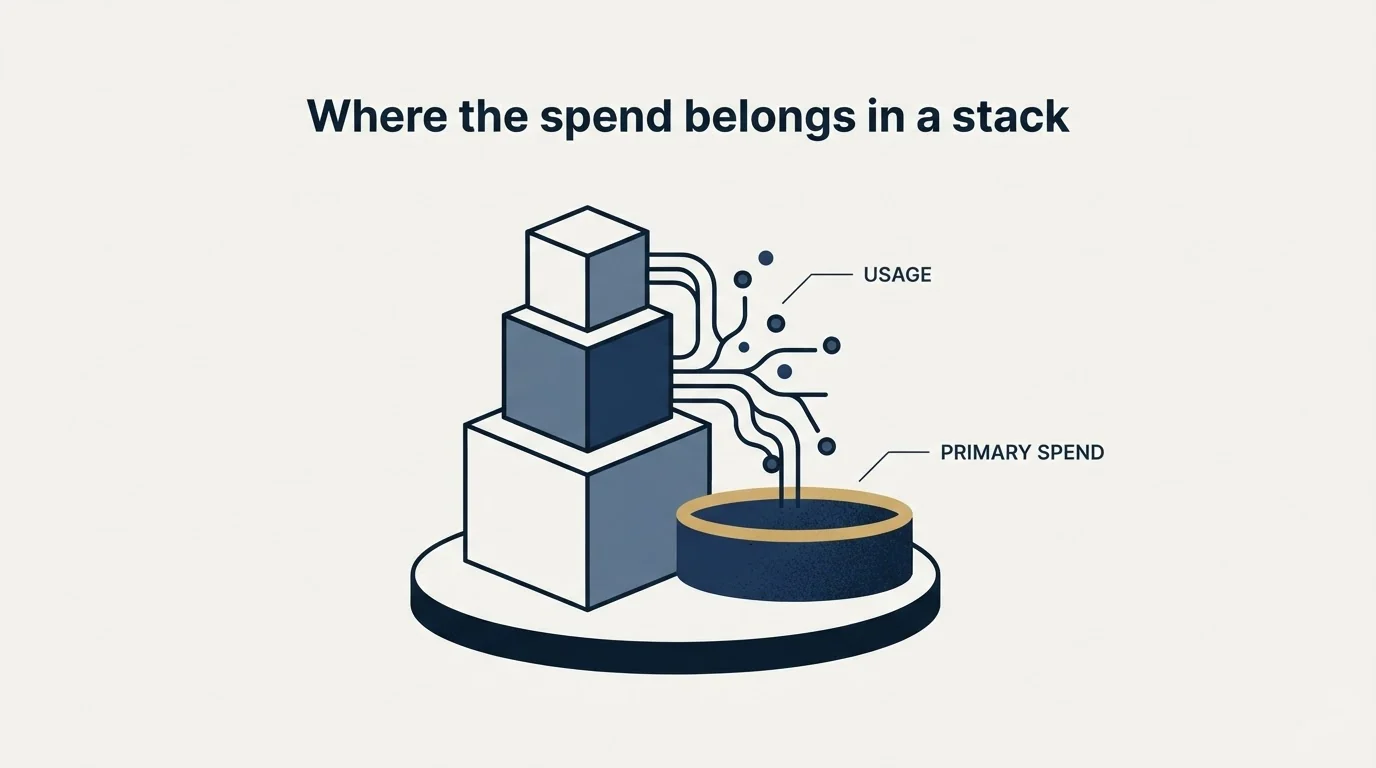
Lookup pricing only tells you what one provider's attempt costs. What decides your real cost per contact is the sequence you run around it. A waterfall runs providers in order, stops at the first confident result, and only pays the next stage for the rows the previous stage could not resolve. The economics behind that ordering are in our waterfall enrichment guide, and the stack we run is MillionVerifier brute-force first, then Prospeo, then Findymail, with no fourth paid stage.
Priced against that, RocketReach's annual unlimited tier is best understood as a flat-rate sourcing and first-attempt layer rather than as a per-address cost. Whether that is cheaper than a metered waterfall depends entirely on your volume, and the crossover point is a question your own rows answer. The protocol for finding it is in our guide to email finder tools. If you are comparing the field rather than the tiers, our RocketReach alternatives roundup covers the category.
The short version
RocketReach monthly plans run $56, $105 and $210 for 100, 250 and 1,000 lookups a month, with phone data on the top two. Annual plans run $328, $832 and $1,699, convert the lookup meter to unlimited for the term, and carry published savings of 51, 33 and 32 percent, the largest of them on the entry tier. Team seats sit a few percent below individual pricing. Extra lookups cost $0.30 standard and $0.45 premium, which on the smallest plan is cheaper per unit than the plan itself. Rollover exists on monthly billing only. The annual entry tier is the value in the ladder for a team that never needs a phone number.
If you would rather see the whole motion running on your own ICP before you commit to a data vendor, start a free campaign and we will build the list, the copy and the sending infrastructure around it.
Pricing and features verified as of mid-2026. Verify current terms with the vendor before relying on them.
Frequently asked questions.
Frequently asked questions- How much does RocketReach actually cost per month?
- There is no single monthly figure because pricing depends on billing term. Monthly plans cost $56, $105 or $210 for Essentials, Pro and Ultimate with fixed lookup allowances, while annual billing converts the same tiers to unlimited lookups at equivalent monthly rates of $28, $70 and $142.
- What's the difference between RocketReach's monthly and annual plans?
- They are structurally different products, not the same plan at a discount. Monthly billing buys a fixed lookup allowance that rolls over up to 12 months, while annual billing gives unlimited lookups for the year with no rollover, a 12-month commitment, and savings of 51%, 33% and 32% by tier.
- Does RocketReach offer a discount code or coupon?
- No verified discount codes exist; most search results are coupon-aggregator pages rather than vendor offers. The only real discount is RocketReach's own published saving for switching from monthly to annual billing, which appears directly in its product feed as 51%, 33% and 32% off Essentials, Pro and Ultimate.
- How much do extra lookups cost on RocketReach beyond the plan allowance?
- Additional lookups beyond a plan's monthly or annual allowance cost $0.30 for a standard lookup and $0.45 for a premium lookup, according to RocketReach's own application code. These overage charges are one of the costs that do not appear on the main pricing page.
- Is RocketReach cheaper for teams than buying individual seats?
- Only slightly. Team plans are charged per seat and sit about 3-5% below individual pricing, for example $53 per seat monthly for Essentials versus $56 for an individual plan. Teams should choose team plans mainly for seat management and shared lists rather than a meaningful price drop.
About the author.

B2B cold email experts helping companies generate qualified leads through done-for-you outreach campaigns.
RevenueFlow Team
Explore more.
Ready to scale your outreach?
We build GTM engines that book real meetings. See the receipts.
Related articles.
Airscale Pricing: Three Plans, One Credit, Four Rates
Airscale prints a different credit cost on every plan, and its advertised per-email price belongs to the custom one. The dated ladder and the rollover rules.
Snitcher Pricing: The $49 Table Is the Annual Rate
Snitcher's visible price table is the annual-billing ladder. The ten bands at both billing states, the unique-company meter, and the rules on a help page.
Autobound Pricing: One-Time Credit Packs, Not Seats
Autobound's pricing page sells one-time credit packs for a signal data API, not seats. The six packs, the per-endpoint meter, and what a company costs.
TexAu Pricing: Four Tiers, Billed Only on a Match
TexAu charges credits only when a lookup succeeds. The four tiers at both billing states, the rollover cap, and three places the page disagrees with itself.
The Real Cost per 1,000 Emails, Verifications and Data Credits in 2026
Unit prices computed from verified vendor plans: $1.00 per 1,000 emails sent, $2.00 per 1,000 verifications and $19.60 per 1,000 enrichment credits.
Free Tiers and Trials in Sales Tools: What $0 Gets You Across 386 Vendors
37.0% of 386 verified sales tools have a permanent free plan. The median free data tier gives 50 credits and the median free sending plan 2,500 emails a month.