Sales Coaching Templates: Six Forms for One to Ones
Six sales coaching templates printed in full: a one-to-one agenda, a call review scorecard, a four-week skill plan, a written-work sheet and two more forms.
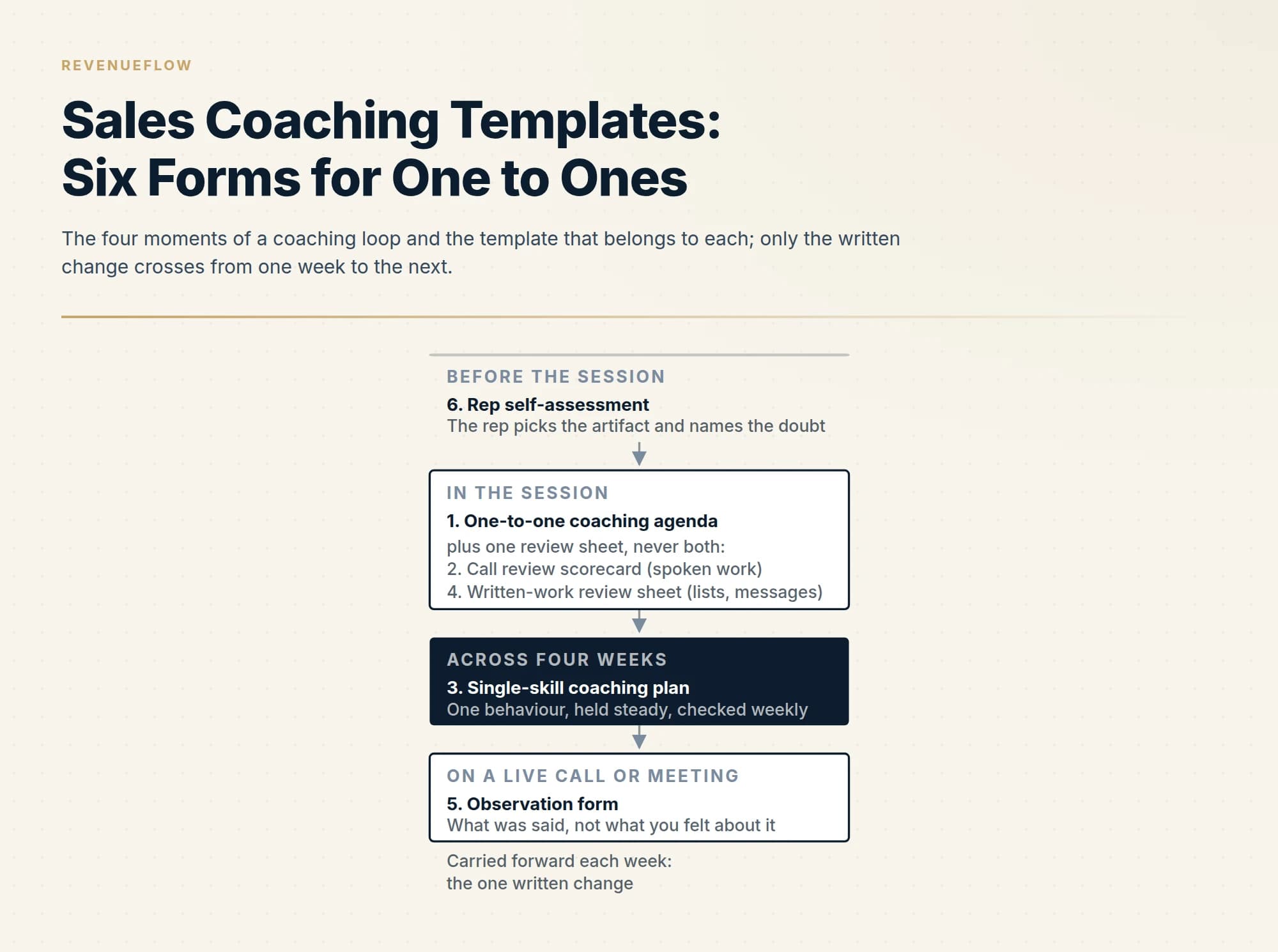
A useful sales coaching template forces three things: an artifact in the room, one named focus, and one written change checked first the next week. Six forms cover the loop: a rep self-assessment, a one-to-one agenda, a call review scorecard, a written-work review sheet, a four-week single-skill plan and an observation form for live calls.
Key takeaways
- Build every coaching template around an artifact, one named focus and one written change; an agenda of wins, numbers and blockers records a status report, however tidy the form.
- Score only the scorecard row that matches the week's focus, on a behaviour scale of not yet, sometimes and by default, and review the same ninety seconds across four calls.
- Answer the layer check before scoring a call: a list problem and a message problem look like a skills gap in a review, and neither is fixed by coaching delivery.
- Keep coaching records readable by the rep and out of the performance file, because reps only bring a bad call to a session whose notes cannot be used against them.
Reviewed and updated September 17, 2026
The sales coaching template a manager downloads is often a meeting agenda with the word coaching at the top: wins, numbers, pipeline, blockers, action items. A manager can fill one in every week for a year without a single rep changing how they open a call. The form is tidy and the session it records was a status report.
The six templates on this page are built the other way round, from the rules in our guide to sales rep coaching: every session has an artifact in the room, one named focus, and ends with one written change that is checked first next week. Each template is printed in full below so it can be copied into a doc, a CRM note or a spreadsheet. Every worked row, name and detail in them is invented for illustration. RevenueFlow runs outbound programmes for clients, in writing, and does not sell coaching or training, so this is a method with no results claim attached.
Which template for which moment
A coaching loop has four moments, and the six templates sit on them. Before the session the rep fills in a short self-assessment and picks the artifact. In the session the manager runs the one-to-one agenda and uses one review sheet: the call scorecard for spoken work, or the written-work sheet for lists and messages. Across a month a single-skill plan holds the focus steady for four weeks. And when a manager listens to a live call or sits in on a meeting, the observation form keeps the notes to evidence.
Two things are deliberately missing. There is no deal-by-deal sheet, because inspecting deals is a different meeting with a different output, and its agenda is in our sales meeting agenda template. And there is no rating of the rep as a person, because a coaching record that doubles as a performance file teaches reps to bring their best call every time.
Template 1: the weekly one-to-one coaching agenda
Thirty minutes, one rep, one focus. The focus is sent to the rep beforehand so they know what is being watched, and the first block is always last week's written change.
| Block | The only question | Output required |
|---|---|---|
| Last week's change | Did the one thing we wrote down happen? | Yes, partly or no, with an example |
| This week's focus | Which single behaviour are we looking at? | The focus, as sent in advance |
| The artifact | What did the rep bring, and why this one? | A call, a message or a list, named |
| The review | What do four samples of that behaviour show? | One pattern, in the rep's words first |
| The written change | What will the rep do differently on Monday? | One sentence, written down by the rep |
The agenda has no block for numbers. If activity or conversion needs discussing, that belongs in the pipeline meeting, and mixing it in here is how a coaching slot turns back into a report.
Template 2: the call review scorecard
A scorecard earns its place when it makes the review specific, and it does harm when it becomes a grade. This one lists six criteria and scores only the row that matches the week's focus. The other rows are there so the manager can note something for a later week without raising it now.
Before scoring anything, answer the layer question at the top. If the call went badly because the person could never have bought, that is a list problem, and if every rep's calls stall at the same sentence, that is a message problem. Neither is fixed by coaching the rep's delivery.
| Criterion | What to listen for | Evidence |
|---|---|---|
| Layer check | Was this a list problem, a message problem or a live conversation problem? | One line, before any scoring |
| Opening | Name, company and a reason about them inside the first exchange | Timestamp and the words used |
| First question | A question the prospect could answer from their own week | Timestamp and the question |
| Listening | The rep's next line follows from the answer they were given | One example either way |
| Buying signal | When the prospect asked a buying question, the rep stopped presenting | Timestamp of the signal |
| First objection | The rep asked about the objection before answering it | The objection, verbatim |
| Next step | A specific step with a date, or a clear no | What was agreed |
Score the focus row on a three-point scale that describes behaviour: not yet, sometimes, by default. Review the same ninety seconds across four calls, because four samples of one behaviour show a pattern and one whole call shows an anecdote. Software can produce the transcript and the timestamps, and our guide to AI sales coaching tools sorts that category by mechanism. The reading is still a person's job.
Template 3: the four-week single-skill plan
A focus that changes every week never becomes a habit. The plan holds one behaviour for four weeks and defines what done looks like before it starts. Here it is with an invented example: a rep called Jordan whose focus is what happens after the first objection.
- Before week 1Define the behaviour and the test
Invented example: after the first objection, Jordan asks one question before answering. Test: it happens by default on four current calls.
- Week 1Baseline from four calls
Review the objection moment on four recent calls. Write what Jordan does now, in Jordan's words.
- Week 2One change, practised
Agree the question Jordan will ask. Practise it aloud in the session, then review four new calls.
- Week 3Same behaviour, harder calls
Pick calls where the objection came early or sharp. Note where the old habit returns.
- Week 4Run the test
Pull four current calls Jordan did not choose. If the behaviour is the default, close the plan; if not, narrow the focus and run it again.
The plan has a closing test on purpose. Without one, a skill stays on the agenda until everyone is bored of it, and nobody can say whether it changed.
Template 4: the written-work review sheet
On an outbound seat the decisions that set the week's result are made before anyone replies: who went on the list, what the first line assumes, which signal justified the touch. Those decisions are written down, so they can be reviewed the same way a call can. This sheet is for that session, and the artifact is four messages together with the accounts they went to.
| Item reviewed | The question | Record |
|---|---|---|
| The segment | What evidence put each of these accounts on the list? | The evidence, or none |
| The contact | Does this person own the problem the message names? | Yes, no or unknown |
| The first line | What does it assume the reader already knows? | The assumption, stated |
| The specific detail | Is it true, and did the rep check it? | Source of the detail |
| The ask | Can it be answered in one line? | The ask, quoted |
| The written change | What will the next four messages do differently? | One sentence |
In our own programmes this is where the coaching effort goes, because we send one message per campaign with no bumps and no thread replies. There is no chasing behaviour to coach, so the review lands on the list and the first message, which is where the outcome was decided.
Template 5: the observation form
The observation form is the descendant of the field ride-along, used when a manager listens to a live call or sits in on a meeting. Its job is to keep the notes to evidence. The left column is what was said or done, with a time. The right column is left empty until afterwards, and it holds a question for the rep, never a verdict.
| Time | What was said or done | Question for the debrief |
|---|---|---|
| 00:40 | Rep gave name, company and the reason for the call | none |
| 02:15 | Prospect asked what it costs; rep continued the overview | What did you hear at 02:15? |
| 06:30 | Rep proposed a second meeting; no date agreed | What would a date have needed? |
Those three rows are invented to show the form. Two rules make it work. The manager does not speak on the call unless the rep asked them to beforehand. And the debrief happens the same day, starts with the rep's own account, and ends with at most one written change, the same as any other session.
Template 6: the rep self-assessment
The rep fills this in before the session, in five minutes. It replaces the question "how do you think it's going", which produces a mood, with five that produce material.
- Which artifact am I bringing, and why this one and not an easier one?
- At which exact moment did it stop going the way I intended?
- What did I do at that moment, and what else could I have done?
- Is this a one-off, or have I seen it on other calls or messages this month?
- What was last week's written change, and did I do it? One example.
A team where reps arrive with the call that confused them has coaching. A team that only reviews calls the manager selected is being audited, and this form is the cheapest way to move from the second to the first.
Three ways the forms go wrong
The first is filling them in afterwards. A one-to-one agenda completed from memory on Friday afternoon records what the manager wishes had happened. The written change is written by the rep, in the session, before it ends.
The second is scoring everything. A scorecard with seven marks on it hands the rep seven things to fix, and a rep cannot hold seven things in mind during a live conversation. One scored row is the design, and the unscored rows are a notebook for later weeks.
The third is adapting the criteria to the product and forgetting the seat. The six criteria above suit a rep who holds live conversations. A rep whose week is mostly list building and first messages should be reviewed on Template 4 most weeks, with the scorecard brought out when there are calls worth hearing. Change the criteria freely, and keep the three rules: an artifact, one focus, one written change.
How to keep the records
One page per rep per week is enough: the focus, the artifact, the pattern and the written change. Keep it somewhere the rep can read it. Keep it out of the performance file, and say so, because reps will only bring a bad call to a session whose notes cannot be used against them. When a skill plan closes, keep its one-line result and delete the detail.
The quarterly check is the one from the coaching guide: take a focus from three weeks ago, pull four current calls, and see whether the behaviour is now the default. If the templates are filled in and that check keeps failing, the focus was too broad or the sessions had no artifact in them. For a newer team the order in which skills are introduced matters more than any form, and that is covered in SDR training and ramp.
The short version
Six templates cover a coaching loop: a rep self-assessment before the session, a one-to-one agenda with a call scorecard or a written-work sheet in it, a four-week single-skill plan, and an observation form for live calls. Each one forces an artifact, one focus and one written change. None of them rates the rep or inspects deals, and the records stay out of the performance file.
If the message and list layers are the part you would like off your team's plate, that is what we run: start with a free campaign.
Every example row, name and detail in these templates is invented for illustration. The templates are a method, not a vendor's product, and carry no measured result.
Frequently asked questions.
Frequently asked questions- What should a sales coaching template include?
- Five blocks for a weekly one-to-one: whether last week's written change happened, the single behaviour in focus this week, the artifact the rep brought and why, a review of four samples of that behaviour, and one sentence the rep writes down about what changes on Monday. Leave numbers and deal inspection out, because those belong to the pipeline meeting and crowd out the coaching.
- How do you score a sales call for coaching?
- List a small set of criteria with what to listen for, such as the opening, the first question, listening, the response to a buying signal, the first objection and the next step, and score only the row that matches the week's focus. Use a behaviour scale of not yet, sometimes and by default, and record a timestamp and the words used as evidence for every mark.
- How long should a sales coaching plan run?
- Four weeks on one behaviour is a workable unit. Define the behaviour and the closing test before week one, take a baseline from four calls, agree and practise one change, move to harder calls in week three, and in week four pull four current calls the rep did not choose. If the behaviour is the default, close the plan; if not, narrow it.
- Should coaching notes go in a rep's performance file?
- No. Coaching asks a rep to expose the work they are least sure about, and a performance conversation attaches consequences to what gets exposed. If the notes can be used as evidence in a review, reps bring their best call every week and the session becomes a presentation. Keep one page per rep per week, readable by the rep, separate from any formal record.
About the author.

B2B cold email experts helping companies generate qualified leads through done-for-you outreach campaigns.
RevenueFlow Team
Explore more.
Ready to scale your outreach?
We build GTM engines that book real meetings. See the receipts.
Related articles.
MEDDIC vs BANT: What Each Qualifies and When to Use Which
MEDDIC and BANT from the originators' own text: IBM's BANT form as a gate after the first call, PTC's six themes as an audit of a live deal, and when to run each.
The Urgency Close: Real Deadlines and Manufactured Ones
The urgency close from the publishers who teach it, the test that separates a real deadline from a manufactured one, the structure, and why we never invent one.
B2B Sales for Financial Services Companies: Regulated Seller
For the bank, agency, broker-dealer or adviser selling to businesses: the buying group, the credit and renewal windows, and the rules that bind the seller's own message.
The Direct Close: Asking Plainly for the Business
The direct close asks for the business with nothing wrapped around the question. The condition the publishers attach, the buyer it suits, where it backfires.
Command of the Sale: Force Management's Process Programme
Command of the Sale is Force Management's sales process and qualification programme, not its messaging one. What the vendor says it is, delivers and how it runs.
Objection Handling Frameworks: LAER, AAA and Others Compared
The named objection-handling frameworks with their publishers quoted: Carew's LAER, RAIN Group's four steps, HubSpot's five, Gong's three and both AAAs.