SEO Landing Page Optimization: Ranking vs Converting Pages
Ranking and converting want opposite pages. Optimising one page for both produces a compromise that underperforms at each, and Google names the usual workaround as spam.

A page built to convert strips navigation, carries one offer and stays short. A page built to rank needs depth, internal links and coverage of the surrounding questions. Those requirements conflict, so the working architecture is an article that earns the ranking linked to a stripped page that earns the completion.
Key takeaways
- Stripped navigation, a single call to action and short copy all raise completions and all work against ranking, so one page cannot be optimal for both.
- Google's spam policies name near-identical pages that funnel visitors to one destination as doorway abuse, which is the shape a per-keyword landing page set takes.
- Read the search results before committing: articles ranking means a conversion page will not, and product pages ranking means one page can do both.
- A campaign destination does not need to rank at all, and optimising it for search makes it worse at continuing the conversation the message started.
Reviewed and updated September 2, 2026
A marketing team is told the campaign landing page should also bring in organic traffic, which sounds like free upside. So the page gets a thousand words of supporting copy, an FAQ block, the site navigation restored so search engines can crawl onward, and internal links to six related pages. Six months later it ranks on page three for a term nobody searches, and it converts worse than it did before, because every change made for the search engine gave the visitor another way to leave.
Nothing went wrong in the execution. The page was asked to do two jobs whose best moves point in opposite directions, and it did neither.
The useful starting position is that a page which ranks and a page which converts are usually two different pages, and the productive question is not how to merge them but how to connect them.
The two jobs, and where the moves conflict
Set the requirements side by side and the tension is immediate rather than subtle.
A page built to convert strips navigation, because every additional exit reduces completions. It carries one offer and one call to action, because a second choice is a decision the visitor did not come to make. It stays short, because length between the promise and the form is friction. It is written for a person who arrived already knowing what they wanted, usually from an ad or a message.
A page built to rank needs the opposite in almost every case. Search engines reward depth on a topic, so thin pages struggle. Internal links are how authority moves through a site and how a crawler discovers what else exists, so a page with none is a dead end. Coverage of the questions around a topic is what earns the ranking, which means the page has to serve people at several different stages, most of whom are not ready to act.
- Navigation removed
- One offer, one call to action
- Short, with nothing between promise and form
- Written for someone who already knows what they want
- Judged on completions
- Navigation and internal links present
- Covers the questions around the topic
- Long enough to be the best answer available
- Written for someone still deciding what they want
- Judged on positions and organic sessions
- Loads fast on a phone
- The title and description describe the page honestly
- The headline matches whatever brought the visitor
- Works without a mouse and reads at small sizes
The third column is the part usually skipped in the argument, and it is worth doing properly, because speed and mobile rendering cost the same to fix on either kind of page and both jobs suffer without them.
The workaround that Google names in its own spam policy
The obvious response to the conflict is to make more pages. One per keyword, one per segment, one per city, each thin, each pointing at the same form. This is a well-established tactic and it has a name in Google's own documentation.
Google's spam policies page defines the category directly: "Doorway abuse is when sites or pages are created to rank for specific, similar search queries. They lead users to intermediate pages that aren't as useful as the final destination." Among the examples it lists are "Having multiple domain names or pages targeted at specific regions or cities that funnel users to one page" and "Creating substantially similar pages that are closer to search results than a clearly defined, browseable hierarchy" (developers.google.com, Search spam policies, fetched 29 August 2026).
Read the second example carefully, because it catches a pattern that is not obviously spammy from inside the team that built it. A set of near-identical landing pages differing only by an industry token, all routing to one form, is the described shape, whatever the intent behind it was.
The line worth holding is whether each page would be worth publishing if the search engine did not exist. A page written for a genuinely distinct audience, saying genuinely different things, passes that test. A page generated by substituting a vertical name into a template does not, and no amount of optimisation changes which side it is on.
The architecture that works instead
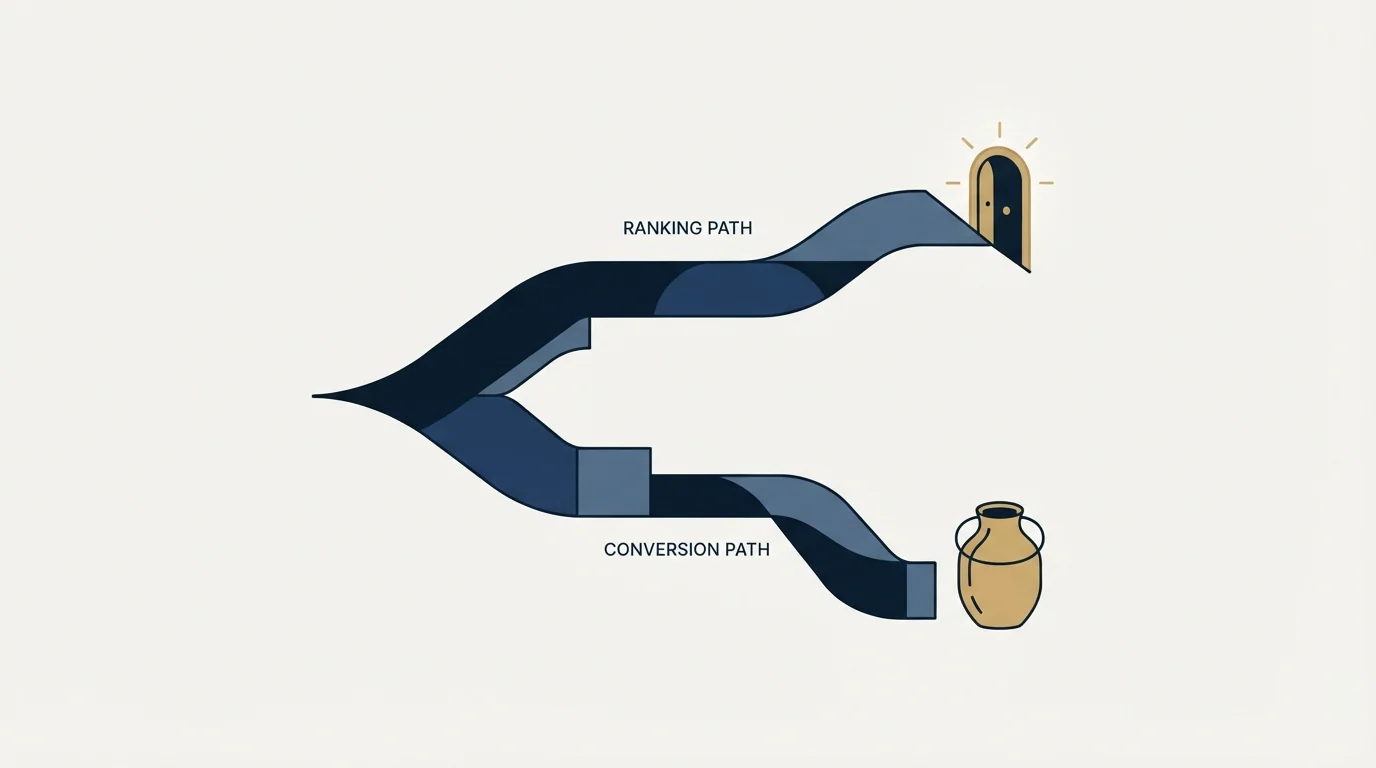
The alternative is boring and it holds up: publish the thing that ranks and the thing that converts as separate pages, and link them.
The ranking asset is a real article on the question people search. It has depth, it links outward and inward, it serves readers at every stage, and it is judged on organic sessions and on the quality of the readers it brings. Its call to action is a link rather than a form.
The conversion asset is the stripped page. It is fed by campaigns, ads and that link, and it is judged on completions and on what those completions become. It does not need to rank at all, and freeing it from that requirement is what lets it be good at its job.
Judging that page by test results needs volume most business pages never see, and the arithmetic behind a low-traffic split test settles whether one can run at all.
- Step 1Article ranks and is read
Depth, internal links, coverage of the surrounding questions. Judged on organic sessions and reader fit
- Step 2Reader arrives at a decision point
Having read enough to know what they want, they are offered one specific next thing
- Step 3Link, not a form
A contextual link to the conversion page, placed where the reader is ready rather than at the top
- Step 4Conversion page asks once
Stripped, single offer, no navigation. Judged on completions that become conversations
The connection between them is where a large share of the available improvement sits, and it is the cheapest part to fix. A link placed after the section that establishes the need outperforms the same link in a banner at the top, because the reader has been given a reason before being given an ask.
When one page genuinely can do both
The split is a default rather than a law, and there is a real exception.
A query with strong commercial intent, where the searcher wants to evaluate and act in one visit, can be served by one page. Comparison and category queries behave this way: somebody searching for a specific category of tool is ready to look and decide, so a page with real depth and a clear ask does both jobs without either compromising the other.
The tell is the search results themselves. Where the ranked pages are articles and guides, the searcher wants to read and a conversion page will not rank. Where the ranked pages are product and category pages with prices and calls to action, a page that both informs and asks fits the intent and can win.
That reading takes one look at the results for the term in question, and it is the step most often skipped in favour of a keyword difficulty score. The score describes how hard the term is; the results describe what kind of page the term wants, which is the question that decides whether a landing page belongs there at all.
What optimisation actually means on the ranking half

Assuming the article is the thing being ranked, the work divides into three parts of very unequal value.
The largest lever is topic and intent selection, which happens before anything is written. A page targeting a term whose results are all product pages will not rank however well it is optimised, and a page targeting a term whose searchers are students or job seekers will rank and produce nothing. The general version of that selection problem, and what organic can and cannot supply to a pipeline, is worked through in SEO lead generation.
The middle lever is being the best available answer to the question, which is mostly a writing problem rather than a technical one. Covering what the question actually needs, including the parts competitors leave out, is what the ranking is for.
The smallest lever is the technical checklist that guides tend to lead with: the title tag, the description, the headings, the alt text, the URL. These are worth doing correctly and they take an afternoon. They do not rescue a page targeting the wrong term, and treating them as the substance of the work is how six months get spent on the least consequential third of it.
Tooling gets bought at that level too, and four different jobs behind one category label carry different buyers, failure modes and traffic requirements before any feature grid matters.
Measuring it without fooling yourself
Two reporting habits separate a page that is working from one that looks like it is.
Rankings and organic sessions describe the acquisition job and say nothing about the second one. A page can climb steadily while producing no conversations, which usually means the term was selected for volume rather than for the reader behind it. Report positions alongside what those visitors did.
The conversion half needs its own denominator and it needs to be segmented. A page fed by organic search, paid search and a campaign will show three different rates, and an average across all three describes none of them. The mechanics of that trap, and why a rate and a count belong in the same view, are set out in the number that needs both ends named. On the landing page specifically, why the headline conversion rate is rarely the binding constraint covers what to report instead.
- Yes: The search results for the target term were read, and they contain articles rather than product pages
- Yes: The reader behind the term is somebody who could buy, not a student or a job seeker
- Yes: The ranking asset and the conversion asset are separate pages with a link between them
- Yes: The link sits after the section that establishes the need, not in a banner at the top
- Yes: Positions are reported beside what the organic visitors actually did
- Yes: Conversion is segmented by source rather than averaged across all of them
- No: Near-identical pages differ only by a vertical or a city token
- No: Navigation was restored to a campaign page so crawlers can pass through it
The outbound reader's version

For a team whose pipeline comes from outbound rather than from search, the conclusion is shorter and it removes work rather than adding it.
The destination behind a campaign does not need to rank. Its entire job is to continue the specific conversation the message started, for a visitor who arrived from a message written to them by name. Optimising it for search adds navigation, depth and competing calls to action that make it worse at that job, in exchange for traffic that would take a year to arrive.
Search is a genuinely good channel and it operates on a different clock. It compounds, it costs its money up front, and it produces its first meaningful traffic in quarters rather than weeks. Running both is reasonable. Asking one page to serve both is what produces the outcome at the top of this piece.
The corollary is that a thin campaign is not a page problem. When too few of the right people are arriving, no amount of page work changes the total, because a landing page converts demand that already exists and has no mechanism for creating any. Deciding whether to add a second acquisition channel at all, and whether it buys coverage or sequencing, is the question in multichannel lead generation.
The short version
Ranking and converting want opposite pages, and the standard advice to optimise one page for both produces a compromise that underperforms at each. Publish an article that earns the ranking and a stripped page that earns the completion, and put a link between them where the reader is ready for it. Read the search results before committing, because they say which kind of page the term wants. Do the technical checklist, and do not mistake it for the work.
If the real question is where the next qualified conversations come from while the search programme compounds, see what a first campaign against your own market produces.
Google's spam policies page was read from developers.google.com on 29 August 2026, with a dated snapshot retained. Search documentation changes; confirm the current wording before relying on it.
Sources: Google Search spam policies
Frequently asked questions.
Frequently asked questions- Can one page rank in search and convert campaign traffic?
- Sometimes, on queries with strong commercial intent where the searcher wants to evaluate and act in one visit. The tell is the search results: where they are filled with product and category pages, a page that both informs and asks fits the intent. Where they are articles and guides, a stripped conversion page will not rank however well it is optimised.
- Is making a landing page per keyword against Google's guidelines?
- It can be. Google's spam policies define doorway abuse as pages created to rank for specific, similar queries that lead users to intermediate pages less useful than the destination, and list substantially similar pages funnelling visitors to one page as an example. The test worth applying is whether each page would be worth publishing if search did not exist.
- What actually matters most when optimising a page for search?
- Topic and intent selection, decided before anything is written, because a page targeting the wrong term will not rank however well it is optimised and a page targeting the wrong reader will rank and produce nothing. Being the best available answer comes second. The technical checklist of titles, headings and alt text is real, takes an afternoon, and is the smallest lever.
- Should I restore navigation to a landing page so search engines can crawl it?
- Not on a page whose job is conversion. Navigation gives every visitor additional ways to leave, which is the cost the stripped design exists to avoid. If the page needs to be discoverable, link to it from an article that does rank, placed after the section establishing the need. That gives the crawler a path without charging the visitor for it.
About the author.

B2B cold email experts helping companies generate qualified leads through done-for-you outreach campaigns.
RevenueFlow Team
Explore more.
Ready to scale your outreach?
We build GTM engines that book real meetings. See the receipts.
Related articles.
LinkedIn Outreach for Banks: A Regulated Message
How a bank's relationship managers use LinkedIn to reach business owners: what the FFIEC guidance, FINRA's notices and LinkedIn's own rules require, and where to stop.
SDR Outsourcing for Financial Services: The Third Party
What a bank, broker-dealer, adviser or agency's regulators say about an outside team that speaks for it, the licensed line, and which arrangement survives due diligence.
SDR Outsourcing for Business Brokers: The Fee Timing
Whether a success-fee brokerage should rent sales development at all: the fee timing, the texts that limit what an outside person may say about value, and who signs.
Sales Prospecting for Health Systems: The Public Record
Where health systems are written down in public: the Medicare cost report, the facility list a non-profit system files, and the two gates that follow qualification.
Appointment Setting for Business Brokers: The Seller Meeting
What a bought meeting with a business owner has to be for a brokerage: the three-part qualification, the confidentiality rules, the licence line and the owner's reasons.
SDR Outsourcing for Logistics Companies: The Brokerage Line
What an outside sales development team may do in a freight company's name, the calling and email rules it inherits, and which arrangement survives a bid-shaped market.