Agency Sales Funnel: Size It Against Churn, Not Ambition
An agency sells a commitment a client can end with thirty days notice, so the funnel refills before it grows at all. Sizing it, and the four leaks agencies carry.
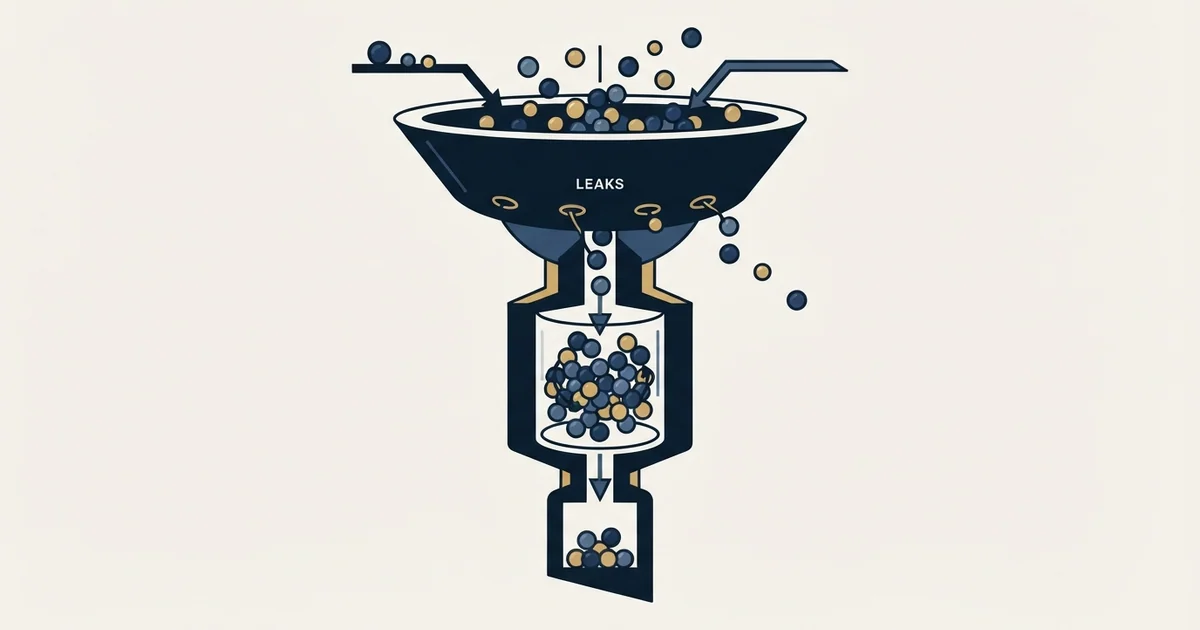
Size an agency sales funnel against retainer churn rather than a growth target. Work backwards from one signed retainer through your own conversion ratios to the number of conversations required each month, then fix the proposal stage before widening the top, because scoping consumes billable delivery hours.
Key takeaways
- Replacing what churns is the floor, so the conversation count a funnel must produce is a monthly obligation rather than a target.
- Tightening qualification returns delivery hours immediately, while widening the top only helps if the close rate holds, and it usually does not.
- Every stage needs an exit test somebody other than the founder can apply, or the pipeline tells you nothing.
- Outbound is the only channel that produces conversations on a schedule you choose, which is the property the churn arithmetic actually requires.
Reviewed and updated August 28, 2026
Most agency funnels are drawn once, on a whiteboard, during a quarter when the pipeline already looks fine. Awareness at the top, a lead magnet, a discovery call, a proposal, a closed retainer. It is a correct diagram and it is missing the only number that decides whether the agency survives the year, which is how fast the bottom of it leaks.
An agency does not sell a product once. It sells a monthly commitment that a client can end with thirty days of notice, and every ended retainer is a hole the funnel has to refill before it can grow anything. Sizing the funnel against that rate, rather than against a growth target somebody picked, is the whole exercise.
If you are reading this as one of the agency owners it is written for, the persona-specific version of this playbook lives in our guide to outbound for agency owners.
Start from churn, not from ambition
Take the arithmetic in the order it actually binds.
Suppose an agency runs twelve retainers at an average of eight thousand a month, and clients stay a little under two years. That is roughly one departure every other month at steady state. To grow at all, the funnel has to produce more than one new signed retainer every other month, every month, without exception, and the months it fails to are invisible until two quarters later.
Now run it forward. If one in four proposals closes, and one in three qualified conversations reaches a proposal, and one in five initial conversations qualifies, then a single signed retainer sits behind roughly sixty initial conversations. To grow rather than tread water, double it.
Those ratios are illustrative and yours will differ, sometimes wildly, by service line and price point. Use your own. The point is the shape: the number of conversations required is large, it is required continuously, and almost every agency discovers the real figure during the quarter it can least afford to.
People who agreed to talk
Right problem, right budget shape
Scoped and priced
The unit that has to arrive continuously
The four leaks that are specific to agencies
A general sales funnel leaks at conversion points. An agency funnel leaks in four places that are structural to the business model.
The general version of that diagnosis, covering the five seams any B2B funnel loses at and the evidence each one produces, is in leaky sales funnel.
The founder is the only credible closer. Prospects buying a service are buying judgment, and they want the person whose judgment it is. That is fine at three deals a quarter and it becomes the binding constraint at eight, because the founder is also the delivery escalation path, the hiring manager and the person the largest client calls.
Scoping consumes delivery capacity. Producing a serious proposal for a serious client takes real hours from the people who would otherwise be billing. A funnel that generates plenty of top-of-funnel and closes poorly is not merely inefficient, it is actively eating the margin on the work you already won.
Referrals arrive on a schedule you do not control. They convert better than anything else and they are a lagging function of delivery from months ago. An agency that has never needed outbound has usually not noticed that its best channel is also its least steerable, and the transition from referral-led to outbound-supported growth takes longer than the gap it is being asked to fill.
The prospect judges your outreach as a work sample. This is the one no other seller carries. An agency sending a mediocre message has demonstrated its product, and the credibility problem that creates shapes what you can claim and what proof will be accepted.
Qualification is where the leverage is, not lead volume
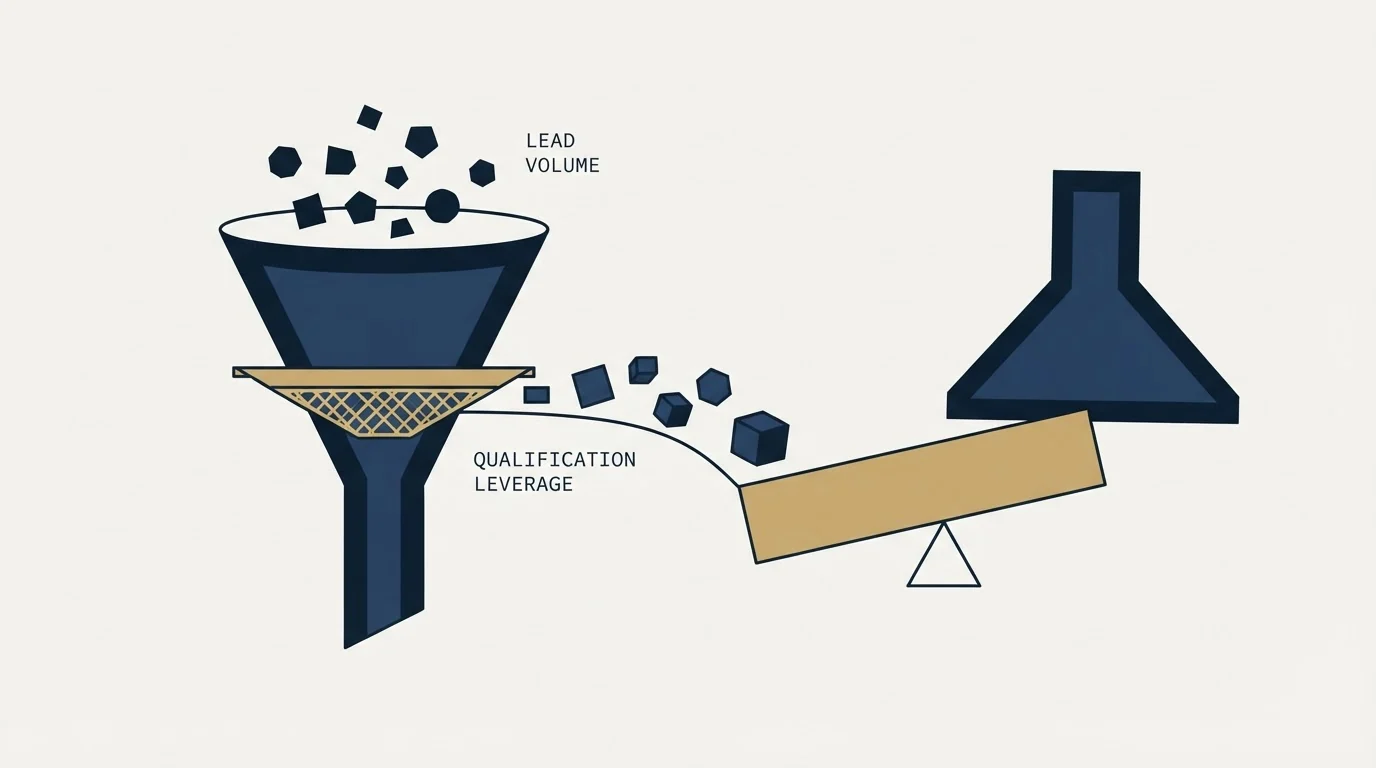
The instinct when the funnel is thin is to widen the top. For agencies that is usually the wrong move, because the expensive stage is not conversation, it is proposal.
Tightening qualification by one notch removes proposals you were going to lose, and each removed proposal returns hours to delivery. Widening the top adds conversations that mostly convert into more of those same proposals. The first change improves margin immediately; the second improves it only if the close rate holds, and it rarely does.
Practically, that means having explicit disqualifiers and using them early. Budget shape rather than budget number. Whether there is an internal owner who will make decisions. Whether the outcome they want is one your service actually produces, or one adjacent to it that you would be improvising. An agency with no written disqualifiers has a proposal problem it has misdiagnosed as a lead problem.
- Yes: There is a named internal owner who can decide
- Yes: The outcome they want is one this service reliably produces
- Yes: The budget shape fits a monthly commitment rather than a one-off
- Yes: They can articulate why now, in their own words
- No: They are shopping four agencies on price and have said so
- No: They want a proposal before they will describe the problem
The stages an agency funnel actually needs
Stripped of the marketing-diagram vocabulary, the funnel has five states and each one has an exit test.
Contacted. Someone knows you exist and it was deliberate. The exit test is a reply, not a delivery.
In conversation. A real exchange about their situation is happening. The exit test is that you can state their problem in a sentence they would agree with.
Qualified. They pass your written disqualifiers. The exit test is a named owner and a why-now you did not supply for them.
Proposed. A scoped, priced document exists. The exit test is a decision date they set.
Signed. Commercials agreed. The exit test is the first invoice paid, which is not the same event and sometimes reveals a problem the signature hid.
The value of naming exit tests rather than stages is that it makes the funnel countable by someone who is not the founder. A stage anybody can move a deal into is a stage that tells you nothing.
Sales pipeline versus sales funnel explains why counting deals and counting people are different exercises that meet only at the moment a conversation becomes an opportunity, as detailed in sales pipeline versus sales funnel.
Where outbound fits, and how it is different for you
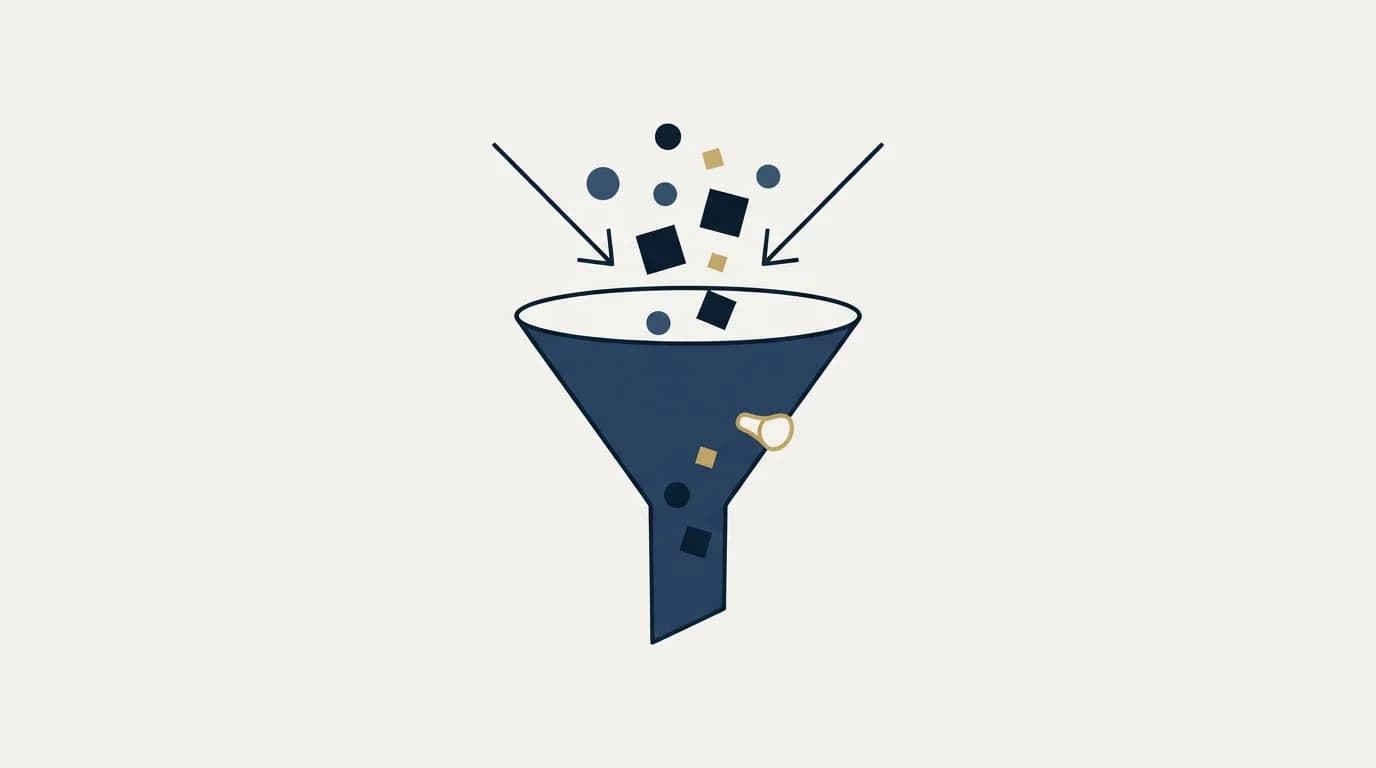
Outbound is the only channel in the list that produces conversations on a schedule you choose, which is exactly the property the churn arithmetic demands. It is also the channel where an agency is judged hardest.
Two consequences follow. The message has to be good enough that its quality is itself the proof, which for an agency is achievable in a way it is not for most sellers, because you have the skill. That skill is also why the buy-versus-build question reads differently for you than for a client of yours asking it. And the targeting has to be narrow enough that the message can be specific, because a generic message from a marketing agency reads as a self-refuting artefact.
We run one message per campaign, built on one premise, sent once. For an agency that constraint is a feature rather than a limitation: a single well-aimed message is the work sample you want on the table, and a series of increasingly insistent ones is the opposite of the judgment the prospect is trying to buy. A later approach on a genuinely different premise is a separate campaign and stands on its own merit.
- Arrives on its own schedule
- Closes faster and at better prices
- Volume is invisible until it stops
- Cannot be increased this quarter
- Arrives on the schedule you set
- Longer cycle, more price scrutiny
- Volume is a decision you make
- Quality of the message is itself the proof
Getting the founder out of the middle without losing the sale
Every agency eventually tries to hand the funnel to someone else, and most attempts fail the same way: the founder is removed from the whole conversation at once, close rates collapse, and the conclusion drawn is that only the founder can sell. That conclusion is usually wrong, and the correct one is that the founder was removed from the wrong part.
Split the conversation into two things the prospect is buying. One is confidence that this agency understands their situation, which is judgment work and genuinely hard to delegate early. The other is everything around it: qualifying, scheduling, gathering the inputs a scope needs, writing the document, chasing the decision date, handling the commercial back and forth. That second half is most of the calendar time and almost none of the judgment.
Hand over the second half first. A funnel where somebody else runs qualification and produces the scope, and the founder appears for one conversation at the point where judgment is actually being assessed, roughly triples what the founder can carry without changing what the prospect experiences at the moment that decides the deal.
The tell that the split is working is that the founder's calendar fills with second conversations rather than first ones. If it is still filling with first conversations, the qualification step is being skipped and the handover has not really happened.
Reviewing the funnel without fooling yourself

Two habits separate agencies that fix their funnel from agencies that redraw it.
Count conversations rather than leads. A lead is a record and an agency can generate any number of them without moving revenue at all. A conversation is a person who replied and engaged, and the ratio between the two is the honest measure of whether the top of the funnel is real.
Review on a cycle longer than the sales cycle. An agency selling a retainer with a two-month decision window that reviews channel performance monthly is reading noise and acting on it, usually by killing a channel a month before it would have produced. If the pricing conversation is where deals stall, that is a positioning question rather than a funnel one, and how agencies structure pricing is the more useful place to look than another stage in the diagram.
The short version
Size the funnel against churn, because replacing what leaves is the floor and everything above it is growth. Work backwards from one signed retainer through your own ratios to the number of conversations required, and treat that number as a monthly obligation rather than a target.
Fix the proposal stage before widening the top, since disqualifying early returns hours to delivery while more leads only multiply the losses. Give every stage an exit test somebody other than the founder can apply. And put outbound in the mix specifically because it is the one input you can schedule, accepting that your own message will be read as a work sample and building it accordingly.
If you would rather see what a specific, well-aimed campaign against your target accounts produces before building the function internally, we will run one and show you the output.
Frequently asked questions.
Frequently asked questions- How many leads does an agency need per month?
- Leads is the wrong unit. Work backwards from one signed retainer through your own close rate, proposal rate and qualification rate to a number of conversations, then multiply by how many retainers you must replace plus how many you want to add. The figure is usually larger than expected and it is required every month, not on average.
- Should agencies rely on referrals?
- Referrals convert faster and at better prices than anything else, so nothing argues for replacing them. The problem is that they are a lagging function of delivery from months ago and arrive on a schedule you do not control. An agency whose only channel is referral has excellent economics and no ability to respond when a quarter goes quiet.
- Why do agency proposals cost so much to produce?
- Because the hours come from the people who would otherwise be billing. A serious proposal for a serious client needs real thinking from senior delivery staff, so a funnel that generates plenty of conversations and closes poorly eats the margin on the work you already won. That is why disqualifying early is a margin decision rather than a sales one.
- Can someone other than the founder close agency deals?
- Usually yes, provided the handover happens in the right place. Prospects are buying judgment, so the conversation where judgment is assessed is hard to delegate early. Everything around it, meaning qualification, scheduling, scoping inputs, document production and the commercial back and forth, is most of the calendar time and almost none of the judgment.
About the author.

Ben Carden is CRO at RevenueFlow, which builds and operates outbound revenue engines for B2B companies. Previously at Gartner Enterprise. Studied at London School of Economics.
Ben Carden · CRO
Connect on LinkedIn →Explore more.
Ready to scale your outreach?
We build GTM engines that book real meetings. See the receipts.
Related articles.
Unqualified Lead: Which Test It Actually Failed
One flag covers two opposite verdicts. A fit failure is stable and belongs in an exclusion; a readiness failure expires and belongs on a watch list with its trigger.
5 ABM Campaign Examples and How Each One Is Built
Five worked account-based campaign examples, each built on the same five fields: account set, tier, plays in order, owner and handoff, and the exit condition.
Field Marketing in B2B: What a Programme Costs Per Meeting
Two different practices answer to the name field marketing. The B2B one runs dinners and roadshows for named accounts, and it divides like any other channel.
Average Landing Page Conversion Rate: What It Measures
Four published answers to one question span more than four to one. What each dataset actually counted, and why none of them applies to a page fed by cold outbound.
Two Agencies, One Target List: Who Owns Which Accounts
Two outbound suppliers on one market will contact the same companies unless the buyer splits it first. How to cut the list, run the exclusion feed and check the overlap.
Define Content Syndication: Two Purchases Behind One Word
One budget line, two different purchases. Republication buys reach; lead syndication buys contact records produced by a download. The deliverable tells you which.