AI Sales Script Generators: What You Still Supply
A generator returns a complete, category-average script in seconds. What it gets right, the four things that break out loud, and the brief that narrows it.
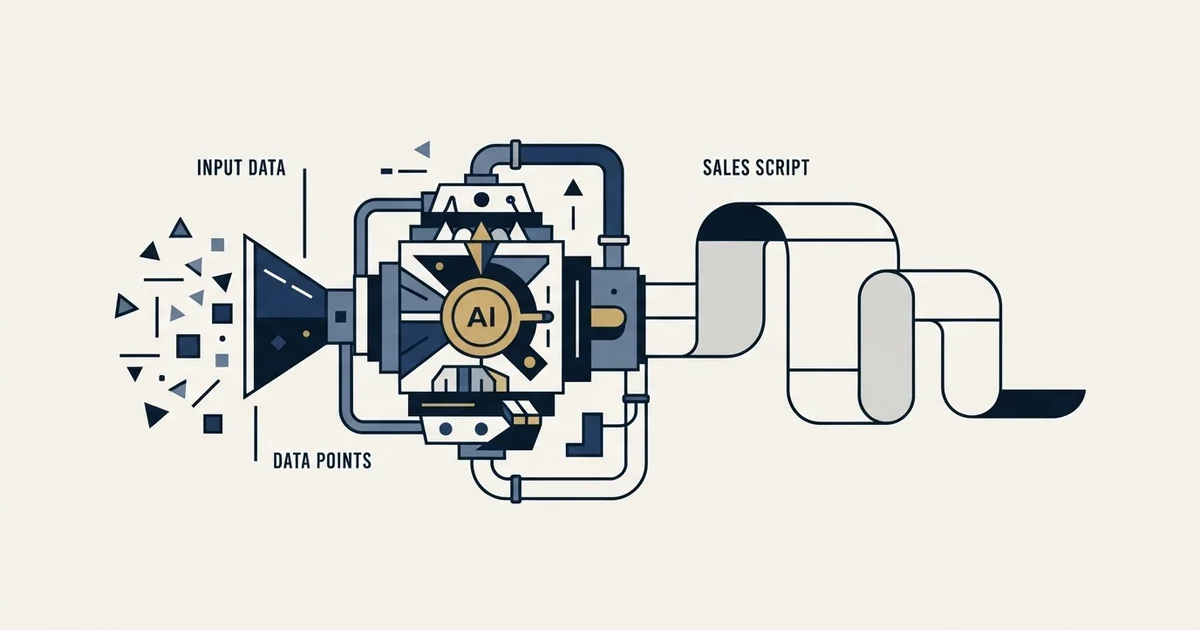
An AI sales script generator produces a well-structured, category-average script in seconds. It reliably handles structure, objection enumeration and phrasing variation. It cannot know what changed at an account, judge whether a claim is defensible, or decide what to leave out, so those parts stay with the person using it.
Key takeaways
- Output quality is decided upstream: a brief naming the segment, the observable situation, the alternative and one outcome produces something narrow, while a product description produces a category average.
- Generated scripts assert results in the same confident register as the safe parts, so treat every number and named customer as unverified and delete rather than soften anything unverifiable.
- Generated discovery questions come back closed or leading, because the model is completing a persuasive document rather than trying to learn something.
- Asking for many variants creates a selection problem: cut unverified claims, cut openings about your own company, then read the survivors aloud and keep what you can say without stumbling.
Reviewed and updated September 1, 2026
Paste a company description into an AI sales script generator and something usable comes back in about four seconds. It has an opener, a permission line, two discovery questions, a value statement, an objection response and a close. It reads like a script. The structure is right, the grammar is right, and roughly nothing in it is specific to the company that will be on the other end of the call.
That gap is the whole subject. Generation is genuinely good at some parts of this job and structurally incapable of others, and knowing which is which decides whether the output saves an hour or costs a quarter.
What these tools actually are
Most tools carrying this name fall into two groups. The first is a free single-page generator: a text box, a few dropdowns for industry and tone, and a generated script on submit. These exist largely as an entry point to a larger product, which is worth knowing because it explains the shape of the output. A tool designed to demonstrate capability in one screen produces something that looks complete rather than something that has been narrowed.
The second group is a feature inside a sales platform, generating against data the platform already holds about the account. The output is meaningfully better for a specific reason: the model has been given something to be specific about.
The distinction matters more than any comparison of the models behind them. A generator with no account context is writing a category-average script, and a category-average script is the thing every competitor calling that prospect is also reading from.
What the output reliably gets right
Three things, and none of them are trivial.
Structure. A generated script has all the parts in a sensible order. For somebody who has never written one, that alone removes a blank page.
Coverage of objections. Ask for objection handling and the output will enumerate the common ones for that category thoroughly, including several a new rep would not have anticipated. As a checklist of what to prepare for, it is strong.
Variation. Asked for fifteen ways to phrase the same opener, it produces fifteen. That is a real capability and it is the one that matters most at volume.
What breaks on a live call

Four failures show up consistently, and they are properties of the generation rather than defects of any particular tool.
The specificity is fabricated or absent. With no real information about the account, a model either writes a generic line or invents a plausible one. The invented version is the dangerous outcome, because it reads better and it is a claim about a company somebody is about to speak to.
The register is written, not spoken. Generated sentences are grammatically complete and slightly too long, which is fine on a page and audibly wrong out loud. Reading any generated script aloud once catches most of this.
The questions are closed or leading. Discovery questions come back in a form that invites confirmation rather than information, because the model is completing a persuasive document rather than trying to learn something.
The objection responses argue. A generated response to a stated objection typically rebuts it. Experienced sellers usually do the opposite first, which is to understand the objection before addressing it. The cold call objection handling guide covers that difference at length.
- Producing a complete structure from nothing
- Enumerating objections for a category
- Fifteen phrasings of one line
- Tightening a sentence you wrote
- Drafting a summary of a call you took notes on
- Turning a long paragraph into something speakable
- Knowing what changed at the account this month
- Deciding which of three problems this buyer has
- Judging whether a claim is defensible
- Choosing what to leave out
- Hearing that the last line landed badly
- Being accountable for a factual statement
The input decides the output
The quality difference between a useless generated script and a usable one is almost entirely upstream. A prompt containing a product name and an industry produces a category-average script. A prompt containing the segment, the observable situation the account is in, the alternative they are currently using and the single outcome being offered produces something narrower, because the model has been given the constraints that make narrowing possible.
Those same four inputs are what it takes to create a sales script by hand, so the brief below is the shortest useful form of the work whether a model drafts it or a person does.
That list is a value proposition statement. Teams that already have one written properly get noticeably better generated output than teams that do not, which is a fairly strong argument for writing that document before buying any tool. The value proposition statement template covers the shape.
The practical version of that, written as a brief rather than a product description:
Write the opening 30 seconds of a call.

SEGMENT      B2B software firms, 50 to 250 staff
SITUATION    Two SDRs building their own lists by hand
              (verified: both hired in the last six months)
ALTERNATIVE  They are considering hiring a third SDR
OUTCOME      Their reps work replies instead of research
CONSTRAINT   No claim about results. No statistics.
              Spoken register, sentences under 12 words.
ASK          Fifteen minutes, not a demo.

Return five different openings, not one.
The constraint lines do most of the work, and they are the lines nobody writes. Without an explicit instruction to make no results claims, the output will contain one, because persuasive sales material in the training data contains them everywhere.
What to do with fifteen variants
Asking for many versions is the right instinct and it creates a second problem, which is choosing. Reading fifteen openings in sequence produces a preference for whichever one is most fluent, and fluency is a poor predictor of whether a line works out loud.
Three filters cut the list quickly. Delete every variant containing a claim nobody has verified, which usually removes a third of them immediately. Delete every variant whose first sentence is about your company rather than the prospect, which removes most of the remainder. Then read the survivors aloud and keep the ones you can say without stumbling, because a line that trips the reader will trip the rep at 9am on a Tuesday.
What tends to survive that process is shorter and plainer than anything the generator ranked first. That is the useful signal about this whole category: the output is optimised to look impressive on a results screen, and the editing that makes it usable is almost entirely subtraction.
- Depends: Every factual statement about the prospect has been verified against a public source
- Depends: The script has been read aloud once, all the way through
- Depends: Discovery questions are open, and none of them lead
- Depends: Any claim about results is one your company can actually defend
- Depends: The objection responses understand before they answer
- Depends: Nothing in it would embarrass you if the prospect quoted it back
The factual-claims problem, stated plainly

A generated script will happily assert an outcome. It has no way to know whether your company can substantiate that outcome, and it produces the claim in the same confident register as the parts that are safe.
This is the single item on the checklist above worth being inflexible about. Every number, percentage and named customer in generated output should be treated as unverified until somebody has checked it, and anything that cannot be checked should be deleted rather than softened. Softening produces a vaguer version of an unverifiable claim, which is worse, because it survives review.
The RFI response sample guide applies that same discipline of cutting unverifiable claims to a document whose only job is earning a shortlist spot.
The same discipline applies to written outbound. Nothing that goes out of our own campaigns states a result we cannot evidence, and generated drafts get read for exactly this before anything else.
Calling and emailing are not the same problem
One thing worth being clear about, because these tools are marketed across both. RevenueFlow runs email and LinkedIn rather than phone, so the calling half of this category sits outside what we operate. The generation lesson transfers, the channel practice does not.
Where it does transfer, our documented policy shapes what generated output is allowed to look like. We run one message per campaign, with no bump steps and no thread replies. A generator asked for outbound copy will almost always return a sequence, because that is what the material it learned from contains, and the first editing pass on any generated email output is deleting messages two through five and checking that message one still carries a complete reason for existing on its own. Re-contacting an audience happens as a new campaign on a new angle rather than as a follow-up.
The generation strength that survives that constraint is variation. Producing many genuinely different first messages, each complete, is exactly the task models are good at, and it is more useful than producing one message and four reminders.
Where the time actually goes

The promise of these tools is time saved on writing. In practice, writing was rarely the expensive part. Deciding who to contact and finding the thing worth saying to them is the expensive part, and generation does not touch either.
A team that generates scripts faster while contacting the same undifferentiated list has increased its output of category-average messages. The ideal customer profile guide covers the decision that actually moves the number, and how to write a cold email covers the order the work runs in for the written equivalent.
Teams that generate email openers with the same tool will find subject line guidance useful, since it explains why reply rate rather than open rate should guide those decisions.
There is a version of this that does pay off, and it is worth naming because it is easy to miss. Generation earns its place once the targeting decision is already made and the constraint is volume of genuinely different first touches across several segments. At that point the bottleneck really is drafting, the brief is already narrow, and a model producing forty variants against a specific situation is doing work a person would do more slowly and no better. The order matters: targeting first, brief second, generation third. Reversing it produces a large quantity of fluent copy aimed at nobody in particular, which is the failure this category is best known for.
If the list building and the sending are the parts worth handing over, see what a campaign looks like.
The short version
An AI sales script generator produces a well-structured, category-average script in seconds, and its output is only as narrow as the brief it was given. Use it for structure, objection enumeration and variation. Supply the account specifics, the judgement about what to leave out and the accountability for every factual claim yourself, and read the result aloud before anyone uses it.
Frequently asked questions.
Frequently asked questions- Are AI sales script generators worth using?
- For structure, objection enumeration and phrasing variation, yes. For knowing what changed at a specific account or judging whether a claim can be defended, no, because neither is something generation can do. The order that pays off is targeting first, a narrow brief second, generation third. Reversed, it produces fluent copy aimed at nobody in particular.
- Why does generated output sound wrong when read aloud?
- Because it is written rather than spoken. Generated sentences are grammatically complete and slightly too long, which looks correct on a page and is audibly off in speech. Reading any generated script aloud once, all the way through, catches most of it, and the fix is almost always cutting words rather than adding them.
- Can I use a generator for cold email copy too?
- Yes, with one editing pass built in. A generator asked for outbound copy will nearly always return a multi-step sequence, because that is what its training material contains. RevenueFlow policy is one message per campaign with no bumps or thread replies, so the first edit deletes the later steps and checks the first still stands alone.
- Does RevenueFlow use these tools for cold calling?
- We run email and LinkedIn rather than phone, so the calling half of this category sits outside what we operate. The lesson about generation transfers directly to written outbound: supply the specifics, control the claims, and use the model for variation rather than for judgement. The channel practice does not transfer.
About the author.

B2B cold email experts helping companies generate qualified leads through done-for-you outreach campaigns.
RevenueFlow Team
Explore more.
Ready to scale your outreach?
We build GTM engines that book real meetings. See the receipts.
Related articles.
Sample Cold Emails: Six Written to Be the Only One You Send
Most sample cold emails are step one of five, so they underperform alone. Six complete messages, what to change in each, and why the middle is the part to cut.
The Tim Ferriss Cold Email Template: What the Original Says
The template is one email published on tim.blog in 2008 with five notes under it. What the five tenets say, which transfer to cold outbound, and which cannot.
Value Proposition Statement Template for Cold Email
Most value proposition statements are agreed in a workshop and never used where a buyer can see them. Five slots, and the test that shows whether yours holds.
9 Bump Email Templates and When to Send Each
Nine bump email templates for threads where the other side owes you something, the three checks that make a bump correspondence, and what never to send.
Roundtable Invitation Email Templates: Eight Invitations
Eight roundtable invitation templates by seat: the cold first invite, the invite via a member, the seat confirmation, the waitlist reply and the guest expert.
Multi-Threading Email Templates: Ten Second-Person Emails
Ten multi-threading email templates for the second and third people in a live deal: the user, the blocker, the economic buyer, the sceptic and more.