Best CRM Tools for Manufacturing (2026)
The five CRM tools worth comparing for Manufacturing in 2026, with every price attributed to the page it came from and the unverifiable ones marked.
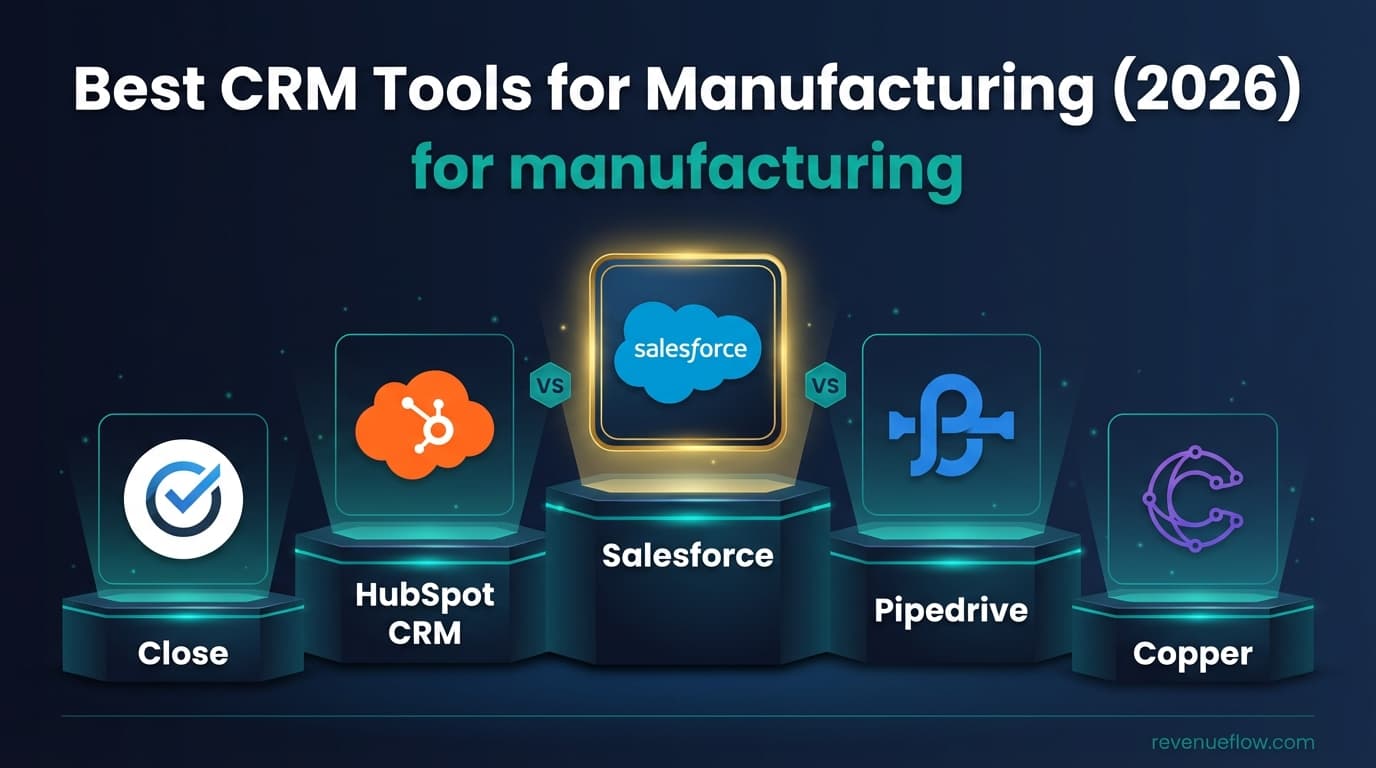
The best CRM tools for Manufacturing in 2026 are HubSpot, Zoho CRM, Freshsales, Salesforce and Pipedrive. Freshsales publishes $9 per user a month billed annually and Salesforce $25 per user a month. HubSpot and Zoho offer free tiers whose paid ladders could not be verified. For manufacturers, the question is whether the record survives the cycle.
Key takeaways
- In an eighteen-month manufacturing cycle the CRM outlives reps and sending tools, so export quality and account hierarchy matter more than dashboards.
- Three of the five vendor pricing pages could be read for this update: HubSpot renders its ladder in JavaScript and Zoho geo-serves its currency, so those two are carried forward unverified, while Pipedrive, which refuses this network with a 403, was read from a United States egress on 1 September 2026.
- Freshsales publishes $9 /user/month, billed annually on Growth and has no free tier, only a 21-day trial, which is easy to miss when comparing it against the two free CRMs on the list.
- Salesforce publishes its full ladder from $ 25 USD/User/Month to $ 550 USD/User/Month, and only the entry tier is offered billed monthly or annually rather than annually only.
Reviewed and updated September 2, 2026
Best CRM Tools for Manufacturing (2026)
A manufacturing deal that closes this year may have started with a conversation at a show two years ago, held by a rep who has since left. Whether that history still exists is a CRM question, and it is the only one that really matters in this industry.
Vertical lists deserve one check before any shortlist, since the products sold as medical sales CRM get ranked against each other as though they competed.
What Manufacturing Companies Need
- Long sales cycle support
- Account-based targeting
- Technical buyer personas
- Trade show follow-up
Long cycles turn the CRM from a reporting tool into an institutional memory. Over eighteen months a deal outlives reps, sending platforms and often the campaign that started it, so the record has to survive staff turnover and tool changes. That puts weight on export quality and on how much context a record can hold, rather than on dashboards.
Account-based targeting is the second demand and it is structural. One plant has a purchasing lead, a plant manager and a process engineer who all talk to each other, so the CRM has to model the account as the primary object with contacts beneath it rather than treating three people as three unrelated rows. Check how the CRM handles company-to-contact relationships and whether reporting rolls up to the account.
Technical buyer personas and trade show follow-up are both field problems. Persona is a field, show is a source field, and the value of both depends entirely on whether the fields get populated at the moment of capture. A CRM that makes capture slow at a show is a CRM whose show data is worthless six weeks later.
How This Guide Was Put Together
Every price here was read off the vendor's own pricing page from a dated snapshot, and each figure is attributed to the page it came from rather than to the vendor. On this list that produced a result worth stating plainly: only two of the five pages could be read.
Freshsales and Salesforce both served a full ladder, so their figures below are verified. HubSpot returned a page whose pricing is rendered by JavaScript, leaving a couple of dozen characters of readable text. Zoho served its pricing in rupees, so its dollar ladder is not in the page that arrived. Pipedrive refused the request with a 403.
For those three, the pricing shown is carried forward unchanged and is not verified as current, which is repeated beside each one. Nothing in the prose reuses those numbers, and the budget section names only figures that were actually read.
No lab test sits behind this either. Nobody here ran five CRM implementations side by side, so the guide makes no claim about which is fastest to deploy. What it does judge is what each pricing model rewards, where each sits relative to an outbound motion, and which shape of team the published plans were drawn for.
Top 5 CRM Tools for Manufacturing
- Contact and company management
- Deal pipeline and tracking
- Email tracking and notifications
- and 5 more listed below
- Lead, contact, and deal management
- Sales automation and workflow rules
- Zia AI assistant with predictions and suggestions
- and 5 more listed below
- Contact, account, and deal management
- Built-in email and phone with call recording
- Freddy AI lead scoring and deal insights
- and 5 more listed below
1. HubSpot CRM
An all-in-one CRM platform with a free tier covering contact management, deal tracking and email, plus separate Hubs for marketing, sales, service and content.
Pricing below is CARRIED FORWARD and UNVERIFIED. The HubSpot pricing page renders its ladder in JavaScript, so no figure on it could be read for this update. Check the page before budgeting.
Starting price on that page, carried forward: Free, with a top tier of $150/mo.
Key Features:
- Contact and company management
- Deal pipeline and tracking
- Email tracking and notifications
- Meeting scheduling
| Plan (HubSpot, carried forward from the previous version, UNVERIFIED) | Price |
|---|---|
| Free | Free |
| Sales Hub Starter | $20/mo |
| Sales Hub Professional | $100/mo |
| Sales Hub Enterprise | $150/mo |
Integrations: Gmail, Microsoft Outlook, Slack, Salesforce, Zapier, Shopify, WordPress, Zoom
Fits a manufacturer wanting one place for marketing and sales without a heavy implementation, with a free tier for a first territory. Its paid ladder could not be read for this update, so budget from the page rather than from here.
2. Zoho CRM
A broad, low-cost CRM from the Zoho ecosystem, with sales automation, multichannel communication, analytics and the Zia AI assistant, integrated across the rest of the Zoho suite.
Pricing below is CARRIED FORWARD and UNVERIFIED. The Zoho CRM pricing page geo-serves its currency and returned rupee pricing rather than the dollar ladder quoted here. Check it in your own currency before budgeting.
Starting price on that page, carried forward: Free, with a top tier of $52/mo.
Key Features:
- Lead, contact, and deal management
- Sales automation and workflow rules
- Zia AI assistant with predictions and suggestions
- Multichannel communication (email, phone, social, live chat)
| Plan (Zoho CRM, carried forward from the previous version, UNVERIFIED) | Price |
|---|---|
| Free | Free |
| Standard | $14/mo |
| Professional | $23/mo |
| Enterprise | $40/mo |
| Ultimate | $52/mo |
Integrations: Zoho Suite (45+ apps), Google Workspace, Microsoft 365, Slack, Zapier, Mailchimp, Shopify, QuickBooks
Popular with mid-sized manufacturers on cost, particularly where several Zoho products are already in use. Its dollar figures could not be verified here because the page geo-serves currency.
3. Freshsales
An AI-assisted CRM from Freshworks combining contact and deal management with built-in email and phone, and Freddy AI for lead scoring and deal insights.
From the Freshsales pricing page, read for this update: $9 /user/month, billed annually on Growth, up to $59 /user/month, billed annually on Enterprise.
| Plan (Freshsales pricing page) | Price | Billing basis |
|---|---|---|
| Growth | $9 /user/month | billed annually |
| Pro | $39 /user/month | billed annually |
| Enterprise | $59 /user/month | billed annually |
Three details from that page change the arithmetic. Those are the page's ANNUAL prices, shown with a Monthly and an Annually toggle at Save 20%, so a monthly commitment costs more. There is no free tier, only a 21-day trial. And the page prices two add-ons separately: Branded documents at $19/user/month, and the Freddy AI Agent at $49 /100 sessions.
Key Features:
- Contact, account, and deal management
- Built-in email and phone with call recording
- Freddy AI lead scoring and deal insights
- Visual sales pipeline management
Integrations: Freshworks Suite, Gmail, Microsoft Outlook, Slack, Zoom, Zapier, Segment, Shopify
Reasonable for a compact commercial team, at a published $9 /user/month, billed annually, with phone built in, which suits an industry where deals still move on calls. Territory management appears on its higher tiers rather than the entry one.
4. Salesforce
The largest CRM platform, with sales, service, marketing and commerce products, deep customisation, Einstein AI and the AppExchange ecosystem.
From the Salesforce pricing page, read for this update: $ 25 USD/User/Month on Starter Suite, up to $ 550 USD/User/Month on Agentforce 1 Sales.
| Plan (Salesforce pricing page) | Price | Billing basis |
|---|---|---|
| Starter Suite | $ 25 USD/User/Month | Billed monthly or annually |
| Pro Suite | $ 100 USD/User/Month | Billed annually |
| Enterprise | $ 175 USD/User/Month | Billed annually |
| Unlimited | $ 350 USD/User/Month | Billed annually |
| Agentforce 1 Sales | $ 550 USD/User/Month | Billed annually |
Two things there are worth carrying into a plan. Only Starter Suite is offered billed monthly or annually; every tier above is billed annually, so the entry tier is the only one not asking for a year up front. And the page runs a currency converter rather than geo-forcing one, publishing GBP beside USD at £ 20, £ 80, £ 140, £ 280 and £ 440, the cleanest currency disclosure on this list.
Key Features:
- Lead, account, and contact management
- Opportunity and pipeline tracking
- Einstein AI-powered analytics and predictions
- Sales forecasting and territory management
Integrations: Slack, Google Workspace, Microsoft Outlook, Mailchimp, DocuSign, Zapier, Tableau, MuleSoft
The usual destination for manufacturers with distributors, territories and forecasting to manage, and the only ladder on this list published in full. Territory management and forecasting are the reasons this industry ends up here, and they are priced accordingly.
5. Pipedrive
A sales-first CRM built around a visual deal pipeline and activity-based selling, with workflow automation and an AI sales assistant.
Pricing below was read from Pipedrive's own pricing page on 1 September 2026. Every direct route from our network is still refused with a 403, so the page was read from a United States egress, and the document it returned names its own state: "country":"us", prices in US dollars, and a billing toggle whose accessibility label reads "Currently selected is Billed annually". That also retires the five-tier ladder the previous version carried. Pipedrive renamed and merged its plans, so Essential is now Lite, Advanced is Growth, Professional and Power are both Premium, and Enterprise is Ultimate.
Starting price on that page: US$14 per seat per month, billed annually.
Key Features:
- Visual deal pipeline management
- Activity-based selling methodology
- Email sync with templates and tracking
- Workflow automation builder
| Plan (Pipedrive's own pricing page, read 1 September 2026) | Per seat per month | Billed annually |
|---|---|---|
| Lite | US$14 | US$168 per seat per year |
| Growth | US$39 | US$468 per seat per year |
| Premium | US$59 | US$708 per seat per year |
| Ultimate | US$79 | US$948 per seat per year |
Integrations: Google Workspace, Microsoft Outlook, Slack, Zoom, Zapier, Mailchimp, Trello, Asana
Suits a manufacturer whose sales motion is a straightforward pipeline run by a few reps. Its pricing page refuses our network, so the figures above were read from a United States egress on 1 September 2026. A visual pipeline CRM that names manufacturing on its own homepage, with a dollar and a pound ladder served by location and a three user floor on its entry tier, is read on this site's Pipeliner CRM pricing page, under the vendor's new name Coevera.
What the CRM Actually Has to Do With Outbound
A CRM does not send cold email and does not improve deliverability, so the reason it belongs in an outbound stack is narrower than a feature list suggests: it is the record of truth that outlives every other tool in that stack.
Sending platforms get replaced, warmup subscriptions lapse, sequences get rebuilt. What survives is who was contacted, when, and what they said, because that record stops the same person being pitched twice and settles a dispute about whether a meeting counted. So the practical test of a CRM in an outbound context is whether activity arrives intact and attributable, which is a question about the write-back path rather than about features.
Two consequences follow, both cheap now and expensive later. Decide which system is the record of truth before integrating anything, because a team treating both as authoritative reconciles them monthly. And agree the qualification criteria in writing before the first campaign, in the CRM's own fields, so a meeting is judged against a definition rather than a memory. Budget, timing and authority are never among those criteria.
The house rule follows: one message per campaign, no bumps and no thread replies. A CRM will happily record a five-touch sequence, and recording it does not make it a good idea.
Comparison Table
| Tool | Entry price | Verified for this update? |
|---|---|---|
| HubSpot CRM | Free tier, paid ladder carried forward | No, the pricing page is JS-rendered |
| Zoho CRM | Free tier, paid ladder carried forward | No, the pricing page geo-serves currency |
| Freshsales | $9 /user/month, billed annually | Yes, read from the pricing page |
| Salesforce | $ 25 USD/User/Month | Yes, read from the pricing page |
| Pipedrive | Carried forward | No, the pricing page returned 403 |
Recommendation by Budget

The verified entry point. Freshsales publishes $9 /user/month, billed annually on Growth, the lowest verified per-seat price here. Note the unit and basis: per user, at the annual rate, with that page offering Save 20% on annual against monthly.
The verified enterprise ladder. Salesforce publishes $ 25 USD/User/Month for Starter Suite billed monthly or annually, then $ 100, $ 175, $ 350 and $ 550 USD/User/Month billed annually. It is the only page here showing a whole ladder in one place and in your own currency.
The free tiers. HubSpot and Zoho both offer a free CRM tier, and neither page could be read, so treat the paid steps above them as unconfirmed. Freshsales has none at all, only a 21-day trial, which is easy to miss when comparing entry prices.
Before budgeting, open the three unread pages yourself. A CRM is a multi-year commitment with migration costs at both ends, and the last place to plan against a number nobody verified this week.
How to Choose for Manufacturing
Does the account, not the contact, sit at the centre? Three people at one plant are one account. A CRM that cannot roll reporting up to the account will mislead you about where a deal actually is.
Will the record survive the cycle? Eighteen-month deals outlive reps and tools. Check the export format now, not when you migrate.
How fast is capture at a show? Trade show data has a short half-life. If tagging a source and a persona takes more than a few seconds on a phone, it will not happen.
Does it handle territories and distributors? This is the feature that pushes manufacturers up a tier or across a vendor, so price it before choosing rather than discovering it at renewal.
Which system is the record of truth? Decide before integrating the sending tool, because a long cycle gives a reconciliation problem plenty of time to compound.
Getting It Adopted
- Step 1Define first
Write the stage definitions and the qualified-meeting criteria before configuring anything
- Step 2Model the account
Decide what an account is and how contacts hang beneath it, before the first import
- Step 3Set permissions
Agree who sees what while the CRM is still empty, because retrofitting means auditing every record
- Step 4Then integrate
Test write-back with real records and real owners, and name one system as the record of truth
Model the account structure before importing anything. Manufacturers commonly import a contact list and discover later that the CRM has no idea two hundred of those contacts work at forty companies, and fixing that after automations are built is genuinely painful.
Then make capture fast and make source tagging mandatory at the point of entry, especially for shows. A field that is optional at capture is empty in reporting, and show attribution is the number this industry most often wants and least often has.
Keep outbound activity writing into the same account record, and keep one message per campaign. A plant engineer who did not answer has answered; the CRM's job is to remember that, not to schedule the follow-up.
Where the Tool Stops Mattering
The tool stops mattering at discipline over a long horizon. A CRM that is updated properly for six months and abandoned in month seven produces a record that looks complete and is not, which is more dangerous than an obviously empty one.
The second limit is the specification. Technical buyers move on a concrete claim about their operation, and no CRM writes that sentence. It only ensures the right person receives it and that somebody remembers what happened next.
Final Thoughts

Territories, distributors and forecasting: Salesforce, ladder fully published. Compact commercial team wanting phone built in: Freshsales at a published $9 /user/month, billed annually. Marketing and sales in one place with a free start: HubSpot. Cost-led and already on Zoho: Zoho CRM. A simple pipeline for a few reps: Pipedrive.
Related Reading
- Best HubSpot CRM Alternatives in 2026
- Best Zoho CRM Alternatives in 2026
- Best Salesforce Alternatives in 2026
- Best Pipedrive Alternatives in 2026
- Best Freshsales Alternatives in 2026
- Email sending tools for manufacturers
If you would rather have this run for you, RevenueFlow books qualified meetings on a pay-per-meeting basis and publishes client results.
Pricing and features are taken from the vendors' own pages where those pages could be read, and are carried forward unverified where they could not. Verify current terms with the vendor before relying on them.
Frequently asked questions.
Frequently asked questions- What matters most in a CRM for manufacturing?
- Account hierarchy and durability. Three contacts at one plant are one account, and a CRM that cannot roll reporting up to the account will misrepresent where a deal stands. Because these cycles outlive reps and tools, check the export format at the start rather than at migration time.
- How should a manufacturer handle trade show data?
- Make source tagging mandatory at capture rather than optional. Trade show data has a short half-life, and a source field that is optional at entry is empty in reporting six weeks later, which is exactly when somebody asks which show produced the pipeline.
- Why can't you verify the prices for some of these CRMs?
- Two of the five pages could not be read. HubSpot renders its pricing in JavaScript, so the fetched document carried a couple of dozen characters of text. Zoho geo-serves its currency and returned rupee pricing rather than dollars. Their figures here are carried from the previous version and marked unverified. Pipedrive refuses this network with a 403 as well, but it was read from a United States egress on 1 September 2026, so its figures are current.
- Does a CRM help with cold email deliverability?
- No. A CRM does not send cold email and has no effect on inbox placement, which is decided by your sending domains, warmup, list quality and volume. What the CRM does is hold the record that outlives your sending platform: who was contacted, when, what they said, and whether they asked not to be contacted again.
About the author.

B2B cold email experts helping companies generate qualified leads through done-for-you outreach campaigns.
RevenueFlow Team
Explore more.
Ready to scale your outreach?
We build GTM engines that book real meetings. See the receipts.
Related articles.
CRM Report Template: Four Reports, Field by Field
A CRM report template is four saved queries: pipeline by stage, activity by owner, conversion by source and stale deals, each with its filter, fields and formulas.
Which CRMs and Tools the Outbound Stack Connects To: Integration Data From 342 Sales Tools
HubSpot is named as an integration by 52.3% of 342 verified sales tools, Zapier by 50.3% and Salesforce by 43.3%. Here is the full map by category.
Sales Data: The Classes, and Which Ones You Can Buy
Sales data covers two collections with almost nothing in common: the account attributes a provider sells you, and the outcomes only your own sending produces.
Best CRM for Google Workspace: What Lives in Gmail
Working with Google Workspace covers four separate integrations, and most of the category ships as a browser extension. What five vendors publish about theirs.
Best Time to Cold Call: What the Studies Counted
The best time to cold call figures traced to their originals: one inbound study from six companies, three vendor call datasets, and what survives the read.
Best Time to Send a Sales Email: What Was Measured
The send time studies behind the midweek morning answer, what each one actually counted, and why a broadcast finding does not transfer to a sales email.