Bitrix24 vs HubSpot: Per Organisation or Per Seat
Both free tiers stop at two users, so the comparison starts at the third person. One vendor then charges by the seat and the other by the account.
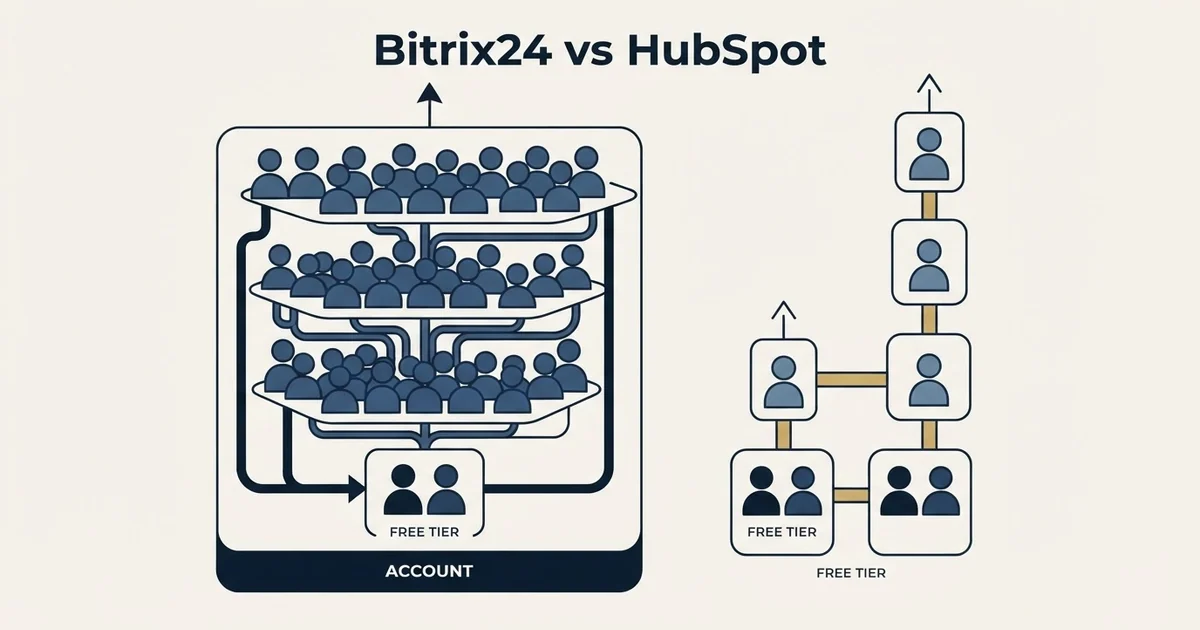
HubSpot sells a CRM priced per seat across three paid tiers, with marketing and service as separate layers. Bitrix24 sells a workspace priced per organisation, with user allowances stepping from five to fifty to one hundred, and the CRM inside it. Count the logins you would issue if they were free.
Key takeaways
- Both free tiers cap at two users on the vendors' own pages, so the shared free entry point says nothing about how the paid products compare.
- HubSpot publishes Starter, Professional and Enterprise as rates per seat per month, with a footnote that the entry discount applies to new customers only.
- Bitrix24 publishes a flat rate per organisation, with paid plans stating five, fifty and one hundred users included.
- A seat meter rations access and keeps the record specialist; an account meter invites the whole company in and makes it a general system.
Reviewed and updated September 2, 2026
Both free tiers stop at two people. HubSpot's own CRM product page on hubspot.com states that "With up to two users, 1,000 contacts, and no limits on customer data" its free functionality is "100% free, with no expiration date". Bitrix24's pricing page describes its own free plan as free for one to two users. Both were read on 2 September 2026. The free tier that draws most people into this comparison is the same size on either side, which means the comparison starts at the third person you add.
From that point the two products stop resembling each other, and not in the way a feature grid suggests. They diverge on what the subscription counts.
One meter counts people, the other counts organisations
HubSpot prices per seat. Its CRM product page on hubspot.com publishes Starter at "Starts at $15/month per seat", Professional at "Starts at $50/month per seat" and Enterprise at "Starts at $75/month per seat", with a footnote reading "Discount available for new customers only". Add a person and the bill goes up by one seat.
Bitrix24 prices per account. Its pricing page carries the line "A flat rate for all users included in your plan" under a heading reading "One flat rate. One platform.", and each paid plan card states how many users the rate covers: the entry paid plan "includes 5 users", the next "includes 50 users" and the third "includes 100 users", while the top tier drops the fixed allowance for a user count you select. Add a person and, until the allowance runs out, nothing happens to the bill at all.
That is the entire structural difference, and it is worth more than any capability comparison, because it changes what happens to the cost of a decision. On a seat meter, giving the office manager and two contractors a login is a recurring cost that somebody has to justify. On an account meter with fifty users included, it is free, so more of the business ends up inside the system.
- Free tier capped at two users and a stated contact allowance
- Each paid tier is a rate per seat per month
- Adding a person adds a recurring line to the bill
- Sales, marketing and service are separately priced layers
- Entry rate carries a new-customer discount footnote
- Free plan stated as covering one to two users
- Each paid plan is a rate per organisation with users included
- Allowances step from five users to fifty to one hundred
- CRM, tasks, projects, telephony and a site builder in one account
- Rate card renders in the currency of the requesting region
Which product each one actually is

HubSpot's CRM product page lists contact management, deal pipelines, CRM import, an assistant and a reporting dashboard on the free tier, and its whole architecture is a CRM foundation with separately priced layers on top. The upgrade path is deliberately gentle: the page promises that you can "Simply upgrade your free account to get advanced CRM capabilities whenever you're ready." What that phrasing hides is that the upgrade is usually not one decision. It is a decision per layer, taken over a year, by whoever needs the next thing.
Bitrix24 is not a CRM with layers. It is a workspace containing a CRM. Its own product navigation on bitrix24.com puts sales management, a contact centre, sales team collaboration, sales enablement and mobile CRM under one heading, and then puts tasks and projects, collaboration, a site builder and human resources tooling beside it as peers. Its CRM section describes itself as a place to "Manage leads, deals, contacts, pipelines, access permissions & roles", which is a full pipeline product, but the product it sits inside is a general operating system for a small company.
The practical consequence is about who else ends up in the tool. A CRM is used by the people who sell. A workspace is used by everybody, and the pricing model is built to make that happen. A company that wanted a sales CRM and bought a workspace usually discovers this when the sales pipeline turns out to be one tab among eleven that reception also has open.
What the plan ladder tells you about the intended buyer
Bitrix24 labels its own tiers by company shape rather than by feature set. The entry paid plan is described on the page as one that "Works for solopreneurs and small teams getting off the ground", the next as "Best for mid-sized businesses, expanding their operations", and the one above as "Ideal for scaling companies that run on deep automation", with the top tier offering "Maximum data protection, speed, and unlimited business growth". The sales capabilities arrive across those steps: unlimited leads and invoicing on the second paid tier, sales automation and call tracking on the third.
Read against the user allowances, that ladder says something specific. A five-user plan aimed at solopreneurs and a fifty-user plan aimed at mid-sized businesses is a product expecting the whole company on the account, not a sales team on a CRM.
HubSpot's ladder is the opposite reading. Required fields, permission sets and multiple currencies arrive at Starter; an AI customer agent, duplicate management and custom reporting at Professional; custom objects, teams, single sign-on and field-level permissions at Enterprise. Those are the concerns of an organisation whose sales operation has grown its own administrative requirements, and they are priced per person who has one.
- Yes: Count the people who need a login, then count the people you would give one to if it were free
- Yes: Decide whether tasks, projects and internal chat should live with the sales record
- Yes: Read both rate cards on the vendors' own pages, in your own currency
- Yes: Check which sales capabilities sit on the tier you were going to buy rather than above it
- Yes: Ask who will own the configuration once the tool covers more than selling
- No: Comparing the two entry prices without noting that one covers five people and one covers one
- No: Treating the shared free tier as evidence the paid products are comparable
The arithmetic that usually settles it

The example below is invented to show how the two meters behave. It uses the HubSpot rates attributed above and no Bitrix24 figure at all, because the Bitrix24 rate card arrived in the currency of the region the request came from rather than in the currency a reader elsewhere is quoted. Every quantity here is invented.
Take an invented company of four salespeople and eight other staff. On HubSpot, the sensible configuration is four Starter seats, because giving the other eight a login costs money for data they would rarely open. On Bitrix24, the cheapest paid plan already covers five users and the next covers fifty, so the same company has no reason to ration access at all, and the record ends up containing operations, support and delivery activity as well as deals.
Both outcomes are defensible and they are different products by the time the year ends. The first is a sales system with clean boundaries and a smaller population maintaining it. The second is a company system with a fuller picture and more people able to change a record nobody asked them to change.
The question that decides it is not which is cheaper. It is whether the sales record should be a specialist system or part of the general one, and the pricing model of each vendor is a strong hint about which answer it was designed for.
Where either one sits in a cold outbound stack
Neither product should be the sending layer for cold volume. Both can send email, and both would send it from the company's own domain, which puts the deliverability of invoices, support replies and everything else on the same reputation. Cold sending belongs on dedicated mailboxes and separate sending domains, and the CRM's job is the record at the end of it.
Bitrix24 carries more of that risk by design, because email marketing, telephony and a contact centre are inside the same account as the pipeline, so switching on a broadcast is a configuration decision rather than a purchase. That convenience is real and it removes the procurement step that would otherwise force somebody to think about sending reputation.
What either product needs to do well for an outbound programme is narrow. The meeting has to be recorded against the account with enough structure to join it back to the campaign that produced it. The list of accounts that are off limits has to export cleanly, because that is what the next build suppresses against. And meetings are qualified against criteria agreed in writing before launch, so whichever system holds that definition should hold it as a field rather than as a note somebody typed. Where the boundary between the CRM and the sending tool should sit is worked through in connecting a CRM to the sending layer.
Both vendors also sell chains of scheduled messages to a contact who did not answer, which is standard practice in this category and is not how campaigns run here. This site sends one message per campaign, with no bumps and no thread replies, for the reasons set out in why we stopped using follow-ups. Weight that part of either feature list accordingly.
The short version

The shared free tier is a coincidence of packaging rather than a similarity between the products. Both stop at two users, and everything interesting happens after that.
HubSpot sells a CRM priced per seat, with the sales operation's administrative features distributed up a three-tier ladder, and separately priced layers for marketing and service. Bitrix24 sells a workspace priced per organisation with user allowances stepping from five to fifty to one hundred, and the CRM is one of its parts.
Count the logins you would issue if they were free, because that number tells you which meter you are. Where HubSpot is the incumbent and the free tier has just run out at two people, the four CRMs whose entry rates were read at that size are compared in HubSpot alternatives for a small business. If neither tool is the actual constraint and the pipeline is thin rather than badly recorded, see what a campaign built for your market produces first. If HubSpot is the incumbent and the question is what else exists, the field is in the alternatives to HubSpot CRM worth a look, and how this category splits into four separate purchases is covered in the four things sold as sales automation software.
Plans, user allowances and free-tier limits verified against each vendor's own pages on 2 September 2026, with dated snapshots retained. Both pricing pages carry billing toggles and render regional currencies, so read current terms in your own browser before relying on them.
Sources: HubSpot CRM product page, Bitrix24 pricing, Bitrix24
Frequently asked questions.
Frequently asked questions- Is Bitrix24 cheaper than HubSpot?
- The two rate cards count different things, so the comparison depends on headcount. HubSpot charges per seat, so its total multiplies by the number of logins. Bitrix24 charges per organisation with users included, five on its entry paid plan and fifty on the next. Read both pages in your own currency, since one rendered a regional rate card here.
- Do both Bitrix24 and HubSpot have a free plan?
- Yes, and both stop at two users. HubSpot's CRM product page states its free functionality covers up to two users and 1,000 contacts with no expiration date. Bitrix24's pricing page describes its free plan as covering one to two users. The free tiers are the same size, which is why they settle nothing.
- Is Bitrix24 a CRM or something else?
- It is a workspace containing a CRM. Its own product navigation puts sales management, contact centre, sales collaboration and mobile CRM under one heading, then puts tasks and projects, collaboration tooling, a site builder and human resources features beside it as peers. The pipeline is a full product; it sits inside a general operating system for a small company.
- Can either one run cold outreach?
- Neither should be the sending layer. Both can send, and both would send from the company's own domain, which puts the deliverability of every other message on the same reputation. Bitrix24 carries more of that risk because email marketing and telephony sit inside the same account, so switching on a broadcast needs no purchase decision.
About the author.

B2B cold email experts helping companies generate qualified leads through done-for-you outreach campaigns.
RevenueFlow Team
Explore more.
Ready to scale your outreach?
We build GTM engines that book real meetings. See the receipts.
Related articles.
Best CRM for Google Workspace: What Lives in Gmail
Working with Google Workspace covers four separate integrations, and most of the category ships as a browser extension. What five vendors publish about theirs.
Which CRMs and Tools the Outbound Stack Connects To: Integration Data From 342 Sales Tools
HubSpot is named as an integration by 52.3% of 342 verified sales tools, Zapier by 50.3% and Salesforce by 43.3%. Here is the full map by category.
Seamless.AI Email Finder: How It Works, What a Credit Buys
How Seamless.AI's email finder resolves a contact in real time, what one Universal Credit buys, the Total AI score on every address, and what the Chrome extension reads.
Social Selling Tools by Job, and the Account-Risk Line
Fourteen social selling tools sorted into six jobs, split by whether each acts through your LinkedIn account or beside it, from the vendors' own pages.
Is Clay Free? The Free Plan, the Trial and Where Each Stops
Clay's free plan, its 14-day trial and the no-charge-on-a-miss rule are three different things. What each holds and where it stops, from clay.com on 19 September 2026.
Video Prospecting Tools by Job: What Each One Is For
Ten video prospecting tools sorted by the job each vendor's own page describes: record and share, personalise at volume, avatars, hosting and interactive demos.