Closely Pricing: Per LinkedIn Account, Not Per Seat
Closely counts LinkedIn accounts rather than people and hands every tier unlimited email inboxes, which inverts the ladder for agencies against sales teams.
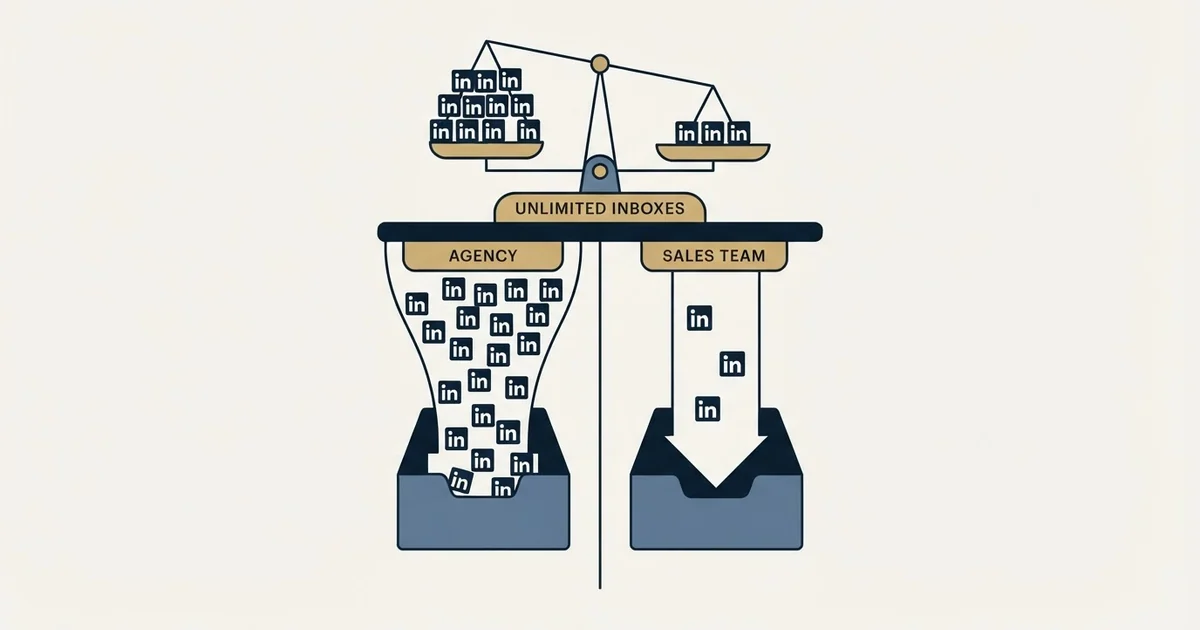
Closely publishes three named tiers in both billing states, counting LinkedIn accounts rather than seats, with unlimited email inboxes and white label on every tier. Enrichment arrives as a monthly bonus credit grant that converts at published rates. A separate flat rate agency product covers unlimited managed seats.
Key takeaways
- The unit is the LinkedIn account, not the person: tiers grant one, three and five accounts while email inboxes are unlimited on all of them.
- Billed monthly the tiers are $49, $127 and $205; billed annually they are $29, $87 and $145 a month, invoiced at $348, $1,044 and $1,740 for the year.
- Credits convert at four per email lookup, twenty per phone lookup and two per AI personalisation, and the entry tier's card carries no credit line at all.
- The vendor's own blog and its own pricing page disagree about whether the entry tier includes credits, and only the blog publishes a rate for the custom tier.
Reviewed and updated September 2, 2026
Most outbound tools bill you per seat. Closely bills you per LinkedIn account, hands you unlimited email inboxes on every tier, and defines the unit in one line on its own pricing page: one sender equals one LinkedIn account plus one email inbox. That single decision changes which team this is cheap for and which team it is expensive for, and it is invisible in any comparison that lines up monthly rates side by side.
Read on 2 September 2026, closelyhq.com/pricing publishes a full ladder in both billing states, a credit system with a published conversion rate, a flat rate agency product, and one number its own blog contradicts. Here is what each part actually costs and what it buys.
The published ladder, in both billing states
The page invites you to "Choose a plan that fits your pace", renders a monthly view and an annual view behind a toggle labelled as forty percent off, and keeps the plan names the same across both.
Under the line "Whether you're just starting or scaling fast, Closely's pricing adapts to your outbound goals", the page publishes monthly rates of $49 for Starter with one LinkedIn account, $127 for Growth with three, and $205 for Essential with five. A fourth card reads Custom and carries no rate.
Billed annually, the same page publishes Starter at $29 a month and $348 for the year, Growth at $87 a month and $1,044 for the year, and Essential at $145 a month and $1,740 for the year, with every card repeating "Save more by bundling Senders and Credits together with the All-in-One plan". The annual figures are the ones the page shows by default on the yearly view, and both totals reconcile against their monthly equivalents.
Every tier, at every billing state, carries "Unlimited email accounts" and "Whitelabel included" on its card. The differences between them are the number of LinkedIn accounts and the monthly bonus credit grant. Growth adds 3,000 credits a month, Essential adds 5,000, and Starter carries no bonus credit line on the card at all.
The unit is the LinkedIn account, and that is the whole story
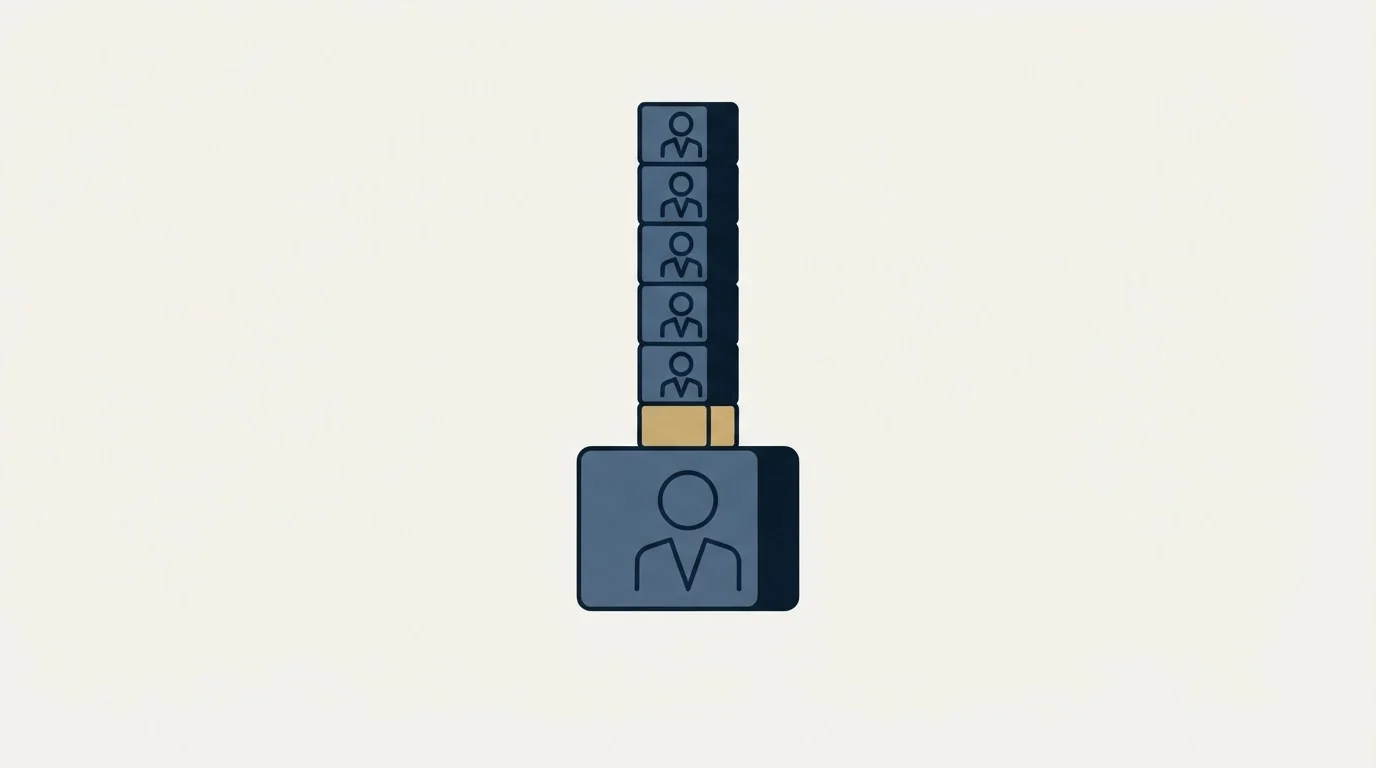
The sender definition sits under every plan card, and it is doing more work than any other line on the page: "1 sender = 1 LinkedIn account + 1 email inbox". LinkedIn accounts are what the ladder counts. Email inboxes are explicitly unlimited on every tier, including the cheapest one.
Work out what that means for two different teams and the ladder inverts.
A three person sales team where each person sends from their own LinkedIn profile needs three LinkedIn accounts, so it is on Growth whatever its email volume. An agency running cold email for ten clients from forty domains needs a lot of inboxes and perhaps one LinkedIn account, so it can sit on Starter and add mailboxes without the bill moving. Per seat tools price those two teams the other way around.
That is a real design position rather than a pricing quirk, and it maps onto how the two channels actually behave. LinkedIn capacity is bounded by the account, because the platform enforces limits per profile and a second profile is a second person's identity. Email capacity is bounded by domains and warmup, which is inventory you can add. Pricing each channel on its own constraint is more honest than pricing both on headcount, and it is worth knowing before comparing this ladder against a per seat LinkedIn automation tool.
- Each seller sends from their own LinkedIn profile
- Three LinkedIn accounts means the middle tier
- Unlimited inboxes are surplus to requirements
- The bill follows headcount because identities do
- One or two LinkedIn accounts across all clients
- Dozens of sending domains and inboxes cost nothing extra
- The entry tier can carry a large email programme
- White label is included rather than a tier gate
The credit conversion, which is where enrichment gets priced
Bonus credits are the enrichment meter, and the page publishes the conversion instead of leaving it to a support article. The Growth card reads "Bonus: 3,000 credits / mo" and converts them as "750 emails or 150 phones or 1,500 AI personalizations". Five thousand credits on Essential converts to 1,250 emails, 250 phones or 2,500 personalisations.
Divide those out and the internal rate is consistent across both tiers. An email lookup costs four credits, a phone lookup costs twenty, and an AI personalisation costs two. The vendor's own blog states the same three rates directly, describing them as "email searches (4 credits per search), phone lookups (20 credits each), or AI personalizations (2 credits each)", so the two surfaces agree here.
The ratio is the useful part. A phone number costs five times what an email address costs on this meter, which is the same shape most contact databases publish and a reminder that a plan sized for email volume will not carry a dialling programme. And because the credits are a bonus attached to the subscription rather than a separately purchasable pool on the published page, running out is a tier question rather than a top up question, at least as far as the pricing page goes.
Starter is the plan to read carefully here. Its card lists no bonus credits, which means the entry tier is a sending tool rather than a sourcing one. Anyone budgeting Starter on the assumption that enrichment is included is budgeting the wrong plan.
The vendor's own two pages disagree about Starter

This is the finding worth carrying into a purchase, and it is not a third party error.
Closely's own blog publishes a pricing breakdown headed "Starter Plan: $49/Month" that states the Starter plan provides 1,000 monthly credits, and two paragraphs later its own comparison table gives Starter a bonus credit count of zero against the note "No enrichment credits included". The pricing page itself lists no credit line on the Starter card. Two of the three statements agree and one does not, and all three are on the vendor's own domains, read on 2 September 2026.
The same blog also prices a fourth tier the pricing page leaves blank. It publishes Custom at $350 a month, or $206 a month billed annually, for ten LinkedIn accounts and tailored credits, describing it in its own words: "The Custom plan is built for enterprise-level operations and large agencies". The pricing page shows a Custom card with a start free trial button and no rate anywhere on it.
Neither of those is a scandal. Marketing pages and blog posts drift apart at every software company. It is a reason to do one specific thing: get the Starter credit grant and the Custom rate confirmed in writing before signing, because a published number that the vendor's other published number contradicts is not a number you can plan against.
- Yes: The three named tiers and their LinkedIn account counts are published consistently
- Yes: Both billing states are published with annual totals that reconcile
- Yes: The credit conversion rate for emails, phones and personalisations is published on both surfaces
- No: Whether the entry tier includes any enrichment credits
- No: What the Custom tier costs, since only the blog prices it
- Depends: Which of the two promotional discount codes actually applies at checkout
Two promotions rendered at once
The page carried two promotional banners simultaneously at the time it was fetched. One reads "Enjoy 20% off all Closely subscription plan" and "Use promo code BLACKFRIDAY20 at checkout". The other announces "Christmas & New Year 2026 Spectacular Deals" and "15% off all Closely plans", on the same page, at the same moment. The footer of the same page reads 2021 to 2025.
Read that as a caution about the discount rather than about the company. The advertised rate and the transacted rate are not the same thing on a page carrying two live codes at once, so the number to write into a budget is whatever the checkout charges, not whatever the card shows. It also means a comparison built by scraping this page on a given day may be comparing a promotional rate against a rival's list rate.
The white label product is a different business
The lower half of the pricing page is an agency offer, and it is priced on a completely different axis from everything above it.
Flat pricing carries its own arithmetic, and a platform fee that already covers five users shows how a fixed charge moves the cost per person.
The answers section states "Pay $999/month fixed price regardless of how many seats you manage", with no per seat fee and no usage caps. It states that "White-label setup is FREE on all plans" and that you can "Cancel with 30 days notice", and the customisation list opens with "Complete platform customization with your logo, colors, and custom domain" before covering subdomain structure, email templates, help centre content, support addresses and onboarding sequences. The page states that "Everything is white-labeled", that clients see the agency's branding throughout, and that support responds under the agency's brand.
Two claims in that section are the vendor's claims about other vendors rather than facts established here. Against its own "Pay $999/month fixed price regardless of how many seats you manage", Closely states that a competing platform charges $1,999 a month for the same unlimited seat position, and that competitors charge between $997 and $2,500 for white label setup that it includes at no cost. Those are attributed to Closely, they are the sort of figure a competitor page exists to publish, and nothing on that page verifies them. RevenueFlow runs its own LinkedIn outreach through HeyReach as a matter of documented practice, which is a reason to read a competitor's figure about it with the same scepticism as any other.
The agency arithmetic on the page follows the same pattern. Beneath the same "Pay $999/month fixed price regardless of how many seats you manage" line it works an example at one hundred seats charging one hundred and fifty dollars each, reports the resulting margin, and publishes a retention claim about agencies staying past twelve months. Those are illustrative and self reported respectively, and they belong in the same bucket as the response rate figure in the testimonial row: vendor claims, useful for understanding the offer, not evidence about outcomes. If the agency model is the reason you are here, the economics of reselling a platform matter more than the platform fee does.
- Step 1Count LinkedIn identities, not people
The plan tiers count LinkedIn accounts. Email inboxes are unlimited on every tier, so the sending side does not move the bill.
- Step 2Decide whether enrichment is in scope
The entry tier carries no bonus credit line, so a plan that needs email or phone lookups starts a tier higher than the ladder suggests.
- Step 3Convert credits into work
An email lookup, a phone lookup and an AI personalisation cost different amounts from the same pool. Size the pool against the mix you will actually run.
- Step 4Confirm the contradicted lines
Get the entry tier credit grant and the custom tier rate in writing, because the vendor's own two surfaces do not agree on either.
Reading the pages that rank around it
One quirk of this SERP deserves a sentence. A well known customer relationship management product with a similar name ranks on the same query, and several review sites carry both. Check which product a review is about before taking its complaints seriously, because the two are not in the same category at all.
The independent guides carry the same drift as the vendor's own blog, whose Starter row reads "No enrichment credits included" a few lines under a sentence granting it a thousand. Several of them publish credit allowances for the entry tier and a rate for the custom tier, both of which the vendor's pricing page leaves blank, which is how a figure with no current source becomes consensus. Take the ladder off the pricing page, note the date, and use everything else as a prompt to ask.
Guides drift furthest where the vendor publishes nothing, and three packages all priced by contact sales leave the figures in search results uncheckable.
If the underlying question is whether a LinkedIn and email programme is the right channel at all rather than which platform runs it, that is settled by looking at how fast each channel answers rather than by any pricing page. RevenueFlow builds and runs those campaigns and charges per attended qualified meeting, one message per campaign with no bumps and no thread replies, against criteria agreed in writing before launch. You can see what a first campaign against your market produces before buying a platform to run it yourself.
The short version

Closely publishes a complete ladder in both billing states, under the sender rule "1 sender = 1 LinkedIn account + 1 email inbox". Monthly, the page publishes Starter at $49, Growth at $127 and Essential at $205. Annually, the same page publishes $29, $87 and $145 a month, billed at $348, $1,044 and $1,740 for the year. The tiers count LinkedIn accounts, one, three and five respectively, and every tier carries "Unlimited email accounts" and "Whitelabel included".
Enrichment is a bonus credit grant of 3,000 a month on Growth and 5,000 on Essential, converting at four credits an email, twenty a phone and two an AI personalisation. Starter's card carries no credit line, and the vendor's own blog contradicts itself on whether it has one. The agency product is a separate published flat rate of $999 a month for unlimited seats.
Price this by counting LinkedIn identities rather than people, confirm the entry tier's credit grant in writing, and check the checkout rather than the card while two discount codes are running.
Plan rates, the sender definition, credit conversions, promotional codes and the white label terms above are taken from Closely's pricing page, fetched 2 September 2026, with a dated snapshot retained. The contradicting figures are from blog.closelyhq.com, fetched the same day and attributed to it. Verify current terms with the vendor before relying on them.
Frequently asked questions.
Frequently asked questions- How much does Closely cost?
- Read from closelyhq.com/pricing on 2 September 2026, the monthly rates are $49 for Starter, $127 for Growth and $205 for Essential. On annual billing the same three tiers are $29, $87 and $145 a month, invoiced at $348, $1,044 and $1,740 for the year. A fourth Custom card carries no rate on the pricing page.
- Does Closely charge per user?
- No. The plan cards count LinkedIn accounts, one on Starter, three on Growth and five on Essential, and the page defines a sender as one LinkedIn account plus one email inbox. Email accounts are listed as unlimited on every tier. That means a team's bill follows how many LinkedIn identities it sends from rather than how many people have logins.
- What do Closely credits buy?
- The pricing page publishes the conversion directly. Three thousand credits a month is described as 750 emails or 150 phones or 1,500 AI personalisations, and five thousand as 1,250 emails or 250 phones or 2,500 personalisations. That works out at four credits an email lookup, twenty a phone lookup and two an AI personalisation, consistent across both tiers.
- What does the Closely white label plan cost?
- The pricing page's own answers section states a flat rate of $999 a month for unlimited managed seats with no per seat fee and no usage caps, free setup and thirty days cancellation notice. The same section makes comparative claims about rival platforms' rates and setup fees. Those are the vendor's claims about other vendors and are not verified here.
About the author.

B2B cold email experts helping companies generate qualified leads through done-for-you outreach campaigns.
RevenueFlow Team
Explore more.
Ready to scale your outreach?
We build GTM engines that book real meetings. See the receipts.
Related articles.
LinkedIn Outreach for Utilities: Selling to the Sector
How a vendor selling to utilities uses LinkedIn next to a published sourcing process: the three ownership models, the registration gate and what a message may ask.
LinkedIn Outreach for Marketing Agencies
How a marketing agency wins its own clients on LinkedIn: the published agency search process, the platform rules aimed at how agencies work, and the expert buyer.
LinkedIn Outreach for Banks: A Regulated Message
How a bank's relationship managers use LinkedIn to reach business owners: what the FFIEC guidance, FINRA's notices and LinkedIn's own rules require, and where to stop.
LinkedIn Outreach for Machine Shops
How a job shop or CNC machine shop uses LinkedIn to win OEM work: the four buyer titles, the RFQ gate, the ISO, AS9100 and ITAR facts, and LinkedIn's own rules.
Sales Prospecting for Utilities: Read the Filings First
Prospecting utilities from the proceedings that announce their spend: rate cases, resource plans and procurement decisions, who owns each, and the supplier gate.
SDR Outsourcing for Commercial Insurance Agencies
What an outsourced sales development team may legally say for a commercial insurance agency, how it may be paid, and the expiration-date calendar it has to work.