Highspot Pricing: Three Packages, No Published Rate
Highspot publishes Good, Better and Best with Contact sales on all three. The pricing model it does publish is the three questions in its quote form.
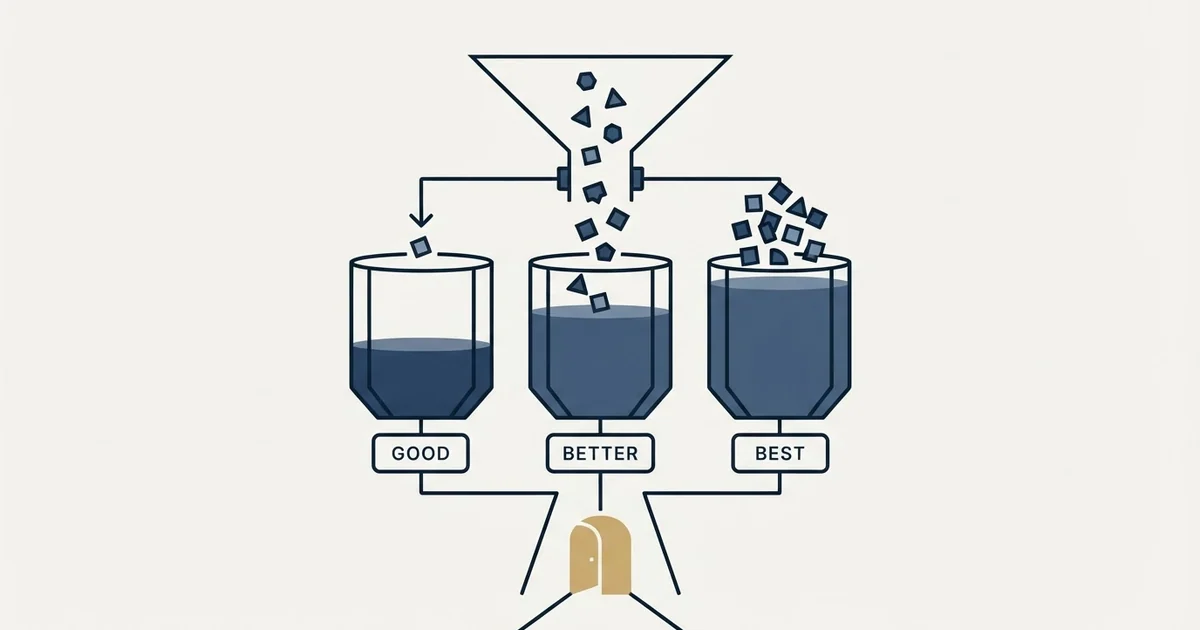
Highspot pricing is not published: the vendor's pricing page shows three packages, Good, Better and Best, describes each in detail and puts Contact sales on all three. The quote is built from the page's own form, which asks for your go-to-market headcount band, what you want to accomplish and which tools you integrate. Highspot is now part of Seismic.
Key takeaways
- Highspot's pricing page carries no rate: Good, Better and Best are subtitled Equip and engage, Train and practice and Coach and reinforce, and each ends at Contact sales.
- The Get Pricing form is the published pricing model: a go-to-market headcount band, an objective and an integration set, asked in that order.
- The Core, Advanced and Enterprise ladder in search results appears nowhere on the vendor's page, so third party figures cannot be checked against it.
- Seismic's newsroom states the merger completed on August 18, 2026; Highspot's merger page says evaluations continue and both platforms serve customers today.
Reviewed and updated September 18, 2026
An enablement lead searching for Highspot pricing opens the vendor's own pricing page to sanity check a budget line, having read three guides that all describe a Core, Advanced and Enterprise ladder. The page is headed "Choose the right plan to enable your team" and shows three packages named Good, Better and Best, subtitled "Equip and engage", "Train and practice" and "Coach and reinforce". Every one of them carries the same call to action, which is "Contact sales". Not one of the tier names in the guides appears anywhere on the vendor's own page.
That gap is the useful thing here. Highspot publishes no price on its pricing page, which is ordinary in enterprise sales enablement, but the same page publishes an unusually detailed picture of what you are buying and, in a short qualification form, of the three variables that will set the quote. Read properly it answers more of the budgeting question than a number would on its own.
Highspot pricing: how much does it cost?
Highspot's pricing page lists no price. It shows three packages, Good, Better and Best, subtitled "Equip and engage", "Train and practice" and "Coach and reinforce", each with a "Contact sales" button, plus an Enterprise capabilities block and two partner extensions. The quote is built from a three question form: your go-to-market headcount band, what you want to accomplish, and which tools you integrate.
What the page publishes instead of a price
Three packages, in a stated order, each described on its own card as everything in the one before it plus a named set of additions.
Good is subtitled "Equip and engage". Its card lists AI supported content organisation and governance, AI powered search and answers, content personalisation and autogeneration, Sales Plays, "Digital Sales Rooms", AI generated knowledge checks on items, AI recommended content, CRM integration, analytics and scorecards, embedded sales methodologies from the Marketplace, and Highspot Agents. The methodologies line carries an asterisk, and the page's own footnote reads "indicates partially included".
Better is subtitled "Train and practice" and its card opens with the phrase "All features from the previous package, plus". What its card adds is the readiness layer: skills and competencies, AI assisted training authoring, event based and on demand learning, adaptive learning including test out, practice and skill reinforcement, AI feedback on training, "Role Play and feedback as part of training", automated nudging, and scorecards for courses, events and learning paths.
Best is subtitled "Coach and reinforce" and again opens with "All features from the previous package, plus". It adds "Meeting Intelligence", Delivery Intelligence, meeting recap and follow up, Role Play to support coaching, AI feedback on meetings, scorecards for reps and teams, an MCP Server, Insights Layer APIs, and named integrations for Agentforce, Microsoft Copilot for Sales and Slack AI.
Good
Equip and engage
- AI supported content organisation and governance
- AI powered search and answers, personalisation
- Sales Plays and Digital Sales Rooms
- CRM integration, analytics and scorecards
- Highspot Agents
Better
Train and practice
- Skills and competencies
- AI assisted training authoring
- Adaptive learning including test out
- Role Play and feedback as part of training
- Scorecards for courses, events and learning paths
Best
Coach and reinforce
- Delivery Intelligence and Meeting Intelligence
- Meeting recap and follow up
- Role Play and feedback to support coaching
- Scorecards for reps and teams
- MCP Server and Insights Layer APIs
Two more blocks sit outside that ladder and are worth reading as separate axes rather than as tier contents.
A block the page heads "Enterprise capabilities" lists "Advanced content management", described there as multi step approvals, advanced watermarks, custom vanity URLs, secure Digital Sales Rooms and linked templates; "Complex document autogeneration"; "Advanced security", described as domain specific or customer managed encryption keys; "Platform scale and extensibility", described as APIs, MCP Server, Data Lake access, multi CRM support and automated provisioning; and "Enterprise support", described as 24/7/365 support with a dedicated CSM.
A partner block offers two named extensions, "Equip and Engage for partners" and "Train and Practice for partners", which push content, plays, digital sales rooms, training and certifications out to a partner network. If your programme reaches resellers, that is a second population of users and a second line on the quote.
The qualification form is the pricing model, stated out loud
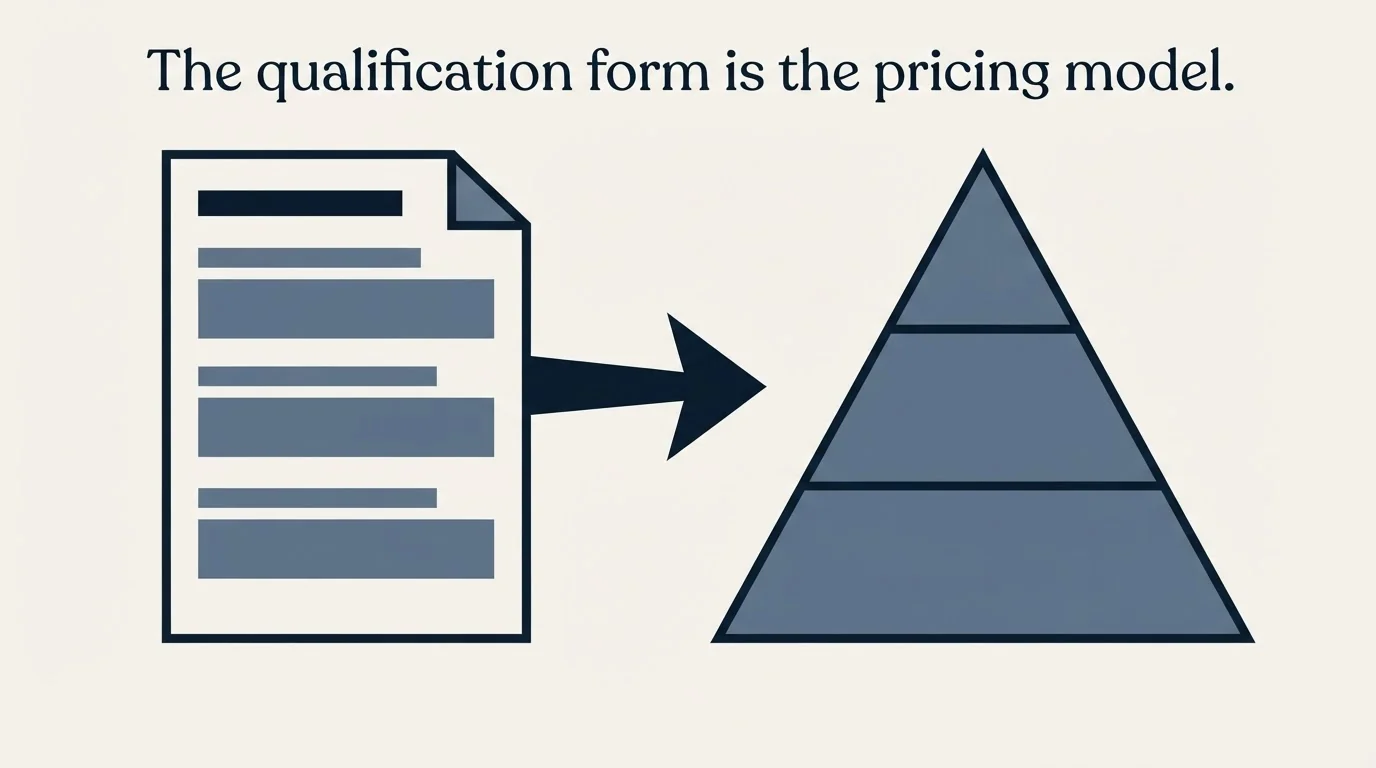
The page's Get Pricing button opens a three question form, and its questions are the closest thing to a published pricing model on the page.
The first, in the page's own words, is "How many employees do you have on your go-to-market team?", and the answer is a band rather than a number: 1-30, 31-100, 101-500, 501-2500, 2501-5000, or 5001 and above. The second is "What are you looking to accomplish?", offering content management, sales plays and playbooks, analytics, sales training, sales coaching, and artificial intelligence. The third is "What tools are you integrating with?", offering a learning management system, conversation intelligence software, sales engagement software, and others.
Read those three in order and the shape of the commercial conversation is visible before it starts. Population is asked first and asked as a band, which is what a seat priced product does. Objective maps onto the three packages, because content sits in Good, training in Better and coaching in Best. Integrations is the question that quietly moves tiers, since the conversation intelligence and MCP surfaces are listed in Best rather than lower down.
The consequence is that the cheapest honest answer to what Highspot costs is a range you can narrow only by deciding two things first: how many people actually need a seat, and whether you are buying content, readiness or coaching. A team that answers only the first is negotiating against a moving specification, and Highspot's own page closes on the invitation "Learn more about our pricing and packages today".
Deciding who needs a seat presumes the seat is the unit, and Closely counts LinkedIn accounts instead of people, handing every tier unlimited email inboxes.
What the merger changes, as the vendor states it
Highspot's pricing page carries the corporate news in two places. Its navigation reads "Highspot is part of Seismic." and its footer reads "About Highspot by Seismic".
Seismic's own newsroom dates the event. In a press release headed August 18, 2026 the company states that "Seismic today announced it has completed its merger with Highspot." and describes the combination as "Operating under the Seismic name" and led by its own chief executive, serving "2,500 customers" and 3.5 million users. Highspot's merger page answers the question in its own FAQ: "The merger is complete. Highspot and Seismic are now one company under the Seismic name."
What that page does not say is anything about a price list. It states that there is "no immediate change to how you use Highspot", that customers keep the same login, workflows and support, and that product plans continue. On evaluation it says "Your evaluation can continue without interruption." and that your current point of contact can answer questions about capabilities, implementation and pricing. That is the whole of the published guidance on commercial terms, and it is worth taking literally rather than reading a repricing into it.
One thing does follow for a buyer mid cycle. The same page states that "Both platforms continue to serve customers today", so which product you are being quoted for is now a real question on a Highspot call and worth putting in writing. The nearest sibling vendor is quote only in exactly the same way, and the read of what it does publish is in Showpad pricing.
Why the figures in the search results are not checkable
Search for what Highspot costs and the results carry specifics: a tier ladder named Core, Advanced and Enterprise, an average contract value, implementation bands, and add on names. None of those tier names appears on Highspot's own page, which publishes "Equip and engage", "Train and practice" and "Coach and reinforce" under Good, Better and Best. That is not a small discrepancy in vocabulary. The pages ranking for the query are describing a catalogue the vendor is not currently publishing, and a reader who takes a figure from one of them is budgeting against a structure they cannot check.
Three of the hosts carrying those numbers are review aggregators and procurement marketplaces, and their figures come from customer contracts or analyst estimates rather than from the vendor. Those sources are legitimate as what they are, which is a named third party's account of deals it saw. They are not the vendor's price and they carry no date on the vendor's authority, so nothing in this article quotes one.
A figure also needs its billing state attached, and Wistia's published rates are the annual billed ones because the toggle on that page opens already set to annual.
The honest statement is narrow and it is the one worth carrying into a budget meeting. Highspot publishes no price on its pricing page. Everything else circulating is somebody else's reconstruction.
| Before you ask for a quote | Why |
|---|---|
| Count the people who need a seat | The form asks for a headcount band first, which is how a seat priced product opens |
| Decide content, readiness or coaching | Content sits in Good, training in Better, coaching in Best |
| List the systems you will integrate | Conversation intelligence and MCP surfaces are listed in Best |
| Ask in writing which platform the quote covers | The merger page says both platforms continue to serve customers today |
| Budget from a tier ladder on a third party site | Core, Advanced and Enterprise appear nowhere on the vendor page |
| Treat the Enterprise capabilities block as included | It sits outside the three package cards |
How to run the evaluation
Start by deciding whether this category is the one you are short of, because the duplicate spend in enablement comes from buying two products that do the same job under different names. The six shapes hiding under one label are separated in sales enablement tools, and the readiness half of Highspot's Better package overlaps directly with what is sold as AI sales coaching. A team already running conversation intelligence is buying something narrower here than the Best package suggests.
Then price the package you need rather than the one whose name sounds like your ambition. The boundary that matters is between Good and Better, because it is the boundary between a content system and a training system, and those are bought by different people for different reasons. The boundary between Better and Best is the meeting intelligence layer, which is the piece most likely to duplicate something already in the stack.
Take the form's three questions into the call with your own answers written down. A quote built on a headcount band you have not verified is the one that gets revised upward after the pilot, and the enablement strategy decisions in order are what make that headcount defensible.
The short version

Highspot publishes three packages named Good, Better and Best, describes each in detail, and puts "Contact sales" on all three. There is no rate on the page, and the tier names circulating in search results are not the vendor's current ones.
The published pricing model is the qualification form: a go-to-market headcount band, an objective, and an integration set. Those three answers set the quote, so decide them before the call rather than during it.
The merger is complete, and Highspot's own footer now reads "About Highspot by Seismic". The vendor's published guidance is that nothing changes about how existing customers use the product and that evaluations continue. Ask which platform your quote covers.
If the constraint is not the enablement stack but the number of qualified conversations reaching it, no package in this ladder touches that, and you can see what a first campaign produces against your own market instead.
Package structures, contents and the qualification form above are read from highspot.com/pricing, and the merger statements from Highspot's own merger page and Seismic's newsroom. Neither company publishes a rate on any of those surfaces. Verify current terms with the vendor before relying on them.
Frequently asked questions.
Frequently asked questions- How much does Highspot cost?
- Highspot does not publish a price. Its pricing page lists three packages, Good, Better and Best, with detailed contents and a Contact sales button on each, plus an Enterprise capabilities block and two partner extensions. The quote is built from a form asking for your go-to-market headcount band, what you want to accomplish and which tools you integrate, so those three answers set the number.
- What are the Highspot pricing tiers?
- The page names Good, subtitled Equip and engage, Better, subtitled Train and practice, and Best, subtitled Coach and reinforce. Each is described as everything in the previous package plus a named layer: content and plays in Good, training and role play in Better, meeting intelligence and APIs in Best. The Core, Advanced and Enterprise names on third party sites are not on the vendor's page.
- Does the Seismic merger change Highspot pricing?
- The published guidance says nothing about a price list. Highspot's merger page states that the merger is complete, that there is no immediate change to how you use Highspot, that your evaluation can continue without interruption, and that your current point of contact can answer questions about pricing. It also says both platforms continue to serve customers, so ask which one your quote covers.
- How do I get a Highspot quote?
- Use the Get Pricing button on the pricing page, which asks three questions: how many employees are on your go-to-market team, answered as a band from 1-30 up to 5001 and above; what you are looking to accomplish; and what tools you are integrating with. Write your own answers down first, because a quote built on an unverified headcount band is the one revised upward after the pilot.
About the author.

B2B cold email experts helping companies generate qualified leads through done-for-you outreach campaigns.
RevenueFlow Team
Explore more.
Ready to scale your outreach?
We build GTM engines that book real meetings. See the receipts.
Related articles.
Sales Enablement Charters: What the Published Ones Ask For
Six publishers set out what a sales enablement charter should contain. Five describe a document nobody can check, and one writes a definition with inspection in it.
Sales Kickoff Agendas: Five Published, Session by Session
Five publishers print a sales kickoff agenda. They agree on four blocks and disagree on session length, rehearsal and where the agenda comes from.
Sales Prospecting for Utilities: Read the Filings First
Prospecting utilities from the proceedings that announce their spend: rate cases, resource plans and procurement decisions, who owns each, and the supplier gate.
SDR Outsourcing for Commercial Insurance Agencies
What an outsourced sales development team may legally say for a commercial insurance agency, how it may be paid, and the expiration-date calendar it has to work.
Cold Calling for Telecom Companies: A Carrier's Own Rules
What only a telecom company meets on the phone: the FTC exemption that stops at its contractor, the verified carrier change, and the CPNI limit on lists.
B2B Lead Lists for Associations: The Census Is Public
The anatomy of an association list: the IRS master file that enumerates every business league, the Form 990 lines that name officers and dues, and what vendors sell.