Sales Forecasting Software: Which Layer You Are Buying
One search returns a $25 CRM tier and an enterprise planning platform. They are not alternatives, and buying at the wrong layer is the expensive mistake.
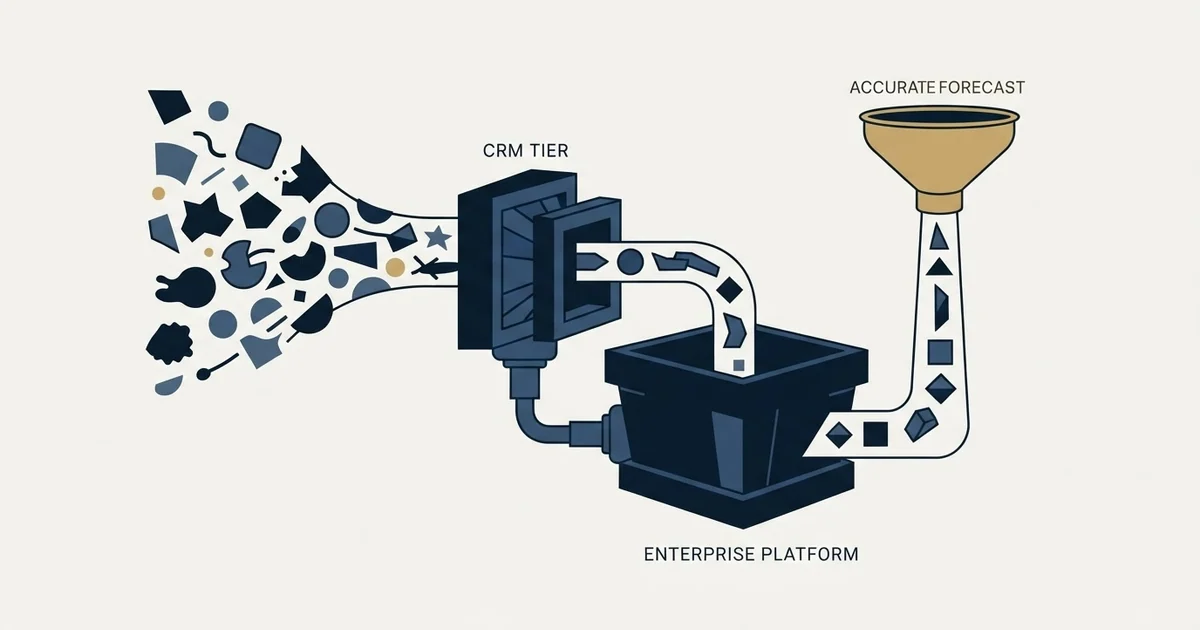
Sales forecasting software divides into four layers: the forecast module inside a CRM, a dedicated forecasting layer priced per company, a revenue platform that generates evidence from activity, and an enterprise planning platform. Each serves different forecasting methods, so the method your data supports decides the layer.
Key takeaways
- Salesforce's pricing page lists quoting and forecasting as part of its Pro Suite at $100 per user per month billed annually, above a Starter Suite at $25.
- Forecastio publishes $249 a month billed annually including two seats, and $369 a month for its pipeline intelligence tier, with additional seats at $49 and $69.
- A CRM tier applies to every user while a forecasting layer applies to the few people who run the process, which usually reverses the intuition about which is cheaper.
- Any published accuracy figure is unreadable until the vendor names the denominator, the period, and whether error is counted in both directions.
Reviewed and updated September 21, 2026
Search for sales forecasting software and the results put a $25 CRM tier next to an enterprise planning platform, as though a buyer were choosing between them. They are not alternatives. They sit at different layers of the same problem, they are bought by different people for different reasons, and the most common expensive mistake in this category is buying at the wrong one.
Three published examples show how far apart the layers sit. Salesforce's sales pricing page lists Sales Quoting and Forecasting as part of what its Pro Suite adds over its Starter Suite, at $100 per user per month billed annually against $25 per user per month. Forecastio's pricing page lists $249 a month, billed annually and including two seats, for a forecasting product that runs on top of HubSpot. Anaplan's sales forecasting page sells something else entirely: a forecast connected to revenue, demand and workforce forecasts across the enterprise. All three fetched from the vendors' own pages on 16 August 2026, with the Salesforce figures read in US dollars from a page that also renders five other currencies.
The four layers
- Reads the pipeline already in the system of record
- Salesforce lists quoting and forecasting as a Pro Suite feature at $100 per user per month billed annually
- Buy here when: nobody has switched the module on and configured it
- Fails when: the stages underneath it have no exit criteria
- Sits on top of a CRM and adds methods, scenarios and accuracy tracking
- Forecastio publishes $249 a month with two seats included and $49 per additional seat
- Buy here when: the CRM data is sound and the process around it is not
- Fails when: it inherits the same unreliable stage data with better charts
- Captures activity and conversations, then infers deal health from them
- Clari listed Capture, Inspect, Groove, Align, Copilot, Forecast and Guide as separate products before its Salesloft merger
- Buy here when: reviews run on opinion because nobody trusts the fields
- Fails when: it routes around the data problem instead of fixing it
A fourth layer sits above all of them and belongs to finance more than to sales. Anaplan's own page describes connecting the sales forecast to revenue, demand and workforce forecasts, with scenario planning across the enterprise, and names a ready-to-deploy Sales Forecasting application alongside territory and quota planning. Nobody buys that layer to improve a weekly commit call. It is bought when the sales number has to reconcile with a plan the rest of the company is also modelling.
So which system supports sales forecasting has four answers, and the right one depends on which part is broken. A CRM supports it as a record of what reps submitted. A dedicated forecasting layer supports it by challenging that submission with history. A revenue platform supports it by adding evidence generated outside the CRM. A planning system supports it by reconciling the result with everything else the company is modelling.
The question that sorts the layers
Before comparing products, answer the question the products cannot answer for you: what will your forecast be allowed to trust.
Judgement-based forecasting trusts the seller's own call. Pipeline-based forecasting trusts the stage, and multiplies each deal's value by a probability attached to it. History-based forecasting trusts the base rate from closed deals. Capacity modelling trusts the inputs instead: sellers, meetings, conversion, deal size.
That choice is upstream of every purchase on this page, because each layer is built to serve some of those methods and not others. A CRM module is a stage-weighted instrument. A dedicated layer usually adds history-based methods and scenario comparison. A revenue platform exists because somebody decided the stage data cannot be trusted on its own. A planning platform is where capacity modelling lives, because that is the method that needs inputs the CRM does not hold.
A related layering problem shows up in coaching software, where the four mechanisms behind AI sales coaching also need sorting before any product comparison starts.
Buying a product whose method your data cannot support is the expensive version of this mistake. Stage-weighted probabilities are only meaningful when stage membership is an observable fact rather than a description of seller activity, which is the argument in pipeline stages that earn their place. Weighted numbers also need a population large enough to average out, so they belong at territory level and above rather than on one seller with eight open deals.
What every layer leaves untouched

Three things are routinely expected of forecasting software and are in none of it.
Stage criteria. A stage is a label until somebody writes what has to be true to leave it, in terms a person outside the deal could check. No product supplies that sentence, and every product's output degrades in the same way without it.
The honesty of the numerator. Open pipeline value is self-reported by the people whose performance it describes. Deals that stalled months ago sit at their original value with a close date pushed for the fourth time, and the arithmetic cannot see it. Why that matters for the ratio everybody quotes is worked through in pipeline coverage.
Pipeline itself. A forecast is a measurement, and a gap found eight weeks from period end is reporting a targeting decision made a full cycle earlier. No configuration changes that.
- Yes: Write the exit criterion for every stage, and check each names something the buyer did
- Yes: Decide which method the forecast will run on, and whether your data supports it
- Yes: Check whether the CRM tier you already pay for includes a forecast module nobody switched on
- Yes: Establish how accuracy will be measured, in both directions, before a vendor quotes one
- Yes: Count the people who genuinely need a seat, which is usually managers rather than every rep
- No: Buying a second reporting product because the first one's numbers are not believed
- No: Treating a forecast as a mechanism for creating pipeline
Reading a vendor's accuracy claim
Forecastio's pricing page states that its product reaches up to 90 to 95 percent sales forecasting accuracy. That is the vendor's own claim, quoted here rather than endorsed, and it is worth using as a worked example because claims of this shape are everywhere in the category and almost none of them are readable as written.
Accuracy of a forecast is not one quantity. Measuring only whether the total landed rewards a forecast set low enough to beat, which is why sandbagged forecasts survive so long: they are accurate in the direction nobody complains about. Measuring absolute error in both directions removes that, because a forecast that comes in forty percent over is as wrong as one that comes in forty percent under. A percentage with no stated denominator, no period and no direction cannot be compared against your current process, and a vendor that will name all three is telling you something real.
The same question applies to any product claiming a machine-learning forecast. Ask what it was trained on, because a model fitted to your historical closed-won deals inherits every bias in your historical targeting, and ask what it does in the first quarter of a new segment where the base rate describes a motion you are no longer running.
The arithmetic that decides between layers

The comparison people expect to be about features is usually about how many people need access.
The following arithmetic is invented for illustration, using the published rates above, and describes no real purchase. A twelve-person sales team moving from the $25 per user per month CRM tier to the $100 tier to unlock the forecast module costs $900 a month more, because a CRM tier applies to every user. Buying the dedicated layer for the four people who actually read a forecast costs $249 plus two additional seats at $49, which is $347 a month, on top of whatever the CRM already costs.
Those two numbers point in the opposite direction to the intuition that the bigger platform is the expensive option. Seat-priced modules scale with the whole team; a forecasting layer scales with the handful of people running the process. The comparison flips again if the CRM upgrade also unlocks things the team needed anyway, which is why the honest version of this evaluation prices the upgrade against everything it includes rather than against the one feature that triggered the conversation. What else changes at each tier is the substance of any CRM comparison.
US dollars, billed monthly or annually, on a page that renders six currencies
Billed annually; the tier whose feature list names quoting and forecasting
Billed annually, two seats included, $49 per additional seat
Billed annually, two seats included, $69 per additional seat
Where the data comes from decides what you can buy
One practical constraint outranks preference: most products in the middle layer are built against a specific CRM. Forecastio's own pages describe it as sales forecasting and pipeline intelligence for HubSpot. A shortlist assembled without checking which system of record each product supports produces demos that cannot be run on your data.
Unlike the forecasting layers here, fintech sales teams must also weigh compliance and data security when choosing sales engagement tools built for fintech compliance.
The related check is what the product needs in order to work at all. A forecasting layer that reads stage history needs stage history to exist, which means the CRM has to have been recording transitions rather than overwriting a field. A team that has been editing one stage value in place for two years has no history to model, and discovering that during implementation is expensive. It is also fixable, and the fix starts now rather than at purchase.
Where we differ from standard practice
Much of the writing about forecasting assumes an outbound motion run the common way, and since this page sits on our site it is worth naming where ours differs and what it costs.
The standard response to a forecast gap is more touches: additional messages to the same prospects, spread over more weeks, often landing in the same thread. We run one message per campaign, with no bumps and no thread replies, and a non-responding audience becomes a new campaign built on a different premise rather than a reminder. The reasoning is mechanical: a repeat message reaches the population that already saw the first and chose not to answer, which is the population most likely to complain, and the reputation cost lands on the sending domain across everything else it sends. The forecasting consequence is worth stating plainly, because it cuts both ways: pipeline built this way tends to move steadily rather than in spikes, which forecasts better and fills more slowly.
We are also paid on attended meetings that meet criteria agreed in writing before launch, with budget, timing and authority deliberately outside the definition. That is the same instinct as settling how accuracy will be measured before a vendor quotes a number at you. What qualified has to mean when money depends on it is set out in qualified lead generation services.
The short version
Sales forecasting software divides into four layers: the forecast module inside the CRM, a dedicated forecasting layer priced per company, a revenue platform that generates its own evidence from activity and conversations, and an enterprise planning platform where the sales number reconciles with the rest of the plan.
Decide which method your forecast will run on before comparing products, because each layer serves some methods and not others, and stage-weighted arithmetic needs stages whose criteria a buyer produces.
Price the layers on how many people need access rather than on feature lists. A CRM tier applies to everybody; a forecasting layer applies to the few people who run the process.
The same trap sits one category over, where four unrelated purchases returned by one automation search are sold as substitutes for each other.
Treat any published accuracy figure as a claim until the vendor names the denominator, the period and whether error is counted in both directions. And remember that none of these products create pipeline: where the gap is supply rather than measurement, see what a first campaign produces for your market.
Pricing and features verified against each vendor's own pages as of mid-2026, with dated snapshots retained. Salesforce figures are the US dollar values on a page that renders several currencies. Verify current terms with the vendor before relying on them.
Sources: Salesforce sales pricing, Forecastio pricing, Salesloft and Clari are now one company, Anaplan sales forecasting
Frequently asked questions.
Frequently asked questions- What is sales forecasting software?
- Software that turns pipeline records into a prediction of revenue for a period. It arrives in four layers: a module inside the CRM, a dedicated forecasting product on top of it, a revenue platform that captures activity and conversations to generate its own evidence, and an enterprise planning platform where the sales forecast reconciles with demand and workforce plans.
- Do I need forecasting software if I already have a CRM?
- Often not. Forecasting is frequently a feature of a CRM tier a company already pays for and has never configured. Salesforce, for instance, lists quoting and forecasting in the Pro Suite feature set at $100 per user per month billed annually. Check what your current tier includes before evaluating anything, because a switched-off module is a cheaper fix than a purchase.
- How much does sales forecasting software cost?
- Published rates vary by layer. Forecastio lists $249 a month billed annually with two seats included and $49 per additional seat, rising to $369 with $69 per seat for its pipeline intelligence tier. CRM tiers that include forecasting are priced per user, so the total depends on how many people need access rather than on the headline rate.
- Can forecasting software fix an inaccurate forecast?
- Only the measurement half. No product supplies stage exit criteria, and stage-weighted arithmetic applied to stages that advance on seller activity computes the frequency with which reps who did a thing went on to close. It also cannot verify self-reported deal values or close dates, and it cannot create pipeline when the gap is supply.
About the author.

B2B cold email experts helping companies generate qualified leads through done-for-you outreach campaigns.
RevenueFlow Team
Explore more.
Ready to scale your outreach?
We build GTM engines that book real meetings. See the receipts.
Related articles.
Physician Email Lists: The Row, Its Sources and Its Gaps
The anatomy of a physician email list: the six field groups, which CMS, AMA and state board records hold each, what vendors claim, the rules, and the order to verify.
Cold Calling for Manufacturers: The Desk and the Floor
Cold calling for a manufacturer calling plants and OEMs: who answers the main line, the buyer's desk against the floor, the show calendar, the channel map, the limits.
Win Rate Benchmarks: Which Figures State a Population
A catalogue of the published average sales win rates, sorted by whether the page names the population behind its own number. Most do not.
SDR Outsourcing for Agriculture Companies
Whether an outside sales development team can work for a company selling into agriculture: who already covers the account, which weeks exist, and the show rule.
Cold Calling for PPC Agencies: What You Can See First
A paid media prospect is partly readable before the call and has already been told by the platform what to do when a stranger rings about its ads.
Cold Calling for Food and Beverage Companies: Three Doors
Cold calling for a food or beverage company: who picks up at a chain, a distributor and an independent grocer, where each publishes its door, and when the phone is wrong.