How to Run Outbound Campaigns in a New Market
A new market removes the closed-won set, the local proof and any way to check the list. What changes, and how to design a first wave that stays attributable.
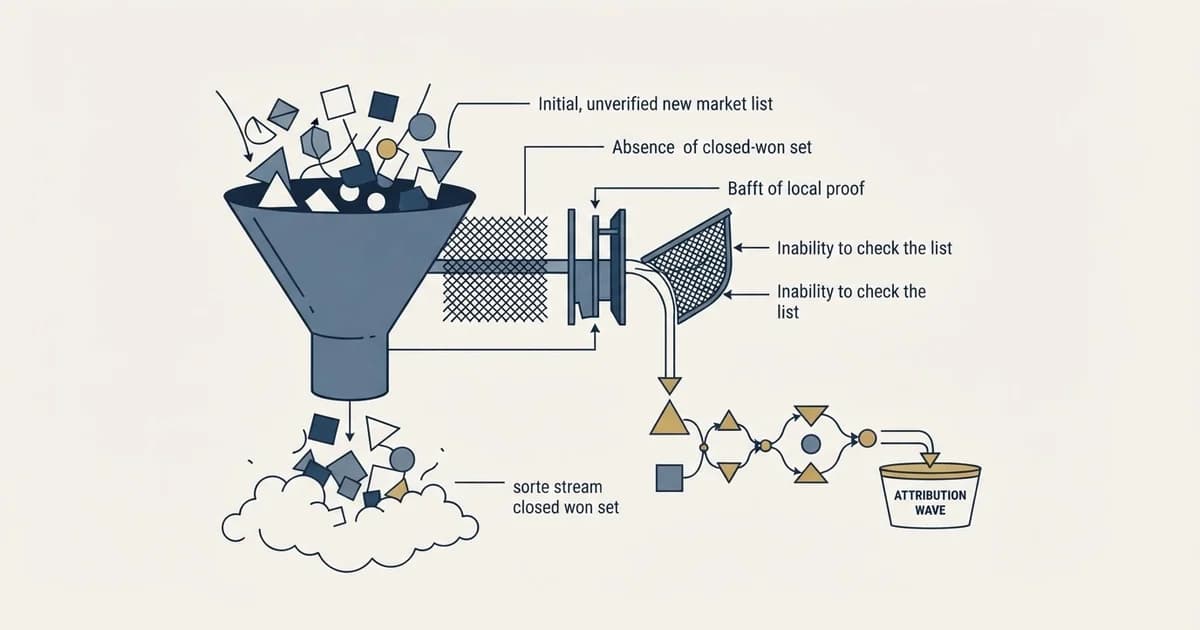
Run the first wave as a measurement instrument. A new market removes the closed-won deals that validated the profile, the proof that carried locally and any ability to eyeball the list, so a null result has four candidate causes rather than one. Count the companies first, send one premise to one segment, and change a single input between waves.
Key takeaways
- A new market removes three inputs rather than one: a profile validated against won deals, proof that carries locally, and a list somebody can sanity check.
- The company count decides the motion, because a market addressable by name and a market that has to be sliced want opposite instruments.
- Carrying the method travels across a border; carrying borrowed recognition does not, and a reader who finds out the proof was from elsewhere is expensive to lose.
- A first wave that changes several inputs at once cannot attribute its own result, so the finding gets assigned to whichever cause somebody already suspected.
Reviewed and updated September 1, 2026
How to Run Outbound Campaigns in a New Market: Working a List You Cannot Validate
A company that has spent three years learning exactly who buys, in one market, opens a second one and runs the campaign that works at home. The reply rate falls by a factor nobody can explain, and the meeting that gets called is about the copy.
The copy is almost never the difference. What changed is that three of the inputs the home campaign was standing on quietly stopped existing, and none of them are visible in the message. A new market removes the closed-won set the targeting was validated against, removes the proof the copy was leaning on, and removes any way to check the list before it is used. The campaign looks identical and it is now a measurement instrument rather than a pipeline instrument, and treating it as the second thing is what produces a verdict about the market that was really a verdict about the setup.
The three things that actually differ
Language, time zones and holidays get all the attention in market-entry advice and they are the easy half. The hard half is that a new market breaks the feedback loop the home motion was built on.
- An ICP validated against deals you actually won
- Named customers in the segment, usable as proof
- A list you can sanity check against known accounts
- A reply pattern you have seen before and can read
- Silence usually means the offer or the premise
- An ICP assumed to transfer, with nothing local to test it against
- Proof that is either absent or visibly from somewhere else
- A list nobody in the building can eyeball for errors
- A reply pattern with no baseline to compare against
- Silence has four candidate causes rather than one
The ICP is a hypothesis again. The definition that works at home was derived from won deals, and the honest version of that derivation is set out in building an ICP that changes your target list, which ends by validating the profile against closed-won. In a market where you have won nothing, that final step is unavailable, so the profile arrives as an assumption wearing the clothes of a finding. It may well be right. It is not yet evidence.
The proof does not travel evenly. Copy that leans on a recognisable customer name is leaning on recognition, and recognition is local. A logo that ends an objection in one market is frequently unknown in the next, and a reader who does not recognise it reads the sentence as filler. The proof problem is the one most likely to be underestimated, because the copy still looks well supported to whoever wrote it, and proof is one of the inputs that stays with the client in every arrangement rather than something a provider can supply, as done for you lead generation sets out.
The list cannot be eyeballed. In a home market somebody on the team spots the obvious errors: the company that is a customer already, the one that closed last year, the one whose name is a coincidence. Nobody has that reflex in a market they have never sold into, so structural errors survive all the way to the send. Data quality also varies by country in ways that are not random, so a database count that would be reliable at home is a wider estimate abroad.
Size the market before choosing the motion
The first decision in a new market comes before the message: whether the market is one you can write to by name.
Count the companies that match the criteria, using a source you can name, and read the company count rather than the revenue figure. The method and the reasons the revenue number misleads are in serviceable addressable market. That single count settles more than any other input, because a market of a few hundred companies and a market of forty thousand want opposite motions, and the difference is not a matter of budget.
Below roughly a few thousand companies, the whole market is addressable by name. Every account can be researched individually and the entire population can be worked deliberately over a year without exhausting it. That is the case where a narrow, specific, low-volume campaign is genuinely the right instrument, and where burning the market with a generic first wave is expensive in a way that cannot be undone: the people who received a message that landed badly cannot usefully be re-approached on the same angle.
Above that, the job becomes choosing a slice, and the choosing is now the main decision rather than a preliminary one. Which cut to attack first is a segmentation question, and the test a cut has to pass is that it changes what you send, which is the subject of market segmentation. Where a dated event is available in the new market, it beats a firmographic cut for the same reason it does at home, and the distinction between the two is worked through in B2B prospecting.
The proof problem, and the two honest ways round it

Nothing here licenses inventing local credibility, so the options are narrower than they look and both of them are usable.
The first is to carry the method rather than the outcome. What travels across a border is how the work is done, what you look at first, and the specific observation you would make about a company in this market having looked. A message that demonstrates a point of view is doing the job that a recognisable customer name does at home, and it is available immediately.
The second is to say plainly where the work was done. Describing prior work as being in an adjacent market, in the reader's own terms, is a weaker claim than a local reference and it is a claim that survives being checked. A reader who discovers on their own that the proof was from somewhere else has learned something about the sender that no reply rate recovers from.
What is not available is a claim that reads as local when it is not, and the reason is commercial rather than moral: in a market you are trying to enter, the first impression is the entire asset.
Deliverability and consent change at the border
Two operational facts change with geography and both are checkable before the first send.
Sending infrastructure is regional in effect even when it is not in configuration. Mailbox providers and filtering behaviour differ by country, and a domain with a clean record sending into one market is an unknown quantity sending into another. The practical implication is to treat a new market as a new ramp rather than as extra volume on an existing one, and to watch bounce and complaint behaviour per market rather than in aggregate, because an aggregate hides exactly the signal you need.
The legal basis for contacting somebody differs too, and it differs in kind rather than in degree. What each regime requires is set out in GDPR for B2B outbound, and the general rule for planning is that jurisdiction belongs on the record as a field rather than as an assumption about the whole list. Take advice on any obligation that applies to you rather than relying on a summary.
Design the first wave as a comparison

This is the part that separates a market entry that produces information from one that produces an opinion.
In a home market, a null result is reasonably attributable, because the targeting and the proof are known quantities and the message is the variable. In a new market four candidate causes are live at once: the segment may be wrong, the proof may not be landing, the message may be wrong, or the mail may not be arriving. A single undifferentiated wave cannot separate them, and the report at the end of it will assign the failure to whichever one somebody already suspected.
The fix is to give the first wave enough structure to be diagnostic without splitting it so finely that no cell is readable.
- Step 1Confirm the mail is arriving
Watch delivery and bounce behaviour for this market specifically rather than in aggregate. A market that never received the campaign has told you nothing about the campaign.
- Step 2Send one premise to one narrow segment
Narrow enough that a single observation is true for everybody in it, and large enough to reach a readable count. Two premises at once make the result unattributable.
- Step 3Read the shape of the replies before the rate
Replies from the right kind of company at a low rate is a different finding from replies from the wrong companies, and it is available far earlier than any rate.
- Step 4Change one input and repeat
Segment, premise or proof. Changing two makes the second wave as unattributable as the first.
- Step 5Validate the ICP against whatever you win
The first few won deals in the market are the evidence the profile never had, and they usually move it.
The third step is the one that pays earliest. Reply shape is qualitative and available from a handful of responses, and in a new market it answers the question that matters most: whether the segment definition transferred at all. Ten replies from companies outside the intended audience is a targeting finding in week two, and it is worth considerably more at that point than a reply rate would be in week ten.
What a null result means, and what it does not
A market that does not respond to a first wave has told you that this premise, aimed at this segment, from this sender, produced nothing. That is a genuine finding and it is narrower than the conclusion usually drawn from it.
The conclusion to resist is that the market does not work, because that reading closes the market on evidence that cannot support it. The four candidate causes above are all still open unless the wave was designed to close them, and the one most often responsible in a genuinely new market is the segment rather than the message. A profile derived from won deals elsewhere can be right about the shape of the buyer and wrong about which companies in this market have that shape, and those two failures are indistinguishable from the reply count alone.
There is also a slower cause that no first wave can detect. Some markets are structurally later than others for a given category, and a proposition that is obvious at home can be genuinely unfamiliar in the new market. That does not make the market bad and it does change the job, because an unfamiliar proposition needs the reader to be told what problem it solves before being asked to meet about it.
Before the first send

- Yes: The company count for the market is derived bottom up from a named source
- Yes: The motion matches that count, addressable by name or worked as a chosen slice
- Yes: The proof position is written down honestly, including what is not local
- Yes: Jurisdiction is a field on the record rather than an assumption about the list
- Yes: Delivery and bounce behaviour are watched for this market separately
- Yes: One premise, one segment, sized to reach a readable count
- Depends: Somebody local, or close to local, has read the message before it sends
- No: The home market's campaign has been copied across with the names changed
The seventh line is worth the effort where it is available at all. A single reader who knows the market will catch the phrasing that lands differently there, the assumption that is not true locally, and the job title that does not exist, and none of those are visible from the outside.
The short version
A new market removes three inputs the home campaign was standing on: an ICP validated against won deals, proof that carries locally, and a list somebody can eyeball. The message is usually the last thing that is wrong and the first thing that gets changed.
Count the companies before choosing the motion, because a market addressable by name and a market that has to be sliced want opposite instruments. Carry the method rather than borrowed recognition, and say plainly where prior work was done. Treat the market as a new ramp for deliverability, and put jurisdiction on the record.
Then design the first wave to be attributable: one premise, one segment, delivery confirmed first, reply shape read before reply rate, and one input changed at a time. A null result from a wave built that way is information about a segment. A null result from a wave that changed everything at once is information about nothing.
If you would rather see the list and the single message built against a market you are entering, you can see what a first campaign looks like.
Frequently asked questions.
Frequently asked questions- Why does a campaign that works at home fail in a new market?
- Usually because the inputs behind it changed rather than the copy. The profile was validated against deals won somewhere else, the proof relies on recognition that is local, and nobody can spot the obvious list errors in a market they have never sold into. All three are invisible in the message, which is why the message gets blamed first.
- Should I translate the campaign or rewrite it?
- Neither is the first decision. Establish how many companies in the new market match the criteria, because that count decides whether the market is addressable by name or has to be sliced, and those want different campaigns entirely. Language matters and it is downstream of a motion that has not been chosen yet.
- What do I do about proof when we have no customers in the market?
- Carry the method rather than the outcome. A specific observation about a company in that market demonstrates judgement in a way a logo they do not recognise cannot. Where prior work is referenced, say plainly that it was done in an adjacent market. A claim that reads as local and is not costs the relationship when the reader checks.
- How should I read a first wave that produced nothing?
- As evidence about that premise, aimed at that segment, from that sender, and nothing wider. Four causes stay open unless the wave was designed to close them: the segment, the proof, the message and whether the mail arrived at all. In a genuinely new market the segment is the most common culprit and the least often blamed.
About the author.

B2B cold email experts helping companies generate qualified leads through done-for-you outreach campaigns.
RevenueFlow Team
Explore more.
Ready to scale your outreach?
We build GTM engines that book real meetings. See the receipts.
Related articles.
Appointment Setting for Business Brokers: The Seller Meeting
What a bought meeting with a business owner has to be for a brokerage: the three-part qualification, the confidentiality rules, the licence line and the owner's reasons.
LinkedIn Outreach for Banks: A Regulated Message
How a bank's relationship managers use LinkedIn to reach business owners: what the FFIEC guidance, FINRA's notices and LinkedIn's own rules require, and where to stop.
SDR Outsourcing for Business Brokers: The Fee Timing
Whether a success-fee brokerage should rent sales development at all: the fee timing, the texts that limit what an outside person may say about value, and who signs.
SDR Outsourcing for Logistics Companies: The Brokerage Line
What an outside sales development team may do in a freight company's name, the calling and email rules it inherits, and which arrangement survives a bid-shaped market.
B2B Lead Lists for Aviation Companies: Build or Buy
Aviation is one of the few industries whose accounts are published by its regulator, which changes what is worth buying and what is worth downloading yourself.
Sales Prospecting for Health Systems: The Public Record
Where health systems are written down in public: the Medicare cost report, the facility list a non-profit system files, and the two gates that follow qualification.