LinkedIn Post Scraping: What Comment Data Buys You
Post scrapers return names and profile URLs rather than contacts, and the User Agreement clause that covers copying other members posts is rarely the one quoted.
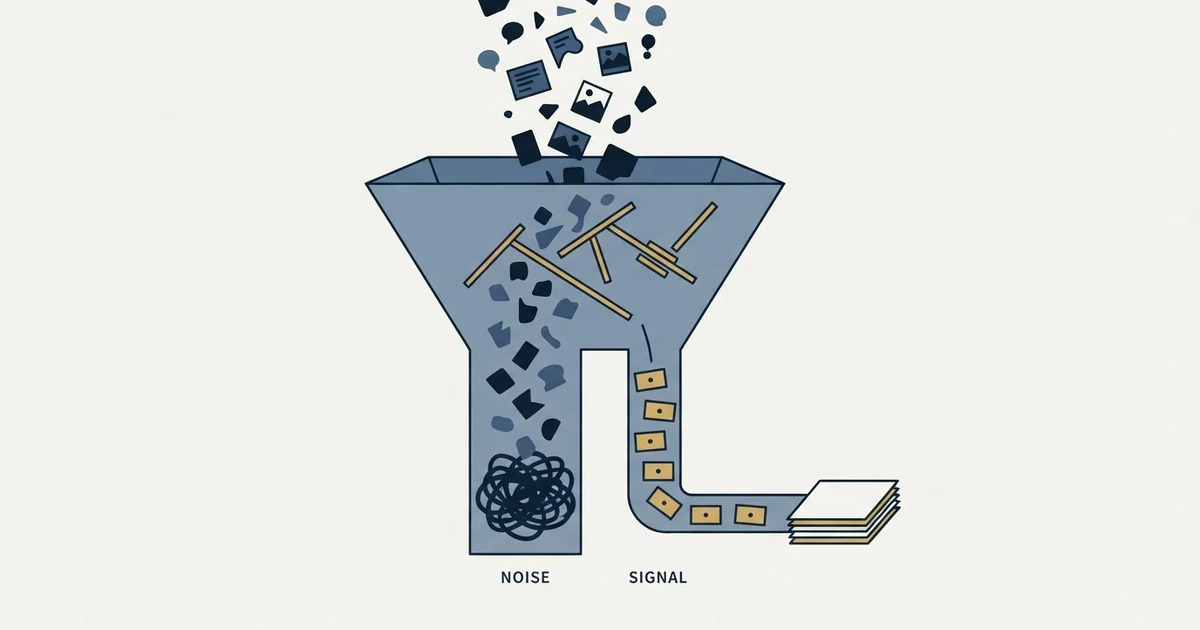
LinkedIn post scrapers return post text, engagement counts, and commenter names with public profile URLs. They do not return contact details, because a member controls the visibility of their email address. The User Agreement prohibits copying other members posts outside the share functionality and prohibits obtaining the same content through a broker.
Key takeaways
- A post scrape yields names and public profile URLs, so every contactable address still comes from a separate lookup against a separate data source.
- Section 8.2 of the User Agreement addresses posts specifically, telling members not to copy or distribute the posts or other content of others outside the available sharing functionality.
- The same section covers the workaround, prohibiting the use of content obtained through third parties such as search tools, data aggregators or brokers.
- LinkedIn help states that members using scraping or automation tools risk having accounts restricted or shut down, and that the tools may become non-operational without notice.
Reviewed and updated September 2, 2026
Somebody in your market posts about the exact problem you solve, and the comment section fills with people agreeing. That comment section is the closest thing outbound has to a room full of raised hands, and it is why a whole category of tooling exists to pull posts, reactions and commenters off LinkedIn in bulk.
The signal is real. What most of these tools return, what LinkedIn's terms say about the specific act of copying other people's posts, and what an engagement list is actually worth once you have it, are three separate questions that the category tends to answer as one.
Company page followers are the other list people try to extract this way, and the mechanics and the exposure are identical: the page owner can export follower analytics from the admin view within the platform, while every third-party collector offering the full list is reading the audience from the interface, which is the activity the clause below covers.
What a post scraper actually returns
Strip away the interface differences and the output is consistent: the post text, a timestamp, reaction and comment counts, and for each commenter or reactor a name and a public profile URL. Some tools add the commenter's headline and current company, which are self-reported profile fields rather than verified firmographics.
Licensed data sells the same split, since People Data Labs withholds contact data on its free tier and returns the profile fields alone.
What none of them return is a way to contact those people off-platform. LinkedIn's own help centre explains why. A member's email address is visible according to a setting they control, and the most protective options restrict it to "only visible to your direct connections on LinkedIn" or "Only visible to me" (Visibility of your email address). A profile is not a contact database, so anything downstream of the scrape that produces an email is a separate lookup against a separate data source, guessing or matching rather than reading.
A related limitation shows up in your own network export: the connections export file only lists an email address when that connection's privacy setting permits it.
That matters for how the play should be budgeted. The scrape produces an audience of names. Turning that audience into something you can send to is an enrichment step with its own cost and its own hit rate, and the addresses come from the same providers you would have used without the scrape.
- Post text, timestamp and engagement counts
- Commenter and reactor names
- Public profile URLs
- Self-reported headline and company
- A moment of demonstrated interest in a topic
- Whether the person's company matches the ICP
- Whether the title is current and decision-relevant
- A deliverable address, found and verified elsewhere
- Whether engaging with a post means anything about buying
- Consent-independent grounds to contact them at all
The clause about posts that almost nobody quotes
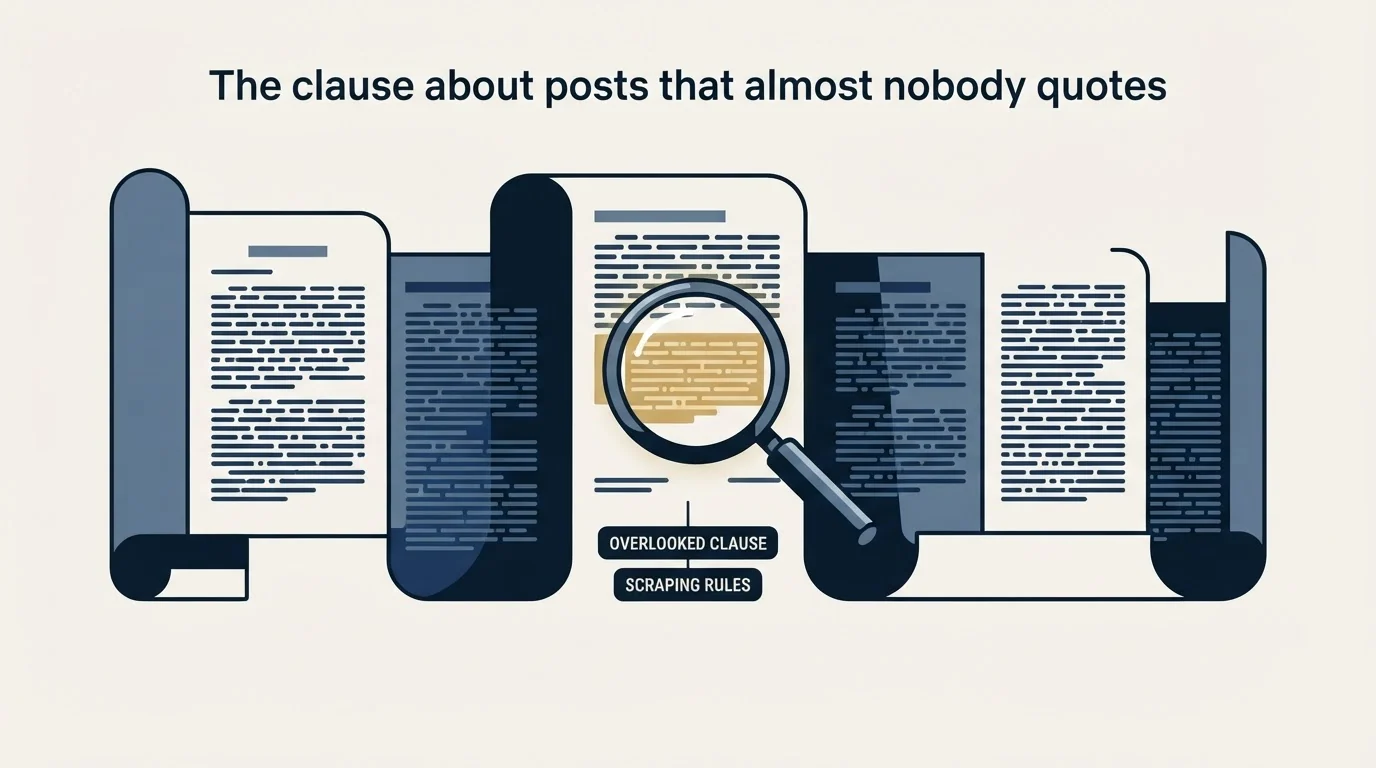
Discussion of LinkedIn scraping usually reaches for one sentence in Section 8.2 of the User Agreement, the one prohibiting the use of "software, devices, scripts, robots or any other means or processes (such as crawlers, browser plugins and add-ons or any other technology) to scrape or copy the Services, including profiles and other data from the Services".
For post scraping specifically there is a second clause that lands closer, and it is about intellectual property rather than about access. The same section says members will not violate the intellectual property rights of others, and gives an example in LinkedIn's own words: "do not copy or distribute (except through the available sharing functionality) the posts or other content of others without their permission, which they may give by posting under a Creative Commons license" (LinkedIn User Agreement).
A post is somebody's writing. The clause treats it that way, points at the share button as the sanctioned route, and carves out an exception only where the author has granted permission. Two further clauses in the same list cover what happens next: members will not "override any security feature or bypass or circumvent any access controls or use limits of the Services (such as search results, profiles, or videos)", and will not "copy, use, display or distribute any information (including content) obtained from the Services, whether directly or through third parties (such as search tools or data aggregators or brokers), without the consent of the content owner".
That last clause is the one that closes the obvious workaround. Buying a dataset someone else scraped sits inside the same prohibition as scraping it yourself, because it names third parties, aggregators and brokers explicitly.
- No: Using crawlers, plugins or scripts to scrape or copy data from the Services
- No: Copying or distributing other members' posts outside the share functionality
- No: Bypassing access controls or use limits such as search results
- No: Obtaining the same content through a data aggregator or broker instead
- No: Using bots to comment on, like, share or re-share posts
- Yes: Reading a post in the feed and deciding a company is worth researching
The half of the category that is automation, not extraction
Search this topic and roughly half the results are not extraction tools at all. They are workflows that watch a post and then act on it: automated comments, automated likes, automated connection requests to everyone in the comment section.
LinkedIn's prohibited-software page addresses that directly and separately. It states that LinkedIn does not permit "any third party software, including 'crawlers', bots, browser plug-ins, or browser extensions that scrape, modify the appearance of, or automate activity on LinkedIn's website", and that it does not permit "fake accounts or fake engagement on LinkedIn's website, including any tools or services that try to manipulate LinkedIn's content algorithms". The clause it cites from the User Agreement names the behaviour in full: using bots or unauthorized automated methods to "create, comment on, like, share, or re-share posts, or otherwise drive inauthentic engagement" (Prohibited software and extensions).
The stated consequence is on the same page. Members using such tools "risk having their accounts restricted or shut down", and they also "risk the possibility that any prohibited tools they're using may become non-operational without notice". A tool that stops working takes the workflow with it, which is the failure mode nobody plans for.
We do not run automated engagement, and the reason is commercial before it is compliance. An automated comment is visible to everyone who reads that post, including the person you want to talk to, and a comment that reads as machine output is a worse first impression than no comment at all.
The sanctioned surface, and what it does not cover
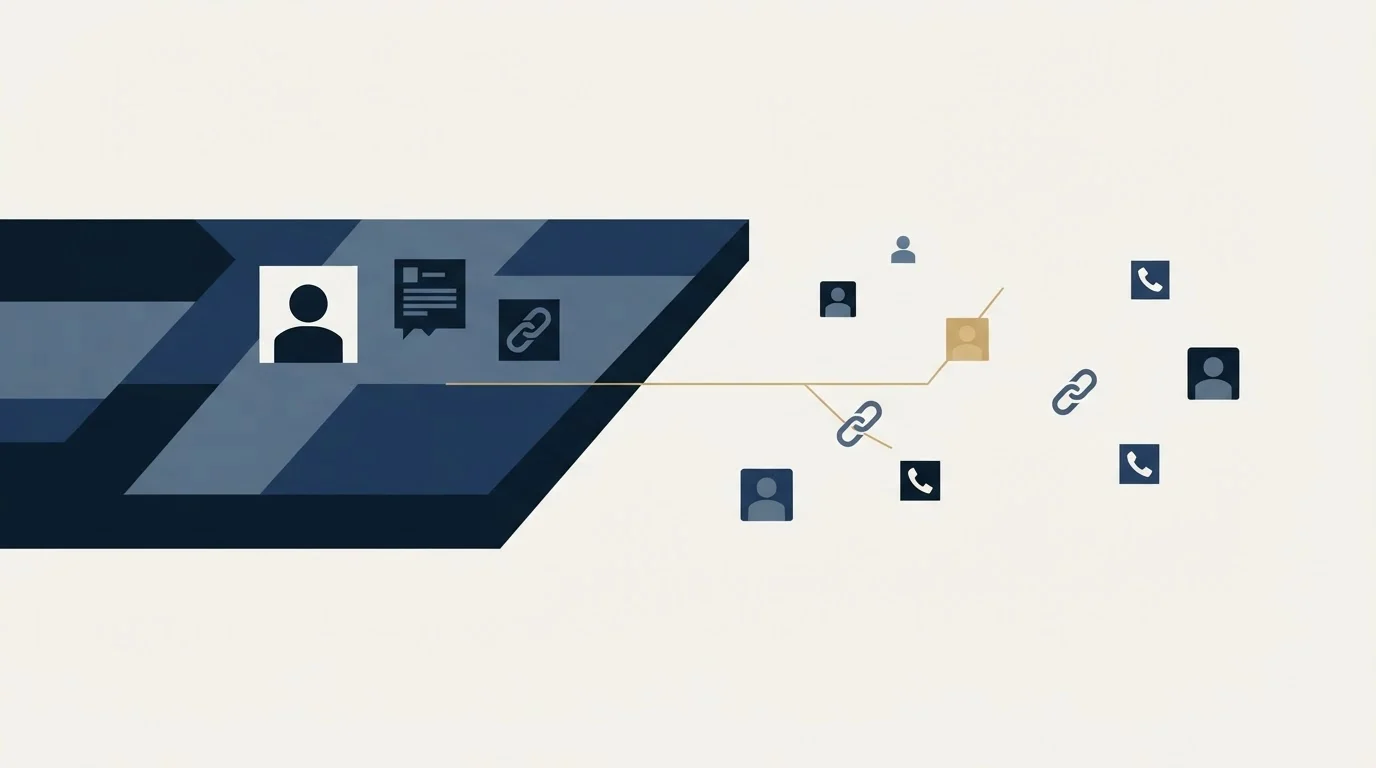
LinkedIn does publish an API programme, and it is worth knowing where it stops. Its developer catalog groups products into consumer sign-in and sharing, marketing, community management, events, data integrations and sales, with the community management family described in LinkedIn's own words as a way to "establish brand presence and nurture a community on LinkedIn" (LinkedIn developer product catalog). Access is gated: LinkedIn's documentation states that "Open Permissions are the only permissions that are available to all developers without special approval", and that "most permissions and partner programs require explicit approval from LinkedIn" (Getting access to LinkedIn APIs).
The shape of that programme is worth reading carefully. It lets an approved application publish to a page you administer and manage the community around it. Nothing in the open tier reads arbitrary members' posts or comment sections, which is why the third-party category exists in the first place. The same gating governs the sales side, where the Sales Navigator API and its alternatives shows what partner approval does and does not unlock.
What the signal is worth, honestly
Set the terms aside for a moment and ask what an engagement list predicts. Someone commenting on a post about a problem has demonstrated interest in a topic, which is genuinely more than a title and a company size tell you. It is also the weakest kind of intent signal available, because commenting is free, most comments on business content are network maintenance rather than research, and the person best placed to buy is frequently the one reading without engaging.
The three populations a scrape flattens into one list behave differently. A commenter has written something, which gives you material to reference and some evidence they read past the headline. A reactor has clicked once, which is close to no evidence at all and is the population that inflates every engagement export. The silent reader leaves no trace in the file and is frequently the person with budget, so a list built exclusively from visible engagement is filtered toward the people most comfortable being seen on the platform rather than toward the people most likely to buy.
The play works when the signal is used to improve relevance rather than to replace qualification. A post about a hiring bottleneck tells you what to open a message with. It does not tell you whether that company matches the criteria, whether the commenter can sign anything, or whether the timing is real. Engagement is also a poor proxy for authority: the comment sections of B2B posts skew toward peers, jobseekers in the field and other vendors, all of whom look identical to a scraper reading names and headlines.
- Step 1Read the post
Manually, in the feed, on accounts already inside the target list
- Step 2Qualify the company
Against the written criteria, not against the comment
- Step 3Send one message
Referencing what was actually said, once
- Step 4Stop
Silence is an answer, and a second message in the same thread reads as a bump
That last step is where our practice differs most sharply from what the tooling encourages. We send one message per campaign and we do not bump. On LinkedIn specifically we do not run no-reply retargets, because a second message lands directly underneath the one that was ignored, so it reads as a bump whatever the campaign structure calls it. A tool that watches a post and queues a follow-up sequence for everyone who did not reply is automating the thing we refuse to do by hand.
If somebody is selling you this

The useful question about a post-scraping tool is not whether it works. Most of them do work, for a while.
The questions worth asking are whose LinkedIn account the extraction runs through, what happens to that account and its network if the extraction is detected, and what the resulting list is actually worth after the enrichment step that the demo skipped. Ownership is the one that gets skipped in demos, because the answer is usually a founder's personal profile carrying years of relationships that no campaign result would replace. What can be automated on LinkedIn without triggering a restriction draws that line tool by tool, and the general position on LinkedIn scraping sets out the terms and the case law that usually gets misquoted beside them.
We run LinkedIn outreach through HeyReach alongside email, and our targeting comes from criteria agreed in writing before launch rather than from a comment section. LinkedIn prospecting routes covers what each route costs, and content-led outbound covers the other side of this coin, which is publishing the post that makes the comment section worth reading in the first place.
If the goal is meetings rather than a list of commenters, see what a first campaign looks like.
LinkedIn User Agreement, help centre and developer documentation verified against pages fetched in mid-2026. Verify current terms with LinkedIn before relying on them.
Frequently asked questions.
Frequently asked questions- Is scraping LinkedIn posts against the terms?
- LinkedIn prohibits using crawlers, plugins or scripts to scrape or copy data from the Services. For posts there is a closer clause still, telling members not to copy or distribute the posts or other content of others outside the available sharing functionality, unless the author granted permission by publishing under a licence that allows it.
- What data can you actually get from a LinkedIn post?
- The post text, its timestamp, reaction and comment counts, and for each commenter or reactor a name, a public profile URL and often a self-reported headline. Contact details are not included, because members control whether their email address is visible even to direct connections.
- Are people who comment on a post good leads?
- They are a weak signal used well. Commenting is free and most comments on business content are network maintenance, so the list skews toward peers, jobseekers and other vendors. The useful move is treating a comment as material for a more relevant first message, and qualifying the company against written criteria as usual.
- Can I buy scraped LinkedIn post data instead of scraping it myself?
- That route is named in the same clause. Members agree not to copy, use, display or distribute information obtained from the Services, whether directly or through third parties such as search tools or data aggregators or brokers, without the content owner consenting. Buying the dataset sits inside the prohibition rather than outside it.
About the author.

B2B cold email experts helping companies generate qualified leads through done-for-you outreach campaigns.
RevenueFlow Team
Explore more.
Ready to scale your outreach?
We build GTM engines that book real meetings. See the receipts.
Related articles.
SDR Outsourcing for Financial Services: The Third Party
What a bank, broker-dealer, adviser or agency's regulators say about an outside team that speaks for it, the licensed line, and which arrangement survives due diligence.
LinkedIn Outreach for Banks: A Regulated Message
How a bank's relationship managers use LinkedIn to reach business owners: what the FFIEC guidance, FINRA's notices and LinkedIn's own rules require, and where to stop.
The Direct Close: Asking Plainly for the Business
The direct close asks for the business with nothing wrapped around the question. The condition the publishers attach, the buyer it suits, where it backfires.
Cold Calling for Chemical Companies: Who Picks Up
A chemical cold call rarely arrives first. It reaches a formulator who has already been comparing suppliers on a screen, for one of three published reasons.
Cold Calling for PPC Agencies: What You Can See First
A paid media prospect is partly readable before the call and has already been told by the platform what to do when a stranger rings about its ads.
Sales Kickoff Agendas: Five Published, Session by Session
Five publishers print a sales kickoff agenda. They agree on four blocks and disagree on session length, rehearsal and where the agenda comes from.