Pay per Lead Generation Companies: Definition Over Price
Three vendors quote wildly different prices for the same market and none of them is lying. They are selling three different things, all invoiced as a lead.
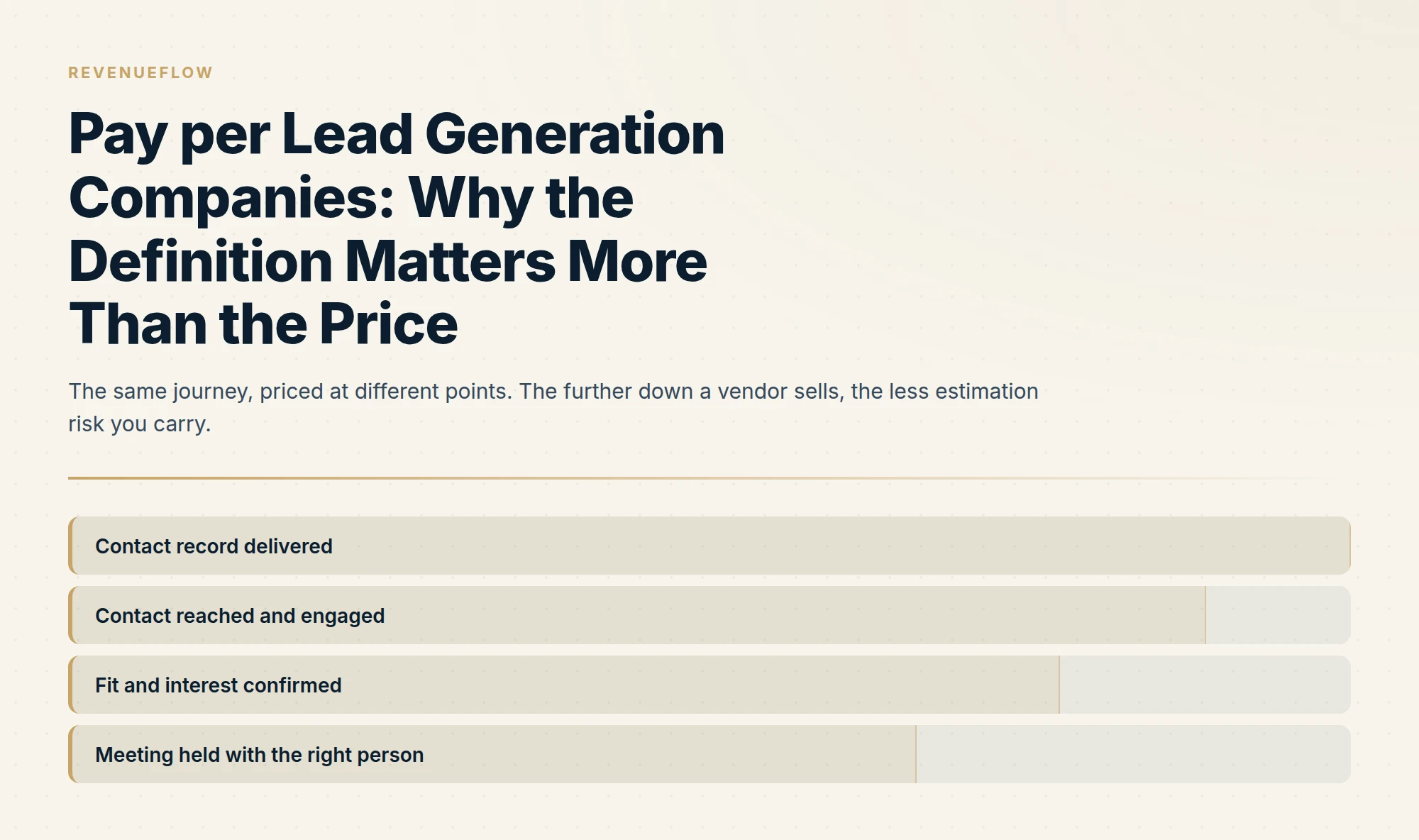
The word lead has a per-vendor definition, and that definition decides what you get far more than the price does. Vendors bill on a delivered contact record, an opt-in response, a scored or qualified lead, or a held meeting. Normalise every quote against the same trigger, evidence, exclusivity, recency and replacement questions before comparing numbers.
Key takeaways
- Pay per lead prices differ by an order of magnitude because vendors bill on four different events, from a delivered contact record to a held meeting.
- Exclusivity is the question buyers skip most often. A shared lead competes with other vendors' outreach in the same week and should be priced accordingly.
- Ask to see a redacted sample unit and the exact field or event that triggers billing. A vendor with a real product can point at it.
- Write your own definition and suppression list first, then ask every vendor to quote against it. The quotes become comparable and some vendors decline.
Reviewed and updated September 1, 2026
Three vendors quote a price per lead for the same target market and the prices are nowhere near each other. The cheapest is an order of magnitude below the most expensive. Nobody is lying. The first vendor is selling a contact record with a verified email address. The second is selling a person who downloaded something and consented to be contacted. The third is selling a conversation that already happened. All three invoice against a line item that says "lead", and the buyer who chooses on price alone has bought whichever one of those three happened to be cheapest that week.
The word "lead" does not have an industry definition. It has a per-vendor definition, and that definition determines the entire economics of the deal: how much work the vendor does, how much work remains for your team, what the unit converts at, and whether the price is high or low. Compare definitions and the prices sort themselves out. Compare prices and you are guessing.
In B2B pay per lead the fourth definition is a booked appointment rather than a record, and that is the version where the price and the risk finally sit on the same side of the contract.
Vendors selling on a pay per sales lead basis are describing the invoicing unit rather than the product, which is why two quotes using the same phrase can differ by an order of magnitude.
The four things vendors mean by "lead"
Buyers who report mixed results across pay per lead companies have usually bought two different products under one word, and the variance they are describing is a definition gap rather than a performance gap: without the definition in writing, the same rate can buy a verified conversation or a form fill.
Most pay-per-lead offers in B2B fall into one of four shapes. Knowing which shape you are being quoted takes one question and saves the entire evaluation.
- Trigger: a record is delivered and passes verification
- Prospect has no idea you exist
- Cheapest per unit by a wide margin
- Your team does all outreach and all qualification
- Watch: recency, verification method, resale
- Trigger: form fill, content download, ad lead form, reply
- Prospect took an action, often for the asset not for you
- Middle of the price range
- Your team qualifies and books
- Watch: what the asset promised, exclusivity, speed of handoff
- Trigger: the record clears a fit or intent threshold
- Someone applied a rule, and the rule may be theirs
- Priced above raw response
- Your team books and sells
- Watch: whose scoring model, and can you audit a sample
The fourth shape, a booked or held meeting, sits at the far end and is priced as a different product entirely. It carries its own contractual apparatus around attendance, rescheduling and rejection, which is why it belongs in its own conversation: B2B appointment setting covers that unit, and appointment setting versus lead generation covers the boundary between the two categories.
Within each shape there is still variation. Two data vendors both selling "verified contacts" can differ on whether verification means a syntax check, a mailbox probe, or a full deliverability pass, and that difference shows up as your bounce rate rather than as a line in the proposal.
The comparison framework
Put every quote through the same seven questions and they become comparable. Not equal, comparable, which is the goal.
- Yes: What single event triggers the invoice, stated as a testable condition
- Yes: What evidence accompanies each unit at delivery
- Yes: Is the unit exclusive to you, or also sold elsewhere
- Yes: How old is the underlying data or the response
- Yes: What is the replacement or credit policy, and inside what window
- Yes: How is conformance to your target profile tested before delivery
- Yes: Who does the follow-up, and how fast does it happen
The trigger question comes first because everything else is conditional on it. Ask the vendor to write the billable event as a condition a stranger could evaluate without them in the room. If the answer requires interpretation by the vendor, the vendor has reserved the right to decide what you owe.
Exclusivity is the question most often skipped and most often decisive. In several parts of the market, the same responding contact is sold to multiple buyers, which is legitimate when disclosed and ruinous when discovered. A shared lead is competing with two or three other vendors' outreach inside the same week, and the price should reflect that. Ask directly, and ask whether exclusivity has a duration.
Recency does most of the work in whether a record performs. A contact who moved roles nine months ago is not a bad lead, it is a different person's email address, and no verification pass catches that reliably. Ask when the underlying record was last confirmed and by what method.
The replacement policy is where a weak definition finally surfaces. If a delivered unit fails your criteria, does the vendor replace it, credit it, or argue? Get the window in writing, because a replacement policy with no clock is an intention.
The questions that expose a weak definition

Some questions are diagnostic. A vendor with a real product answers them in a sentence, and a vendor without one answers them in a paragraph about partnership.
Ask to see a sample unit, redacted, exactly as it would be delivered, along with the specific field or event that triggers billing. This single request separates vendors faster than any amount of reference-checking. A vendor billing on a defined event can point at the field. A vendor billing on a vibe will offer a case study instead.
Ask what happens in a month where nothing qualifying is produced. In a real pay-per-lead structure the answer is close to a zero invoice. Hesitation here means there is a fixed component that has not been foregrounded.
Ask who wrote the qualification rule. If the vendor scores fit against their own model rather than your written criteria, then you are buying their opinion of your market. That can be fine, and it is a completely different purchase from buying your own criteria enforced.
Ask what a rejection looks like. Specifically: what reasons are valid, who decides, and how long you have. A vendor that has never been rejected by a client has either never delivered at volume or has a client who gave up.
Ask how many buyers are currently being served in your exact segment. If the vendor sells the same audience to your three closest competitors, the audience is being contacted four times, and yours is one of the four.
What a replacement policy should actually say
Every vendor has a replacement policy and most of them are one sentence long, which is the problem. A usable policy answers four things.
What qualifies for replacement, stated against the written criteria rather than against dissatisfaction. What the window is, in business days, counted from delivery rather than from when someone got round to reviewing. Whether the remedy is a replacement unit or a credit, since those are not equivalent when you are near the end of a term. And what happens to a unit that is neither accepted nor rejected inside the window, which should be that it counts, because a policy with no default state leaves every invoice permanently open.
The window length is worth negotiating on both sides. Too short and the buyer cannot realistically review, particularly where the reviewer is a sales manager rather than an operations person. Too long and the vendor is financing an argument with no end, which they will price into the unit. A window measured in a small number of business days, with a named reviewer on the buyer's side, works for both.
One warning about credits. A vendor that replaces failed units with additional units, indefinitely, is not carrying much risk: they are converting a quality problem into a volume promise, and the volume costs them less than the refund would. Ask whether money ever moves.
Consent, provenance and the questions nobody asks

Two questions that rarely appear in evaluations and occasionally matter more than price.
Where did the underlying data come from, and on what basis is the contact reachable? For opted-in leads, ask what the person actually consented to, because a download form that promised a report and a form that promised vendor contact produce very different conversations, and the second one performs better than its lower volume suggests. For sourced records, ask what the collection method was.
Who does the outreach, and under whose identity? A vendor sending on your behalf from your domains, a vendor sending from its own, and a vendor selling you records to work yourself are three different risk profiles for your sending reputation. That question belongs in the evaluation rather than in the onboarding call, and cold email agency covers the infrastructure side of it.
Converting quotes into a decision
Once the definitions are on the table, the arithmetic is straightforward and it does not run on the vendor's numbers.
Take each vendor's unit and ask what fraction of those units become the thing you actually need. If you buy data records, the relevant chain runs from record to contact to conversation to meeting. If you buy responses, the chain is shorter. Each vendor's price divided by your own conversion rate through the remaining steps gives a cost per unit of the thing you care about, and that figure is the only one worth comparing across vendors.
Naming both ends of that chain is what makes the arithmetic work, and the conversion rate definition refuses to discuss a rate until both are stated.
The obvious problem is that you need your own conversion rates to run it. Many buyers do not have them, particularly for a channel they have not run before. When that is the case, the definition is your protection rather than the model, and the correct move is to buy the unit closest to the outcome you want even at a higher headline price, because that shifts the estimation risk onto the party who has the data.
Data vendors bill here
Response and opt-in vendors bill here
Qualified-lead vendors bill here
Appointment vendors bill here
Two other adjustments matter. Account for the work each option leaves on your side, since a cheap record that consumes a salesperson's week is not cheap. And account for volume ceilings, because the cheapest unit is often only available at volumes above what your team can process, and unworked leads are pure loss.
These tradeoffs between fixed unit price and uncertain total spend are explored further in the economics of pay per lead pricing, which contrasts them with retainer and in-house models.
Broader vendor landscape and pricing context sit in B2B lead generation companies and what a lead generation agency costs, which together cover the range a quote should sit inside before you start comparing definitions.
Fixing the definition before you shop
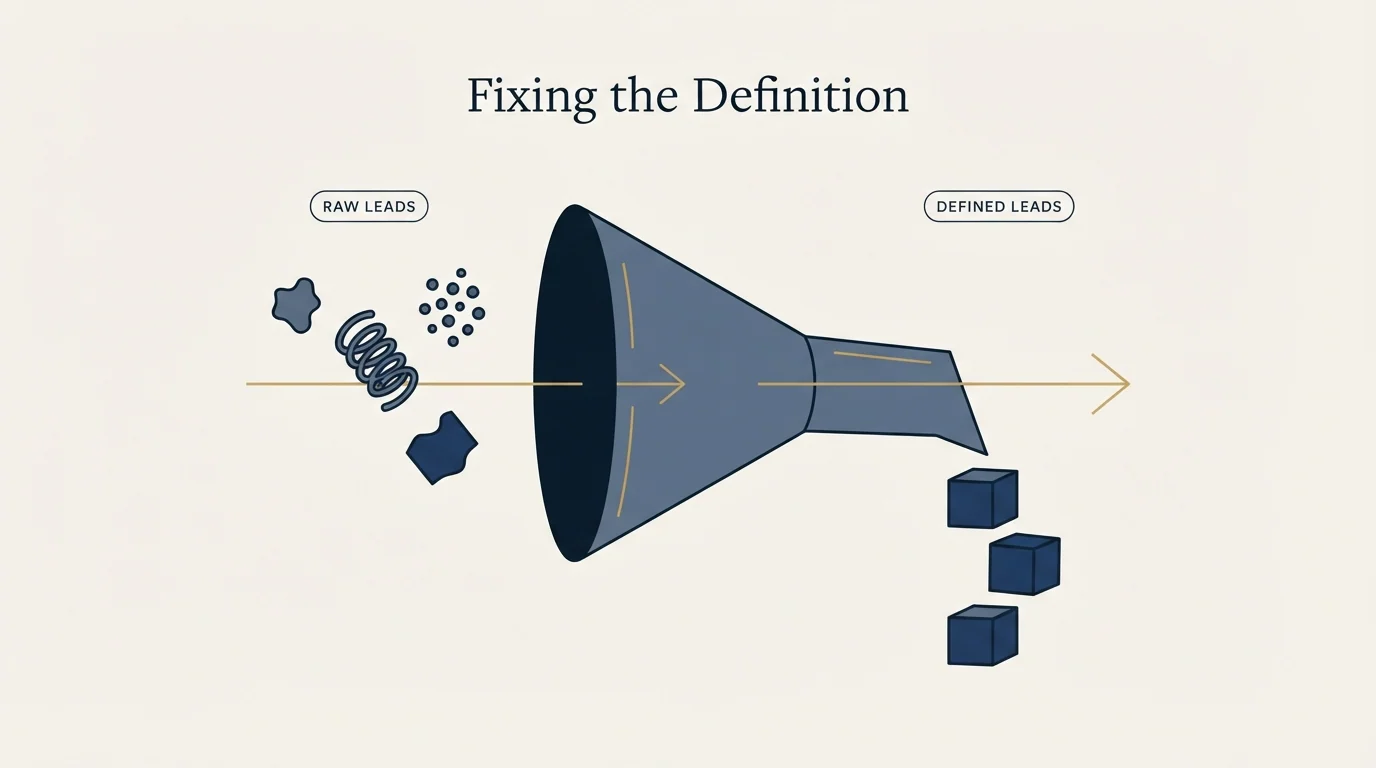
The strongest position in any of these conversations comes from having written your own definition first.
Write down the company criteria, the roles that count, the exclusions you will not accept, and any qualifying question that must be satisfied. Include your suppression list: existing customers, live opportunities, partners and accounts your team is already working. Then hand that document to each vendor and ask them to quote against it rather than against their own definition.
Three things happen. The quotes become genuinely comparable, because they now describe the same unit. Some vendors decline, which is useful information delivered free. And the vendors who proceed have accepted your standard in writing, which converts every later disagreement from an argument into a lookup.
We work this way by default: the qualification standard is agreed in writing before anything sends, and it is the standard the invoice is measured against. If you want to see what that looks like applied to your own market, you can see what a campaign would look like for your market.
Price is the last question, not the first. A vendor selling a well-defined unit at a high price is usually a better buy than a vendor selling an undefined unit cheaply, because the second one is not selling a unit at all.
Frequently asked questions.
Frequently asked questions- What counts as a lead when you buy pay per lead?
- Whatever the vendor's contract says. In B2B the four common triggers are a delivered contact record that passes verification, an opt-in response such as a form fill or content download, a lead scored above a fit or intent threshold, and a booked or held meeting. Each requires different work from the vendor and leaves different work for your team.
- Why do pay per lead prices vary so much between vendors?
- Because the unit is different at each one. A verified contact record costs a fraction of a held meeting because the prospect does not yet know you exist and every downstream step is yours. Price differences mostly encode how far down the journey the vendor is selling, plus whether the unit is exclusive to you or resold.
- How do I compare quotes from different lead generation companies?
- Convert each one into a cost per unit of the thing you actually need, using your own conversion rates through the steps the vendor leaves to you. If you do not have those rates, buy the unit closest to your desired outcome even at a higher headline price, because that moves the estimation risk to the party holding the data.
- What questions expose a weak lead definition?
- Ask for a redacted sample unit plus the field that triggers billing. Ask what the invoice says in a month with no qualifying delivery. Ask who wrote the qualification rule, since a vendor scoring against their own model is selling you their opinion of your market. Ask what a valid rejection looks like and how long you have.
About the author.

B2B cold email experts helping companies generate qualified leads through done-for-you outreach campaigns.
RevenueFlow Team
Explore more.
Ready to scale your outreach?
We build GTM engines that book real meetings. See the receipts.
Related articles.
Win Rate Benchmarks: Which Figures State a Population
A catalogue of the published average sales win rates, sorted by whether the page names the population behind its own number. Most do not.
Sales Kickoff Agendas: Five Published, Session by Session
Five publishers print a sales kickoff agenda. They agree on four blocks and disagree on session length, rehearsal and where the agenda comes from.
Sales Cycle Length Benchmarks: What Each Figure Counts
The published B2B sales cycle benchmarks, sorted by what each page says it counted. The same number means two different things in two of them.
Sales Enablement Charters: What the Published Ones Ask For
Six publishers set out what a sales enablement charter should contain. Five describe a document nobody can check, and one writes a definition with inspection in it.
Sales Comp Plan Design: What the Publishers Prescribe
Four publishers set out how to design a sales compensation plan. Here are their procedures, their components, and which of their ratios carry a population.
B2B Lead Lists for Aviation Companies: Build or Buy
Aviation is one of the few industries whose accounts are published by its regulator, which changes what is worth buying and what is worth downloading yourself.