Pay per Lead Marketing: The Economics From Both Sides
A headcount plan, an agency retainer and a per-lead price quote three different things. How each shapes fixed versus variable cost, and where each stops working.
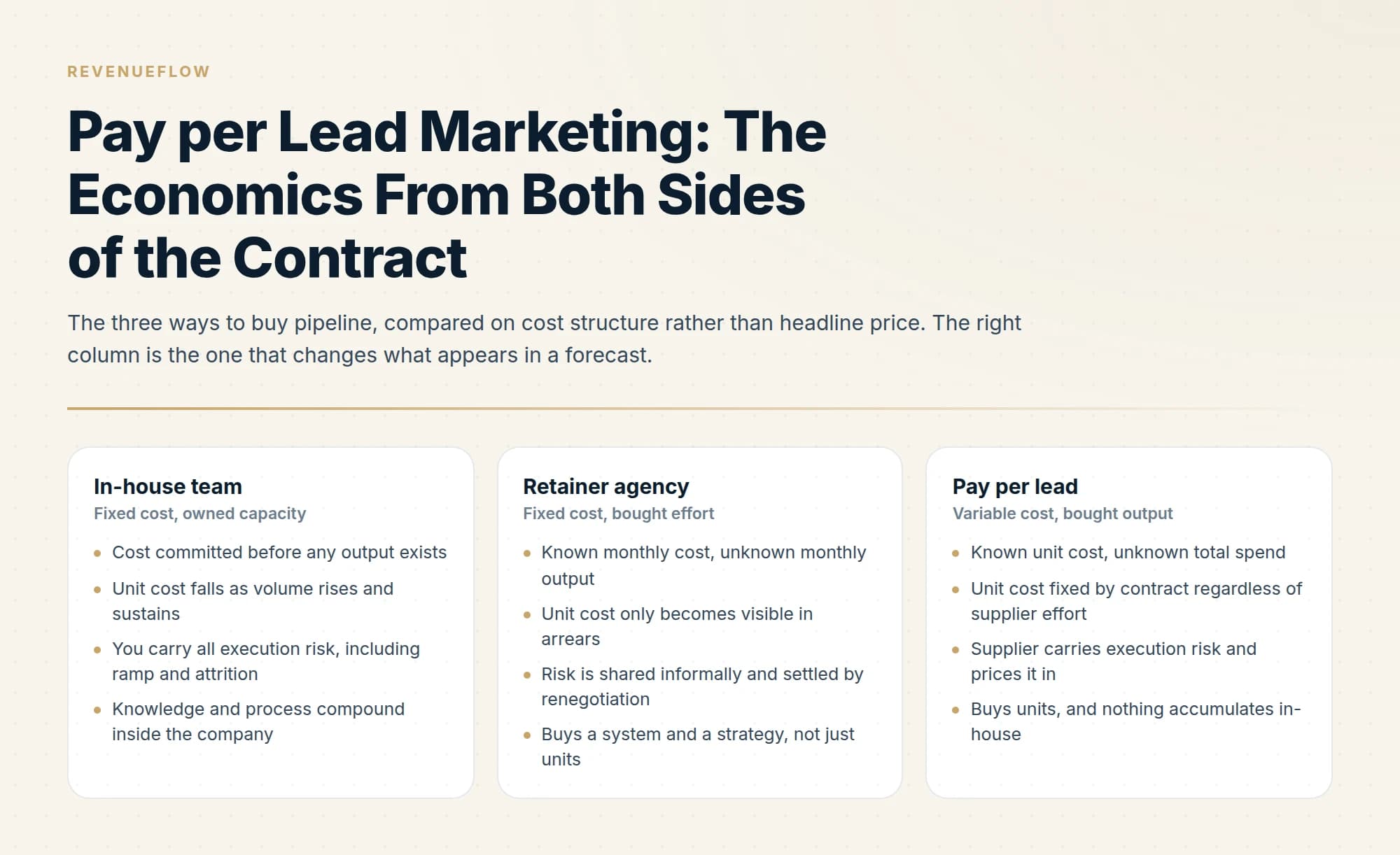
Pay per lead is better than a monthly retainer when you want to buy countable output and hand the execution risk to the supplier, and worse when you need strategy, positioning or a channel built. Retainers fix cost and leave output uncertain; pay per lead fixes the unit price, bills in arrears and lets total spend flex with delivery.
Key takeaways
- An in-house team and a retainer are fixed costs with uncertain output; pay per lead fixes the unit price and lets total spend flex.
- Pay per lead prices above an equivalent retainer because the supplier absorbs bad lists, broken domains and weak months.
- The written definition of a billable unit is the contract; budget, timing and authority should never be billing conditions.
- Compare quotes by converting each into an implied cost per held meeting, then run it again at half the planned output.
Reviewed and updated September 21, 2026
Whether pay-per-lead pricing is better than a monthly retainer for lead generation depends on what each quote is actually pricing. Three quotes land in the same budget planning meeting for what is nominally the same outcome. One is a headcount plan: two SDRs, a manager's time, tooling and data. One is an agency retainer with a monthly fee and a set of activities. One is a price per qualified lead, billed on delivery. As written, none of the three can be compared to the others, because they are quoting different things: the first quotes capacity, the second quotes effort, and the third quotes output.
Pay per lead is the only one of the three that puts a price on the thing you actually want. That is its entire appeal, and understanding what it costs to get that requires looking at the contract from the supplier's side as well as your own.
A pay per lead SEO arrangement adds one problem the other shapes do not have, which is that organic traffic arrives without a click record either side can point at, so the lead definition has to carry the attribution argument on its own.
Three cost shapes
These models differ less in headline price than in what happens to your cost when volume changes, which is the comparison that survives into the planning model.
An in-house team is almost entirely fixed. Salaries, tooling and data are committed before a single lead arrives, and they continue whether the quarter goes well or badly. Cost per lead falls as output rises, which makes an in-house team the cheapest option per unit at high, sustained volume and the most expensive at low or uncertain volume.
A retainer agency is also fixed, with a shorter commitment. You buy a monthly amount of effort, and the output is a forecast rather than a promise. Cost per lead is unknown at signing and only becomes visible after a few months of delivery, at which point it is knowable but no longer negotiable for the period already paid.
Pay per lead is variable by construction. Cost tracks output exactly, so cost per lead is fixed at the price you agreed and total spend is the uncertain quantity. There is normally a floor of some kind, a minimum commitment or a setup fee, and there is usually a cap you set to stop spend running past the budget.
| Shape | What you know | Who carries the risk | Exit |
|---|---|---|---|
| In-house | Cost, before any output exists | You, including ramp and attrition | Slowest to start and stop |
| Retainer | Monthly cost; output only in arrears | Shared, settled by renegotiation | Notice periods |
| Pay per lead | Unit cost; total spend flexes | The supplier, priced into the rate | Fastest, subject to any minimum |
What each does to a forecast
For a CMO, the practical consequence sits in the planning model rather than in the P&L.
With fixed models you can forecast spend precisely and pipeline loosely. The budget line is certain a year out, and the pipeline number attached to it is an estimate that will be wrong in one direction or the other. Every quarterly review becomes a conversation about why output differed from the assumption, and the cost was incurred either way.
With pay per lead the certainty inverts. Pipeline is forecastable at the unit level, since you know what a lead costs and how many you have committed to buy, while total spend flexes with delivery. The awkward version of this is a supplier who over-delivers into a month you had budgeted conservatively. The bill is larger than planned, the outcome is good, and finance is unhappy. Volume caps exist for exactly this, and agreeing one at signing is cheaper than arguing about it in month three.
The cash timing differs too, and it favours the buyer. Fixed models bill in advance for capacity you have not yet consumed. Pay per lead bills in arrears against units already delivered, so the working capital sits with the supplier while the work is being done. In a business where cash is the binding constraint, that difference can outweigh a higher unit price.
The supplier's side, and why the price looks high

Pay per lead prices above the equivalent retainer for the same work. The gap is the cost of the risk transfer, priced the way any insurer prices variance.
Teams weighing that risk premium against alternative structures will find a broader breakdown of performance-based pricing useful for seeing when the transfer stops paying off for either side.
A supplier on a retainer gets paid for the month regardless of what the market does. A supplier on pay per lead absorbs a bad list, a broken domain, a seasonal collapse in reply rates and a client whose offer turns out to be unsellable, and gets paid nothing for any of it. That variance has a price, and the buyer pays it in the unit rate. Comparing a per-lead price to a retainer without accounting for who is holding the downside compares two different products.
Three consequences follow, and they shape how the relationship behaves.
Suppliers need volume to make the economics work, because they are averaging across accounts and months. A tiny commitment is expensive per unit or refused outright.
Suppliers push toward breadth in the ICP, because a narrow definition raises their cost per unit while the price stays fixed. This is the single most common source of friction, and it is settled by the qualification definition rather than by goodwill.
Suppliers optimise for the definition as written rather than for the intent behind it, which is simply how any output-based contract behaves. A loose definition produces exactly what a loose definition describes.
Qualification disputes often trace back to the mechanics of where lead tracking and billing break down, the software layer that captures, dedupes and routes leads before reconciling invoices.
The definition is the contract
Everything that goes wrong in a pay per lead arrangement traces back to disagreement about what counts as a unit, and that disagreement is far cheaper to have before launch than after the first invoice.
Our own standard for a qualified meeting has five points, and all five have to hold. The company sits in a pre-approved audience matching the agreed ICP. The participant has reasonable responsibility for or influence over the relevant area. The prospect agrees to a relevant business conversation. The prospect attends and participates. The prospect was not disclosed as an existing customer, an active opportunity or a suppressed account before outreach started.
What is deliberately absent from that list is as important as what is in it. Budget, timing, decision authority and immediate purchase intent are not billing conditions. Those describe how a conversation went, and a supplier cannot control how a conversation goes. Making them billing conditions turns every invoice into a negotiation about whether a prospect was enthusiastic enough, which is unresolvable and poisons the relationship inside a quarter.
Two operating defaults make the rest of it work in practice. Book by default: a prospect meeting the agreed criteria goes straight on the calendar without a pre-booking review hold, every booking is flagged in the shared channel as it lands, and the client can cancel any booking they do not want. Waiting on review costs momentum on every single meeting to protect against the rare miss that the cancel right already covers. And qualified by default: a held meeting counts unless the client flags it within three business days with a reason that maps to the written definition. Subjective quality complaints are not valid rejections, because the standard is a real conversation with the right person at a fitting company rather than a good outcome.
Pay per lead vs pay per meeting
The unit is the whole difference between the two. A lead is a record: a contact who filled in a form, replied, or matched a filter, and what happens next is still the buyer's problem. A meeting is a conversation that took place with the right person at a fitting company, which is why the definition above is written around attendance rather than interest. Pay per meeting prices further down the funnel, so the unit costs more and says more; pay per lead is cheaper per unit and leaves the conversion risk with you. Compare them on the cost of a held meeting, not on the sticker price of the unit.
Speed has its own measurement problem, and lead response time hides two legs: a systems leg nobody is accountable for, and a workload leg somebody is.
Agree in writing
- The billable unit, every condition listed
- The ICP, firmographics and buyer responsibility
- A rejection window in business days, with a named reviewer
- Rejection reasons mapped to the definition
- A suppression list, a volume cap and any minimum
- The de-duplication rule, and who owns domains and data at the end
Keep out of the contract
- Budget, timing or authority as billing conditions
- Rejection on subjective call quality
Where each model stops making sense
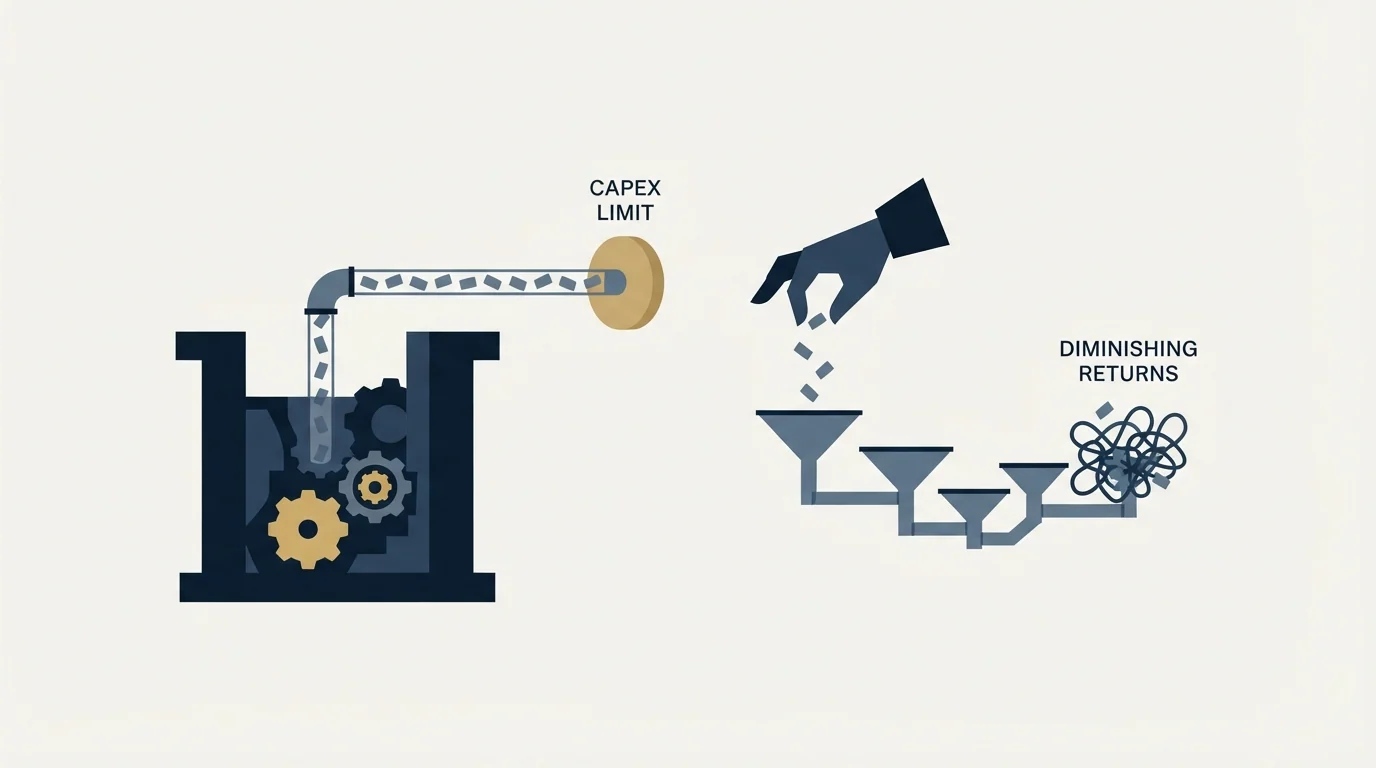
The crossover points are structural rather than numerical, and you can locate yours with arithmetic you already have.
An in-house team beats a per-unit supplier once your loaded cost per delivered unit falls below the supplier's price and stays there. Loaded means everything: salary and employer costs, ramp time during which output is near zero, management attention, data and tooling, and the cost of replacing someone who leaves. Companies routinely compute this against base salary and conclude in-house is cheaper than it is. The honest version of the calculation is in our comparison of outsourced SDR against in-house.
A retainer makes sense when you are buying something other than units: positioning work, a repeatable system, a channel that has to be built before it produces, or senior judgement about an offer that is not working. Paying per lead for those is a category error, since none of them are countable. It stops making sense when the deliverable is genuinely a volume of meetings and the retainer is functionally a per-unit price with the risk pointed at you. Our breakdown of lead generation agency cost covers how to read a retainer proposal for which of the two it actually is.
Pay per lead stops making sense in two situations. When the ICP is so narrow that the total addressable list is small, per-unit economics collapse for the supplier and the price rises past what the model is worth. And when volume is high, sustained and predictable, the risk premium you are paying every month starts to look like the salary of the person who could be doing it internally.
Deal size sets a third limit the ICP and volume tests miss, and pay per meeting arithmetic on small deals shows where gross profit stops repaying the rate.
Is pay per lead pricing better than a monthly retainer?
The comparison only works in one direction: convert everything into an implied cost per delivered unit, then adjust for who carries the risk.
Step two is where the comparison is usually decided, because the in-house and retainer options are being divided by an output number that nobody has committed to. The discipline that helps is to run the division twice, once at the planned output and once at half of it, then look at whether the ranking survives. Where the ranking flips, the decision is really a bet on the output assumption rather than a comparison of prices, and it should be discussed on those terms. The upstream unit economics in our guide to what a lead generation agency costs are the input to that division.
Most companies end up running more than one

The tidy answer is one model. The common answer is a mix, and it is usually the right one.
Pay per lead is a good fit for a new segment where you do not yet know whether outbound works, for filling a gap while an internal team ramps, and for a motion whose economics you want to prove before committing headcount. A retainer is a good fit for the strategic and creative layer that produces the offer everything else sells. In-house is a good fit for the segment you understand best and intend to work for years.
The failure to avoid is running them without a common definition of a unit and a common counting source, at which point you cannot compare their performance and every reallocation decision becomes a matter of who argued more persuasively. Pick the definition once, count in one place, and let the models compete on the same metric. Our overview of B2B lead generation services covers what each type of supplier is actually selling underneath the label.
If you want a per-unit view of what outbound would produce in your specific market before choosing a model, you can see what a campaign would look like.
Frequently asked questions.
Frequently asked questions- Is pay-per-lead pricing better than a monthly retainer for lead generation?
- It is better when the deliverable is a countable volume of meetings or leads and you want the supplier to carry execution risk, since pay per lead fixes the unit price and bills in arrears. A retainer is better when you are buying strategy, positioning or a channel that has to be built before it produces, none of which is countable.
- What is the difference between pay per lead and pay per meeting?
- The unit. A lead is a record, such as a form fill, a reply or a contact matching a filter, and converting it is still your job. A meeting is a held conversation with the right person at a fitting company. Pay per meeting costs more per unit and says more, so compare both on the cost of a held meeting.
- Why does pay per lead cost more than a retainer for the same work?
- Because the supplier carries the variance. A retainer is paid whatever the market does, while a pay per lead supplier absorbs a bad list, a broken domain, a seasonal dip in replies and an offer that does not sell, and earns nothing for any of it. That risk transfer is priced into the unit rate.
- What should a pay per lead contract define?
- A written definition of the billable unit with every condition listed, the agreed ICP, a rejection window in business days with a named reviewer, valid rejection reasons mapped to the definition, a suppression list, a volume cap, any minimum, and a de-duplication rule. Budget, timing and authority should not be billing conditions.
About the author.

B2B cold email experts helping companies generate qualified leads through done-for-you outreach campaigns.
RevenueFlow Team
Explore more.
Ready to scale your outreach?
We build GTM engines that book real meetings. See the receipts.
Related articles.
Win Rate Benchmarks: Which Figures State a Population
A catalogue of the published average sales win rates, sorted by whether the page names the population behind its own number. Most do not.
Sales Kickoff Agendas: Five Published, Session by Session
Five publishers print a sales kickoff agenda. They agree on four blocks and disagree on session length, rehearsal and where the agenda comes from.
Sales Cycle Length Benchmarks: What Each Figure Counts
The published B2B sales cycle benchmarks, sorted by what each page says it counted. The same number means two different things in two of them.
Sales Enablement Charters: What the Published Ones Ask For
Six publishers set out what a sales enablement charter should contain. Five describe a document nobody can check, and one writes a definition with inspection in it.
Sales Comp Plan Design: What the Publishers Prescribe
Four publishers set out how to design a sales compensation plan. Here are their procedures, their components, and which of their ratios carry a population.
B2B Lead Lists for Aviation Companies: Build or Buy
Aviation is one of the few industries whose accounts are published by its regulator, which changes what is worth buying and what is worth downloading yourself.