Pay per Lead Software: Where the Model Breaks
One person, two forms, nine days apart, two invoice lines. What lead distribution software does, and where its count and the buyer's count come apart.
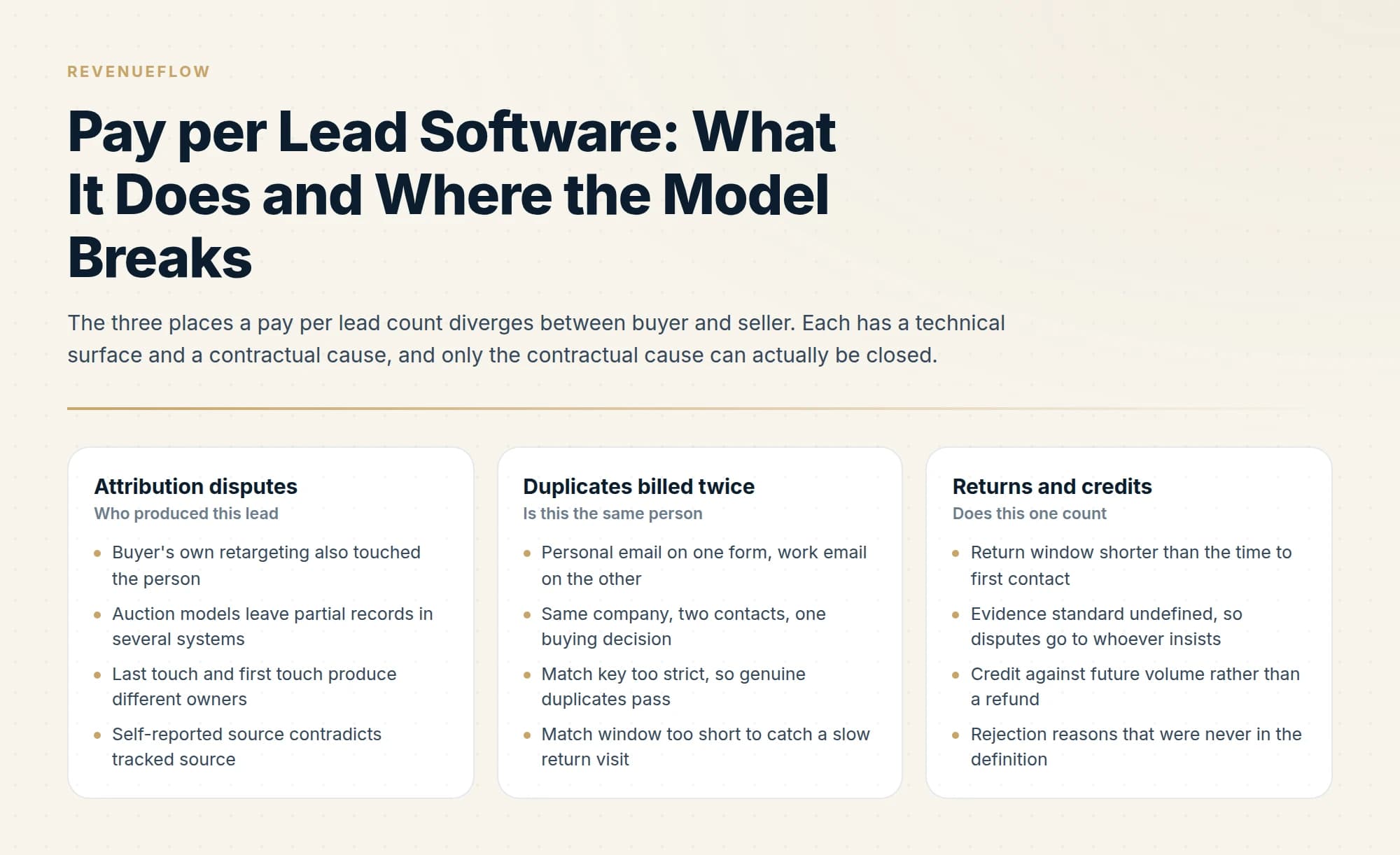
Pay per lead software captures leads, validates and deduplicates them, routes them to buyers, tracks disposition and reconciles billing. It breaks in three places: attribution when several parties contributed, duplicates when the match key or window is wrong, and returns when the window, valid reasons and evidence standard were never agreed in writing.
Key takeaways
- The software enforces the unit definition you give it, and it cannot tell you that the definition you wrote is unenforceable.
- Every de-duplication system rests on a match key and a time window, and both are wrong in one direction or the other.
- Attribution rules are a settlement mechanism rather than a measurement of truth, so agree the rule and lookback window before launch.
- Naming one system as the counting source turns month-end negotiations into record-level questions that have answers.
Reviewed and updated September 2, 2026
The same person submits a form on a comparison site on a Tuesday and a second form on a different comparison site nine days later. Both submissions reach the same buyer. The email addresses differ by one character because the second form was filled in on a phone. Two records enter the CRM, two line items appear on the invoice, and the sales rep who calls the number twice gets told, with some feeling, that they already spoke to somebody.
Everything in that sequence worked as designed. Pay per lead software exists to move records from the people who generate them to the people who buy them, and it does that reliably. What it struggles with is agreeing on what happened afterwards.
What the category actually is
The label covers software sitting between a lead generator and a lead buyer, automating the handoff and the money that follows it. It shows up in two deployments that are worth keeping separate.
Seller side, a platform runs a distribution business: it captures leads from owned properties or affiliate publishers, applies filters, sells each record to one or more buyers, and bills them. Buyer side, a system ingests leads from multiple suppliers, normalises them into one schema, deduplicates against records already owned, pushes them into the CRM, and reconciles what arrived against what was invoiced.
Plenty of tools do parts of this under other names. Marketing automation handles capture. A CRM handles routing internally. A billing platform handles invoicing. What a dedicated system adds is the join between them, so that a record, its source, its disposition and its invoice line are the same object rather than four objects somebody reconciles in a spreadsheet at month end.
The five things it does
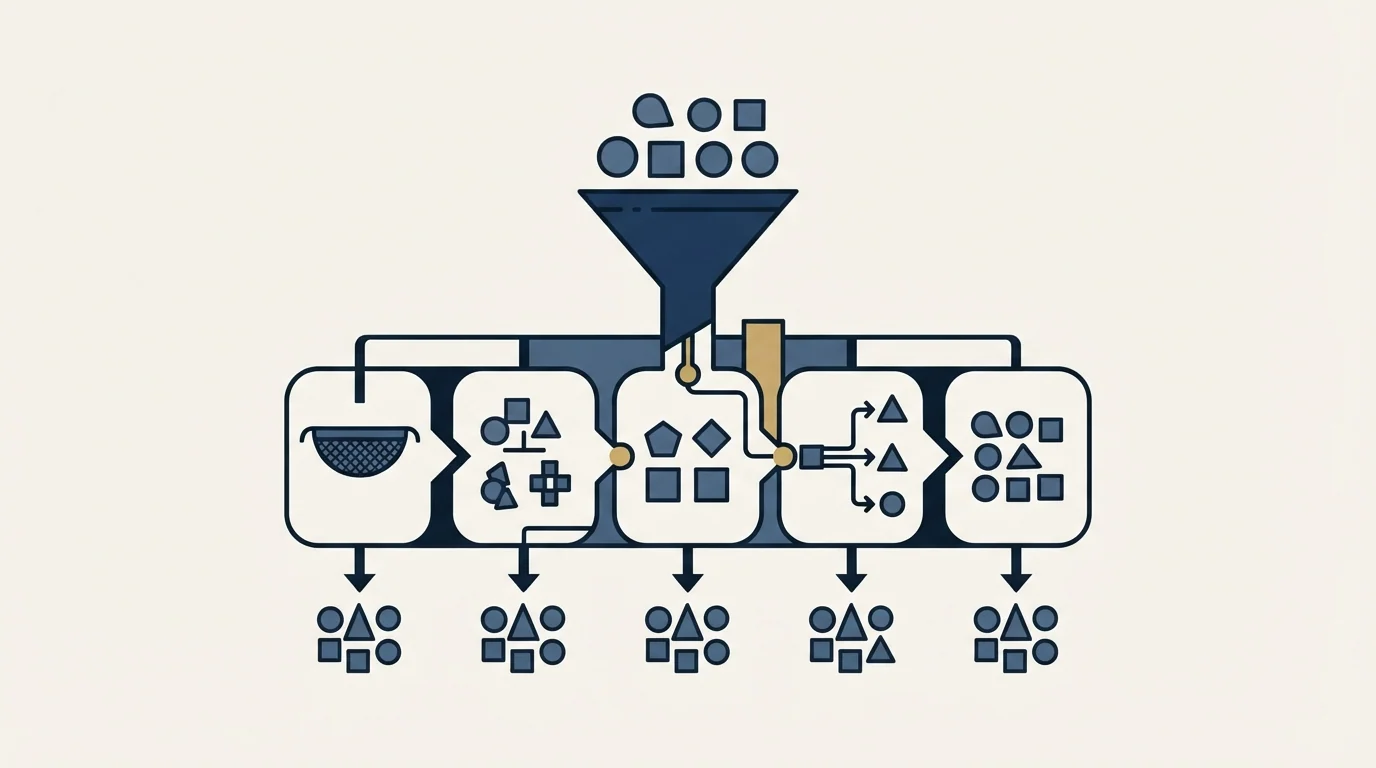
- Step 1Capture
Forms, landing pages, call tracking numbers, API and webhook ingestion from suppliers and affiliate publishers.
- Step 2Validate and deduplicate
Format and deliverability checks, enrichment, then matching against records already in the system to decide whether this is new.
- Step 3Route and distribute
Filters, caps and schedules decide which buyer receives the record, exclusively or shared, in real time or in batches.
- Step 4Track disposition
Feedback flows back from the buyer's CRM: contacted, qualified, rejected, converted, tied to the original source.
- Step 5Reconcile and bill
Delivered units are counted, returns and credits applied, invoices generated against the agreed unit definition.
Capture is the least interesting part technically and the most consequential for quality. What the form asks determines what can later be checked against a qualification definition. A form collecting a name and an email cannot support a definition that requires company size and buyer responsibility, so the definition and the capture schema have to be designed together.
Validation and de-duplication is where the record becomes billable or not. Format checks and deliverability verification are the easy half. Matching the record against everything already in the system is the hard half, and it is the source of most of the money that gets argued about.
Distribution is the seller-side core. Filters restrict which records a buyer receives, caps limit daily or monthly volume, schedules stop records arriving when nobody is there to call them. Exclusive delivery means one buyer per record. Shared delivery sends the same record to several, at a lower price each, which is standard in some verticals and unacceptable in others. Some platforms run a real time auction in which a stripped-down version of the record is offered to multiple buyers, and the buyer accepting first or highest receives the full record. That model is efficient and it multiplies attribution problems, because a single consumer action produces bids, partial records and full deliveries across several systems.
Tracking closes the loop by pulling disposition back from the buyer. This is the stage most often left half built, and its absence is why so many lead relationships are argued in anecdotes.
Billing and reconciliation counts delivered units against the contract, applies returns and credits, and produces an invoice. Prepaid wallets are common because they remove collection risk from the seller.
Because billing follows delivered units, the underlying economics of per lead pricing explain why suppliers price above an equivalent retainer to absorb execution risk.
Where the model breaks
Three failure modes account for most of the disputes, and all three are contract problems that software surfaces rather than software problems that a better product fixes.
- Buyer's own retargeting also touched the person
- Auction models leave partial records in several systems
- Last touch and first touch produce different owners
- Self-reported source contradicts tracked source
- Offline conversations that never touched any system
- Personal email on one form, work email on the other
- Same company, two contacts, one buying decision
- Match key too strict, so genuine duplicates pass
- Match window too short to catch a slow return visit
- Two suppliers sourcing from the same publisher
- Return window shorter than the time to first contact
- Evidence standard undefined, so disputes go to whoever insists
- Credit against future volume rather than a refund
- Rejection reasons that were never in the definition
- No agreed reviewer, so rejections arrive from anyone
Attribution
The dispute is rarely about tracking accuracy. Several parties genuinely contributed to the outcome, and the contract pays only one of them.
A prospect sees a supplier's campaign, does not act, sees the buyer's own retargeting a week later, then arrives through a branded search and fills in a form. Under last touch the supplier gets nothing. Under first touch the supplier gets everything. Both models are internally consistent and neither describes what happened. Auction-based distribution makes it worse, because the same consumer action can leave traces in three buyers' systems and each will believe it originated the record.
What platform CPA numbers leave out explains why board-level cost reporting requires reconciling tracked conversions with true acquisition cost.
The workable resolution is agreeing the attribution rule and its lookback window in writing before launch, and accepting that it will be wrong at the edges in both directions. Attribution rules are a settlement mechanism rather than a measurement of truth, and treating them as truth is what turns a rounding error into a quarterly argument. The upstream version of this problem, where a measured cost per lead diverges from the eventual cost per customer, is covered in our guide to what a lead generation agency costs.
Duplicates
Every deduplication system rests on a match key and a time window, and both are wrong in one direction or the other.
Email as the key fails when the same person uses a personal address once and a work address the next time. Phone fails on shared lines and on numbers that change. Company domain catches the case where two people from the same account submit separately, which is exactly right for one buyer and exactly wrong for another, since two genuine contacts at a large enterprise may represent two independent opportunities. Fuzzy matching on name and company catches more and creates false positives, which are the expensive kind of error because they suppress records the buyer paid to receive.
The window matters as much as the key. Too short and a prospect returning after six weeks bills twice. Too long and a genuinely renewed interest is suppressed. Cross-supplier duplicates are the hardest case, because two suppliers can honestly both have sourced the same person from the same underlying publisher, and neither has done anything wrong.
None of this is solvable by picking a better algorithm. It is solvable by agreeing the key, the window and the cross-supplier rule up front, and by having one system of record that both sides can query rather than two counts compared at month end.
Returns and credits
The return workflow is where the relationship is actually tested, and it is usually the least specified part of the contract.
Four things need to be written down and rarely all are. The window, in business days, within which a buyer can reject. The valid reasons, mapped to the qualification definition rather than left open. The evidence required, since a rejection with no evidence is unfalsifiable in both directions. And whether a valid rejection produces a credit against future volume or a refund, which is a cash question the seller cares about far more than the buyer expects.
The incentive asymmetry is worth naming. A buyer under budget pressure has a reason to reject marginal records, and a seller has a reason to make rejection administratively tedious. Software can make the workflow fast and auditable, which removes the tedium as a weapon, and that is genuinely useful. It cannot decide whether a given rejection is fair.
What the software cannot do

A platform enforces the definition you gave it. It does not write one, and it cannot tell you that the one you wrote is unenforceable.
Nor can it tell you the unit is too expensive for what you sell, which turns on the deal size behind a per meeting rate rather than the rate itself.
This is where our own practice sits, and it is deliberately a contract standard rather than a feature. A qualified meeting has to satisfy five conditions, all of them. The company is in a pre-approved audience matching the agreed ICP. The participant has reasonable responsibility for or influence over the relevant area. The prospect agrees to a relevant business conversation. The prospect attends and participates. The prospect was not disclosed as an existing customer, an active opportunity or a suppressed account before outreach began.
Budget, timing, decision authority and immediate intent are explicitly not billing conditions. They describe how a conversation turned out, which is not something a supplier controls, and admitting them into the definition converts every reconciliation into an argument about enthusiasm.
The operating defaults matter as much as the definition. Meetings meeting the criteria are booked straight onto the calendar with no pre-booking review hold, flagged in the shared channel as they land, and the client can cancel any booking. A held meeting counts unless it is flagged within three business days with a reason mapping to the written definition, and subjective complaints about how the call felt are not valid rejections. Those two defaults are what a reconciliation workflow needs in order to be automatable at all: a clock, a reviewer, and a closed list of reasons.
Two structural notes for anyone building this on outbound rather than inbound forms. Our campaigns carry one message each, with no thread replies and no bump sequences, which makes touch attribution simpler than it is in a multi-touch inbound funnel, because there is one send per prospect per campaign to attribute. And the qualification stage definitions have to be settled before any of it is wired up, since a reconciliation system inherits whatever ambiguity sits in the boundary between a marketing qualified and a sales qualified record, a distinction we work through in MQL versus SQL.
What to ask before wiring anything up
- Yes: The billable unit is defined in writing, with every condition listed
- Yes: De-duplication key and time window are agreed, including across suppliers
- Yes: Attribution rule and lookback window are agreed and documented
- Yes: Return window, valid reasons and evidence standard are written down
- Yes: One system is named as the counting source for invoices
- Yes: Suppression list of customers and open opportunities is loaded before launch
- Depends: Disposition feedback flows back from the buyer's CRM automatically
- Depends: Exclusive or shared delivery is specified per source
- No: Rejection reasons can be added unilaterally after launch
- No: Two systems count units and are reconciled manually each month
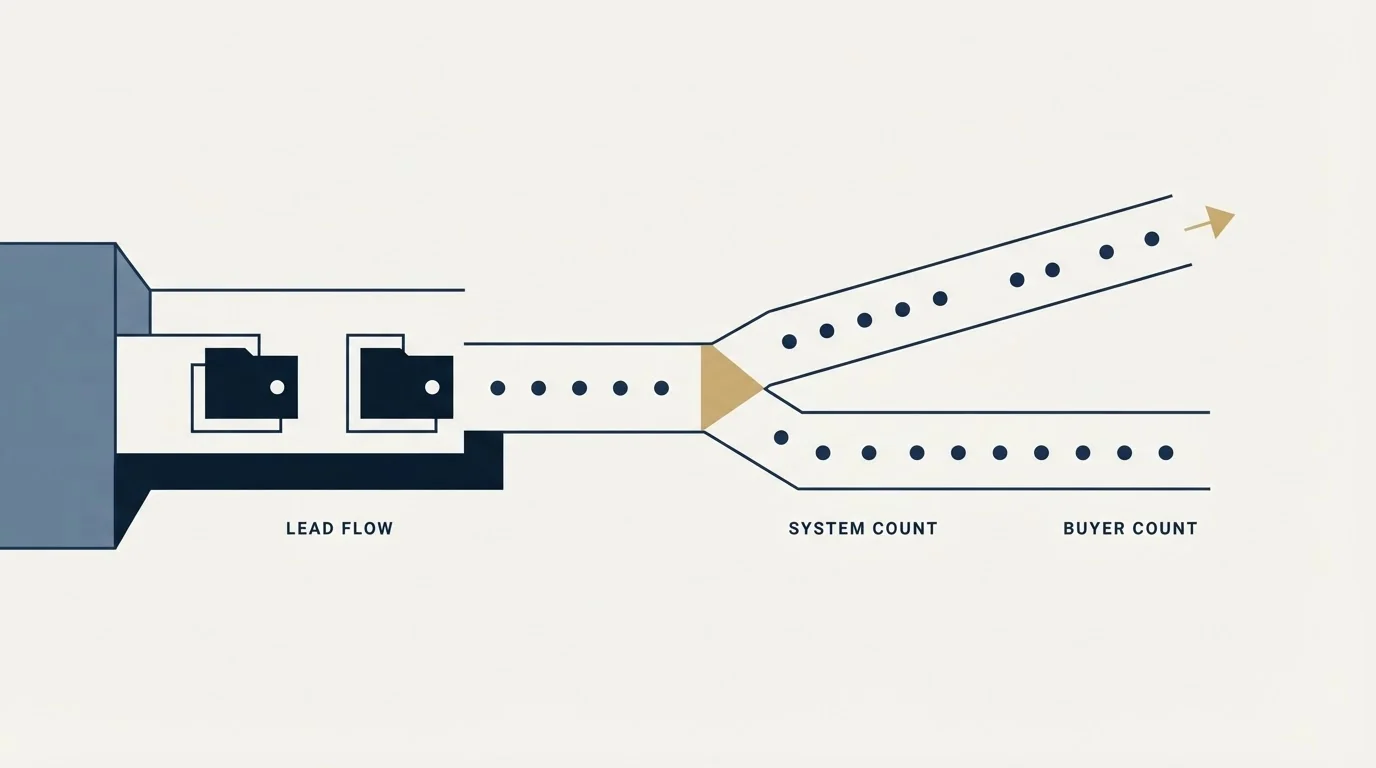
The single highest-leverage line there is the counting source. When both sides run their own count and compare at month end, every discrepancy becomes a negotiation, and the discrepancies never reach zero. When one system counts and both sides can query it, disagreements become specific record-level questions with answers.
Choosing between suppliers before you have that in place is premature. Our overviews of B2B lead generation companies and pay per appointment pricing cover what to hold a supplier to underneath the tooling, and the definition travels with you whichever platform you end up running it on.
If you want to see what the delivered units would look like in your market before committing to a stack, you can see what a campaign would look like.
Frequently asked questions.
Frequently asked questions- What does pay per lead software actually do?
- It captures leads from forms, call tracking and API feeds, validates and deduplicates them against records already held, routes each to a buyer under filters, caps and schedules, tracks disposition back from the buyer's CRM, and reconciles delivered units into invoices with returns and credits applied. The value is joining those stages so one record carries its own billing history.
- How do you stop being billed twice for the same lead?
- Agree the match key, the time window and the cross-supplier rule before launch. Email fails when someone uses a personal address once and a work address next. Company domain suppresses genuine second contacts at large accounts. Fuzzy matching creates false positives that suppress records you paid for. No algorithm resolves this, only a written rule and a single counting source.
- Who owns attribution when two sources touched the same lead?
- Whoever the contract says, which is why the rule and its lookback window need writing down before anything launches. Last touch credits the source that closed, first touch credits the source that found them, and both are internally consistent while describing different events. Expect the rule to be wrong at the edges in both directions and settle on that basis.
- What should a lead return policy include?
- Four things: the window in business days within which a buyer can reject, the valid reasons mapped to the written qualification definition rather than left open, the evidence required for a rejection to stand, and whether a valid rejection produces a credit against future volume or a refund. The last one is a cash question sellers care about more than buyers expect.
About the author.

B2B cold email experts helping companies generate qualified leads through done-for-you outreach campaigns.
RevenueFlow Team
Explore more.
Ready to scale your outreach?
We build GTM engines that book real meetings. See the receipts.
Related articles.
Win Rate Benchmarks: Which Figures State a Population
A catalogue of the published average sales win rates, sorted by whether the page names the population behind its own number. Most do not.
Sales Kickoff Agendas: Five Published, Session by Session
Five publishers print a sales kickoff agenda. They agree on four blocks and disagree on session length, rehearsal and where the agenda comes from.
Sales Cycle Length Benchmarks: What Each Figure Counts
The published B2B sales cycle benchmarks, sorted by what each page says it counted. The same number means two different things in two of them.
Sales Enablement Charters: What the Published Ones Ask For
Six publishers set out what a sales enablement charter should contain. Five describe a document nobody can check, and one writes a definition with inspection in it.
Sales Comp Plan Design: What the Publishers Prescribe
Four publishers set out how to design a sales compensation plan. Here are their procedures, their components, and which of their ratios carry a population.
B2B Lead Lists for Aviation Companies: Build or Buy
Aviation is one of the few industries whose accounts are published by its regulator, which changes what is worth buying and what is worth downloading yourself.