Performance-based Marketing: The Economics From Both Sides
Performance pricing costs more per unit than a retainer when everything works. That premium is the price of risk transfer, and here is how it is calculated on both sides.
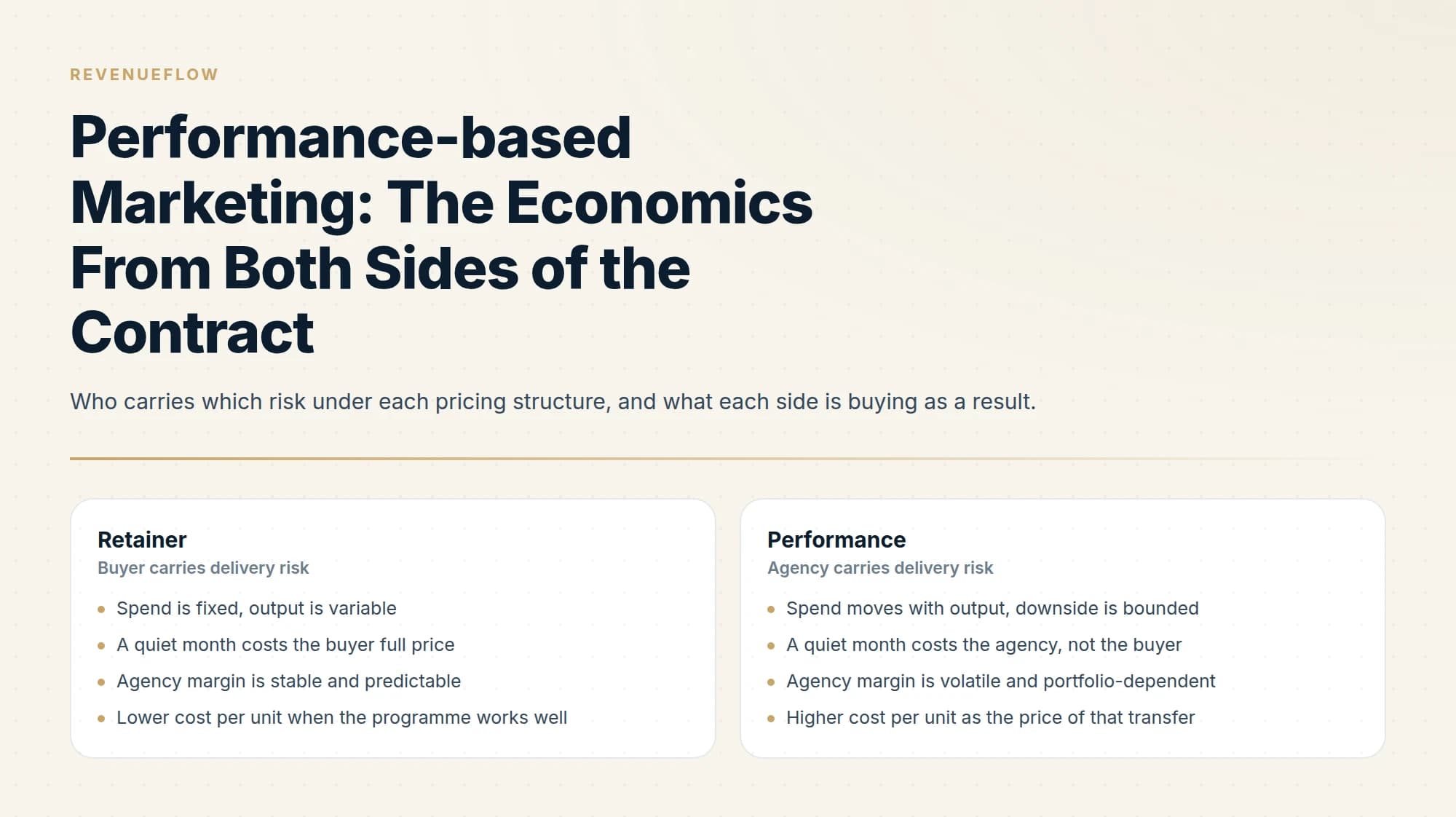
Performance-based marketing transfers delivery risk from the buyer to the agency, and the higher per-unit price is the cost of that transfer. The buyer purchases a bounded downside rather than a cheaper unit. The structure fails both sides when the sales cycle outlasts the contract, the market is too small to sustain sourcing, or the customer profile was never defined.
Key takeaways
- Performance pricing usually costs more per unit than a retainer in a good month, and that premium buys the removal of the bad month.
- The per-unit price on accounts that work has to fund the accounts that underperform, which is why agencies price the account rather than the market.
- Long sales cycles, a small addressable market and an undefined customer profile each break the model for the buyer and the agency at once.
- Ask for a monthly or quarterly cap. Performance pricing with no ceiling turns an unusually strong month into an unbudgeted invoice.
Reviewed and updated September 2, 2026
A buyer runs the arithmetic on two quotes for the same outbound programme. The retainer agency wants a flat monthly fee. The performance agency wants nothing monthly and a fee per qualified meeting that, at the volume both vendors are forecasting, adds up to noticeably more than the retainer. The buyer's first reaction is that the performance vendor is overcharging. The buyer's second reaction, usually a week later, is the more useful one: the performance vendor is charging more because the retainer's total is a forecast and theirs is a bill.
That gap is the whole model. Performance pricing is a transfer of delivery risk from the buyer to the agency, and risk transfer has a price the way insurance has a premium. Understanding what each side is actually trading makes it obvious why the per-unit number looks expensive, why agencies decline certain accounts that would happily pay them, and why the structure is genuinely wrong for some businesses.
What each side is actually buying
The buyer is not buying cheaper meetings. In a programme that works, performance pricing costs more per unit than a retainer would have, because the retainer's implied per-unit cost in a good month is very low. What the buyer is buying is the removal of the bad month.
Under a retainer, the monthly spend is fixed and the output is variable. The buyer absorbs every source of variance: a list that underperforms, a market that goes quiet in August, a domain reputation problem, three weeks of copy iteration that goes nowhere. Under performance pricing, the spend moves with the output, so the downside is bounded by construction. The buyer pays a premium in the good months to buy that.
The agency is buying the opposite exposure and needs to be compensated for holding it. It finances infrastructure, list construction, verification, copy and the sending weeks required before results stabilise, all before the first invoice exists. If the account underperforms, the agency has spent the money anyway.
- Spend is fixed, output is variable
- A quiet month costs the buyer full price
- Agency margin is stable and predictable
- Lower cost per unit when the programme works well
- Buyer needs their own judgement to tell effort from results
- Spend moves with output, downside is bounded
- A quiet month costs the agency, not the buyer
- Agency margin is volatile and portfolio-dependent
- Higher cost per unit as the price of that transfer
- Buyer needs a definition tight enough to bill against
Neither column is better. They price different things, and a buyer who compares the totals without noticing which risk they are holding has compared two numbers that do not measure the same quantity.
Why the premium is not margin
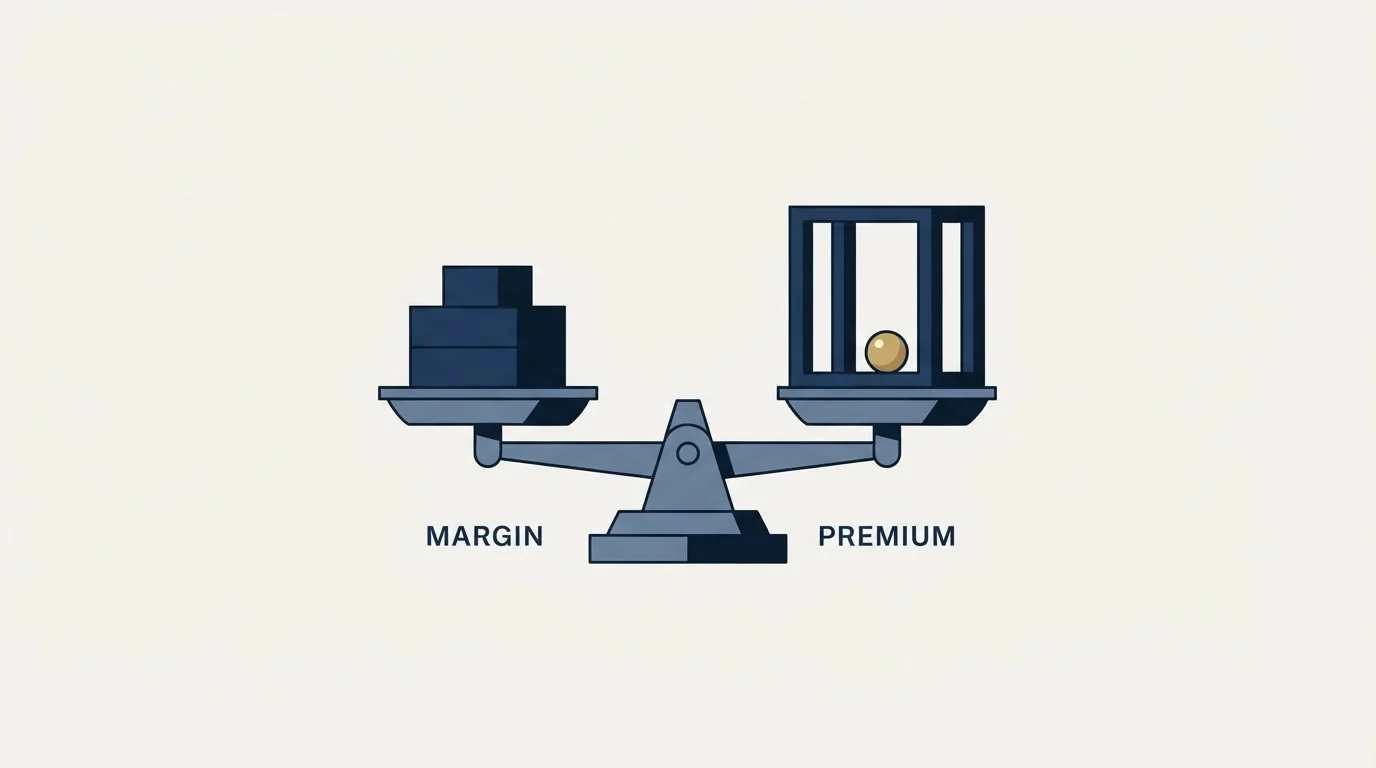
The intuitive read is that the agency charges more per unit because it can. The real reason is that the average unit has to pay for the units that never arrive.
An agency running a performance book prices from expected delivery rather than realised delivery. Some accounts will run below forecast, and on those accounts the agency loses money outright, having spent the build cost and collected less than it planned. Some accounts will not launch at all after the work has started. The per-unit price on the accounts that work is what funds that distribution.
This has three consequences a buyer should recognise, because they explain agency behaviour that otherwise looks arbitrary.
Agencies price the account, not the market. Two companies selling into the same buyer universe can get materially different quotes, because the expected delivery for each depends on offer strength, target profile clarity, brand recognition and how quickly the client answers questions. A vendor that quotes a single number before understanding your offer is quoting an average and will reprice or underdeliver later.
Agencies need portfolio scale. A single performance account has high variance. A book of them has manageable variance, in the same way an insurer needs more than one policy. This is why performance vendors are usually stricter about fit than retainer vendors: a bad account damages the pool the others are priced against.
Agencies need a floor. Minimum terms and minimum volumes exist so the build cost has time to amortise. A one-month performance engagement is a bet the agency cannot win, so either it gets refused or the first month is priced as though it were the entire contract.
- Before launchAll cost, no revenue
Infrastructure, list construction, verification, copy and approvals are financed entirely by the agency.
- Early sendingCost continues, first units arrive
Volume ramps while the sending profile is still warming and the copy is still being tuned against real replies.
- Stabilised sendingUnits become predictable
Delivery settles into a range the agency can forecast, which is the first point either side can judge the programme fairly.
- AmortisationBuild cost recovered
Only past this point does the engagement earn. A term shorter than this is a structural loss for the vendor.
What the buyer gives up
Risk transfer is not free of consequences beyond the price.
The first is control over the definition. Under a retainer, a buyer can move the goalposts mid-quarter at no contractual cost, because nothing bills against them. Under performance pricing, the definition is the invoice, so it has to be fixed in writing before launch and changed deliberately. Buyers who value the ability to redirect weekly find this constraining, and the constraint is real.
The same accountability shift happens inside marketing teams, where marketing judged on pipeline and closed revenue replaces reporting built on leads, downloads and traffic.
The second is the incentive gradient. Any per-unit price rewards volume of that unit. If the unit is loosely defined, the model quietly rewards delivering marginal units, and the buyer ends up policing quality that the contract should have handled. This is not a reason to avoid performance pricing. It is the reason the definition work is not optional, and for meeting-based deals specifically it is why the meeting standard has to be written before launch, as covered in B2B appointment setting services.
The third is optionality. Performance vendors want minimum terms because their economics require them, so a buyer trades some flexibility for the bounded downside. That trade is usually worth making, and it should be made knowingly.
When the structure is wrong for both parties

The interesting cases are the ones where performance pricing fails both sides at once. A vendor with a functioning book will decline these, and a buyer is better served knowing why.
- No: Sales cycle longer than the contract, so nobody can measure what was bought
- No: Addressable market small enough to exhaust inside the term
- No: No agreed ideal customer profile, so every unit is arguable
- Depends: The product needs education before a meeting is useful
- Depends: A brand-new category with no existing search or vocabulary
- No: Buyer cannot staff the meetings that get booked
Long sales cycles break the feedback loop. If the outcome the buyer cares about lands well after the engagement ends, the billable unit has to be an upstream proxy, and the two parties then argue about whether the proxy was any good using evidence neither of them has yet. Performance pricing works best where the billable event and the buyer's judgement of value are close together in time.
A small total addressable market breaks the agency's arithmetic. Performance delivery assumes the ability to keep sourcing fresh audience. When the entire universe is a few hundred companies, the list exhausts, and since we send one message per campaign rather than bumping people who did not reply, there is no volume to recover by re-contacting the same names. Both sides run out of road at the same moment.
An undefined target profile is the most common failure of all, and the most avoidable. If the buyer cannot say who counts before launch, then every delivered unit is negotiable, the vendor cannot price, and the relationship becomes a monthly adjudication instead of a programme. Fixing this costs a week of work up front and is the single highest-leverage thing a buyer can do. Our guide to building an ideal customer profile is the starting point, and MQL versus SQL covers the stage-definition half of the same problem.
Products requiring education before a conversation is worth having are a softer version of the same issue. The meeting can be perfectly qualified against the criteria and still feel worthless to a sales team that spends it explaining the category. That is a definition problem the buyer must solve in the qualifying questions, not a delivery failure.
The hybrid structures, and why they exist
Pure performance pricing is rarer than the language suggests, and the middle structures are usually honest rather than evasive.
A setup fee plus a per-unit price is the most common. The fee covers the financed build, and in exchange the per-unit number should be visibly lower than a pure performance quote from the same vendor. That is the test of whether the hybrid is fair: the buyer has taken back part of the risk and should be paid for it in the unit price. A setup fee that does not move the unit price is a retainer with extra steps.
A floor plus performance is the other common shape, where a small monthly minimum covers operating cost and everything above it is earned. This tends to appear where delivery is lumpy by nature, and it is reasonable when the floor is genuinely small relative to expected performance spend.
A cap is the structure buyers should ask for and rarely do. Performance pricing with no ceiling means a month of unusual delivery produces an invoice nobody budgeted for, which is an odd way to punish success. A monthly or quarterly cap, with overflow rolling into the next period, keeps the model's downside protection without creating an unbounded upside liability.
How to reason about the price

Once the definition is fixed, the comparison becomes tractable, and it is not a comparison of headline numbers.
Take the performance quote and multiply it by the volume you would need for the programme to matter. Take the retainer quote and multiply the monthly fee by the term. Then apply the difference that actually distinguishes them: on the retainer, model a bad quarter honestly, because you will pay in full for it, and on the performance deal, model the good quarter, because that is where you pay the premium. If the retainer only wins in the scenario where everything goes right, you are pricing optimism rather than a programme.
The buyers who do best with performance pricing tend to share three traits. They know their downstream conversion rates well enough to say what a unit is worth to them. They can staff the output, since a booked calendar nobody attends destroys value on both sides. And they treat the definition conversation as commercial work rather than paperwork.
Reading those rates depends on the record underneath, and what a hosted CRM deployment decides covers the assumptions a sending platform and a reporting layer make about it.
Cost benchmarks across models are covered in what a lead generation agency costs and what a lead generation agency costs. If you would rather see the shape of a programme against your own market before deciding which structure fits, you can see what a campaign would look like for your market.
The premium is real, the reason for it is structural, and the model rewards the party that does the definition work. Performance pricing is a good deal for a buyer who wants variance removed and a bad deal for a buyer who wants the cheapest possible meeting, and those two buyers regularly believe they are the same person.
Frequently asked questions.
Frequently asked questions- Why is performance-based pricing more expensive per unit?
- Because the agency is carrying delivery risk and pricing from expected rather than realised delivery. It finances the build before earning anything, and some accounts run below forecast or never launch. The per-unit price on the accounts that work funds that distribution. A buyer paying the premium is purchasing a bounded downside, which is a different product from a cheaper unit.
- Is performance-based marketing cheaper than a retainer?
- Not in a month where everything goes right. In that month a retainer's implied cost per unit is very low and the performance invoice is higher. Performance pricing wins over a full term by removing the months where you pay full price for weak output. Compare both across a realistic quarter rather than an optimistic one.
- When should we avoid a performance-based structure?
- When the sales cycle is longer than the contract, so neither side can judge what was bought. When the total addressable market is small enough to exhaust inside the term. When there is no agreed customer profile, so every unit is arguable. And when your team cannot staff the meetings or leads that get delivered, which destroys value on both sides.
- What is a fair setup fee alongside performance pricing?
- One that visibly lowers the per-unit price compared to the same vendor's pure performance quote. The fee covers the financed build, so the buyer has taken back part of the risk and should be paid for it in the unit price. A setup fee that leaves the unit price unchanged is a retainer with additional steps.
About the author.

B2B cold email experts helping companies generate qualified leads through done-for-you outreach campaigns.
RevenueFlow Team
Explore more.
Ready to scale your outreach?
We build GTM engines that book real meetings. See the receipts.
Related articles.
Win Rate Benchmarks: Which Figures State a Population
A catalogue of the published average sales win rates, sorted by whether the page names the population behind its own number. Most do not.
Sales Kickoff Agendas: Five Published, Session by Session
Five publishers print a sales kickoff agenda. They agree on four blocks and disagree on session length, rehearsal and where the agenda comes from.
Sales Enablement Charters: What the Published Ones Ask For
Six publishers set out what a sales enablement charter should contain. Five describe a document nobody can check, and one writes a definition with inspection in it.
Sales Cycle Length Benchmarks: What Each Figure Counts
The published B2B sales cycle benchmarks, sorted by what each page says it counted. The same number means two different things in two of them.
Sales Comp Plan Design: What the Publishers Prescribe
Four publishers set out how to design a sales compensation plan. Here are their procedures, their components, and which of their ratios carry a population.
Cold Calling for Chemical Companies: Who Picks Up
A chemical cold call rarely arrives first. It reaches a formulator who has already been comparing suppliers on a screen, for one of three published reasons.