Performance-based Marketing Agency: Definition Over Price
Two agencies can both call themselves performance-based and bill on completely different events. The four contract questions that tell you which one you are buying.
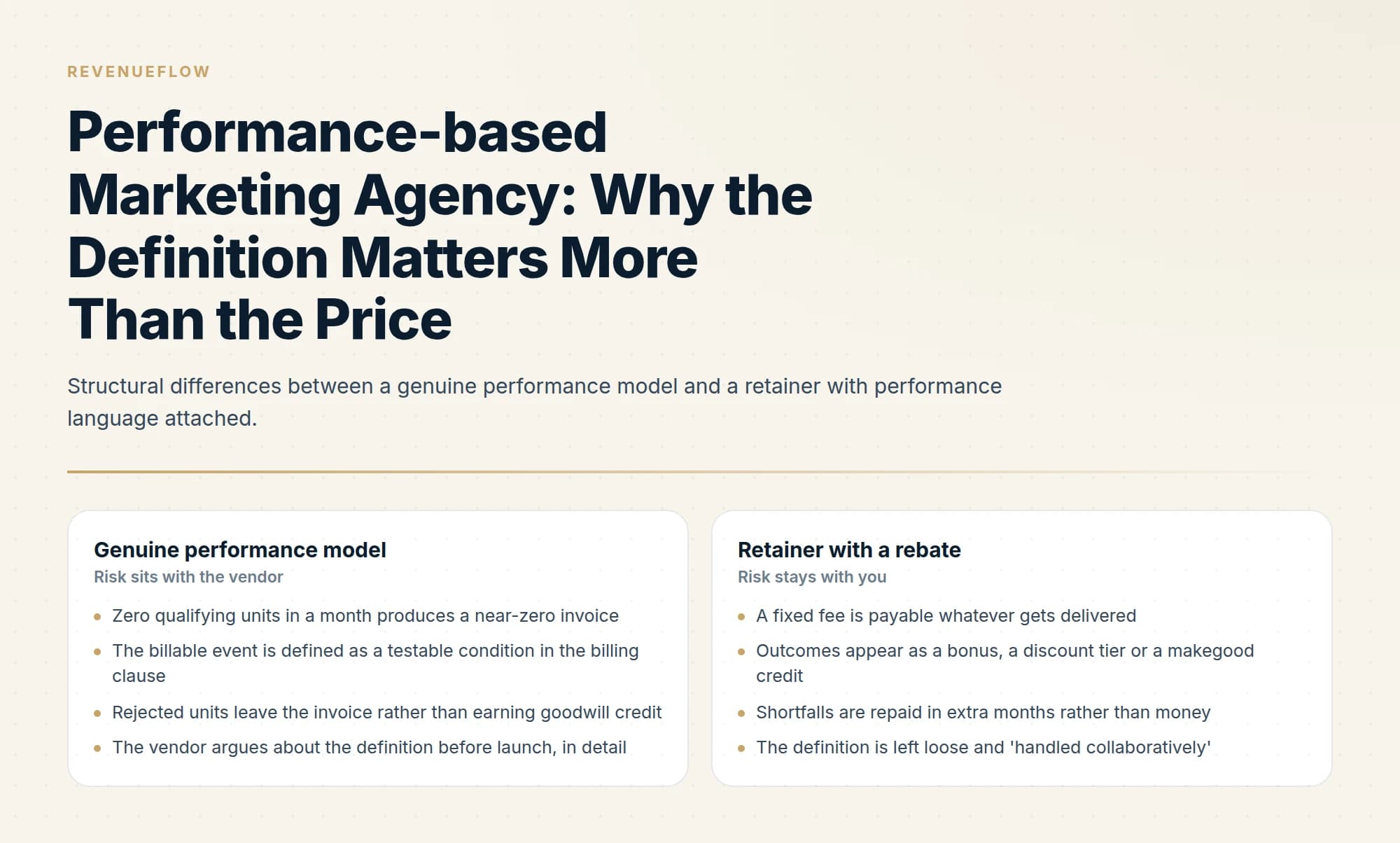
Performance-based means whatever the billing clause says it means, so vet the contract before the price. Resolve four things: the exact event that triggers an invoice, who adjudicates whether it happened, what happens to a disputed unit and within what window, and the minimum commitment. A genuine model invoices close to nothing in a month with no qualifying delivery.
Key takeaways
- The billable event, not the label on the proposal, defines what a performance-based agency is selling you.
- Ask what the invoice says in a month with zero qualifying delivery. A genuine performance model answers close to nothing.
- A disputed unit needs a named arbiter, attached evidence and a fixed review window, or every invoice reopens the whole month.
- Minimum terms are normal in a real performance model, because the agency finances the entire build before it earns anything.
Reviewed and updated September 1, 2026
Two proposals land in the same week and both use the phrase "performance-based" on the first page. One bills you when a prospect fills in a form. The other bills you when a prospect meeting your written criteria sits on a call and participates in it. The second proposal quotes a number several times higher than the first. Read only the price and the first vendor looks like the obvious choice. Read the payment trigger and you are comparing two entirely different products that happen to share a label.
"Performance-based" is not a pricing model. It is a category containing every arrangement where some part of the fee attaches to an outcome, and the outcomes range from a click through to a signed contract. The word tells you almost nothing on its own. What tells you something is the paragraph in the agreement that defines the billable event, the paragraph that says who decides whether an event happened, and the paragraph that says what happens when the two of you disagree.
This is a vetting guide. It covers the four contract questions that separate a real performance model from a retainer with a rebate stapled to it, and what a competent answer to each one sounds like.
The four questions that decide everything
Buyers who say they would rather pay based on results rather than lead volume are describing this model, and the question that decides whether they get it is which event triggers payment rather than what the rate is.
Everything else in a performance agreement is commentary on these four.
- Yes: What exact event triggers an invoice, written as a testable condition
- Yes: Who adjudicates whether that event occurred, and on what evidence
- Yes: What happens to a unit you dispute, and inside what window
- Yes: What the minimum commitment is, in months and in units
- Depends: Whether any fee is payable when zero units are delivered
- Depends: Who owns the data, the domains and the sequences at the end
A vendor who answers all four crisply has run the model before. A vendor who answers the first one and gets vague on the other three has usually sold performance pricing without building the operational machinery underneath it, and you will discover that in month two, during an argument.
What event triggers payment
Ask for the billable event as a condition you could hand to a stranger who would then reach the same verdict you would. If the definition needs the vendor present to interpret it, it is not a definition.
The common triggers, roughly in order of how much work sits behind each one: a form submission, a downloaded asset, a contact record delivered with verified email, a lead scored above a threshold, a conversation held with a named person, a booked meeting, a held meeting, a qualified held meeting, a closed deal. Each step up that list costs the agency more to produce and transfers more risk away from you.
Two details inside the trigger matter more than people expect.
The first is whether the event is a state or a moment. "Booked" is a moment: a calendar invite exists. "Held" is a state that only resolves after the meeting time passes, which means a booked-trigger contract bills you for calendar entries and a held-trigger contract bills you for attendance. A vendor that bills on booking has no financial exposure to no-shows, so no-show rate becomes your problem entirely. That is a legitimate structure if the price reflects it. It is a bad surprise if you assumed otherwise.
The second is whether conformance to your target profile is part of the trigger or a separate promise elsewhere in the document. If the agreement bills on "a meeting" and describes your ideal customer profile in an appendix that the billing clause never references, then the profile is aspirational. The billing clause is the contract. Anything you care about needs to be inside it.
Who adjudicates, and on what evidence

Someone has to decide whether a delivered unit counts. There are only three possible answers, and each has a failure mode.
The vendor decides, which is fast and obviously self-serving. You decide, which is fair to you and gives the vendor no protection against a client who tightens the standard whenever cash is tight. Or the definition decides, with a named process for the cases where the definition genuinely does not resolve.
The third is the only one that survives contact with a real month. It requires the definition to be specific enough that most units are unambiguous, and it requires a short written process for the remainder. Ask the vendor to walk you through the last genuine dispute they had with a client and how it resolved. The answer tells you whether the process exists or whether the paragraph describing it was drafted by a lawyer who has never run the workflow.
Evidence matters as much as the arbiter. For a contact-record model, the evidence is the record plus a verification result. For a meeting model, the evidence is the calendar event, the attendance, and the notes. Establish before launch what artifact accompanies each delivered unit, because reconstructing evidence for a unit delivered six weeks ago is the single most common reason disputes get abandoned rather than resolved.
What happens to a disputed unit
A disputed unit needs a path, and the path needs a clock.
- Step 1Unit delivered
The vendor flags it as it lands, with the evidence attached, not in a monthly batch.
- Step 2Review window opens
A fixed number of business days in which you can reject it. Short enough to be memorable, long enough to be real.
- Step 3Rejection cites the definition
A valid rejection names the clause the unit failed. Subjective disappointment is not a clause.
- Step 4Resolution or replacement
Either the unit is removed from the invoice or it is replaced. Decide which, in advance, in writing.
- Step 5Silence means accepted
Unflagged units count once the window closes, so the invoice is never a negotiation.
The clock is the part buyers skip and later regret. Without a window, every invoice reopens every unit delivered that month, and the vendor is financing an argument that has no end date. With a window, both sides know what the invoice will say before it arrives.
The other half is what constitutes a valid rejection. A rejection that maps to the written definition is valid: wrong company profile, wrong role, an agreed exclusion, a failed qualifying question. A rejection based on how the conversation felt is not, because "the call went poorly" and "they did not buy" describe your sales conversation rather than the vendor's delivery. Both parties should agree that distinction in writing before launch, since it is completely uncontroversial in month zero and completely contested in month three.
The minimum commitment
Every genuine performance model carries a minimum term, a minimum volume, or both, and a vendor who waves that away is either inexperienced or pricing something else.
The reason is mechanical. An agency working on outcomes finances the entire build before it earns anything: infrastructure, list construction, verification, copy, and the weeks of sending required before results stabilise. That capital comes back over the life of the engagement. A one-month term means the vendor takes all of the setup risk and none of the recovery, so either they refuse the deal or they price the first month as though it were the whole deal.
Beyond contract wording, a broader limitation shapes these deals: the economics of performance based contracts explains why risk transfer, not a cheaper unit, sets the price.
What to check is whether the minimum is honest about that. A minimum term with a stated ramp is honest: the vendor is saying that the first stretch produces less and asking you not to judge the engagement on it. A minimum term with a large non-refundable fee attached, and no reduction in the per-unit price to reflect it, is a retainer wearing a costume.
For the retainer comparison, what a lead generation agency costs covers the fixed-fee side, and outsourced SDR pricing covers the per-seat side that most performance quotes are implicitly measured against.
Telling a genuine model from a rebate
The tells are structural rather than tonal, which is useful, because every vendor sounds confident.
- Zero qualifying units in a month produces a near-zero invoice
- The billable event is defined as a testable condition in the billing clause
- Rejected units leave the invoice rather than earning goodwill credit
- The vendor argues about the definition before launch, in detail
- Volume forecasts are ranges with stated assumptions
- A fixed fee is payable whatever gets delivered
- Outcomes appear as a bonus, a discount tier or a makegood credit
- Shortfalls are repaid in extra months rather than money
- The definition is left loose and 'handled collaboratively'
- Forecasts are single numbers with no stated assumptions
The sharpest single test is the zero month. Ask what the invoice says if the agency delivers nothing at all in a given month. In a genuine model, that answer is close to nothing, and the vendor will have thought about it, because their entire business depends on that scenario being rare. In a rebate model, the answer arrives with caveats.
The second test is the argument. A vendor who has carried delivery risk before will push back hard on a loose definition, because a loose definition is the thing that bankrupts them. Enthusiastic agreement to every criterion you propose is a warning sign rather than good service. The vendors who are most difficult during the definition conversation are usually the ones who intend to deliver against it.
The parts of the agreement people forget

Three clauses cause most of the friction that is not about money.
Suppression and exclusions. Your existing customers, live opportunities, partners and anyone your own team is already working belong on a suppression list handed over before launch. If a delivered unit turns out to be an account you had already disclosed, that is a valid rejection. If you never disclosed it, that is your cost. Get the list built during onboarding rather than after the first collision.
Treating it as a per-campaign filter is the common mistake, and the suppression list definition makes the case for a permanent record instead.
Exclusivity. Ask whether anything the vendor produces for you is also sold to someone else. In contact-record and form-fill models, resale is common and legitimate when disclosed, and it changes what you are buying substantially. In meeting models it is generally incompatible with the product.
Teams that still weigh channels beyond meetings and forms will find addressed mail versus route saturation useful when judging whether a tactic reaches a real target account list.
Ownership at the end. Domains, sending infrastructure, sequences, and the data itself all belong to someone when the engagement stops. Decide which, in writing, while both parties are cheerful. Related reading on how these tradeoffs compare to hiring: outsourced SDR versus in-house and what appointment setting companies actually do.
How we handle it
We work on a defined qualified-meeting standard agreed in writing before anything sends, every booking is flagged in the client channel as it lands, and a held meeting counts unless the client rejects it inside a short window with a reason that maps to the written definition. Budget, timing and purchase authority are not conditions of billing. If you want to see the definition against your own market before committing to anything, you can see what a campaign would look like for your market.
The definition is the product. The price is downstream of it, and comparing prices across two different definitions produces a decision that looks rigorous and means nothing.
Frequently asked questions.
Frequently asked questions- What does performance-based actually mean in an agency contract?
- It means part or all of the fee attaches to a defined outcome, and the definition varies enormously between vendors. The outcome can be a click, a form fill, a delivered contact record, a booked meeting, a held meeting or a closed deal. Read the billing clause rather than the cover page, because that clause is the only place the promise is enforceable.
- How do I tell a real performance model from a retainer with a bonus?
- Ask what you pay in a month where nothing qualifying is delivered. Under a genuine model that figure is close to zero and the vendor has clearly thought about it. Under a rebate model there is a fixed fee payable regardless, and shortfalls are repaid as extra months or service credits rather than money leaving the invoice.
- Should a performance-based agency require a minimum term?
- Usually yes. The agency finances infrastructure, list building, verification, copy and several weeks of sending before it can invoice anything, and that cost only amortises over a term. A vendor waving away any minimum is either inexperienced or pricing the first month as though it were the whole contract. Check the minimum comes with a stated ramp.
- Who decides whether a delivered unit counts?
- The definition should decide, with a short written process for genuine edge cases. A vendor deciding alone is self-serving and a buyer deciding alone gives the vendor no protection against a tightening standard. Ask the vendor to describe their last real dispute with a client and how it resolved, which reveals whether the process exists in practice.
About the author.

B2B cold email experts helping companies generate qualified leads through done-for-you outreach campaigns.
RevenueFlow Team
Explore more.
Ready to scale your outreach?
We build GTM engines that book real meetings. See the receipts.
Related articles.
Win Rate Benchmarks: Which Figures State a Population
A catalogue of the published average sales win rates, sorted by whether the page names the population behind its own number. Most do not.
Sales Kickoff Agendas: Five Published, Session by Session
Five publishers print a sales kickoff agenda. They agree on four blocks and disagree on session length, rehearsal and where the agenda comes from.
SDR Outsourcing for Logistics Companies: The Brokerage Line
What an outside sales development team may do in a freight company's name, the calling and email rules it inherits, and which arrangement survives a bid-shaped market.
SDR Outsourcing for Business Brokers: The Fee Timing
Whether a success-fee brokerage should rent sales development at all: the fee timing, the texts that limit what an outside person may say about value, and who signs.
Sales Cycle Length Benchmarks: What Each Figure Counts
The published B2B sales cycle benchmarks, sorted by what each page says it counted. The same number means two different things in two of them.
Sales Enablement Charters: What the Published Ones Ask For
Six publishers set out what a sales enablement charter should contain. Five describe a document nobody can check, and one writes a definition with inspection in it.