Route to Market vs Go-to-Market: Two Different Questions
One asks how the product reaches the buyer and who takes a margin. The other asks which market to enter and what to say to it. Answer them in order.
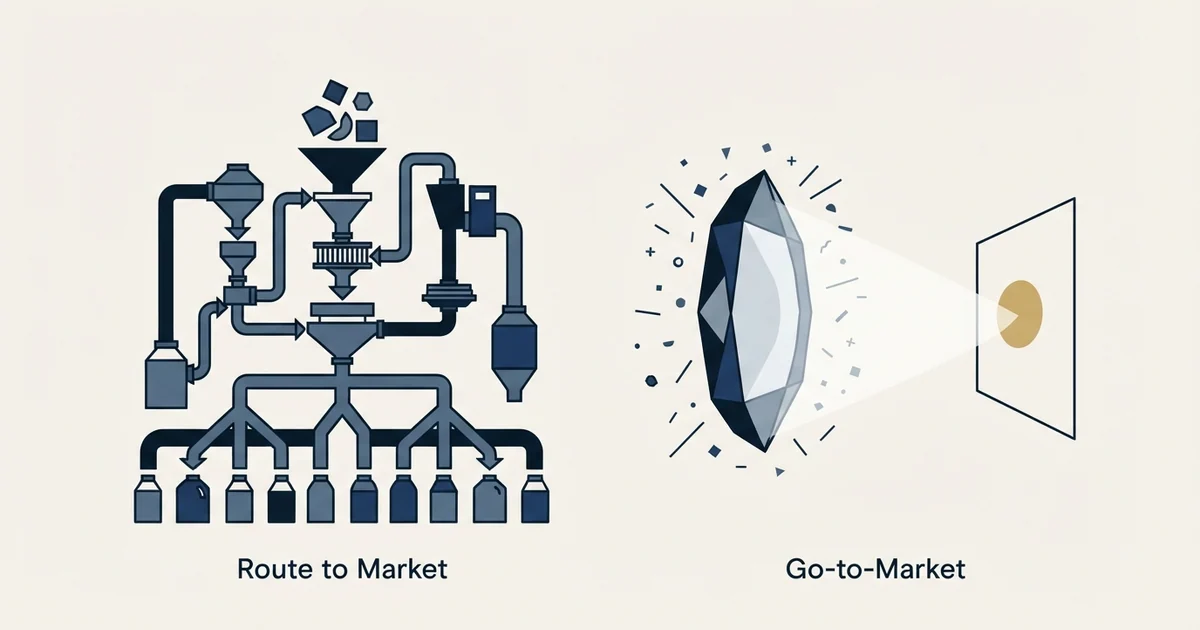
Route to market asks how a product reaches its buyer, including who holds the relationship and who takes a margin. Go-to-market asks which market to enter, what to say to it, and how a first conversation gets created. The route is one decision inside the go-to-market plan rather than an alternative to it.
Key takeaways
- Route to market is the vocabulary of distribution-heavy industries, where reaching the buyer at all is the hard part. In software and services the route is frequently direct by default.
- A B2B team genuinely means route to market in three situations: a partner or reseller motion, a marketplace listing, and geographic expansion. Otherwise it means the channel line.
- Answer them in order. The segment comes first, contract value and segment size rule routes out, and the route is chosen against capacity that exists rather than capacity being hired.
- Judge a route proposal on buyer conversations produced per quarter rather than accounts covered. Coverage is a property of the agreement; conversations are a property of incentive.
Reviewed and updated August 28, 2026
Two people in a planning meeting use the phrases route to market and go-to-market within a minute of each other, mean different things, and neither notices. One is asking how the product physically and commercially reaches a buyer, including who else takes a margin along the way. The other is asking which market to enter and what to say to it. Both questions are real and only one of them is usually on the agenda.
The terms come from different traditions, which is why the confusion is stable rather than a matter of sloppiness. Route to market is the older vocabulary of distribution-heavy industries, and the search results for it are dominated by consumer goods and distribution consultancies. Go-to-market is the vocabulary of technology and services companies, where the route is often direct and the interesting decisions sit elsewhere.
What each term is actually asking
- Direct, or through a reseller, distributor, marketplace or agent
- Who holds the customer relationship
- Who takes what margin at each step
- Coverage: which territories and outlets are reached at all
- Fails as: a channel that reaches the buyer and cannot be supported
- The segment, tight enough to build a list from
- The problem the first message names
- The route, chosen from what the segment allows
- What a first conversation is for, in writing
- Fails as: a document nobody can act on before Tuesday
Read that way, the relationship is containment rather than opposition. The route is one decision inside a go-to-market plan, and in the industries where route to market has its own vocabulary it is the dominant decision, because reaching the buyer at all is the hard part. A drinks manufacturer choosing between wholesalers, direct-to-retail and its own e-commerce is making a route decision worth more than any messaging choice it will make that year.
For a B2B software or services company, the route is frequently settled before the conversation starts. The product is sold directly by the people who make it, and the live questions are which segment, what premise and what capacity, which is why the go-to-market framing dominates that literature.
Teams that outsource the segment and channel decisions rather than the route itself should read what go-to-market consulting actually delivers before signing anything.
When a B2B team genuinely means route to market
Three situations, and in each the distinction earns its keep.
A partner or reseller motion is under consideration. The moment somebody else can carry your product to a customer, the route becomes a real decision with margin, control and support consequences. It also becomes a question about incentive rather than agreement: a signed partnership creates permission, and the partner's individual sellers still have their own quota and no particular reason to spend a call on your product.
A marketplace listing is the entry point. Listing on a platform converts distribution into a discovery problem inside somebody else's catalogue, with the platform holding part of the transaction and often part of the relationship.
Geographic expansion is on the table. Entering a market where you have no presence usually means choosing between hiring, an agent, a distributor, or serving remotely, and that choice constrains everything the go-to-market plan can later assume about how a first conversation gets created.
Once a go-to-market plan narrows to a single industry, the changes to proof, vocabulary and exclusions are detailed in the vertical go-to-market guide.
Outside those three, a B2B team saying route to market usually means the channel line of its go-to-market plan, and the conversation gets shorter as soon as that is said out loud.
The cost of conflating them
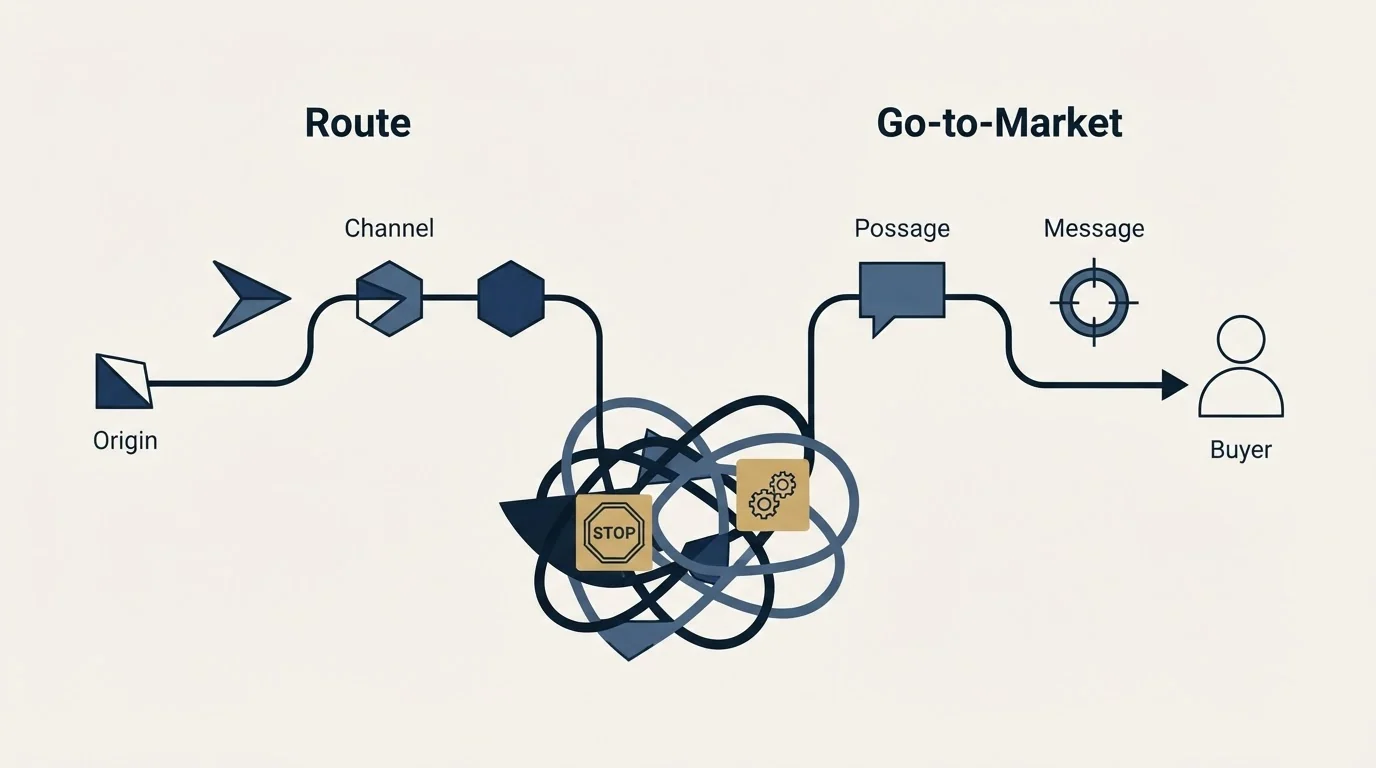
The failure is asymmetric, which is what makes it worth naming.
A plan that answers the go-to-market questions thoroughly and skips the route is common in software, and it is usually harmless because the route is direct by default. A plan that answers the route question and treats the rest as downstream is common in manufacturing and distribution, and it is expensive: the channel gets built, the coverage numbers get hit, and nothing in the plan ever specified which customers within that coverage are worth pursuing or what to say to them. Distribution reaches everybody equally, and a message aimed at everybody performs accordingly.
The reverse error appears when a software team adopts route-to-market vocabulary during a partner push and quietly stops doing the segment work, on the theory that the partner knows their own customers. The partner knows their customers and does not know which of them have the problem you solve, and the definition of who is worth an introduction remains yours to write.
- Step 1Define the segment
Who the buyer is, tightly enough that someone outside the room could build the list. This is upstream of every route decision and constrains all of them.
- Step 2Establish what the segment allows
Contract value caps how much human attention a deal can absorb. Segment size decides whether volume is even a lever. Both rule routes out before preference rules any in.
- Step 3Choose the route
Direct, partner, marketplace or distributor, chosen against those constraints and against the capacity you have this quarter rather than the one you are hiring for.
- Step 4Write the first conversation
What the first exchange is for, and the criteria that make it worth having, agreed in writing before anything launches.
Choosing a route before defining the segment is the ordering mistake that produces a channel optimised for reaching people whose fit was never established, and it is expensive to unwind because a route is a set of relationships and commitments rather than a line item.
Two more terms in the same neighbourhood
Distribution strategy is usually a synonym for route to market, with a slight bias toward the physical and logistical side.
Channel strategy normally means the subset of route decisions that involve a third party selling on your behalf, so a company selling directly has a route and no channel in this sense. Where a team says channel and means email, LinkedIn and phone, that is a fourth usage entirely: the media through which a first conversation gets created, which sits inside the go-to-market plan rather than beside it.
Market entry is broader than either and often what somebody means when they use both terms in one sentence. It covers the legal, hiring and support decisions that come with operating somewhere new, and the route and the go-to-market plan are two of its components rather than alternatives to it.
Nothing is gained by policing any of this vocabulary. What is worth doing, once, at the start of a planning conversation, is asking which question is being answered, because two people can agree on every word of a plan while answering different questions with it. The tell that it has not been asked is a plan whose channel section names a partner type and whose segment section names an industry, with nothing connecting the two: no statement of which accounts inside that industry the partner can actually reach, and no count.
The arithmetic a route decision has to survive
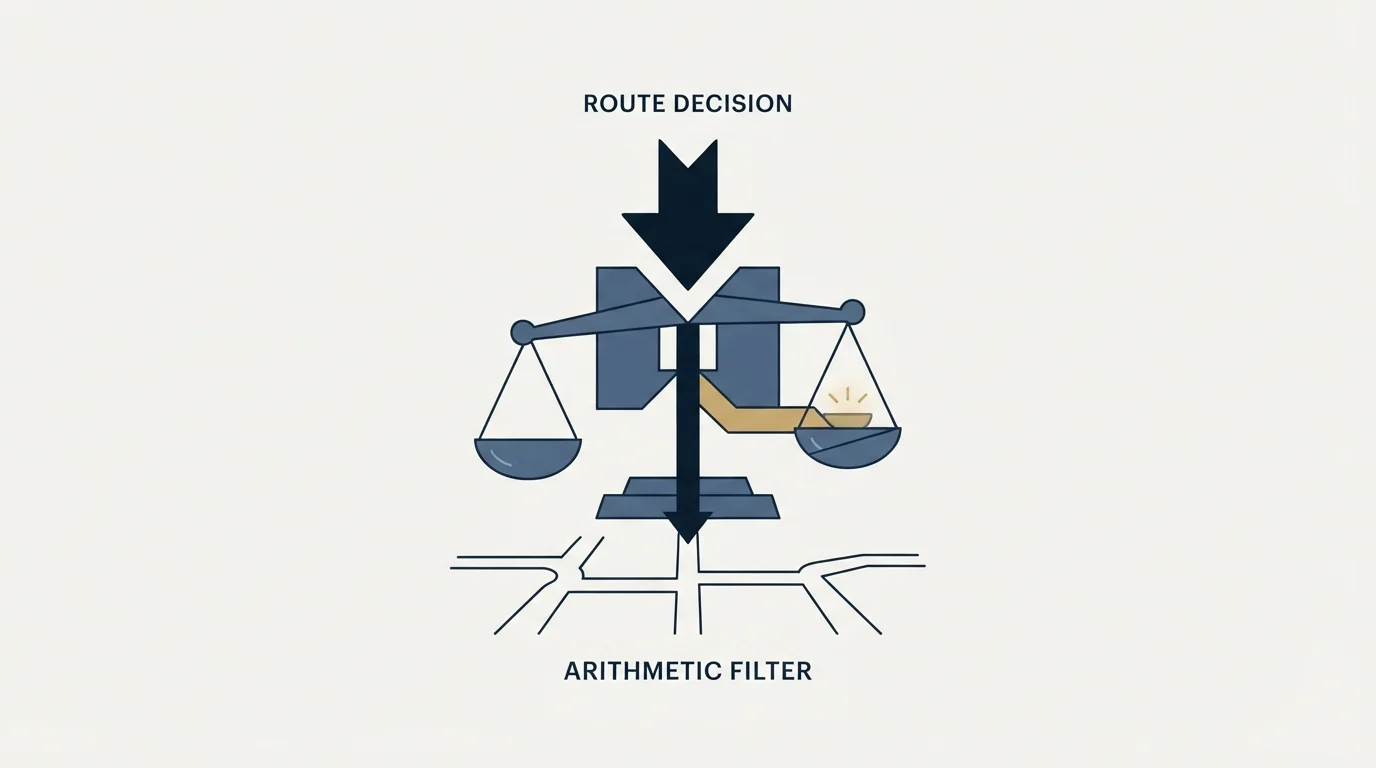
Route decisions are usually argued as questions of reach and settled as questions of margin, and the two rarely get put on the same page. The figures below are invented for illustration and describe no real company.
Suppose a product sells for an average of $12,000 a year. Sold directly, the acquisition cost is the sourcing and selling effort, say $3,000 per customer, leaving $9,000 of first-year contribution. Sold through a reseller taking 30 percent, the same customer contributes $8,400 before any acquisition cost, and the acquisition cost does not fall to zero because partner recruitment, enablement and co-selling are real work with a real owner.
The comparison only becomes decisive when volume enters it. If the direct route can reach 200 accounts a quarter with current capacity and the partner route puts the product in front of 2,000, the margin given away buys reach that cannot be bought any other way, and the arithmetic favours the partner. If the partner's sellers each carry a quota that your product contributes little toward, the 2,000 is theoretical, and what has been bought is an agreement rather than a route.
That is the test worth applying to any route proposal: name the number of buyer conversations the route produces per quarter, not the number of accounts it theoretically covers. Coverage is a property of the agreement. Conversations are a property of somebody's incentive, and the two diverge quietly.
- Depends: Somebody else would hold part of the customer relationship
- Depends: Margin would be shared with a third party
- Depends: The decision is which segment to pursue and what to say to it
- Depends: The decision is coverage: which territories or outlets are reached at all
- Depends: The route is already direct and not under review
If the first two are true, the meeting is about a route. If the third is true and the last is true, the meeting is about go-to-market and the word route is being borrowed. If several are true at once, the plan needs both sections written separately, because the route decision constrains what the go-to-market plan can assume.
Where each one leads next
For the go-to-market half, the decisions that have to be made and the artefact they produce are covered in the go-to-market strategy guide, and the segment definition that everything else inherits, including the count arithmetic that makes it real, is in the ideal customer profile guide. The difference between a filter and a signal, which decides whether a list is a population or a reason to write, sits in B2B prospecting.
For the direct route specifically, the operating model we run, including the single-message policy behind it, is written out in the outbound sales playbook. If the route is direct and the missing piece is the capacity to work it, see what a campaign would look like for your market, with the meeting criteria agreed in writing before anything sends.
The short version
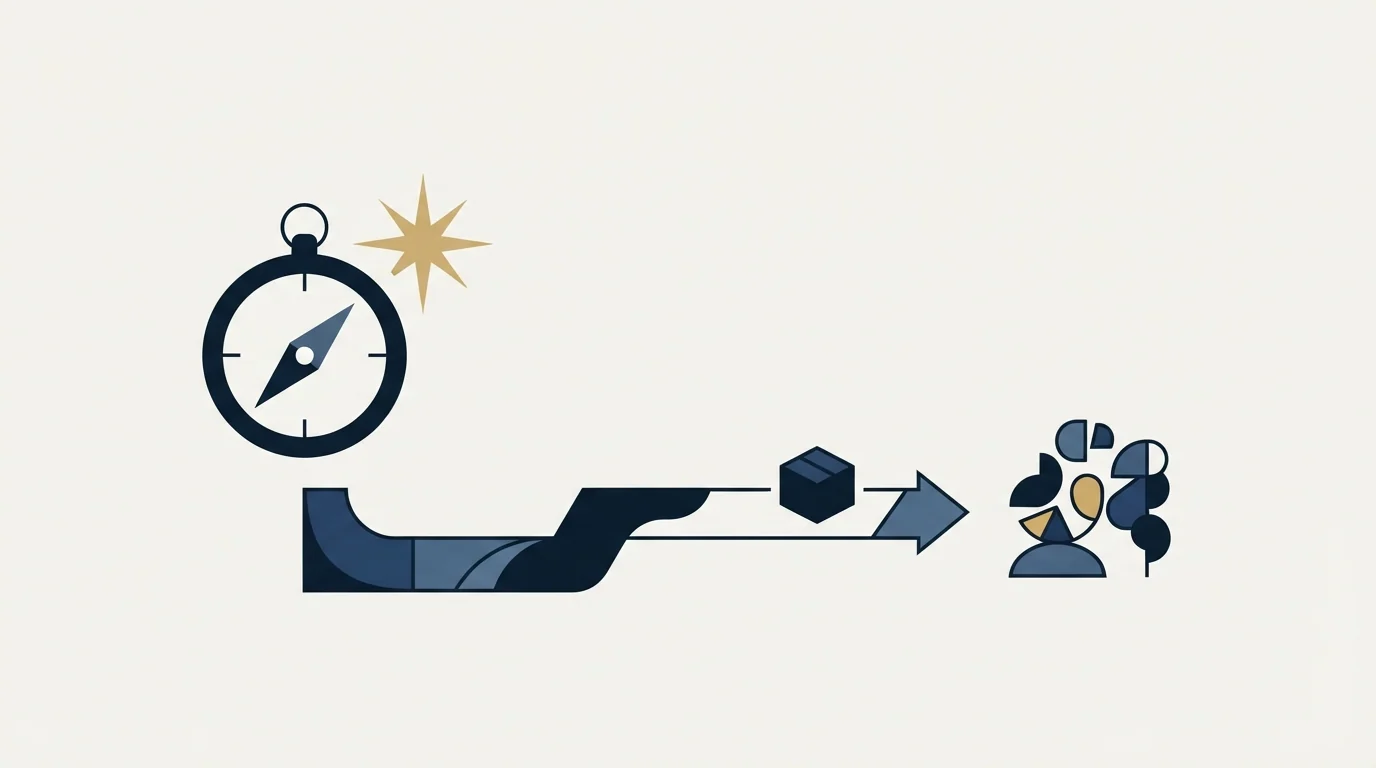
Route to market asks how a product reaches its buyer, including who else takes a margin and who holds the relationship. Go-to-market asks which market to enter, what to say to it, and how a first conversation gets created. The route is one decision inside the go-to-market plan, and it is the dominant one in distribution-heavy industries and frequently settled by default in software and services.
A B2B team genuinely means route to market in three situations: a partner or reseller motion, a marketplace listing, and geographic expansion. Outside those, it usually means the channel line of its go-to-market plan.
Answer them in order. The segment comes first, what the segment allows rules routes out, and the route gets chosen against capacity that exists rather than capacity that is being hired. Choosing the route first produces a channel optimised for reaching people whose fit was never established.
Frequently asked questions.
Frequently asked questions- Is route to market the same as go-to-market?
- No. Route to market is one decision inside a go-to-market plan: how the product reaches the buyer, through whom, and on what margin. Go-to-market covers the segment, the problem the first message names, the route, what a first conversation is for, and how the result is measured. Confusing them usually costs the segment work.
- When does a B2B software team really mean route to market?
- When a partner or reseller could carry the product to a customer, when a marketplace listing is the entry point, or when entering a territory where there is no presence. In each case somebody else holds part of the relationship or the margin, which makes the route a genuine decision rather than a default.
- Which should be decided first?
- The segment. Contract value caps how much human attention a deal can absorb and segment size decides whether volume is a lever at all, so both rule routes out before preference rules any in. Choosing a route first produces a channel optimised for reaching people whose fit was never established.
- How does channel strategy relate to these two?
- Channel strategy usually means the subset of route decisions involving a third party selling on your behalf, so a company selling directly has a route and no channel in that sense. Where a team says channel and means email, LinkedIn or phone, that is the media used to create a first conversation, which sits inside the go-to-market plan.
About the author.

B2B cold email experts helping companies generate qualified leads through done-for-you outreach campaigns.
RevenueFlow Team
Explore more.
Ready to scale your outreach?
We build GTM engines that book real meetings. See the receipts.
Related articles.
Sales Kickoff Agendas: Five Published, Session by Session
Five publishers print a sales kickoff agenda. They agree on four blocks and disagree on session length, rehearsal and where the agenda comes from.
Sales Enablement Charters: What the Published Ones Ask For
Six publishers set out what a sales enablement charter should contain. Five describe a document nobody can check, and one writes a definition with inspection in it.
Sales Cycle Length Benchmarks: What Each Figure Counts
The published B2B sales cycle benchmarks, sorted by what each page says it counted. The same number means two different things in two of them.
Win Rate Benchmarks: Which Figures State a Population
A catalogue of the published average sales win rates, sorted by whether the page names the population behind its own number. Most do not.
Sales Comp Plan Design: What the Publishers Prescribe
Four publishers set out how to design a sales compensation plan. Here are their procedures, their components, and which of their ratios carry a population.
Cold Calling for Consulting Firms: The Partner's Hour
Cold calling for a consulting firm: who it dials and who picks up, why partner-led economics argue against the phone, the client's fiscal year, and when to skip it.