SDR Outsourcing for Cybersecurity: The Trust Problem
What changes when a cybersecurity vendor outsources SDR work: buyers trained by CISA to distrust the contact, partner conflict, and the duty you keep.
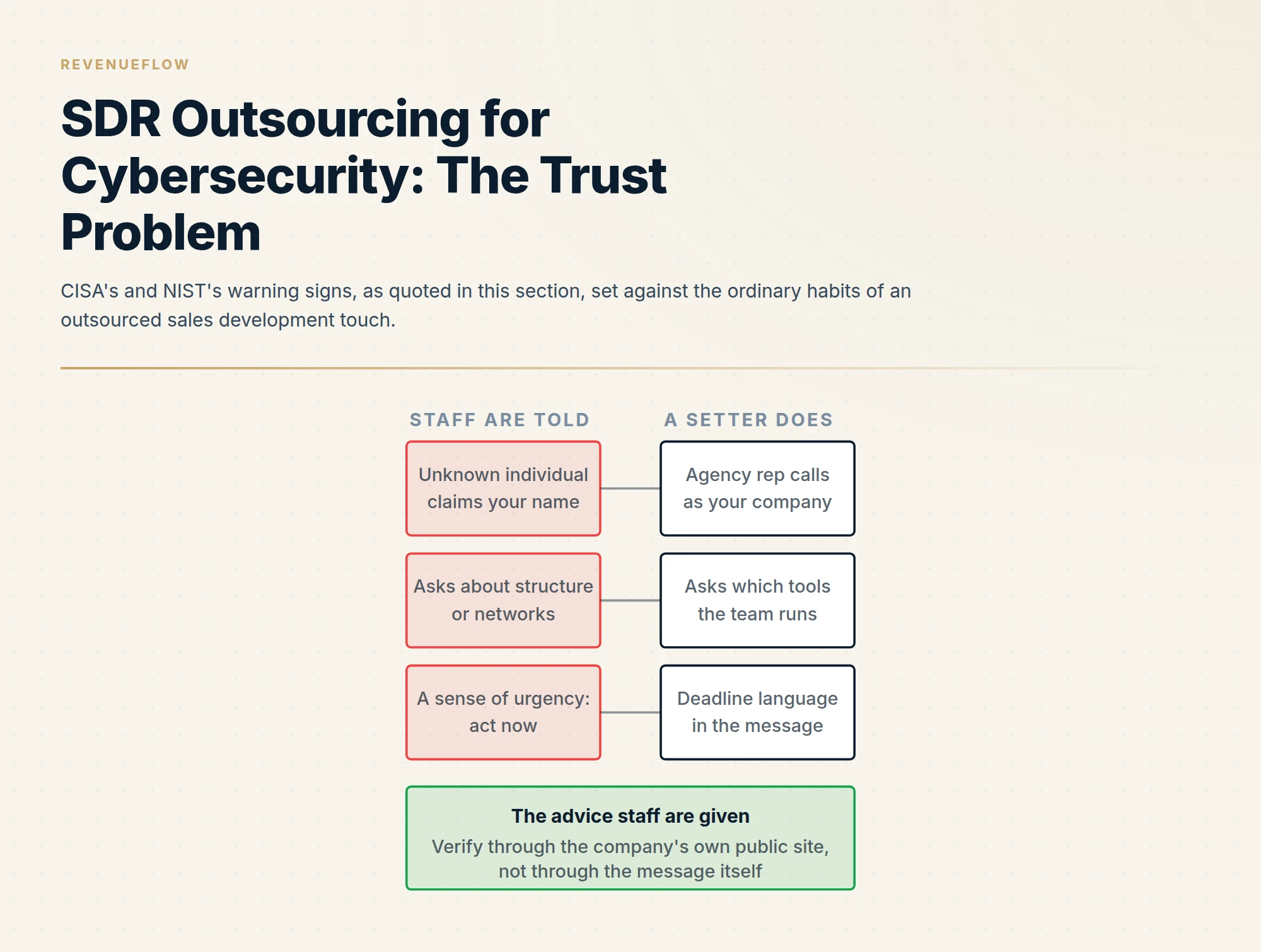
Security teams teach staff to distrust unsolicited contact from unknown individuals and to verify through a company's own public site, which describes an outsourced SDR exactly. A vendor that outsources must make the setter verifiable on its own domain, supply a written answer on its SOC posture, exclude partner accounts, and remember the FTC says responsibility cannot be contracted away.
Key takeaways
- CISA tells employees to be suspicious of unsolicited calls or emails asking about internal information and to verify an unknown individual's identity directly with the company.
- NIST lists a sense of urgency as a phishing warning sign and advises verifying a request through known contact information or a public company website, not the message itself.
- The FTC's CAN-SPAM guide says a company that hires another to handle its email marketing cannot contract away its legal responsibility, and both may be held responsible.
- SentinelOne's partner programme lists four tracks, Manage, Sell, Build and Deliver, which is why an outsourced team needs the vendor's partner account list before it contacts anyone.
Reviewed and updated September 18, 2026
The Cybersecurity and Infrastructure Security Agency publishes guidance for employees on how to treat the call an outsourced sales development rep is about to make. "Be suspicious of unsolicited phone calls, visits, or email messages from individuals asking about employees or other internal information," its guidance reads. "If an unknown individual claims to be from a legitimate organization, try to verify his or her identity directly with the company." (CISA, avoiding social engineering and phishing attacks, read 18 September 2026.) The people who teach that guidance inside companies are security teams, which is to say the buyers a cybersecurity vendor wants its setters to reach.
This guide is for a cybersecurity company deciding whether to hand sales development to an outside team. It is written for the vendor, not for agencies and not for people selling to vendors. The general decision has its own pages here: the four arrangements hiding behind the phrase are in our guide to SDR outsourcing, the billing units are in outsourced SDR pricing, and what each provider publishes is in SDR outsourcing companies. None of that is repeated. What follows is the layer that belongs to security: a buyer trained to distrust the contact, what an outside setter must therefore be able to say, the channel conflict a hired team creates, the responsibility you keep when someone else sends in your name, the dated event calendar, and when outsourcing is the wrong play.
The buyer is trained against your setter
Read the CISA sentences again with an agency rep in mind. The rep is an unknown individual. The rep claims to be from a legitimate organization, yours, and is not employed by it. The standard opening questions of sales development, which tools a team runs and who owns them, are what CISA's next sentence tells employees not to answer: "Do not provide personal information or information about your organization, including its structure or networks, unless you are certain of a person's authority to have the information."
The written channel gets the same treatment. The National Institute of Standards and Technology describes phishing as the use of "convincing emails or other messages" to trick users, and lists as a warning sign "A sense of urgency. They want you to act now." Its advice is to "Verify the request by using known contact information or information from a public company website, not from the message itself." (NIST, phishing guidance for small business, read 18 September 2026.) CISA's consumer campaign names the same signal, "Urgent or emotionally appealing language" (CISA, recognize and report phishing, read 18 September 2026). A setter's deadline language in the message reads, to this audience, as that signal.
Security buyers also keep score in public. Dani Woolf's Audience 1st newsletter ran a recurring feature in 2022, under the headline "Inside a CISO's Email Inbox: 5 Outreach Tactics Cybersecurity Buyers Hate", in which security professionals submitted the vendor outreach they considered bad behaviour along with what they wanted done differently (Audience 1st, 7 June 2022, read 18 September 2026). Elsewhere a clumsy touch is forgotten. In this one it can be collected and shown around.
What an outside setter must be able to say
The guidance above also contains the remedy. Staff are told to verify a caller through the company's own public contact information. So the first requirement of any outsourced arrangement in this market is that the setter can be verified that way.
In practice that means four things to settle before a contract is signed. The rep writes from an address on your domain, not the agency's and not a lookalike. The rep can be found by someone who phones your published number and asks. The rep says on the call who employs them if asked, because a security professional will ask. And the rep never asks for details of the prospect's stack, controls or incidents in a first touch; the opening has to stand on something public.
Second, the setter has to be able to answer the question security buyers put to every vendor, which is whether the vendor itself can be assessed. The AICPA describes System and Organization Controls as "a suite of service offerings CPAs may provide in connection with system-level controls of a service organization" (AICPA and CIMA, SOC suite of services, read 18 September 2026). A rep who does not know whether you hold such a report, and how a prospect obtains it, has lost the conversation at the point a serious buyer starts it. Write the answer down for them.
Third, the limits. Our guide to cybersecurity lead generation sets out why writing to a company about its own breach should not be done, and that rule has to be in the agency's instructions in your words, because an outside team paid on activity will find the incident news before you do.
| Give the team | So the setter can | Source |
|---|---|---|
| An address on your domain and a listing at your published number | Be verified through your own public site | CISA and NIST verification advice |
| A written answer on your SOC report and how to obtain it | Answer the assessability question | AICPA description of SOC services |
| Opening lines built on public facts only | Avoid asking about structure or networks | CISA guidance to employees |
| Your partner account list | Stay out of accounts a partner owns | Vendor partner programme tracks |
The channel conflict a hired team creates
Security software moves through partners, and the vendors' own programme pages show how many kinds. SentinelOne's PartnerOne programme describes "One Program. Four Tailored Tracks.": Manage, for security service providers; Sell, for resellers and solution providers; Build, for independent software vendors; and Deliver, for service providers and integrators (SentinelOne partner programme, read 18 September 2026). CrowdStrike and Palo Alto Networks publish partner programmes of their own.
An outsourced team is handed a list and a target. It does not know which accounts on that list buy only through a reseller, or sit inside a managed security provider's stack, unless you tell it. Our cybersecurity lead generation guide treats that routing as a list-building rule, so the argument is not remade here. What outsourcing adds is distance: the person making the contact has never met your channel manager. The partner account list belongs in the handover, with a rule for what happens when a meeting is booked inside it.
You keep the responsibility when someone else sends
Outsourcing moves the work. It does not move the legal position. On email, the Federal Trade Commission is explicit in its CAN-SPAM guide: "Monitor what others are doing on your behalf. The law makes clear that even if you hire another company to handle your email marketing, you can't contract away your legal responsibility to comply with the law. Both the company whose product is promoted in the message and the company that actually sends the message may be held legally responsible." The same guide says "The law makes no exception for business-to-business email." (FTC, CAN-SPAM Act compliance guide, read 18 September 2026.)
On the phone, the federal position on business calls and the separate rules on dialers and mobile numbers are covered in whether cold calling is against the law. Those rules attach to the call whoever places it, so an agency's dialer is your compliance question. None of this is legal advice. It is a reason to ask an agency, in writing, which sending domains and which dialing technology it will use in your name.
Which model fits a security vendor
Our SDR outsourcing guide describes four arrangements: a dedicated agency team, a fractional rep, offshore staffing, and buying meetings as an outcome. The security layer sorts them by how much of the trust problem each leaves with you.
Research, list building and enrichment are safe to hand to almost any of them, because no buyer is touched. Live calling into security teams is where verification, vocabulary and the limits above all have to hold at once, so it is the last thing to hand to a team you cannot listen to. An outcome-based arrangement transfers delivery risk and leaves one control, the written definition of a qualified meeting. In this market that definition should say who counts as a security buyer and should exclude meetings booked inside partner accounts.
RevenueFlow sits in that fourth category, and works by email and LinkedIn with one message per campaign and no bumps behind it. We describe a provider's calling model above as the market's reality and not as our method. In security the single message is also a credibility choice, for the reason our lead generation guide gives: this audience reads a sequence as evidence about the sender.
The calendar, with dates
Black Hat lists its next events on one page. As read on 18 September 2026 it shows Black Hat Europe 2026 on 7 to 10 December 2026 at Excel London, and Black Hat USA 2027 on July 31 to August 5, 2027 at the Mandalay Bay Convention Center in Las Vegas (Black Hat upcoming events). We could not read RSA Conference's dates from its own site on the day of writing, so none is given here.
For an outsourced programme the dates cut two ways. The weeks before a show are a legitimate reason to write, since a meeting at the event is a small ask. The week itself is a poor time to start a new agency, because the people who would correct its first mistakes are on a show floor.
Three openers an outside setter can use
None names a real person, claims a result or asks about the prospect's environment.
The verifiable introduction.
This is {{name}}. We work with {{vendor}} on their outreach, and you should not take our word for that. Our details are on {{vendor}}'s site under {{page}}, and their main line will confirm us. The reason for the message is {{public_fact}}. If it is relevant, reply and we will bring in {{vendor_engineer}}.
It follows the verification advice CISA and NIST give the reader.
The event.
Black Hat Europe runs 7 to 10 December at Excel London. {{vendor}}'s {{role}} will be there. If {{topic}} is on your list for next year, fifteen minutes on the floor is the whole ask.
The date is the organiser's.
The assessment first.
Before anything else: {{vendor}} holds {{report}}, and we can send the summary under NDA today. If that clears your bar, the next step is a technical conversation with {{vendor_engineer}}, not with us.
It answers the assessability question before it is asked.
When outsourcing is the wrong play
It is the wrong play when partners carry your revenue and you cannot give an agency a clean partner account list. It is the wrong play when you have no written answer on your own security posture for the setter to carry. It is the wrong play for a product that needs a practitioner to explain it in the first conversation, since a security engineer will test the caller. And it is the wrong play if the agency will not send from your domain or tell you what dialer it uses.
It fits a vendor with a direct mid-market motion, a documented posture, a partner list it can share, and a written definition of a qualified meeting. If you want to see that built as a written campaign first, see what a first campaign looks like.
The short version
Security teams teach their companies to distrust unsolicited contact from unknown individuals and to verify through the company's own public site, which describes an outsourced setter exactly. So the setter must be verifiable on your domain and your phone line, must open on public facts, and must carry a written answer on your own SOC posture. Partner accounts have to be excluded in the handover, because the agency has never met your channel manager. The FTC says you cannot contract away responsibility for email sent on your behalf. Black Hat Europe is 7 to 10 December 2026 and Black Hat USA is July 31 to August 5, 2027.
CISA, NIST, FTC, AICPA, vendor partner and event pages quoted above were read on 18 September 2026. Guidance and dates change. Confirm them on the source's own page before relying on them.
Frequently asked questions.
Frequently asked questions- Should a cybersecurity company outsource its SDRs?
- It can, if it solves the trust problem first. CISA tells employees to be suspicious of unsolicited contact and to verify unknown individuals directly with the company they claim to represent. An outsourced setter must therefore write from the vendor's domain, be confirmable through the vendor's published phone number, open on public facts, and carry a written answer about the vendor's own SOC report.
- What should an outsourced SDR never ask a security buyer?
- Anything about the prospect's environment in a first touch. CISA's guidance tells employees not to provide information about their organization, including its structure or networks, unless they are certain of a person's authority to have it. Questions about which tools a team runs fall inside that warning, so the opening has to rest on something public.
- Who is legally responsible when an agency sends email for a vendor?
- Both can be. The FTC's CAN-SPAM compliance guide says that even if you hire another company to handle your email marketing, you cannot contract away your legal responsibility, and that both the company whose product is promoted and the company that sends the message may be held legally responsible. It also says the law makes no exception for business-to-business email.
- When is SDR outsourcing the wrong choice for a security vendor?
- When most revenue moves through partners and no clean partner account list can be shared, when there is no written answer on the vendor's own security posture, when the product needs a practitioner to explain it in the first conversation, or when the agency will not send from the vendor's domain or disclose which dialer it uses.
About the author.

B2B cold email experts helping companies generate qualified leads through done-for-you outreach campaigns.
RevenueFlow Team
Explore more.
Ready to scale your outreach?
We build GTM engines that book real meetings. See the receipts.
Related articles.
SDR Outsourcing for Biotech Companies: When It Fits
SDR outsourcing for life science sellers: which parts of the job can go outside, what FDA research use only guidance means for the brief, and when it is the wrong play.
SDR Outsourcing for Private Equity Firms: Deal Origination
Which part of private equity deal origination an outside SDR team can carry, what it may say in the firm's name, and the rules the firm keeps when it outsources.
SDR Outsourcing for Insurtech Companies
What an outsourced SDR team must be able to say for an insurtech: the buyer function, the enrollment and trade-press calendar, the licence question, the security review.
B2B Lead Lists for Collection Agencies: Fields and Sources
What a creditor prospect list needs for a collection agency: the fields that matter, the FDIC, NCUA, CMS and court sources behind them, and the rules that apply.
SDR Outsourcing for Fintech Companies: Assessability Test
For the fintech weighing an outside setter: the three assessability sentences, the promotion rules that bind every message, the sponsor test and which model fits.
Outbound Sales for Food and Beverage Companies: Who to Reach
Outbound sales for food and beverage brands: the four buyers behind a yes, the public show calendar, what a message may claim, and when outbound is the wrong play.