Snovio: What Snov.io Bundles, and What the Bundle Costs
Snov.io bundles prospect search, email finding, verification, sending and LinkedIn into one credit balance. What the pricing page publishes, and how bundles strain.
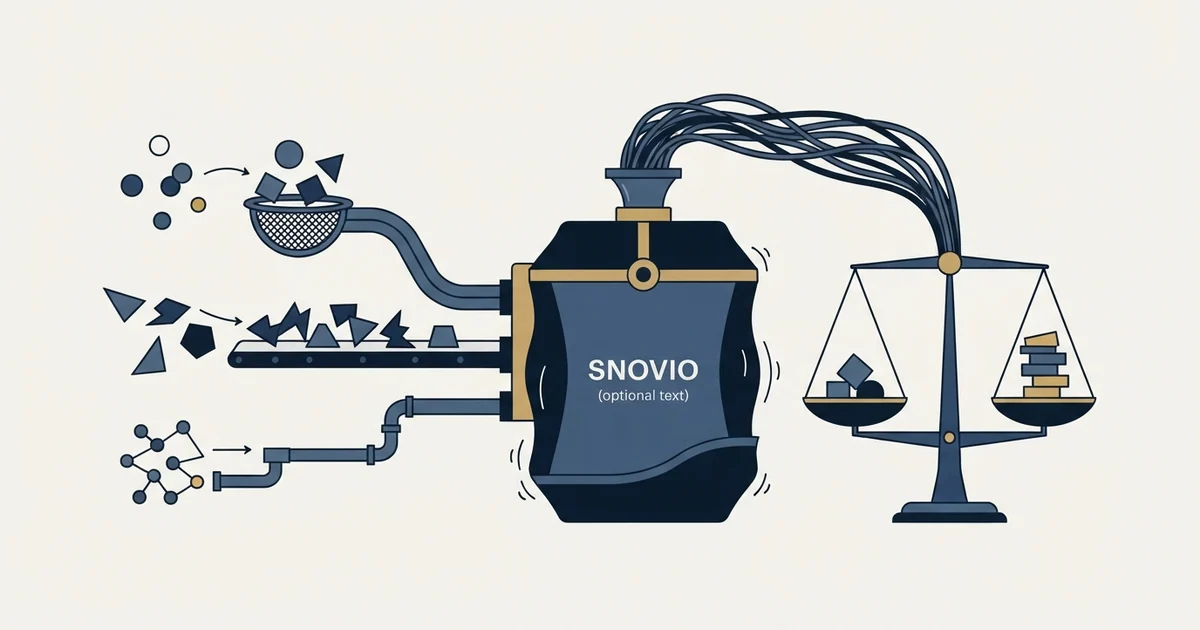
Snov.io, often typed as Snovio, is a bundled sales platform covering prospect search, email finding, verification, drip sending and a separately priced LinkedIn automation layer. The modules share one credit balance, so heavy use of any single module consumes the budget for the others. Coverage on your own list decides whether it works.
Key takeaways
- Snovio and Snov.io are the same platform: the first is how the product gets typed, the second is how the company writes itself.
- Credits are shared across modules, so the weakest-planned module starves the rest, and verification is the one teams cut first and pay for later in bounces.
- The LinkedIn automation layer is priced per connected account slot on top of the plan, so the plan card is not the cost of an email plus LinkedIn motion.
- Coverage on your particular list, measured by a bounded test, decides the purchase more than any headline database figure does.
Reviewed and updated August 28, 2026
The spelling gives away how people find it. Snovio, with no dot, is how the product gets typed into a search bar, while the company writes itself as Snov.io. Both point at the same platform: a sales toolkit that bundles prospect search, email finding and verification, sending, and a LinkedIn automation layer into one subscription.
Bundling is the whole proposition, and it is also the thing to evaluate carefully. A platform that does five jobs adequately can be a better purchase than five best-in-class tools, or it can be the reason none of the five jobs is done well enough to matter. Which one it is depends on what you are actually running.
Reviews of Snov.io quote its allowance table straight, and the table is easy to misread: the four impressive per-feature columns are ONE credit pool shown four ways, because the page states credits distribute between Email Finder and Email Verifier and each column assumes every credit went to that feature alone.
What the platform covers
Snov.io's own pages, captured on 16 August 2026, describe a set of modules that share a credit balance: prospect search and enrichment, an email finder with a Chrome extension, email verification, drip campaigns with a unified inbox, and a separately purchased LinkedIn automation layer.
Two structural details matter more than any individual feature. The first is that credits are the currency across modules, so a heavy month of enrichment eats the budget that would otherwise fund sending. The second is that the LinkedIn automation is priced per connected account rather than being included, which means the sticker price on the plan card is not the cost of running an email plus LinkedIn motion.
The platform also sells adjacent infrastructure. Its pricing page lists done-for-you Google mailboxes at $5 per month per email account and sending domains from $12 per year per domain, which puts it in the same territory as a managed sending stack rather than only a data tool.
- Step 1Search
Find companies and people against filters
- Step 2Find and verify
Email finder plus verification before anything sends
- Step 3Send
Drip campaigns from connected mailboxes, replies in one inbox
- Step 4LinkedIn
Separately priced per connected account slot
What it costs, as published
Snov.io's pricing page was showing a promotional state on 16 August 2026, with a banner reading 25% off for annual subscriptions. Its compare-plans table on that snapshot publishes a free trial tier, then Starter at $29,25 a month, Pro S at $74,25, Pro M at $141,75, Pro L at $276,75 and Ultra at $553,50. Those are the discounted figures the page was displaying rather than undiscounted list rates, and a promotional banner is exactly the sort of thing that changes between one visit and the next.
Worth noting because it will trip anyone checking the figures: the same page renders the same prices two different ways. The plan cards at the top use a decimal point, showing Starter as $ 29 .25 /mo, while the compare-plans table lower down uses a comma, showing the same plan as $29,25. Read whichever section you are quoting from and expect the punctuation to differ.
The LinkedIn layer is priced separately and the page states the terms in prose rather than only in a card: the price per slot is $69 a month on a monthly subscription or $62 a month on an annual one, with an additional $10 off each slot for accounts that also hold a Sales Suite subscription. Each slot connects one LinkedIn account.
The enrichment product is metered rather than tiered, and the page prices it at $0.02 per token, with the vendor's own argument being that you pay for results rather than for searches.
Pricing and features verified as of mid-2026. Verify current terms with the vendor before relying on them.
Reading a bundled plan honestly

The comparison people make is between a bundle price and the sum of specialist tools, and it is usually the wrong comparison, because the two are not doing the same amount of work.
A more useful test has three parts. First, which module are you actually buying, and would you pay the full plan price for that one alone. Second, what happens to the other modules when the credit balance runs down in week three, since a shared currency means the weakest-planned module is the one that starves. Third, what the switching cost looks like per module, because a bundle you leave is four migrations rather than one.
- A single seat runs search, sending and follow-through
- Volume is predictable enough to budget credits
- Nobody needs a specialist feature the bundle lacks
- Credit balance is consumed by one module
- Deliverability needs domain-level control the bundle does not expose
- Data coverage in your niche is thinner than a specialist source
Where the data question gets decided
Every platform in this category is a data business wearing a software interface, and the number that decides whether it works for you is coverage on your particular list, not the vendor's headline database size. A tool with excellent coverage of US software companies can be close to useless on European manufacturers, and no plan comparison will tell you that.
The only reliable way to find out is a bounded test against a list you already know: run a sample of accounts you can verify by hand, then measure how many contacts came back and how many of those addresses survived verification. Those are two different numbers and vendors often quote the friendlier one. The general shape of the problem, and why serious teams stack several sources rather than trusting one, is covered in waterfall enrichment.
Verification is the other half. Finding an address is cheap and being wrong about it is expensive, because bounces damage the sending reputation that every later campaign depends on. Our roundup of email verification tools covers what the standalone products do, and email finder tools covers the finding side.
The credit model is the plan, whatever the plan card says

Credit-based pricing looks like a detail on the pricing page and behaves like the main constraint once a team is running. The reason is that credits convert your work into a single number before you can see which activity consumed it, so a month that felt productive and a month that burned the balance on failed searches look identical on the invoice.
Three habits keep that under control. Decide in advance roughly how the month's credits divide between searching, finding and verifying, so an overrun is visible in week two rather than at renewal. Keep a record of what a completed lead actually cost in credits on your own list, since that figure is specific to your niche and no vendor benchmark substitutes for it. And treat a sudden change in that cost as a data-quality signal, because a rising credit cost per usable contact usually means coverage has thinned rather than that the team got busier.
The second-order effect is the one worth planning for. When credits run low, the module that gets cut is whichever one is easiest to skip, and in practice that is verification. Skipping verification to save credits trades a small immediate cost for bounce damage that lands on the sending domain and takes weeks to recover, which is the most expensive way a bundle can fail.
Illustrative arithmetic, invented for the shape only
Take a hypothetical desk that wants 800 verified contacts a month. If a third of searched contacts never yield a usable address, and a further slice fails verification, the desk has to search materially more than 800 records to land 800. The exact ratios are made up here and should not be read as observed figures from any vendor or from us; they exist only to show the direction the arithmetic runs.
The point the invented numbers make is structural. Budgeting credits against your target output rather than against your search volume is the difference between a plan that lasts the month and one that runs out in week three. Whatever the real ratios turn out to be on your list, they are discoverable in one bounded test and unknowable from a pricing page.
Where it fits, and where teams outgrow it
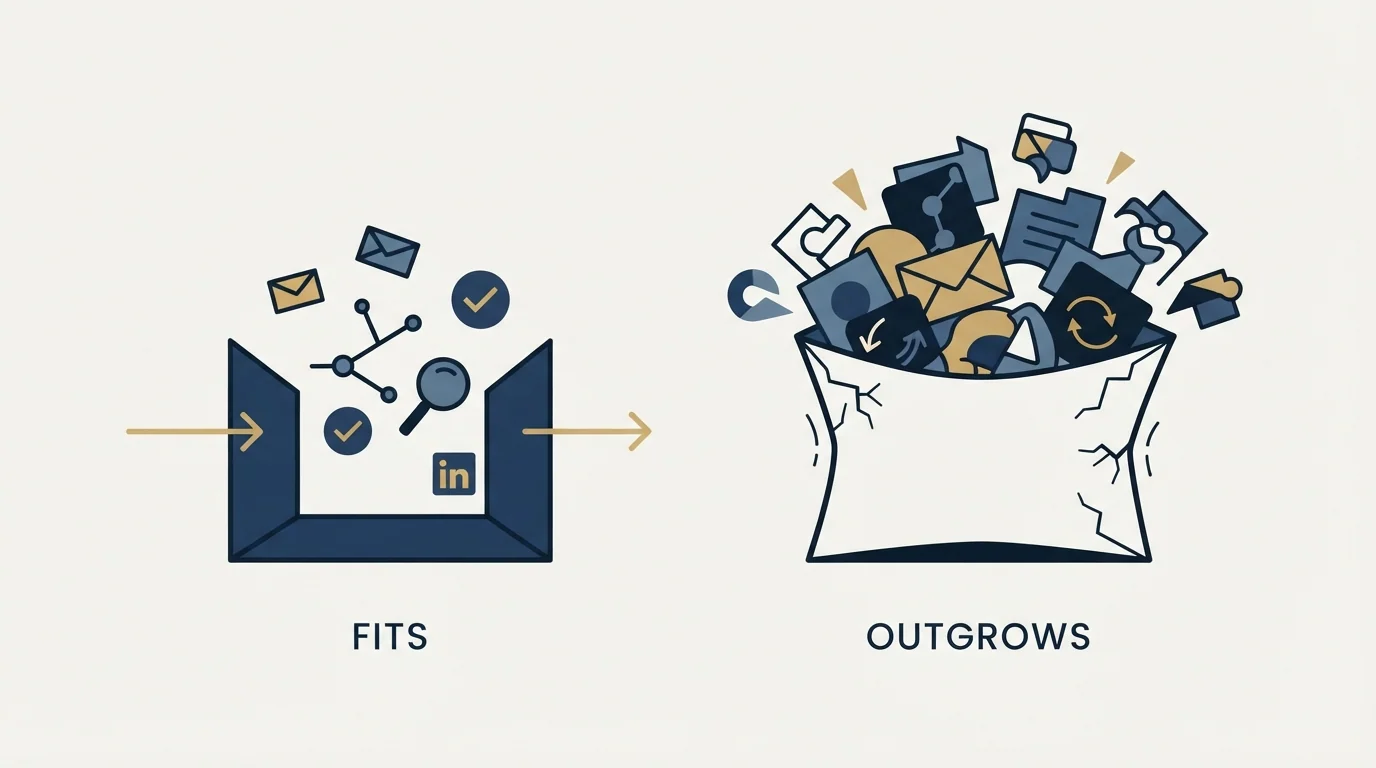
Snov.io fits a team that wants one subscription, one interface and one invoice, running a moderate volume of outbound with a single motion. For that team, the bundle removes a genuine coordination tax and the shared credit balance is a feature rather than a constraint.
Teams outgrow it in two predictable ways. The first is volume: once sending is the core of the business, the sending layer wants domain-level control, mailbox rotation and warmup managed as infrastructure rather than as a feature inside a data tool. The second is specialisation: once a niche list is the differentiator, one data source stops being enough and the enrichment layer becomes a stack rather than a subscription.
Unlike a bundled data tool, a dedicated execution layer such as Salesloft assumes a CRM and data source already exist, focusing instead on running a rep's daily outbound queue.
Neither is a criticism of the product. They are the ordinary consequences of a bundle meeting a team whose requirements have separated. The alternatives worth comparing when that happens are set out in Snov.io alternatives, and the sending-side category is covered in cold email software.
What to check before you buy
Check coverage on your own list before anything else, because it is the only variable that cannot be fixed later with configuration. Check what the credit balance actually funds at your intended monthly volume, using the vendor's own credit costs rather than an estimate. Check whether the LinkedIn slots you need are in the budget you approved, since they sit outside the plan price. And check what leaves with you: exported contacts, campaign history and suppression state are three separate exports, and the third one is the one teams forget until they need it.
If the honest answer is that you want the outbound programme run rather than the tooling owned, that is a different purchase, and our page on what a cold email agency actually operates describes what that includes.
Want a campaign built and sent on infrastructure that is already warmed? Start with a free campaign.
Frequently asked questions.
Frequently asked questions- Is Snovio the same as Snov.io?
- Yes. Snovio is the way the product name gets typed without the dot, and Snov.io is how the company writes it. Both refer to the same sales platform covering prospect search, email finding and verification, drip campaigns and a LinkedIn automation layer, and search engines resolve the two spellings to the same set of results.
- How much does Snov.io cost?
- Its pricing page publishes tiered plans from Starter up to Ultra, and it was displaying a 25 percent annual discount when checked in mid-2026, so the figures shown were discounted rather than list rates. LinkedIn automation is charged separately per connected account slot, and enrichment is metered per token. Check the vendor's page for current terms.
- How do Snov.io credits work?
- Credits are a single balance spent across modules, so searching, finding and verifying all draw from the same pool. That makes the month's plan a budgeting exercise rather than a feature choice: decide in advance roughly how credits divide between activities, and track what a usable verified contact actually costs on your own list.
- When should a team move off a bundled sales platform?
- Two triggers are reliable. Volume, when sending becomes the core of the business and needs domain-level control, mailbox rotation and warmup managed as infrastructure. And specialisation, when a niche list is the differentiator and one data source no longer covers it, so enrichment becomes a stack of sources rather than a single subscription.
About the author.

B2B cold email experts helping companies generate qualified leads through done-for-you outreach campaigns.
RevenueFlow Team
Explore more.
Ready to scale your outreach?
We build GTM engines that book real meetings. See the receipts.
Related articles.
Seamless.AI Email Finder: How It Works, What a Credit Buys
How Seamless.AI's email finder resolves a contact in real time, what one Universal Credit buys, the Total AI score on every address, and what the Chrome extension reads.
LeadGibbon Pricing: Three Monthly Plans, No Annual Tab
LeadGibbon publishes three monthly plans and no annual rate. The dated ladder, the verified-emails-only meter, the rollover rule, and what the page does not publish.
Enrow Pricing: Three Billing States, Two Currencies
Enrow prices per verified result across monthly, annual and pay-as-you-go tabs in euros and dollars. The ladder, the credit meter and the currency clause.
SalesQL Pricing: Four Plans, Priced Per Credit
SalesQL publishes four plans on a monthly-first pricing page. Here is the dated ladder, the per-profile credit meter, the seat limits, and what the page leaves out.
Is Clay Free? The Free Plan, the Trial and Where Each Stops
Clay's free plan, its 14-day trial and the no-charge-on-a-miss rule are three different things. What each holds and where it stops, from clay.com on 19 September 2026.
Snitcher Pricing: The $49 Table Is the Annual Rate
Snitcher's visible price table is the annual-billing ladder. The ten bands at both billing states, the unique-company meter, and the rules on a help page.