Spam Word: Diagnosing Placement Without Guesswork
Spam word lists describe the text rules inside a scoring engine, and a scoring engine's verdict is not a placement result. Where vocabulary actually earns weight.
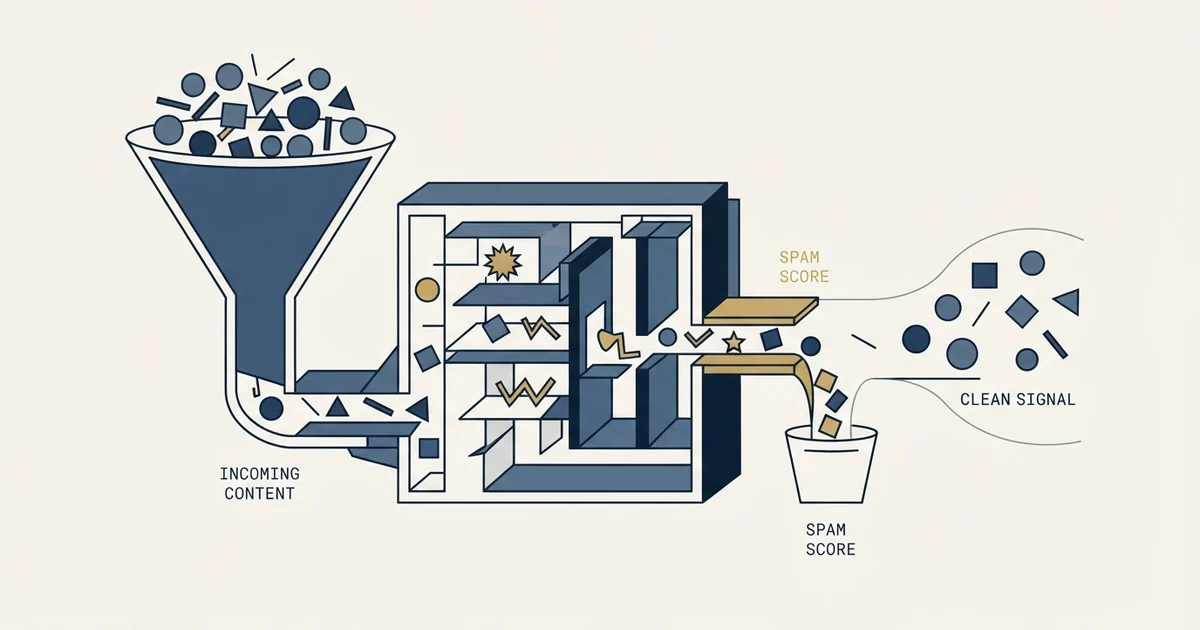
A spam word is a term that adds points to a rule engine's content score, not a rule that a message will be filtered. Modern placement is decided mainly by authentication, sending reputation and complaint rate. Vocabulary carries real weight in one case, which is a sending domain with no history behind it.
Key takeaways
- Spam word lists come from rule-based content scoring, where text analysis is one input beside Bayesian filtering, DNS blocklists and collaborative filtering.
- Google's published sender requirements name authentication, DNS, TLS, a spam rate below 0.3% and RFC 5322 formatting. They are properties of a sender rather than of its adjectives.
- Two checkers disagree about the same email because each ships its own ruleset, weights and threshold, and part of a real filter's judgment is learned from mail that installation has already seen.
- Word choice matters most on a domain with no reputation yet, because content is what remains when there is no history to read instead.
Reviewed and updated August 28, 2026
A sales team ran every line of a cold email through three free spam-word checkers, removed "free", "guarantee", "opportunity" and "act now", rewrote the subject twice, and sent the campaign from the same domain as the week before. Placement did not move. The messages landed exactly where the previous batch landed, because the thing holding them there was never the vocabulary.
Spam words are the most searched and least load-bearing part of deliverability. The lists are real, they describe something that genuinely existed, and they are close to useless as a diagnosis. Understanding why requires knowing what the lists were originally a list of.
Spam keyword is the same idea under a second name, and everything below applies to it unchanged. The one thing worth separating is that the phrase also names something unrelated in search marketing, where keyword spam means stuffing a page with repeated terms to manipulate a ranking. That is a different practice with a different penalty attached, and it has nothing to do with where an email lands.
Where the idea came from
The word lists in circulation are downstream of rule-based content scoring, and the reference implementation of that idea is Apache SpamAssassin. Its own project page describes it as an anti-spam platform that "uses a robust scoring framework and plug-ins to integrate a wide range of advanced heuristic and statistical analysis tests on email headers and body text including text analysis, Bayesian filtering, DNS blocklists, and collaborative filtering databases" (spamassassin.apache.org).
Read that sentence for what it does not say. Text analysis is one item in a list of four, sitting beside Bayesian filtering, DNS blocklists and collaborative filtering. Even in the tool that invented the spam-word genre, vocabulary was one input among several, each carrying its own weight, all of them summed into a single number and compared against a threshold.
A "spam word" is therefore not a rule that a message will be filtered. It is a rule that adds a small amount to a score. Whether that score crosses a threshold depends on everything else in the message and, more importantly, on everything else about the sender.
What the score is and is not
Our own definition is deliberately blunt about this. A spam score is one rule engine's estimate that a message is unwanted, and the major mailbox providers publish no such number, so a clean score is not a placement result. You can score a perfect 10 on a public testing tool and still land in spam at Gmail, and the tool is not broken when that happens. It answered a different question from the one you asked.
The question a word list answers is: would a rule engine with this ruleset add points to this text. The question you actually have is: will this message reach this person. Those come apart almost immediately, because the second question is dominated by identity and history rather than by wording.
- That a rule engine's text rules would add points to this body
- That an obvious promotional register is present
- That formatting choices such as shouting capitals or heavy punctuation are unusual
- That a link or attachment shape is uncommon
- How the receiving provider rates your sending domain
- Whether your authentication aligns
- What share of your recent recipients marked you as spam
- Whether the receiving organisation runs its own gateway in front of the mailbox
- Where a real message actually landed
What the receiving side actually asks for
Google publishes its requirements for anyone sending to Gmail accounts, and the list is worth reading against a word list. On its sender guidelines page, Google requires senders to set up SPF or DKIM authentication for sending domains, to have valid forward and reverse DNS records, to use a TLS connection, to keep spam rates reported in Postmaster Tools below 0.3%, to format messages according to RFC 5322, and not to impersonate Gmail From: headers (Google Workspace Admin Help).
Since Mimecast sits in front of Google and Microsoft as a security gateway, diagnosing Mimecast quarantine placement requires a different set of signals entirely.
Those are the published requirements: authentication, DNS, transport security, complaint rate, and message format. The requirements are about who you are and how your mail is constructed at the protocol level.
That is the shape of the modern problem. Providers are not primarily reading your adjectives. They are reading your sender reputation, and reputation is built from what happened the last several thousand times a message from your domain arrived somewhere.
Why two checkers disagree about the same email
Run one draft through several free checkers and the results rarely agree. One flags eleven terms, another flags three, a third passes it and warns about your link count instead. This is not a sign that some of the tools are broken. It is a direct consequence of how the underlying model works.
Each tool ships its own ruleset with its own weights, and each is guessing at a threshold. A rule engine is configurable by whoever runs it, so the same message scored on two installations can land on opposite sides of the line without either being misconfigured. The scores are not on a shared scale, and there is no authority publishing the correct one.
There is a second reason, and it matters more. Part of the classification that reaches a real inbox is learned rather than written down. Bayesian filtering, named in SpamAssassin's own description above, builds its judgment from the mail a particular installation has already seen and had classified. Two organisations running identical software will drift apart as their mail differs, which means part of the verdict on your message is a function of what your recipient's employer has received before, and no public checker has access to that at all.
Treat disagreement between checkers as the expected result rather than as a puzzle to resolve. If three tools disagree, the honest reading is that content scoring has wide error bars, not that the average of the three is your true score.
Where words genuinely matter
Dismissing vocabulary entirely is the opposite error, and it is also wrong. There are three situations where the words on the page do real damage.
When your reputation has not been established yet. A new sending domain has no history, so the receiving provider has little to go on beyond the message itself. Content signals carry proportionally more weight precisely when there is nothing else to weigh. This is why a brand-new domain sending aggressive promotional copy struggles in a way that an established domain sending identical copy does not, and it is the strongest practical argument for warming a domain before you send.
When the register is genuinely promotional. The word lists are a crude proxy for something true. Language built to create urgency in a stranger, "act now", "risk free", "limited time", "double your revenue", is the native dialect of bulk promotional mail, and mail that reads like bulk promotional mail gets sorted like it. The fix is not swapping a flagged word for an unflagged synonym. The fix is that a message to one named person about their specific situation does not need urgency language in the first place, which is a point our offer analysis makes at more length.
When you try to hide a word. Writing "F R E E", swapping characters for lookalike unicode, or burying text in an image to defeat text analysis is itself a well-known signal. Obfuscation is a stronger indicator of intent than the original word was. If a term is risky enough to disguise, the honest move is to not need it.
The diagnosis, in order

Placement problems have a hierarchy, and vocabulary sits near the bottom of it. Working the list out of order is how teams spend a week rewriting copy for a problem that lived in DNS.
- Yes: Authentication resolves and aligns for the sending domain
- Yes: Forward and reverse DNS records exist for the sending host
- Yes: The domain and its host are not on a public blocklist
- Yes: Postmaster Tools shows domain reputation and spam rate for your domain
- Yes: Sending volume per mailbox is modest and stable
- Yes: The list was built from verified addresses rather than bought
- Depends: Only then: read the copy for promotional register
The first four are covered in our authentication setup guide, the blocklist question in blacklist check and recovery, and the reputation readouts in the Postmaster Tools guide. If any of those are wrong, no amount of editing will fix placement, and a clean word-list score will actively mislead you into thinking the content is the problem.
How to tell whether words are your problem
There is a cheap experiment that gives a real answer, and it is worth running before rewriting anything.
Send two versions of the same message to two comparable slices of the same list, from the same infrastructure, in the same period. Keep the sending domain, the mailbox, the volume and the recipient profile constant, and vary only the copy. If placement is identical, the copy is not what is holding you back. If it moves materially, you have learned something specific about your own audience rather than something generic about a public word list.
The reason this works is that it holds everything the word list cannot see constant. Every other comparison you might run confounds copy with infrastructure, and the infrastructure is usually the larger term.
Reported in Postmaster Tools, per Google's sender guidelines
Named directly in the same requirements
On the sending domain, at any volume
What to do with the lists

Keep one, and use it as a register check rather than a rulebook. Reading a flagged draft and asking "does this sound like it was written to a stranger by a machine" is a genuinely useful editing prompt. Deleting the flagged token and shipping the same sentence is not, because the token was never the thing being measured.
The lists sold as spam keywords are the same lists under a second name, and the register check is the only job any of them is fit for.
The teams that win here spend their attention on the parts a word list cannot reach: verified addresses, clean authentication, modest per-mailbox volume, and a specific reason for writing to this person. Copy quality then matters enormously, for reply rate rather than for placement, and those are different problems with different fixes.
If placement is currently the constraint and you would rather see it diagnosed against live sending than argued in the abstract, that is what our free campaign build is for.
The short version
Spam words are real, historically grounded, and a poor diagnosis. They describe the text rules inside a scoring engine, and a scoring engine's verdict is not a placement result. Word choice earns real weight in one situation, which is when a sender has no reputation for the provider to read instead. Establish the reputation, and the vocabulary stops being the story.
Frequently asked questions.
Frequently asked questions- Do spam words still matter in 2026?
- They matter less than the lists imply and more than zero. A flagged term adds points to a content score, and that score is one input among authentication, sending reputation and complaint rate. On an established domain the wording rarely decides placement. On a brand new domain with no history for a provider to read, content signals carry proportionally more weight.
- Why do two spam word checkers give me different results?
- Each tool ships its own ruleset, its own weights and its own threshold, and none of them is authoritative. The scores are not on a shared scale. Part of the classification at a real mailbox is also learned from mail that specific installation has already processed, and no public checker can see that at all. Wide disagreement is the expected result.
- Will removing the word free fix my spam placement?
- Almost never on its own. If placement is broken, the cause is usually authentication that does not align, a domain with no history, a blocklist entry, or a list that generated complaints. Swapping a flagged token for a synonym changes the score without changing the register or any of the signals that actually decided the outcome.
- How do I tell whether my copy is the problem?
- Send two versions of the same message to comparable slices of the same list, from the same infrastructure, in the same period. Hold the domain, mailbox, volume and recipient profile constant and vary only the wording. Identical placement means the copy is not your constraint. Any other comparison confounds copy with infrastructure.
About the author.

Tim Carden is CMO / CTO at RevenueFlow, which builds and operates outbound revenue engines for B2B companies. Studied at McGill University.
Tim Carden · CMO / CTO
Connect on LinkedIn →Explore more.
Ready to scale your outreach?
We build GTM engines that book real meetings. See the receipts.
Related articles.
Email Deliverability Services: What They Cannot Fix
Deliverability services fix authentication, reputation and infrastructure. They cannot fix a bad list or an offer nobody wants, which is the usual real problem.
Proofpoint Spam Filter: Diagnosing Placement
Two different Proofpoint systems can stop a cold email, and the remedies have nothing in common. Telling them apart takes a minute and saves a month.
Email Warmup Pricing in 2026: What 20 Tools Charge, and What 10 Mailboxes Cost
Email warmup tools start at a median of $29 a month, but warming ten mailboxes costs from $7.50 to $1,190 depending on how the vendor prices a mailbox.
Mailwarm Pricing: The Page Opens on Its Yearly Tab
Mailwarm's pricing tabs open on yearly and the plans meter daily volume rather than mailboxes. Both tabs, the overage rate, the no-trial rule and the per-mailbox cost.
Warmup Inbox Pricing: Per Inbox, Annual Loads First
Warmup Inbox prices per inbox and its page opens on the annual switch. Both states for all three plans, the reply ceiling meter, the trial and how a fleet bill is built.
MailReach Pricing: The Headline Rate Is the Second Band
MailReach prices warmup on a slider with four mailbox bands and two billing states. Every band at both states, and why the printed rate is not the entry rate.