Voila Norbert: Three Meters and Where It Fits a Waterfall
Voila Norbert prices finding, verifying and enriching separately rather than bundling them into one credit. Every rate, and where each stage slots into a sequence.
Voila Norbert prices finding, verifying and enriching as three independent meters rather than bundling them. Prospecting runs from $49 to $499 a month by lead ceiling, with unlimited seats and credit rollover on every plan. Verification is $0.003 an email up to 500,000, and enrichment starts at $0.04 an email.
Key takeaways
- Finding, verifying and enriching are three separate products at three separate rates, so you can buy the stage you are short of rather than a bundled credit.
- Every prospecting plan carries unlimited team members plus bulk and API access, which is uncommon on an entry tier in this category.
- Verification at $0.003 an email is several times the rate of a dedicated bulk verifier, which is why a cheap verifier belongs earlier in a sequence than a finder's own.
- No accuracy figure and no deliverable-only billing commitment are published on the pricing page, so neither should be assumed.
Reviewed and updated September 1, 2026
Voila Norbert sells finding, verifying and enriching as three separate products with three separate pricing models. Finding is a monthly subscription with a lead ceiling. Verifying is pay as you go at a per-email rate with a two dollar minimum. Enriching is pay as you go at a different per-email rate with a four dollar minimum. Most vendors in this category bundle all three into one credit and let you discover afterwards which one drained it.
That separation is the most useful thing about the product for anyone building a deliberate stack, because it lets you buy exactly the stage you are short of. This page covers each meter, what the plans include, and where a tool shaped like this belongs in a provider sequence.
The prospecting plans
The billing toggle defaults to monthly, with a yearly option marked as discounted. Every plan is bounded by a monthly lead ceiling rather than by a credit count.
| Plan | Monthly | Yearly | Leads per month | Stated saving |
|---|---|---|---|---|
| Valet | $49 | $39 | Up to 1,000 | $120 |
| Butler | $99 | $79 | Up to 5,000 | $240 |
| Advisor | $249 | $199 | Up to 15,000 | $600 |
| Counselor | $499 | $399 | Up to 50,000 | $1,200 |
Four terms appear on every one of those plans, and two of them are unusual enough to be worth naming.
Unlimited team members. Every prospecting plan, including the cheapest, carries unlimited seats. That is genuinely uncommon in this category, where single-user restrictions on entry plans are the norm and a second person often means a jump to an annual-only tier. For a small team, this term alone can be worth more than the difference between two vendors' headline prices.
Bulk and API usage included, with 50 bulk workers. API access on the entry plan, rather than as a top-tier upsell, changes what you can automate at what price.
The other two are credit rollover, and the lead ceilings above.
$49 for up to 1,000 leads
$99 for up to 5,000
$249 for up to 15,000
$499 for up to 50,000
The volume curve is steep, with the top plan costing roughly a fifth per lead of the entry plan. Those figures assume you actually reach the ceiling, which is the assumption that usually breaks: a plan sized for 15,000 leads and used for 4,000 is priced at the rate you used, not the rate advertised.
The verification meter
Verification is priced separately and does not require a subscription at all. The page states the rate as $0.003 an email up to 500,000, and $0.001 an email above that, with a $2 minimum.
Set that against the dedicated bulk verifiers and it reads differently. Our own guide to email verification tools records the cheapest bulk option at around $0.00045 a check, so Norbert's entry rate is several times that, falling to roughly double at very high volume.
That is not damning. A verifier attached to the tool that found the address saves an export, an upload and a reconciliation step, and for small volumes the convenience is worth more than the difference. At the volumes where verification cost actually matters, a dedicated verifier wins clearly, which is exactly why our own stack puts one first.
The enrichment meter

Enrichment is the third meter, at $0.04 an email up to 2,000, $0.02 up to 50,000, and $0.015 above that, with a $4 minimum. Enrichment here means appending attributes to an address you already hold rather than finding a new one, and it is priced roughly an order of magnitude above verification, which is the right relationship: appending data is a database lookup against a maintained corpus, while verification is a protocol conversation with a mail server.
The fourth product, and one boundary
Voila Norbert also sells a sequencing product, priced per user per month on its own separate ladder. It is worth knowing it exists and worth being deliberate about whether you use it.
Re-read on 4 September 2026, that ladder printed Starter at 19 a user a month or 199 a year for up to 500 emails a month, Teams at 59 or 599 for up to 5,000, and Scale at 99 or 999 for up to 50,000, with the numerals shown without a currency symbol and the saving beside each stated in dollars.
Our position is that the data vendor and the sending platform stay separate. When sourcing and sending live in one account, a billing dispute, a policy change or a suspension removes your list and your ability to contact anyone at the same moment. The separation costs a second subscription and removes a single point of failure from the whole motion, and it is why our own stack keeps sending on dedicated infrastructure regardless of what a data vendor offers alongside its data. Our cold email tools stack guide sets out which categories a motion actually needs at which volume.
Where it belongs in a sequence
- Step 1Verify what you already hold
Run existing addresses through a cheap bulk verifier first. Anything confirmed here never needs finding.
- Step 2Find the gaps
Send only the unresolved rows to a finder. A subscription with a lead ceiling suits steady, predictable gap volume.
- Step 3Fall through to the next finder
Rows the first finder misses go to the next provider, which only ever sees the remainder.
- Step 4Bank the tail
Accept-all domains and unresolved rows are preserved rather than guessed at, and volume comes from fresh sourcing.
The stack we run is MillionVerifier brute-force first, then Prospeo, then Findymail, with no fourth paid stage, and the reasoning behind that ordering is in our waterfall enrichment guide. A vendor priced the way Norbert is fits that thinking well, because you can buy its finding stage without buying its verification stage, and slot each where the arithmetic puts it rather than where the bundle puts it.
In contrast, Prospeo's role in the waterfall sequence sits second, returning addresses only on the domain asked about so a miss stays a miss rather than someone else's mailbox.
The hard case in any sequence is accept-all domains, where the server accepts mail to every address so any address verifies and no service can confirm a specific mailbox. Our position is that the catch-all tail gets banked rather than mailed. No vendor changes that, and any that claims to should be asked how.
Why unbundled meters are worth paying attention to
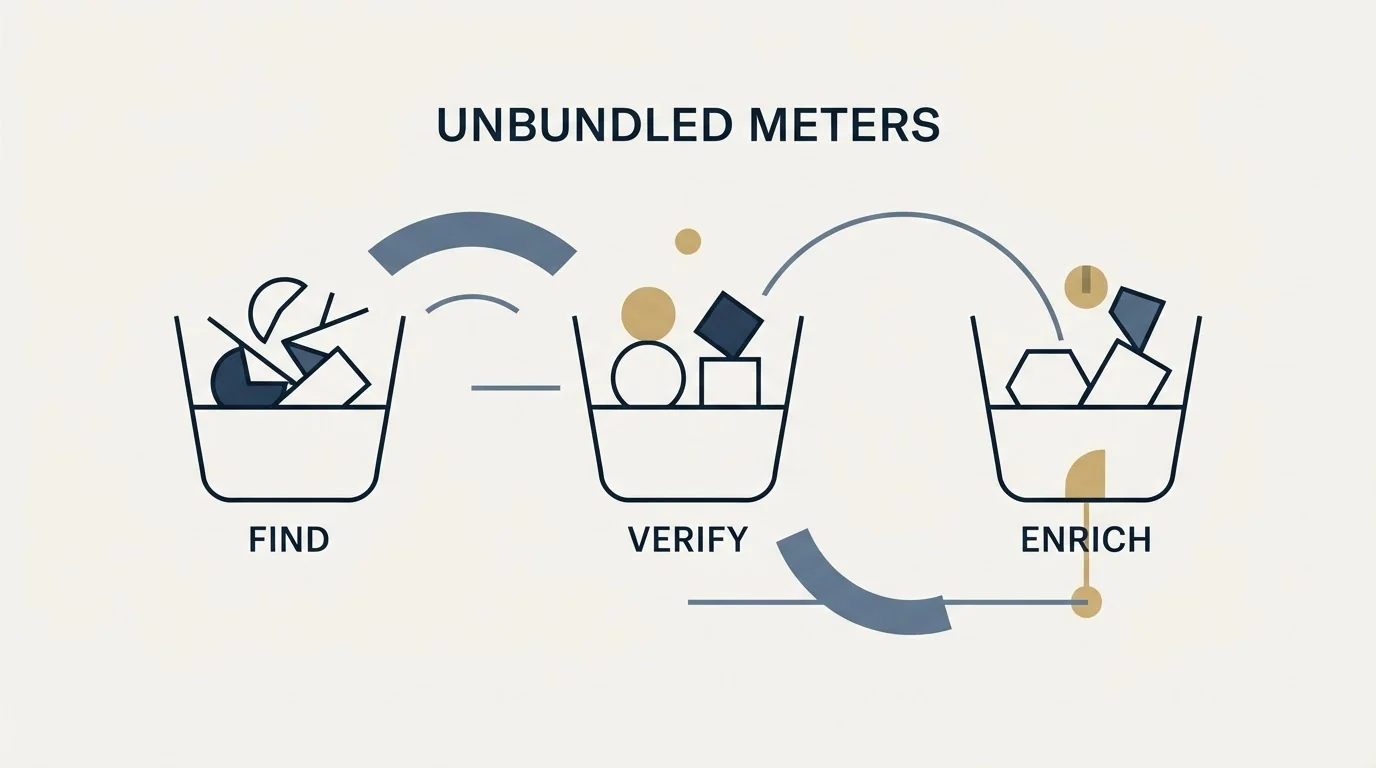
The three-meter structure is not just a pricing curiosity. It changes which mistakes are possible.
On a bundled-credit vendor, the stages are invisible to you. A credit disappears and you cannot easily tell whether it went on a search that found nothing, a lookup that resolved, or a verification you would rather have run somewhere cheaper. When the monthly bill grows, the only lever is to buy a bigger plan, because the thing you would want to optimise is not itemised.
On an unbundled vendor, each stage has a price you can compare against the market rate for that stage alone. That makes the buy-versus-substitute decision explicit: if verification here costs several times what a dedicated verifier charges, you substitute that one stage and keep the rest. It also makes the sequence design visible, which is the part that actually determines cost per correct address.
In contrast, some vendors reject databases entirely, and Dropcontact's algorithm-only enrichment approach shows what that tradeoff means for coverage and cost.
The trade is administrative. Three meters means three line items, three usage patterns to watch and three places a minimum charge can apply, and the $2 and $4 minimums on the pay-as-you-go meters exist precisely because small jobs are not worth billing. For a team running occasional small batches, those minimums are the real floor on cost rather than the per-email rate.
What is not published
Two things a buyer would reasonably want are absent from the pricing page, and it is worth saying so rather than filling them in from reputation.
There is no published accuracy figure for the finder. Some vendors in this category publish one; this page does not, and we do not restate numbers we could not load ourselves.
There is no published pay-only-for-valid-emails policy. Some competitors make that commitment explicitly on their pricing pages. This page's framing is simple, predictable pricing with cancellation any time, which is a different statement. If billing only for deliverable results matters to your decision, treat it as a question for sales rather than a term you can point at.
Testing it against a list you already trust

Take contacts where you already hold an independently verified address, spread across the geographies and seniority levels your real list contains, and compare what the finder returns against what you already had. Count resolution, matching and accept-all results as three separate numbers, and score on cost per correct address rather than hit rate, since an address that is valid and belongs to somebody else costs you a prospect rather than a credit. The full protocol is in our guide to email finder tools. For a comparison against another finder that bills only for deliverable results, see our page on Skrapp.
The short version
Voila Norbert prices finding, verifying and enriching as three independent meters. Prospecting plans run $49, $99, $249 and $499 a month for ceilings of 1,000, 5,000, 15,000 and 50,000 leads, discounted on yearly billing, and every plan carries unlimited team members, credit rollover, and bulk and API access. Verification is pay as you go at $0.003 an email up to 500,000 and $0.001 above, several times the rate of a dedicated bulk verifier. Enrichment is $0.04 falling to $0.015. The page publishes no accuracy figure and no deliverable-only billing commitment. A separately-priced sequencing product exists, and we keep data vendors and sending platforms apart on principle.
If you would rather see the whole motion running on your own ICP before you commit to a data stack, start a free campaign and we will build the list, the copy and the sending infrastructure around it.
Pricing and features verified as of mid-2026. Verify current terms with the vendor before relying on them.
Frequently asked questions.
Frequently asked questions- How much does Voila Norbert cost?
- Prospecting plans are $49, $99, $249 and $499 a month for ceilings of 1,000, 5,000, 15,000 and 50,000 leads, with a discounted yearly rate of $39, $79, $199 and $399. Verification and enrichment are billed separately and need no subscription, at $0.003 and $0.04 an email respectively at entry volumes.
- Does Voila Norbert include email verification?
- It sells verification, but as a separate pay-as-you-go meter rather than as part of a prospecting plan. The published rate is $0.003 an email up to 500,000 and $0.001 above that, with a $2 minimum. At volumes where verification cost matters, a dedicated bulk verifier is substantially cheaper per check.
- How many users does a Voila Norbert plan include?
- Every prospecting plan lists unlimited team members, including the entry tier. That is unusual in this category, where entry plans are commonly restricted to a single user and adding a colleague means moving to an annual-only tier. For a small team it can outweigh a difference in headline price.
- Should I send campaigns from Voila Norbert?
- It sells a separately priced sequencing product, and we would keep the two apart. When sourcing and sending share an account, a billing dispute, policy change or suspension removes your list and your ability to contact anyone simultaneously. A second subscription is cheap insurance against a single point of failure.
About the author.

B2B cold email experts helping companies generate qualified leads through done-for-you outreach campaigns.
RevenueFlow Team
Explore more.
Ready to scale your outreach?
We build GTM engines that book real meetings. See the receipts.
Related articles.
Seamless.AI Email Finder: How It Works, What a Credit Buys
How Seamless.AI's email finder resolves a contact in real time, what one Universal Credit buys, the Total AI score on every address, and what the Chrome extension reads.
The Real Cost per 1,000 Emails, Verifications and Data Credits in 2026
Unit prices computed from verified vendor plans: $1.00 per 1,000 emails sent, $2.00 per 1,000 verifications and $19.60 per 1,000 enrichment credits.
Free Tiers and Trials in Sales Tools: What $0 Gets You Across 386 Vendors
37.0% of 386 verified sales tools have a permanent free plan. The median free data tier gives 50 credits and the median free sending plan 2,500 emails a month.
LeadGibbon Pricing: Three Monthly Plans, No Annual Tab
LeadGibbon publishes three monthly plans and no annual rate. The dated ladder, the verified-emails-only meter, the rollover rule, and what the page does not publish.
Clearout Pricing: Never-Expiring Credits, Three Ways to Buy
Clearout renders its prices in the browser only. The three purchase routes, the three priced cards, the add-on rate card, and what a credit buys on each product.
PersistIQ Pricing: A Demo Form Where the Ladder Was
PersistIQ's pricing address serves a demo form and no platform price. What the site does publish, the Luka add-on ladder at both billing states, and how to read a quote.