Sales Budget: Two Halves and How It Differs From a Forecast
A sales budget is two documents in one: a revenue commitment other teams plan against, and a spend authorisation that makes it reachable. Where each half fails.
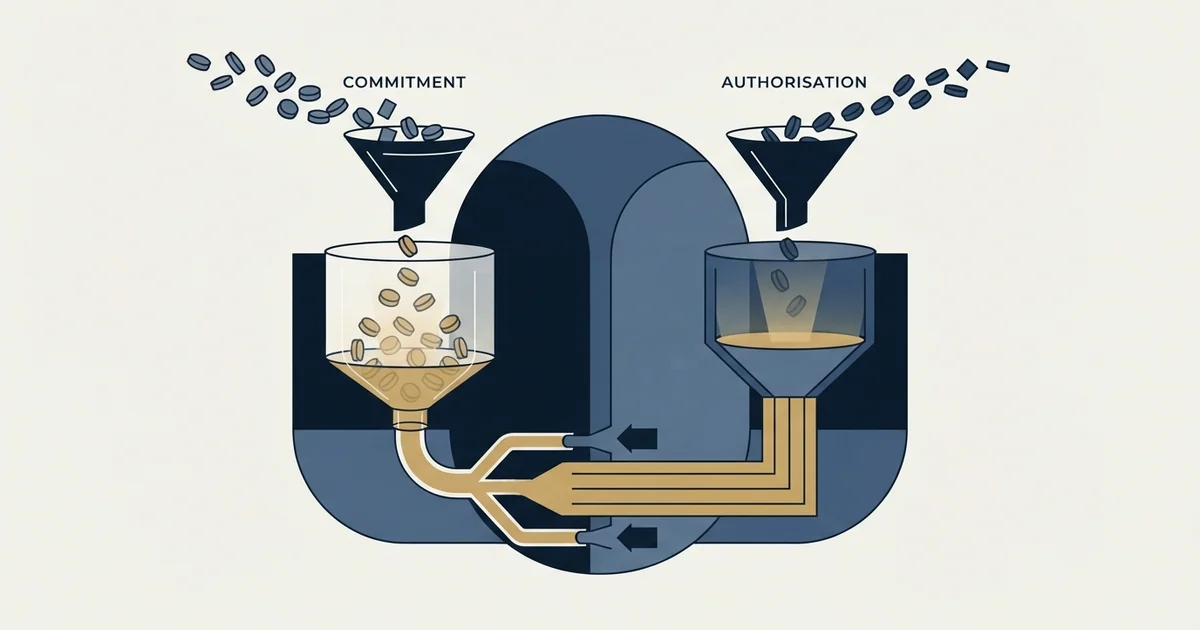
A sales budget is the plan for what a sales function will sell and what it may spend to sell it, over a stated period. The revenue half is a commitment other budgets inherit from. The cost half is an authorisation covering people, commission, ramp, tooling and demand generation. A forecast, by contrast, is updated continuously against real pipeline.
Key takeaways
- A budget is decided and stable so other functions can plan against it; a forecast is observed and updated, and the gap between the two is the earliest useful warning either one produces.
- Ramp is the cost line most often omitted, because it appears as absent revenue rather than as an invoice, so a budget assuming a new hire produces from month one overstates the year.
- Building the revenue half as headcount multiplied by quota assumes every seller hits plan; the honest input is your own attainment history rather than the quota you set.
- Budget demand generation in units rather than in months, because a cost per meeting held is what tells you whether the revenue half is arithmetically reachable.
Reviewed and updated September 2, 2026
A finance team asks the VP of Sales for next year's number by the end of the week, and what comes back is last year's revenue with a growth percentage on top. That document will govern headcount, commission, tooling and every outbound programme the team runs for twelve months, and almost none of the argument behind it is written down anywhere.
A sales budget is the plan for what the sales function will sell and what it will cost to sell it, over a stated period, expressed in money. It has two halves that get discussed as though they were one: the revenue the team commits to producing, and the spend it is authorised to consume producing it. Most confusion about the term comes from people arguing about different halves.
The two halves, and why they are usually confused
The revenue half is a commitment. It says what the function expects to bring in, usually broken down by product, territory, segment or month, and it is the number the rest of the company plans against. Production plans, hiring plans and cash-flow plans all take it as an input, which is why it is normally the first budget a company builds and the one every other budget inherits from.
The cost half is an authorisation. It says what the function may spend to get there: salaries and commission, tooling, data, travel, events, agencies and any outbound programme. It is the half that gets cut first when the revenue half looks shaky, which is a common way a sales budget destroys the number it was written to protect.
Keeping them separate matters because they fail differently. A revenue half that is wrong produces a company that built too much or hired too little. A cost half that is wrong produces a team that cannot reach a number it has already promised.
- What the function expects to sell, by period and segment
- Feeds production, hiring and cash-flow planning
- Built first, because other budgets inherit from it
- Fails by being aspirational, and everything downstream inherits the error
- What the function may spend to produce that revenue
- Salaries, commission, data, tooling, agencies, events
- Usually built second, from the revenue half
- Fails by being cut mid-year while the revenue half stays fixed
Where a budget differs from a forecast
The two words get used interchangeably and they are answers to different questions, which is why several of the pages ranking for this term are titled around the comparison.
A budget is what you have decided to aim at and pay for. It is set once for a period, it is a planning instrument, and its whole value comes from being stable enough that other functions can rely on it. Changing it every month makes it useless to everyone downstream.
A forecast is what you currently expect to happen. It is updated continuously against real pipeline, it is a measurement instrument, and its whole value comes from being honest rather than stable. A forecast that never moves is not being maintained.
The practical consequence is that the gap between them is the most useful number either one produces. A forecast tracking below budget in month four is the signal that something has to change while there is still time to change it, and the earlier that gap is visible the cheaper the response is. The methods used to produce the forecast side of that comparison, and what each one implicitly trusts, are set out in sales forecasting methods; the tooling layer that maintains it sits in sales forecasting software.
A team that reports only one of these numbers has removed its own early-warning system. A team that reports both and never explains the gap has kept the instrument and thrown away the reading.
What actually goes inside the cost half

The revenue half is usually built from a segmentation everyone has already argued about. The cost half is where budgets go wrong quietly, because several of its largest items are easy to leave out.
Fixed people cost. Base salaries, employer costs and benefits for the sellers, the managers and the support functions around them.
Variable people cost. Commission and bonus, which is the item most often budgeted as a single percentage when it is actually a plan with thresholds, accelerators and clawbacks in it. What that plan is made of, and how the rate should be derived rather than assumed, is worked through in SDR comp plans.
Ramp. The interval between a seller being hired and a seller producing at plan. This is the line item that gets forgotten most reliably, because it is a cost that shows up as an absence of revenue rather than as an invoice. A budget that assumes a January hire produces from January has overstated the year by the length of the ramp, and ramp time explains why that interval is mostly set by the sales cycle and the list rather than by training.
Demand generation and outbound. Data, sending infrastructure, tooling, and any external programme. Where this is bought rather than built, the comparable unit is cost per meeting rather than monthly fee, which is the point what a lead generation agency costs is built around.
Tooling and data. CRM seats, enrichment, verification, calling or sending platforms. Usually the smallest of these lines and the one with the most invoices attached to it.
How much that line has to carry depends on where the team sits, and what replaces line of sight remotely turns the activity record into an operating requirement.
Travel, events and everything else. Small in aggregate for most B2B teams, and the first thing cut, which makes it a poor place to look for real savings.
- Yes: Base salaries and employer costs for sellers, managers and support
- Yes: Commission and bonus, modelled from the actual plan rather than as one percentage
- Yes: Tooling, data, verification and sending platforms
- Depends: Ramp, costed as months of reduced production per new hire
- Depends: Outbound or demand generation, costed per meeting rather than per month
- Depends: Backfill for expected attrition, including the ramp on the replacement
Three ways the revenue number gets built, and what each one assumes
Top down. Start from a company target and divide it across territories, segments or reps. It is fast, it aligns with what the board wants, and it assumes the capacity to deliver the number already exists. When it does not, the plan is a wish with a spreadsheet around it.
Bottom up. Start from capacity: how many sellers, at what quota, with what ramp and what attrition. It produces a number the team can actually defend, and it tends to come in under what the board wanted, which is exactly the conversation worth having in October rather than in June.
Historical, adjusted. Start from last year and adjust for the things that changed. It is the most common method and the most dangerous one, because it silently assumes the market, the list and the win rate behave the same way twice.
The version that survives is usually built bottom up and then reconciled against the top-down number, with the gap named explicitly rather than split down the middle. A gap closed by raising quotas without adding capacity is not a plan, it is the same plan with worse odds attached to it.
- Step 1Size capacity
Sellers, quotas, ramp and expected attrition, from your own history rather than a benchmark
- Step 2Build the revenue half
Capacity times realistic attainment, by segment and by month
- Step 3Build the cost half
People, variable pay, ramp, tooling, data and demand generation
- Step 4Reconcile against the top-down ask
Name the gap and decide what changes: capacity, target, or the market you work
- Step 5Set the review rhythm
Forecast against budget monthly, and treat the gap as the reading
Where sales budgets break in practice
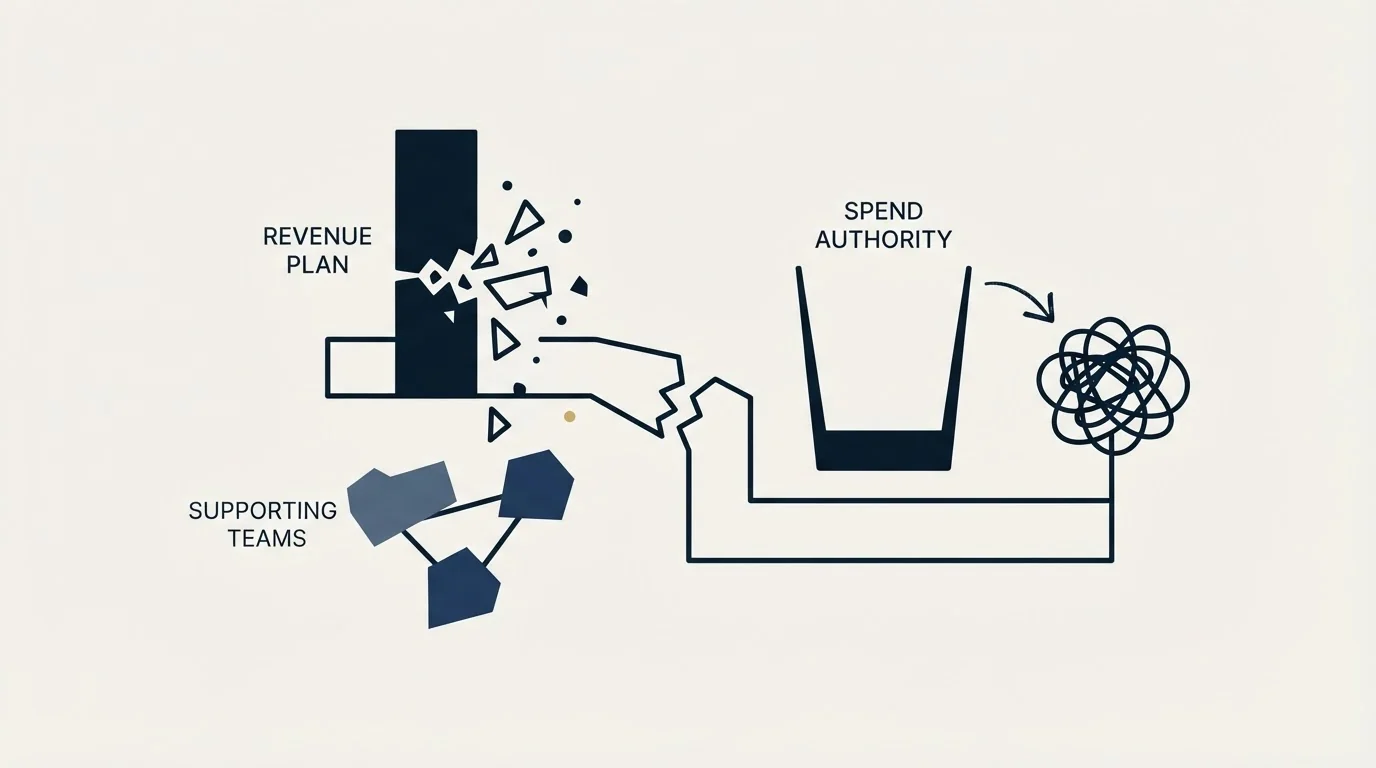
The ramp gap. Covered above and worth repeating, because it is the single most common arithmetic error in the document. Hiring plans are written in headcount and budgets are written in revenue, and the translation between them has an interval in it.
Attainment assumed at full quota. A budget built as headcount multiplied by quota assumes every seller hits plan. Whatever your own distribution looks like, it is not that, and the honest input is your own attainment history rather than the quota you set.
The cost half cut while the revenue half stands. A mid-year spend freeze that leaves the revenue commitment untouched is the clearest way to convert a budget into a fiction. If the cost half moves, the revenue half has to be renegotiated in the same conversation.
A revenue half nobody can reach pushes sellers toward manufactured urgency, when real urgency belongs to the buyer's calendar rather than to the seller's quarter.
One number for commission. Commission modelled as a flat percentage of revenue hides accelerators, which is where the cost overruns in a good quarter, and clawbacks, which is where the disputes happen in a bad one.
No unit anywhere. A budget expressed only in totals cannot be compared to anything or diagnosed when it slips. A cost per meeting, a cost per opportunity and a cost of acquisition give the same document something to be wrong about specifically.
A worked illustration, with invented numbers
The arithmetic below uses invented figures purely to show the shape of the calculation. They are not our numbers, they are not benchmarks, and they should be replaced with your own before any of this is useful.
Suppose a team plans six sellers, a quota of 600,000 each, and an expected attainment of 75 percent based on its own last two years. The capacity-derived revenue half is 6 multiplied by 600,000 multiplied by 0.75, which is 2,700,000. Now suppose two of those six are hired in March with a four-month ramp. Those two produce for roughly five months of the remaining ten at full rate, so the honest figure is lower than the headline, and the size of that adjustment is the number the ramp line exists to make visible.
The point of writing it out is not the answer. It is that each input is a separate argument with separate evidence behind it, and a budget presented as one number has hidden all three.
Where an outbound programme sits inside it
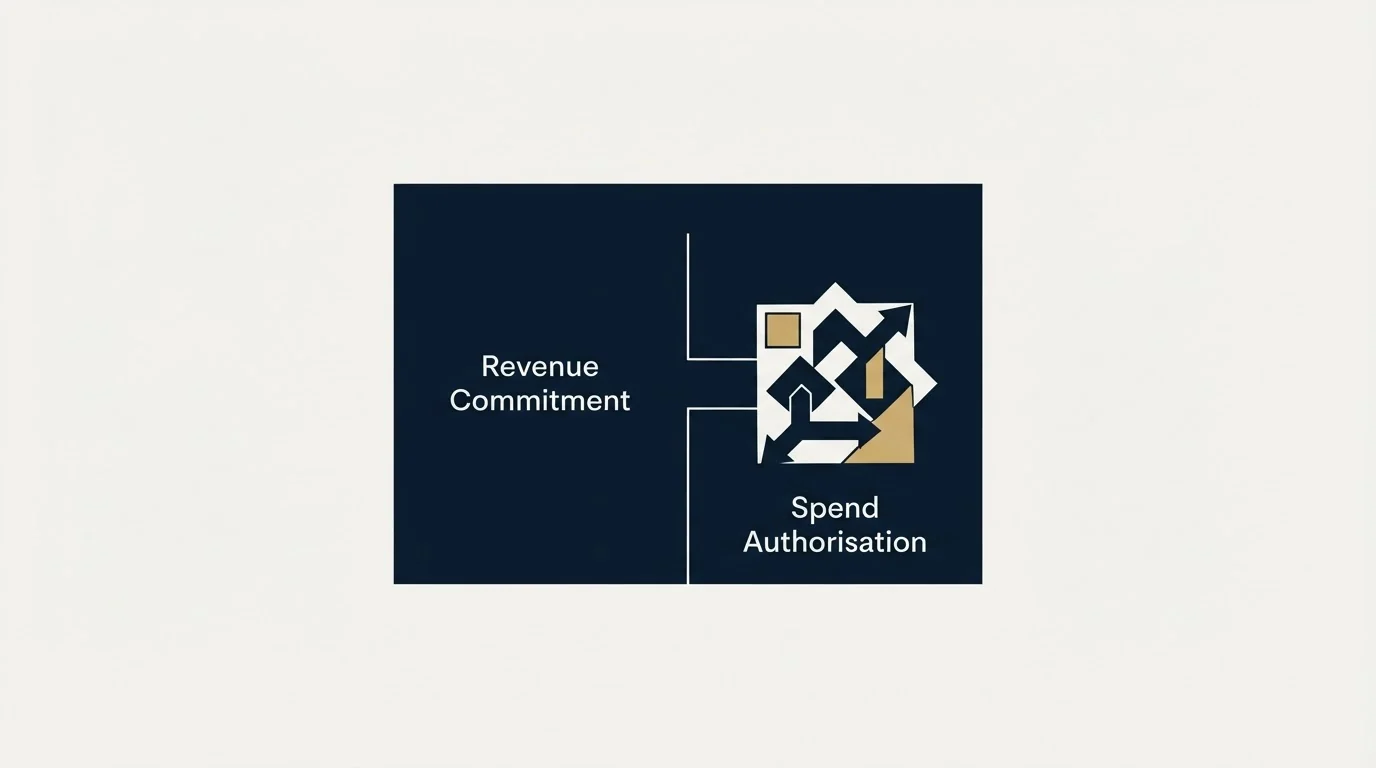
For teams whose pipeline comes from outbound rather than from inbound demand, the demand generation line is the one that decides whether the revenue half is reachable, and it is usually budgeted least carefully.
The useful discipline is to budget it in units rather than in months. A monthly fee tells you what leaves the account. A cost per meeting held tells you whether the revenue half is arithmetically possible: meetings needed, divided by the conversion rates you actually observe, multiplied by what a meeting costs. When those three numbers are written down, a budget stops being a negotiation about how much to spend and becomes a question about whether the plan closes.
Our own position on the last of those inputs is a documented practice rather than advice. Meetings are qualified against criteria agreed in writing before a campaign launches, and budget, timing and authority are never billing conditions, which keeps the cost-per-meeting line in a budget from being quietly redefined halfway through the year.
The short version
A sales budget is two documents in one: a revenue commitment other functions plan against, and a spend authorisation that makes the commitment reachable. It differs from a forecast in that a budget is decided and stable while a forecast is observed and updated, and the gap between the two is the most useful number either produces. Build it bottom up from capacity, reconcile it against the top-down ask rather than splitting the difference, and put ramp, real attainment and a per-meeting cost for demand generation in it explicitly, because those three are where the arithmetic usually fails.
If the demand generation line is the one you are least confident about, get a free campaign plan and we will show you the list, the infrastructure and the one message it sends, costed per meeting rather than per month.
Frequently asked questions.
Frequently asked questions- What is the difference between a sales budget and a sales forecast?
- A budget is what you have decided to aim at and pay for. It is set once for a period and its value comes from being stable enough for other functions to plan against. A forecast is what you currently expect to happen, updated against real pipeline, and its value comes from being honest rather than stable. Track both, because the gap between them is the reading.
- What should a sales budget include?
- The revenue commitment broken down by segment and month, and the spend authorised to produce it: base salaries and employer costs, commission modelled from the actual plan rather than as one percentage, ramp for every planned hire, tooling and data, demand generation or outbound, and travel. Backfill for expected attrition belongs there too, including the ramp on the replacement.
- Should a sales budget be built top down or bottom up?
- Build it bottom up from capacity, then reconcile it against whatever the board asked for and name the gap explicitly. Top down is faster and assumes the capacity to deliver already exists. Splitting the difference between the two numbers is the common move and the worst one, because it raises quotas without adding anything that produces the extra revenue.
- How do you budget for outbound inside a sales budget?
- In units rather than months. A monthly fee tells you what leaves the account; a cost per meeting held tells you whether the plan closes. Work backwards from meetings needed, divided by the conversion rates you actually observe, multiplied by what a meeting costs. Agree what counts as a qualified meeting in writing first, so the unit cannot be redefined mid-year.
About the author.

B2B cold email experts helping companies generate qualified leads through done-for-you outreach campaigns.
RevenueFlow Team
Explore more.
Ready to scale your outreach?
We build GTM engines that book real meetings. See the receipts.
Related articles.
LinkedIn Outreach for Banks: A Regulated Message
How a bank's relationship managers use LinkedIn to reach business owners: what the FFIEC guidance, FINRA's notices and LinkedIn's own rules require, and where to stop.
SDR Outsourcing for Business Brokers: The Fee Timing
Whether a success-fee brokerage should rent sales development at all: the fee timing, the texts that limit what an outside person may say about value, and who signs.
B2B Lead Lists for Aviation Companies: Build or Buy
Aviation is one of the few industries whose accounts are published by its regulator, which changes what is worth buying and what is worth downloading yourself.
Sales Prospecting for Health Systems: The Public Record
Where health systems are written down in public: the Medicare cost report, the facility list a non-profit system files, and the two gates that follow qualification.
Sales Enablement Charters: What the Published Ones Ask For
Six publishers set out what a sales enablement charter should contain. Five describe a document nobody can check, and one writes a definition with inspection in it.
Appointment Setting for Business Brokers: The Seller Meeting
What a bought meeting with a business owner has to be for a brokerage: the three-part qualification, the confidentiality rules, the licence line and the owner's reasons.