What a Spiff Is, and the Payroll Line It Lands On
A spiff is a short-term push that sits on top of the comp plan. The design is easy. The clawback rule and the reporting form are where they come apart.
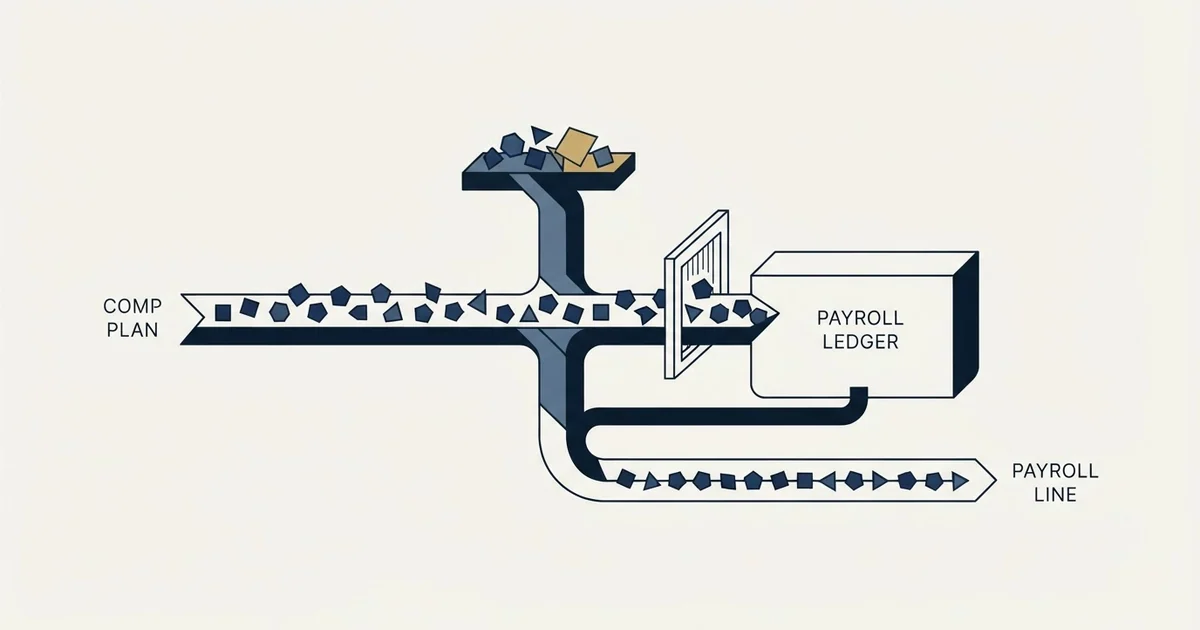
A spiff is a short-term incentive paid for a specific behaviour inside a defined window, layered on top of an existing compensation plan rather than replacing it. It exists so a team can redirect attention for a few weeks without reopening the plan. Paid to your own employee it is wages; paid to a partner's rep it is nonemployee compensation.
Key takeaways
- A spiff differs from commission and bonus on one axis that matters administratively: it is temporary and additive, so it can be launched and ended without renegotiating the compensation plan.
- The most common design error is rewarding an outcome that was already forecast, which buys reporting rather than behaviour; rewarding the missing activity is harder to run and far likelier to change anything.
- The IRS instructions for Forms 1099-MISC and 1099-NEC state that wages, bonuses, prizes and awards paid to your own employees belong on Form W-2, and name an award for the top commission salesperson as an example that does not go in the prizes box.
- Channel spiffs paid to somebody else's salespeople are nonemployee compensation, with Form 1099-NEC applying at payments of at least $2,000 to a person during the year.
Reviewed and updated August 20, 2026
A spiff is a short-term bonus paid for a specific sales action inside a defined window, sitting on top of whatever compensation plan is already running. Sell twelve units of the new product before the end of the month and the reward is a gift card, a trip, or cash. The commission plan does not change. The spiff expires.
A spiff in sales, then, is a bounded incentive rather than a compensation change: it names one action, one window and one reward, and it stops on the date it was announced to.
The acronym is usually expanded as Sales Performance Incentive Fund, and the shorter spellings SPIF and SPIFF are both in circulation for the same thing. The word predates the acronym by well over a century, which is why the backronym never quite fits: it appears in Victorian retail slang for the payment a shop assistant received for shifting stock nobody wanted. That origin is a better guide to how spiffs behave than the modern expansion is.
The three-way distinction that actually matters
Commission, bonus and spiff get used interchangeably in conversation and are three different instruments in a payroll system.
Commission is the core variable pay in the plan. It is earned as a defined percentage or rate on business the rep closes, it applies continuously, and it is the thing a rep models when deciding whether the job is worth taking.
A bonus is usually periodic and tied to an aggregate outcome: quota attainment for the quarter, a team target, an annual accelerator. It is planned in advance, it is budgeted, and it is part of on-target earnings.
A spiff is temporary, narrow and additive. It exists to redirect attention for a few days or weeks toward one product, one segment, one activity, without reopening the compensation plan. Reopening a plan mid-year is slow, contentious and demotivating, and the spiff is the mechanism that avoids it. That is the entire design case for spiffs, and everything good and bad about them follows from it.
- Continuous
- Rate applied to closed business
- Part of on-target earnings
- Changing it is a plan change
- Rep models it before accepting the job
- Tied to an aggregate outcome
- Budgeted in advance
- Usually quarterly or annual
- Predictable enough to plan around
- Days or weeks, then it ends
- Tied to one narrow behaviour
- Sits on top of the plan
- Can be launched without reopening comp
- Ends without renegotiation
What a spiff is genuinely good at

Three situations, and they share a shape: something needs attention now, for a reason that will not still be true next quarter.
A new product launches and nobody is leading with it, because reps sell what they already know how to sell. A quarter is closing and a specific band of deals is sitting one conversation away from signature. A pipeline gap opened two months ago and prospecting activity, not closing skill, is the constraint.
In each case the alternative is a manager asking people to prioritise differently, which works for about a week. A spiff attaches a number to the request and gives it an end date. The end date is doing as much work as the money.
The four ways they go wrong
They pay for the sale that was going to happen anyway. The most common design error is spiffing an outcome rather than a behaviour. If the reward attaches to closed revenue in a month when closed revenue was already forecast, the budget buys reporting rather than behaviour. Spiffing the activity that is genuinely missing, the demo booked on the new product, the segment nobody calls, is harder to administer and much likelier to change anything.
They teach the team to wait. A spiff that appears every quarter-end stops being a surprise and becomes a schedule. Reps who have seen three of them will hold a deal into the window, which means the programme now costs money and moves revenue backwards. The defence is irregularity: unpredictable timing, unpredictable subject.
They reward the wrong deal quality. Any incentive tied to units rather than fit will pull in customers who churn, and the churn arrives one or two quarters after the spiff has been declared a success. If a spiff is running, the same period needs a retention or qualification measure read alongside it, or the evaluation is structurally incapable of finding the cost.
Nobody wrote down the rules. The disputes are never about the concept. They are about whether a deal that closed on the first of the following month counts, whether a split deal pays twice, whether a cancelled order claws back. Those questions have to be answered in writing before the spiff opens, because answering them afterwards always looks like the company changing the rules to save money.
- Yes: The exact behaviour being rewarded, stated so two people cannot read it differently
- Yes: The open and close dates, and which timestamp decides a borderline deal
- Yes: Whether split or team deals pay once, twice, or pro rata
- Yes: The clawback rule if the order cancels or the customer churns inside a stated window
- Yes: Who adjudicates a dispute, by name
- Yes: The quality measure that will be read beside the volume measure
- No: A repeating quarter-end schedule the team can anticipate
The payroll and tax line, which most spiff guides skip
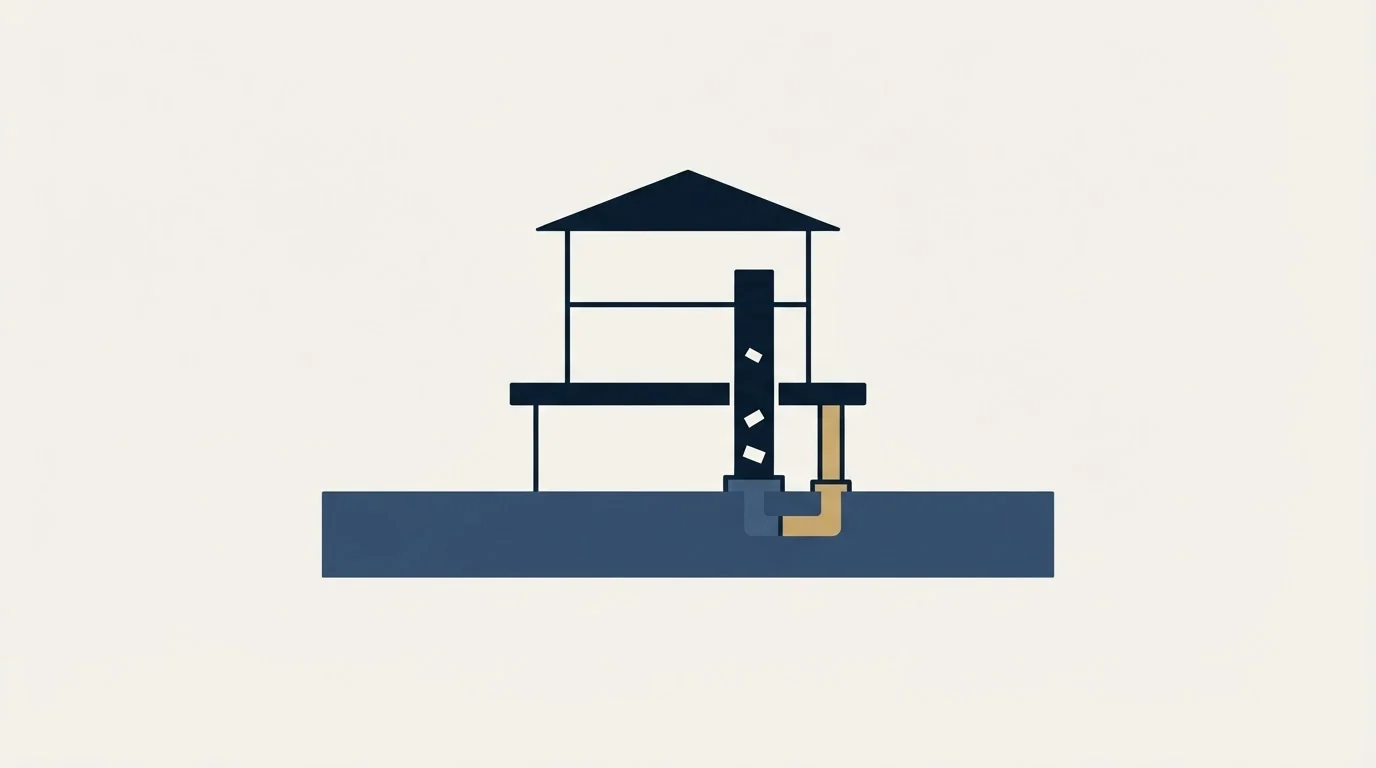
This is where the instrument stops being a motivational idea and becomes an administrative fact, and it splits cleanly by who is being paid.
Paying your own employee. The IRS instructions for Forms 1099-MISC and 1099-NEC are explicit that these forms are the wrong place for it: "Do not include wages, any bonuses, prizes, and awards paid to your employees. Report these on Form W-2." A spiff paid to a rep on your own payroll is compensation, whatever it is called internally, and whether it arrives as cash, a gift card or a prize. Calling it a contest reward does not move it off the W-2, and the same instructions say the payment should not be entered as a prize in box 3 either, naming "an award for the top commission salesperson" as the example of what belongs elsewhere.
Paying somebody else's employee. The classic channel spiff, where a manufacturer rewards a distributor's or reseller's salespeople directly, is a different animal because the recipient is not your employee. The same instructions define nonemployee compensation to include "prizes and awards for services performed as a nonemployee," and set the reporting trigger for Form 1099-NEC at payments of "at least $2,000" to a person in the course of your business during the year.
Two consequences for anyone designing one. A channel spiff carries a reporting obligation and needs the recipient's tax details collected before the reward is promised, not after. And an internal spiff needs finance in the room at design time, because grossing up for tax so the advertised reward is what lands is a decision somebody has to make, and making it late turns a motivational programme into a payroll correction. The accounting treatment of variable pay generally is worked through in our piece on whether sales commission is a period cost.
State wage law adds a further layer for the plan the spiff sits on top of, and the rules are genuinely jurisdictional: our write-up of what California requires of a commission plan is the worked example of how specific that can get.
- Step 1Who receives it
Your employee, or somebody else's
- Step 2Your own employee
Wages, bonuses, prizes and awards go on Form W-2, not on a 1099
- Step 3A non-employee
Prizes and awards for services performed count as nonemployee compensation
- Step 4The trigger
Form 1099-NEC applies at payments of at least $2,000 to a person during the year
How to tell afterwards whether it worked
Most spiff post-mortems compare the spiff period against the period before it and declare victory, which measures the calendar as much as the incentive. Three comparisons are cheap and considerably more honest.
Compare the spiffed behaviour against the same behaviour in the equivalent period a year earlier, so seasonality is not doing the work. Compare the non-spiffed products over the same window, because a spiff that lifted one line by pulling attention off another has moved revenue rather than created it, and that shows up as a dip somewhere adjacent. And read a quality measure at the same time: win rate on the spiffed deals, or retention at ninety days, depending on what the reward could plausibly have distorted.
The last one is the comparison teams skip, and it is the only one that can find the expensive failure. A spiff that hit its unit target and brought in accounts that leave within two quarters looks like a success on every dashboard that reports inside the spiff window, and the cost surfaces later under a different heading. Deciding in advance which quality number will be read, and by whom, is what separates a programme from a giveaway.
Worth recording the answers somewhere durable too. Spiffs are usually designed in a hurry by whoever is closest to the problem, so the institutional memory of which ones worked lives in one person's head until that person leaves.
Where a spiff sits against the rest of the plan
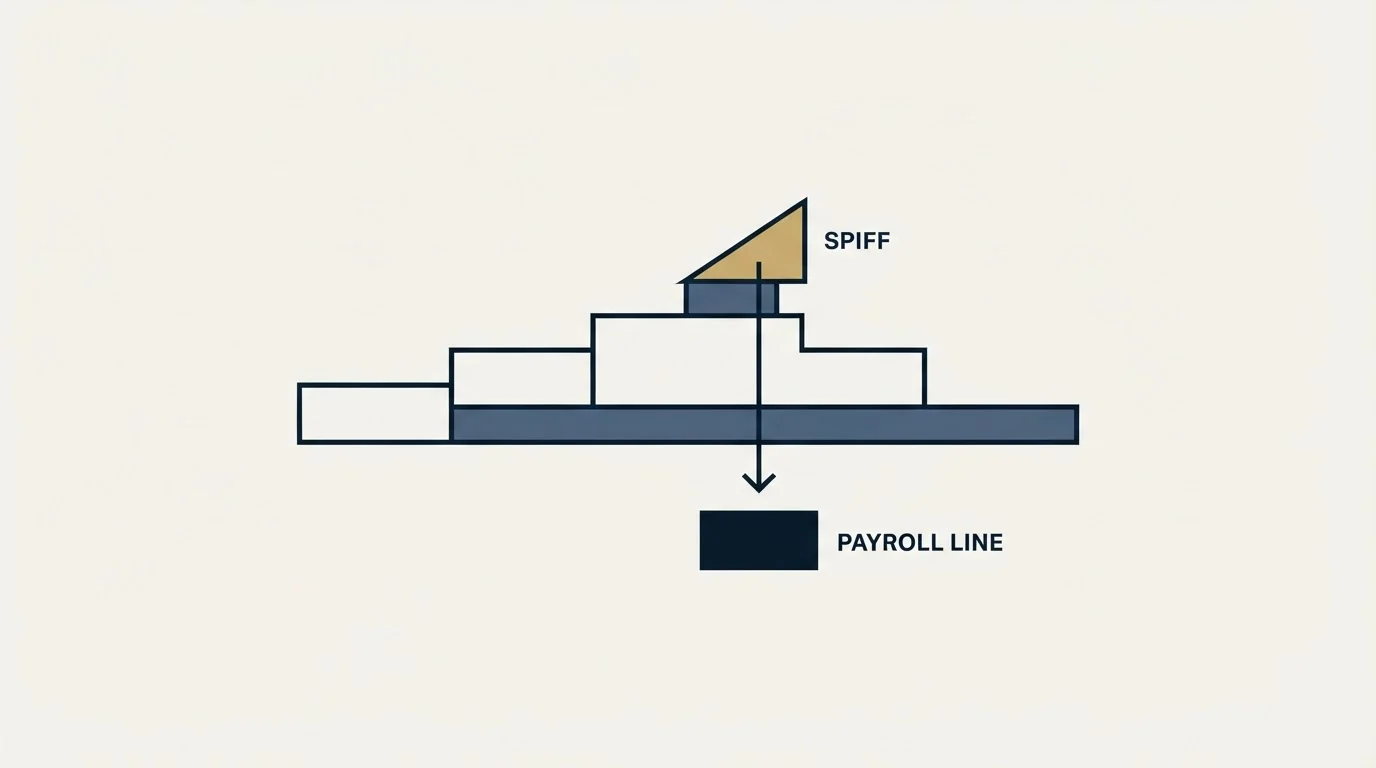
A spiff is the smallest and fastest lever in a compensation system and it is the wrong tool for a structural problem. If reps consistently underperform on a product, the cause is usually enablement, pricing or fit rather than motivation, and a month of gift cards will produce a month of numbers followed by a return to the previous baseline.
The larger design questions belong to the plan itself. How the core rate is set and what it has to survive is covered in our guide to building a commission plan, the programme layer sits in sales rep incentive programs, and the behaviour-first design argument is in designing an incentive plan backwards.
One thing does not respond to incentives at all, which is the number of qualified conversations available to be sold. No spiff creates pipeline that the top of the funnel did not produce. If that is the actual constraint, we will build the first campaign and the compensation question can be answered against a fuller pipeline rather than a thinner one.
Reporting rules quoted from the IRS instructions for Forms 1099-MISC and 1099-NEC at irs.gov, fetched 17 August 2026. This is a description of published guidance and not tax advice; confirm treatment with your own accountant, and note that thresholds and rules change.
Frequently asked questions.
Frequently asked questions- What does spiff stand for?
- It is usually expanded as Sales Performance Incentive Fund, and both SPIF and SPIFF spellings refer to the same instrument. The word is much older than the acronym: it appears in Victorian retail slang for the payment a shop assistant got for shifting stock that was not moving, which describes the modern use fairly well.
- What is the difference between a spiff and a commission?
- Commission is the core variable pay in the plan, earned continuously at a defined rate on closed business and counted in on-target earnings. A spiff is temporary and narrow, attached to one behaviour for a few days or weeks, and it ends without renegotiation. Changing commission is a plan change; running a spiff is not.
- Is a spiff taxable?
- Treat it as compensation and check with your accountant. The IRS instructions for Forms 1099-MISC and 1099-NEC state that wages, bonuses, prizes and awards paid to your employees go on Form W-2, regardless of whether the reward arrives as cash, a gift card or a prize. Grossing up is a decision to make at design time.
- How do you stop a spiff from being gamed?
- Write the rules before it opens and keep the timing irregular. Define the exact behaviour, the close timestamp that decides borderline deals, how split deals pay, the clawback if an order cancels, and who adjudicates disputes by name. A spiff that appears every quarter-end trains reps to hold deals into the window.
About the author.

B2B cold email experts helping companies generate qualified leads through done-for-you outreach campaigns.
RevenueFlow Team
Explore more.
Ready to scale your outreach?
We build GTM engines that book real meetings. See the receipts.
Related articles.
Sales Enablement Charters: What the Published Ones Ask For
Six publishers set out what a sales enablement charter should contain. Five describe a document nobody can check, and one writes a definition with inspection in it.
Sales Comp Plan Design: What the Publishers Prescribe
Four publishers set out how to design a sales compensation plan. Here are their procedures, their components, and which of their ratios carry a population.
Win Rate Benchmarks: Which Figures State a Population
A catalogue of the published average sales win rates, sorted by whether the page names the population behind its own number. Most do not.
Sales Kickoff Agendas: Five Published, Session by Session
Five publishers print a sales kickoff agenda. They agree on four blocks and disagree on session length, rehearsal and where the agenda comes from.
Sales Cycle Length Benchmarks: What Each Figure Counts
The published B2B sales cycle benchmarks, sorted by what each page says it counted. The same number means two different things in two of them.
Sales Prospecting for Utilities: Read the Filings First
Prospecting utilities from the proceedings that announce their spend: rate cases, resource plans and procurement decisions, who owns each, and the supplier gate.