ZoomInfo Reviews: How to Read Them and What They Miss
The vendor's own reviews page links G2 with a five-star filter attached. A method for reading reviews of a data platform, and the test that outranks them.
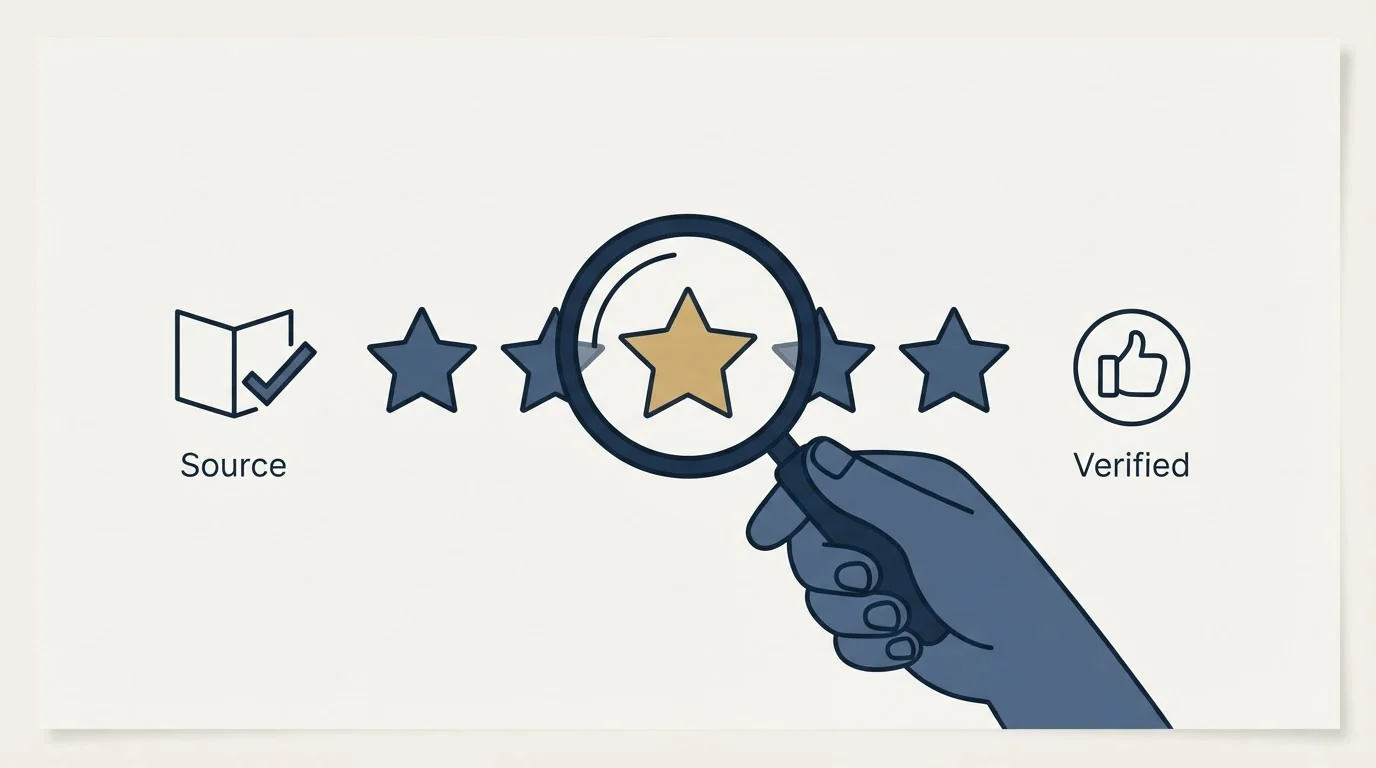
ZoomInfo publishes its own reviews page linking G2 and TrustRadius, and the G2 link carries a five-star filter. Reviews answer support, onboarding and renewal questions well. They cannot answer coverage in your segment, which you test yourself on 200 accounts during the evaluation window.
Key takeaways
- ZoomInfo's own reviews page links G2 with a query string that filters the list to five-star reviews, so open the review site directly instead.
- Reviews attach to products rather than companies, and ZoomInfo's review slug is for the Sales product specifically rather than the whole platform.
- A large share of results for this search are employer reviews about working at ZoomInfo, which tell a buyer nothing about the data.
- Aggregate ratings mix seat-holders with contract owners and average coverage that varies by geography, segment and seniority.
Reviewed and updated September 1, 2026
ZoomInfo publishes its own reviews page, titled "ZoomInfo Reviews: G2, Gartner, and TrustRadius Ratings in 2026". It links readers out to TrustRadius and to G2, which is a reasonable thing for a confident vendor to do.
The G2 link on that page carries a query string. Stripped of its encoding, it filters the review list to five-star reviews only.
That is not a scandal. It is marketing doing exactly what marketing does, and any vendor's own reviews page is a curated surface by definition. It is, however, a perfect illustration of the problem with researching a tool through reviews: the path you arrive by shapes what you see, and almost nobody checks the query string.
This page is about how to read reviews of a vendor in this category, what those reviews systematically fail to capture, and which questions you have to answer yourself. We hold no ZoomInfo licence, so no verdict on its data quality appears here. What follows is method rather than rating.
Searching ZoomInfo G2 returns two different things: the G2 listings for each ZoomInfo product, and the G2 buyer-intent integration, which is a data partnership rather than a review surface and belongs with the intent product instead.
Start by fixing the link
If you follow ZoomInfo's own page to G2, delete everything after the question mark in the URL. You want the unfiltered review list, which sorts and filters however you choose rather than however the vendor chose.
Two more details from that page worth carrying with you.
The product slug is zoominfo-sales, not zoominfo. Reviews on review sites attach to products rather than to companies, and ZoomInfo sells several. A review of the Sales product is not a review of Operations, of the conversation intelligence product, or of the browser extension. If you are evaluating one component, find the reviews for that component.
Readers evaluating the Operations product specifically should see how it evolved from an earlier acquisition in what ZoomInfo Operations does after the RingLead acquisition.
Beyond acquisition history, buyers integrating ZoomInfo with an AI assistant should see what the ZoomInfo MCP server charges for, since licence, plan and credit limits still apply.
The page names Gartner in its own title and links no Gartner page. Whatever the reason, treat any Gartner Peer Insights URL you find for ZoomInfo as something you should verify yourself rather than take from a comparison post. Search Gartner Peer Insights directly if you want that source.
Half the results are about working there, not using it
Search this term and a large share of what comes back is employer reviews: what it is like to work at ZoomInfo, compensation, management, the sales floor. Those pages rank because the search phrase is genuinely ambiguous, and they are useless to a buyer.
The distinction sounds obvious and it catches people anyway, because both kinds of review discuss the same company by the same name, in the same emotional register, on sites that look similar. A former SDR's account of quota pressure tells you nothing about whether the mobile numbers are current. Before you weigh any review, check whether the reviewer is describing a job or a product.
There is a milder version of the same confusion inside product reviews, and it is worth watching for: a reviewer who is describing their employer's buying decision rather than the tool. "We were locked into a contract we did not need" is a procurement story, and a useful one, but it is not evidence about data quality.
The vendor's own social proof, checked
While you are on ZoomInfo's own reviews page, it is worth noticing what is not there. The company's testimonials sub-sitemap is a valid, well-formed file containing zero URLs, so there is no first-party testimonials corpus behind the marketing copy to go and read.
That is not an accusation of anything. Testimonials move between content systems all the time. It is simply a reminder that a vendor's social proof is a designed surface, and the way to use it is as a list of customers you might be able to reach and ask, rather than as evidence in itself.
What reviews of a data vendor are actually good at
Review sites are genuinely useful, on a narrower set of questions than people use them for.
Support responsiveness and account management. These are experiential, they vary enormously, and reviewers describe them accurately because they lived them. A pattern of complaints about being unable to reach anyone after signature is real signal.
Onboarding and time to value. How long it took to get useful, what got in the way, whether the integration worked as sold. Reviewers are precise about this because it was painful and recent.
Contract and renewal experience. The most valuable reviews in any enterprise category are the ones describing what happened at renewal. Auto-renewal terms, notice periods, price increases and negotiation posture are things a buyer cannot discover before signing except by asking people who already did.
The gap between demo and daily use. Features that impressed in a demo and went unused, or the unglamorous thing that turned out to matter most. Reviewers are good witnesses to their own workflow.
- Support quality and responsiveness after signature
- Onboarding effort and time to first value
- Renewal behaviour, notice periods and price movement
- Which features get used daily and which were demo theatre
- How the integration behaved with a named CRM
- Coverage of your segment, geography and seniority
- Accuracy of contact details you can verify today
- Whether the data holds up in a non-US market
- Whether signals change what your team does
- The price, which is quoted rather than published
Why the ratings themselves are close to meaningless here

Aggregate scores in enterprise data have three structural problems, and knowing them changes how much weight you give a number.
The reviewer is usually not the buyer. A rep given a seat has a completely different experience from the ops leader who signed the contract and owns the bill. Both leave reviews, and the aggregate mixes them.
Coverage is local and ratings are global. Contact-data quality is not one property. It varies by geography, by company size, by industry and by seniority. A vendor with excellent coverage of North American software companies and thin coverage of European manufacturers will collect glowing reviews and terrible reviews about the same database, and the average tells you nothing about your market.
Incentives are everywhere. Review sites run campaigns, vendors run campaigns, and reviewers get gift cards. This does not make the reviews fake. It does mean the population of reviewers is not a random sample of users, and it skews toward the recently-onboarded and the recently-asked.
There is a fourth problem specific to reading reviews of anything with a browser extension attached, and it is worth naming because it produces confidently wrong numbers in comparison posts: store listing pages display ratings for several extensions at once, in recommendation cards, and a quick read of the page can attribute a neighbouring extension's rating to the one you are researching. Anchor any rating you quote to the product's own identifier.
The reviews you should actually go and find
The useful ones are not on review sites at all. They are people who bought this category recently, in a company shaped like yours, whom you can ask directly.
Four questions to ask them, which no public review will answer.
What did you actually pay, and what did the first renewal look like? Pricing here is quoted rather than published, so peer benchmarks are the only benchmarks. People are more willing to answer this than you expect, especially if they have already left the company that signed the deal.
What was your coverage rate in the segment you care about? Not the vendor's number. Theirs, measured on their list.
What did you stop using after six months? The answer is usually the thing that sold the deal, which tells you where to discount the pitch.
What broke at renewal? Seat counts that grew, credit allocations that ran out in the last month of the quarter, price increases that arrived with insufficient notice. This is the question that saves real money.
- Yes: Open the review site directly rather than through a vendor link, and strip any filter from the URL
- Yes: Check you are reading reviews of the specific product you are buying, not the company
- Yes: Sort by most recent, and read the two and three star reviews first
- Yes: Weight comments on support, onboarding and renewal above comments on data quality
- Yes: Run a coverage test on 200 accounts from your own target market during the trial
- Yes: Ask two peers who bought in the last year what they paid and what broke
- Depends: Treat any aggregate star rating as a summary of a mixed population, not a measurement of your outcome
- No: Quoting a rating you found in a comparison post without checking its source
The one test that outranks all of the reading

Coverage on your own list, measured by you, during the evaluation window.
Take 200 accounts you genuinely want to reach, in the segment, geography and seniority you actually sell to. Do not let the vendor supply the list, and do not use a sample you already know is well covered. Count how many produce a usable contact at the right seniority. That single number is worth more than every review you will read, because it is measured on the only population that matters to your outcome.
Then check accuracy rather than presence, because a record that exists is not a record that is current. A valid mailbox at somebody's previous employer passes every technical check and fails the only test that matters. Our Apollo versus ZoomInfo data accuracy piece sets out a testing method you can run on a sample, and Apollo's own review is a worked example of reading a vendor in this category. If you are still building a shortlist, the ZoomInfo alternatives roundup covers the field and the Cognism comparison is the one that comes up most for European coverage.
Whatever you conclude, remember that a contact database is only ever an input. The output is conversations, and the number of those is decided by the offer, the targeting and the message far more than by which vendor supplied the row.
Teams weighing engagement tools alongside data providers can see how the two roles differ in Groove versus ZoomInfo comparison.
If it is the conversations you are short of rather than the records, RevenueFlow builds and runs the campaigns and charges per qualified meeting, against criteria agreed in writing before launch. You can see it run on your own market with a free campaign.
Pricing and features verified as of mid-2026. Verify current terms with the vendor before relying on them.
Frequently asked questions.
Frequently asked questions- Where should I read ZoomInfo reviews?
- Go to the review sites directly rather than through the vendor's own reviews page, which links G2 with a five-star filter attached to the URL. Check that you are reading the product you are evaluating rather than the company, sort by most recent, and read the two and three star reviews before the extremes.
- Are ZoomInfo's ratings a good guide to data quality?
- Not really, because coverage is local and ratings are global. A platform with strong coverage of North American software companies and thin coverage of European manufacturers collects both glowing and terrible reviews about the same database. The average tells you nothing about your segment, geography or the seniority you sell to.
- What do reviews of a data platform actually tell you?
- They are reliable on experiential questions: support responsiveness after signature, onboarding effort and time to value, whether an integration behaved as sold, and what happened at renewal. Reviewers describe those accurately because they lived through them. Contract and renewal experiences are the most valuable and the hardest to discover any other way.
- What should I test instead of reading more reviews?
- Coverage on your own list. Take 200 accounts you genuinely want in your real segment and geography, and count how many produce a usable contact at the right seniority. Then check accuracy rather than presence, since a valid address at somebody's previous employer passes every technical check and fails the only test that matters.
About the author.

B2B cold email experts helping companies generate qualified leads through done-for-you outreach campaigns.
RevenueFlow Team
Explore more.
Ready to scale your outreach?
We build GTM engines that book real meetings. See the receipts.
Related articles.
Firmographic Data Providers: What Six of Them Publish
Six firmographic data providers read from their own pages: the fields each sells, the coverage each states, how the data is delivered, and who prints a price.
Salesgear Pricing: Two Ladders Under One Plan Title
Salesgear's page is titled as one plan and carries a Data ladder and an Outreach ladder. Both at both billing states, what each meters, and the two vendor-side conflicts.
Zeliq Pricing: One Seat Rate and a Credit Meter
Zeliq prices one self-serve seat in dollars with a credit meter that never expires. Both billing states, the three credit rates, the top-up ladder and the Custom floor.
Bookyourdata Pricing: 25 Packs, Priced Per Contact
Bookyourdata sells credits in twenty-five packs with no subscription. The dated ladder, the per-contact rates rendered in the browser, the guarantee rule and BeSpoke.
Video Prospecting Tools by Job: What Each One Is For
Ten video prospecting tools sorted by the job each vendor's own page describes: record and share, personalise at volume, avatars, hosting and interactive demos.
Seamless.AI Email Finder: How It Works, What a Credit Buys
How Seamless.AI's email finder resolves a contact in real time, what one Universal Credit buys, the Total AI score on every address, and what the Chrome extension reads.