ZoomInfo vs Lusha: Data Platform vs Prospecting Tool
Two very different approaches to B2B data. ZoomInfo offers enterprise-grade intelligence with intent data and technographics. Lusha provides quick contact reveals through a browser extension. Here's an objective breakdown to help you choose.
ZoomInfo is an enterprise platform with 600M+ profiles, intent data, and technographics starting at $15,000-25,000 annually with required contracts. Lusha is a lightweight browser extension for contact reveals with 50 free monthly credits and paid plans from $36/month with no annual commitment. Choose Lusha for individual reps or small teams needing affordable contact data; choose ZoomInfo for enterprises requiring comprehensive intelligence, intent signals, and maximum database coverage.
Key takeaways
- ZoomInfo maintains 600M+ professional profiles and 135M+ verified phone numbers, significantly larger than Lusha's proprietary database.
- Lusha Pro costs $36/user/month ($432/year) while ZoomInfo Professional typically starts at $15,000-25,000/year, representing approximately a 35x price difference.
- ZoomInfo requires annual contracts on all paid tiers while Lusha offers monthly billing with no long-term commitment on standard plans.
- Lusha provides 50 free credits monthly with basic extension access, while ZoomInfo does not offer meaningful free access for ongoing use.
- A 5-person team on Lusha Pro costs approximately $2,160/year compared to $30,000+ annually for the same team on ZoomInfo.
Reviewed and updated September 1, 2026
ZoomInfo vs Lusha: Enterprise Data Platform vs Lightweight Prospecting Tool
ZoomInfo and Lusha both help sales teams find contact information for B2B prospects. Beyond that basic function, they serve very different market segments with distinct capabilities, pricing models, and use cases.
ZoomInfo positions itself as an enterprise sales intelligence platform with comprehensive data coverage, intent signals, and workflow automation. Lusha positions itself as a lightweight prospecting tool built around a browser extension for quick contact reveals.
This guide provides an objective comparison to help you determine which platform fits your needs.
The Quick Answer
If you are an individual sales rep, small team, or startup looking for affordable access to contact data with minimal complexity, Lusha offers strong value. The free tier provides 50 credits monthly, and paid plans start at $36/user/month with no annual commitment required.
The Close and Lusha cross-category comparison explains why a CRM and a data enrichment tool often work together rather than compete.
If you are an enterprise organization that requires maximum database coverage, intent data across thousands of topics, technographic insights, and advanced sales intelligence features, ZoomInfo delivers a more comprehensive platform. The tradeoff is significantly higher pricing starting around $15,000-25,000/year with required annual contracts.
Understanding the Core Difference
These platforms occupy different positions in the B2B data market.
Lusha focuses on accessibility and ease of use. The core product is a browser extension that reveals contact information while you browse LinkedIn or company websites. You find a prospect, click the extension, and get their email and phone number. The platform also offers bulk enrichment, API access, and team management features.
Browser extension tools for contact discovery vary widely, and the Datanyze vs SignalHire comparison examines another pair built around similar LinkedIn prospecting workflows.
ZoomInfo focuses on comprehensive sales intelligence. The platform offers one of the largest B2B databases available (600M+ professional profiles), combined with intent data covering thousands of topics, technographic information about company tech stacks, org chart mapping, and workflow automation capabilities.
The pricing reflects this positioning. Lusha is designed to be accessible to individuals and small teams. ZoomInfo is designed for enterprise organizations with substantial sales technology budgets.
Database Size and Coverage
ZoomInfo Database
- 600M+ professional profiles
- 135M+ verified phone numbers
- Extensive direct dial coverage
- Org chart mapping for account planning
- Real-time data refresh
Source: zoominfo.com
Lusha Database
- Proprietary B2B contact database
- Direct dials and email addresses
- Company firmographic data
- Community-contributed verification
- GDPR compliant data practices
Source: lusha.com
Database Comparison

ZoomInfo maintains significantly larger database coverage by the numbers. For teams targeting niche industries, specific personas, or comprehensive account coverage, the larger database provides more options.
Lusha's database is smaller but maintains strong coverage for common industries and job titles. For most standard prospecting use cases (targeting sales leaders, marketing executives, or IT decision-makers at mid-market companies), Lusha provides adequate coverage.
The database size difference becomes more relevant when:
- Targeting smaller companies or niche industries
- Requiring comprehensive phone number coverage
- Building large prospect lists across diverse segments
Pricing Comparison
ZoomInfo Pricing (as of January 2026)
| Plan | Annual Price | Notes |
|---|---|---|
| Professional | Custom (typically $15,000-25,000/year) | Core database access, basic intent |
| Advanced | Custom (typically $25,000-40,000/year) | Full intent signals, technographics |
| Elite | Custom (enterprise pricing) | All features, advanced automation |
ZoomInfo requires annual contracts on all paid tiers. Monthly billing is not available. Per-user pricing often applies, meaning costs scale with team size. Actual pricing depends on negotiation, user count, and specific feature requirements.
Source: zoominfo.com/pricing
Lusha Pricing (as of January 2026)
| Plan | Monthly Price | Credits | Key Features |
|---|---|---|---|
| Free | $0 | 50/month | Basic extension access |
| Pro | $36/user | 480/year | CSV enrichment, bulk reveal |
| Premium | $59/user | 960/year | Intent signals, tech stack data |
| Scale | Custom | Custom | Team management, dedicated support |
Lusha charges per user with monthly billing available. Credits are consumed per contact revealed. The per-user model means costs scale linearly with team size.
Source: lusha.com/pricing
Pricing Analysis

The pricing gap between these platforms is substantial.
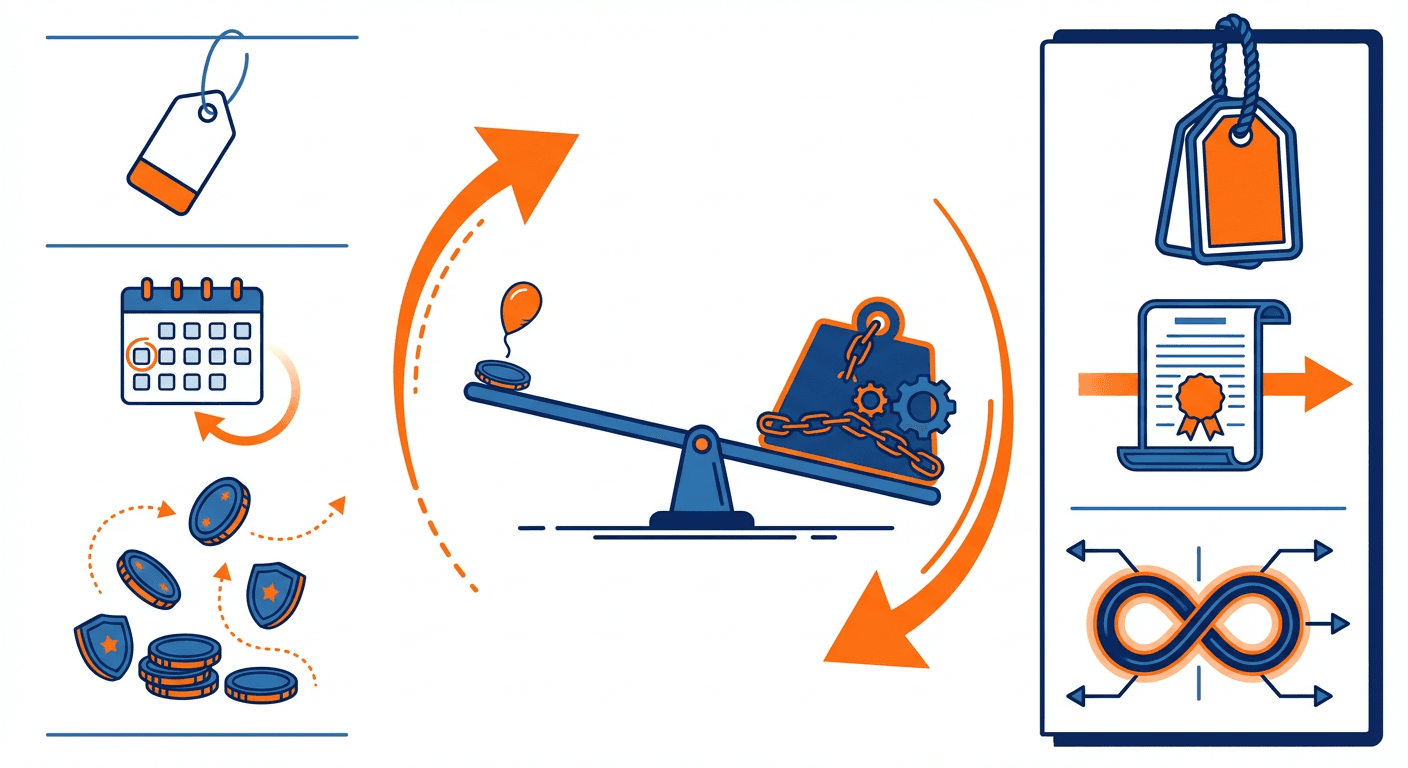
Entry cost comparison: Lusha Pro at $36/month equals $432/year per user. A single ZoomInfo Professional license typically starts around $15,000/year, representing a 35x difference.
Team scaling: A 5-person team on Lusha Pro costs approximately $2,160/year. The same team on ZoomInfo would likely cost $30,000+ annually depending on per-seat pricing.
Contract flexibility: Lusha offers monthly billing with no long-term commitment required on standard plans. ZoomInfo requires annual contracts, creating a larger upfront commitment.
Free tier comparison: Lusha provides 50 credits monthly on the free tier. ZoomInfo does not offer meaningful free access for ongoing use.
For budget-conscious teams: The math is straightforward. Lusha costs a fraction of ZoomInfo while providing core contact data functionality. The question is whether advanced ZoomInfo features justify the premium.
For enterprise organizations: ZoomInfo's higher pricing includes capabilities (intent data, technographics, org charts) that may generate sufficient ROI to justify the investment. Organizations with six-figure sales technology budgets often view the cost as reasonable for comprehensive intelligence.
Feature Comparison
Lusha Features
Browser Extension The core product. Install the extension, browse LinkedIn or company websites, click to reveal contact information. The workflow is simple and requires no training.
Bulk Enrichment Upload CSV files and enrich contact lists in bulk. Useful for list building and database cleanup.
Direct Dials and Emails Focus on the most valuable contact data points for sales outreach. Data quality emphasizes accuracy over quantity.
CRM Integrations Native connections to Salesforce, HubSpot, Pipedrive, Zoho CRM, and Microsoft Dynamics 365. Contacts push directly to your CRM from the extension.
Team Management Coordinate credit usage across team members. Monitor usage and allocate credits based on role requirements.
GDPR Compliance Built with European data protection requirements in mind. Data practices emphasize consent and compliance.
ZoomInfo Features
Comprehensive Database 600M+ professional profiles with extensive phone number coverage (135M+ verified phones). One of the largest B2B databases available.
Intent Data Track buying signals across thousands of topics. Identify accounts actively researching solutions in your category. Prioritize outreach based on demonstrated interest.
Technographics See which technologies companies use. Target accounts based on tech stack compatibility or competitive displacement opportunities.
Org Charts Map organizational hierarchies to understand reporting structures. Identify decision-makers and buying committees more effectively.
Website Visitor Tracking Identify anonymous website visitors and match them to companies and contacts. Capture demand that would otherwise go untracked.
Sales Automation Build workflows that automate prospecting tasks. Trigger actions based on intent signals or data changes.
Integrations Connect to Salesforce, HubSpot, Microsoft Dynamics 365, Outreach, SalesLoft, and other major platforms in the sales stack.
Feature Comparison Table
| Feature | ZoomInfo | Lusha |
|---|---|---|
| Database size | 600M+ profiles | Smaller, undisclosed |
| Verified phone numbers | 135M+ | Yes (quantity undisclosed) |
| Browser extension | Limited | Yes (core product) |
| Intent data | Thousands of topics | Limited (Premium tier) |
| Technographics | Yes | Limited (Premium tier) |
| Org charts | Yes | No |
| Website visitor tracking | Yes | No |
| Free tier | No meaningful access | 50 credits/month |
| Monthly billing | No | Yes |
| Annual contract required | Yes | No (except Scale) |
| CRM integrations | Yes | Yes |
| GDPR compliance | Yes | Yes |
Use Case Recommendations
Best Fit for Lusha
Individual sales reps: The browser extension supports individual prospecting workflows without requiring team-wide platform adoption. The free tier allows testing before purchase.
Startups and small teams: Affordable pricing makes quality contact data accessible. No need to justify enterprise-level budgets.
LinkedIn-centric prospecting: The extension integrates seamlessly with LinkedIn browsing. Find prospects, reveal contacts, and move on without switching tools.
Budget-conscious organizations: Access B2B contact data at a fraction of enterprise platform costs. Focus budget on outreach tools or other investments.
Where budget-conscious teams want another lightweight comparison, the Seamless.AI and SignalHire comparison contrasts real-time contact search against verified data with a browser extension.
Since Lusha often complements rather than competes with adjacent tools, the Gong and Lusha comparison explains how a sales engagement platform and a contact enrichment tool fit different workflow stages.
Simple use cases: If you need emails and phone numbers without advanced analytics, Lusha provides that core functionality efficiently.
Flexible commitments: Monthly billing allows scaling up or down based on current needs. No annual lock-in on standard plans.
Best Fit for ZoomInfo
Enterprise sales organizations: Comprehensive data and support infrastructure designed for large team deployments. Dedicated implementation assistance and account management.
Intent-driven selling: Thousands of intent topics help identify accounts actively researching solutions. Prioritize outreach to engaged prospects.
Phone-heavy outreach: Extensive verified phone number coverage (135M+) supports call-centric sales motions. Direct dials reduce gatekeeping friction.
Account-based marketing: Org charts, technographics, and company insights support sophisticated ABM strategies. Build targeted campaigns based on account intelligence.
Tech stack targeting: Technographic data enables targeting based on current tools. Identify competitive displacement opportunities or complementary technology users.
Website visitor monetization: Convert anonymous traffic into actionable leads by identifying visiting companies and contacts.
Established sales tech stacks: Integrates with enterprise platforms like Salesforce, Outreach, and SalesLoft. Fits into complex multi-tool workflows.
Data Quality Considerations
Data quality in B2B databases varies due to inherent challenges: professionals change jobs, companies restructure, and contact information evolves constantly.
Lusha's approach: Community-contributed data with real-time updates. When users validate or report incorrect information through the extension, the database improves. The GDPR-compliant approach emphasizes consent-based data collection.
ZoomInfo's approach: Dedicated research teams and automated verification processes. The higher price point funds ongoing data quality investments. Regular refresh cycles update records across the database.
Practical reality: Neither platform achieves perfect accuracy. Build verification into your workflow regardless of data source. Use email verification tools, monitor bounce rates, and clean lists regularly.
Integration Ecosystem
Lusha Integrations
- CRMs: Salesforce, HubSpot, Pipedrive, Zoho CRM, Microsoft Dynamics 365
- Email: Gmail, Outlook
- Sales tools: Outreach, SalesLoft
- Automation: Zapier, Make, n8n
- API: Available for custom integrations
ZoomInfo Integrations
- CRMs: Salesforce, HubSpot, Microsoft Dynamics 365
- Engagement: Outreach, SalesLoft
- Marketing: Marketo
- Advertising: LinkedIn Ads
- API: Comprehensive API for custom workflows
Integration Comparison
Both platforms cover major CRM integrations. ZoomInfo offers deeper integration with enterprise marketing and advertising platforms. Lusha provides broader automation tool connectivity (Zapier, Make, n8n) for non-enterprise workflows.
Implementation and Adoption
Getting Started with Lusha
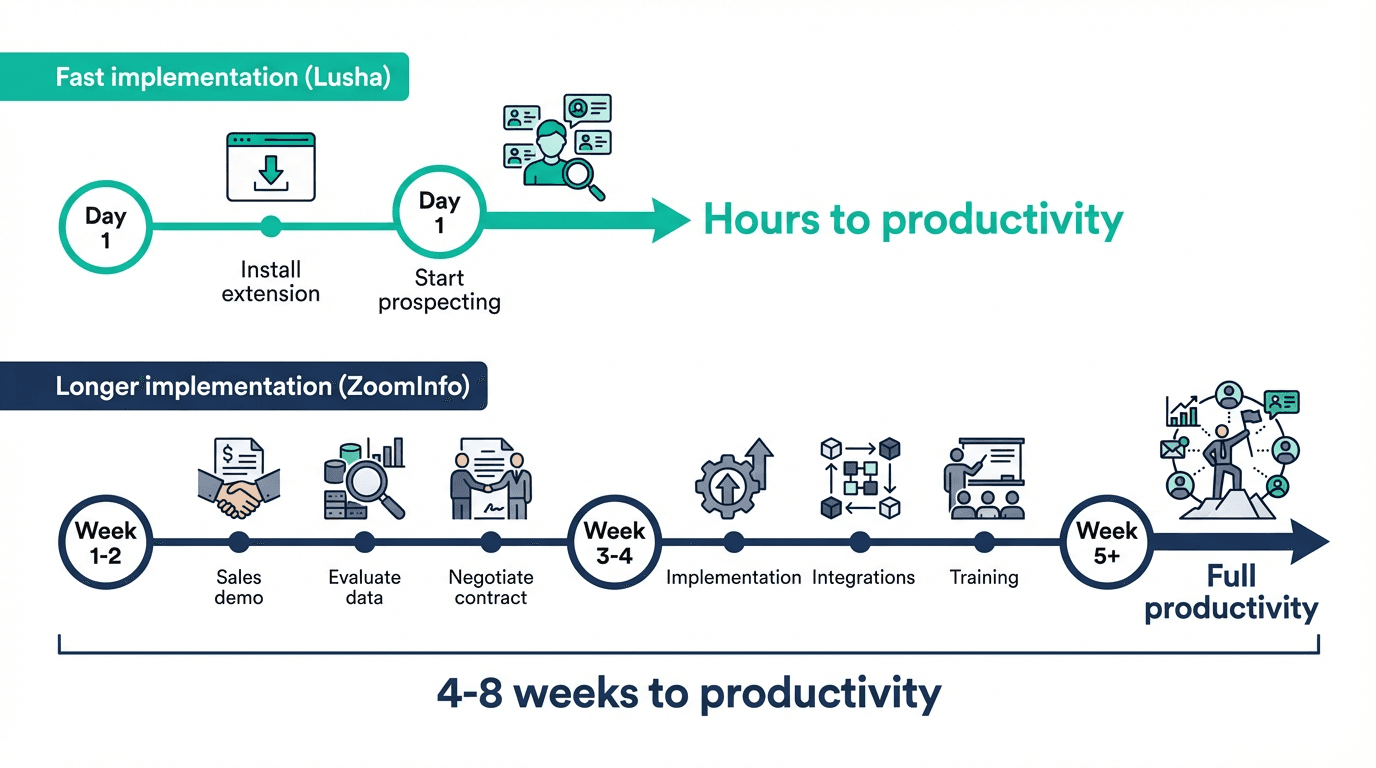
Day 1: Setup
- Create account (free or paid)
- Install browser extension
- Connect CRM integration
- Test contact reveal on a few prospects
Week 1: Regular Use
- Incorporate into daily prospecting
- Set up team if applicable
- Configure auto-save to CRM
- Monitor credit consumption
Lusha's simplicity means rapid time-to-value. Most users become productive within hours of installation.
Getting Started with ZoomInfo
Pre-purchase: Evaluation (2-4 weeks)
- Request demo from sales team
- Evaluate data coverage in your target market
- Test intent signal relevance
- Negotiate contract terms
Post-purchase: Implementation (2-4 weeks)
- Work with implementation team on integrations
- Configure intent alerts and workflow automation
- Train team on platform capabilities
- Establish processes for data hygiene
ZoomInfo requires more upfront investment in setup and training. The payoff is access to advanced capabilities once implementation is complete.
When to Use Both Together
Many organizations use Lusha and ZoomInfo for different purposes:
Lusha for: Quick contact lookups during manual prospecting, individual rep needs, budget-sensitive initiatives
ZoomInfo for: Comprehensive account research, intent-driven campaigns, enterprise ABM programs
The tools can complement rather than replace each other. Lusha's accessibility and ZoomInfo's depth serve different moments in the prospecting workflow.
Making the Decision
Choose Lusha if:
- Budget is a primary consideration
- You need simple contact data without advanced analytics
- Your team does LinkedIn-centric prospecting
- Monthly flexibility matters more than comprehensive features
- Individual reps need autonomous tools
- You are testing demand before scaling
Choose ZoomInfo if:
- Budget supports enterprise-level investment
- Intent data and technographics drive meaningful pipeline impact
- Phone outreach is a core sales motion
- Account-based strategies require comprehensive intelligence
- Website visitor identification creates measurable value
- Your organization has dedicated sales operations resources for implementation
Final Thoughts
ZoomInfo and Lusha serve different segments of the B2B data market. The choice depends primarily on budget, use case complexity, and required capabilities.
Lusha delivers: Accessible pricing, simple workflow, browser extension convenience, monthly flexibility, core contact data functionality
ZoomInfo delivers: Maximum database coverage, intent intelligence, technographic insights, org charts, website visitor tracking, enterprise support
For most small to mid-sized teams, starting with Lusha makes practical sense. The low cost of entry allows testing data quality in your specific market before committing significant budget. Teams that require ZoomInfo's advanced capabilities and can justify the investment will find value in the comprehensive platform.
For enterprise organizations with established sales operations, ZoomInfo provides depth that lighter tools cannot match. Intent data, technographics, and workflow automation create compounding value for sophisticated sales motions.
The platform you choose matters less than how effectively you use the data. Accurate targeting, relevant messaging, and consistent follow-up drive results regardless of data source. Start with the option that fits your current situation, then evaluate as your needs evolve.
Related Reading
- Lusha vs Clearbit: Sales Prospecting Tool vs Marketing Enrichment Platform
- ZoomInfo vs Clay: Enterprise Data Platform vs Data Orchestration Tool
- Clay vs Lusha: Which B2B Data Enrichment Tool Should You Use?
If you would rather have this run for you, RevenueFlow books qualified meetings on a pay-per-meeting basis and publishes client results.
Pricing and features verified as of January 2026. Visit official websites for current information.
Frequently asked questions.
Frequently asked questions- What is the main difference between ZoomInfo and Lusha?
- ZoomInfo is an enterprise sales intelligence platform with comprehensive database coverage, intent data, technographics, and workflow automation. Lusha is a lightweight prospecting tool built around a browser extension for quick contact reveals while browsing LinkedIn or company websites. ZoomInfo serves enterprise organizations with substantial budgets, while Lusha targets individual reps, small teams, and startups seeking affordable access to contact data.
- How much does ZoomInfo cost compared to Lusha?
- ZoomInfo Professional typically costs $15,000-25,000 per year with required annual contracts, while Lusha Pro costs $36 per user per month ($432/year) with monthly billing available. This represents approximately a 35x price difference at entry level. For a 5-person team, Lusha Pro costs around $2,160 annually versus $30,000+ for ZoomInfo.
- Does Lusha offer a free plan?
- Yes, Lusha offers a free tier with 50 credits monthly and basic extension access. ZoomInfo does not offer meaningful free access for ongoing use. The free Lusha tier allows individual sales reps to test the platform and access limited contact data without any financial commitment.
- How do the database sizes compare between ZoomInfo and Lusha?
- ZoomInfo maintains 600M+ professional profiles and 135M+ verified phone numbers with extensive direct dial coverage. Lusha's proprietary database is smaller but maintains strong coverage for common industries and job titles. The database size difference becomes more relevant when targeting smaller companies, niche industries, requiring comprehensive phone coverage, or building large prospect lists across diverse segments.
- Which platform should I choose for a small sales team?
- For small teams and startups, Lusha typically offers better value with its $36/month Pro plan, no annual commitment, and 50 free monthly credits. It provides adequate contact data for standard prospecting use cases like targeting sales leaders, marketing executives, or IT decision-makers at mid-market companies. ZoomInfo's higher pricing and required annual contracts make it less accessible for budget-conscious small teams.
About the author.

Tim Carden is CMO / CTO at RevenueFlow, which builds and operates outbound revenue engines for B2B companies. Studied at McGill University.
Tim Carden · CMO / CTO
Connect on LinkedIn →Explore more.
Ready to scale your outreach?
We build GTM engines that book real meetings. See the receipts.
Related articles.
Cognism vs Upcell: A Data Provider Against a Data Layer
Cognism sells compliance-first contact data by quote and credit; Upcell sells a layer that runs your providers, Cognism included, through one record. Read 18 Sep 2026.
PromptLoop vs ZoomInfo: Web Research Against a Database
PromptLoop builds a dataset from the live web in credits it publishes; ZoomInfo sells access to a maintained database by quote. Both pages read 18 September 2026.
Metadata vs 6sense: Paid Media Execution vs Intent
Metadata runs paid B2B campaigns through seven AI agents; 6sense ranks accounts on intent and sells contact data by credit. Neither publishes a rate. Read 18 Sep 2026.
Chili Piper vs LeanData: Form-First Against CRM-First
Chili Piper publishes a seat floor and bundles scheduling and chat; LeanData prices by Salesforce object and sells scheduling separately. Both read 18 September 2026.
Zoom Revenue Accelerator vs Gong: An Add-On vs a Platform
Zoom's support centre documents Revenue Accelerator as a licence on a Zoom account in two classes; Gong sells a platform per user plus a platform fee. Neither has a rate.
Mailshake vs Pipedrive: A Sender and a CRM, Side by Side
Mailshake sells per-user sending with a two-way Pipedrive sync from its middle tier; Pipedrive is a per-seat CRM with sequences from Growth. Both read 18 September 2026.