Appointment Setting for Security Companies: Licence, Then Meeting
For guard, patrol, monitoring and integration companies: the two contract forms, state licensing as the first qualification, contract and bid timing, and three openers.
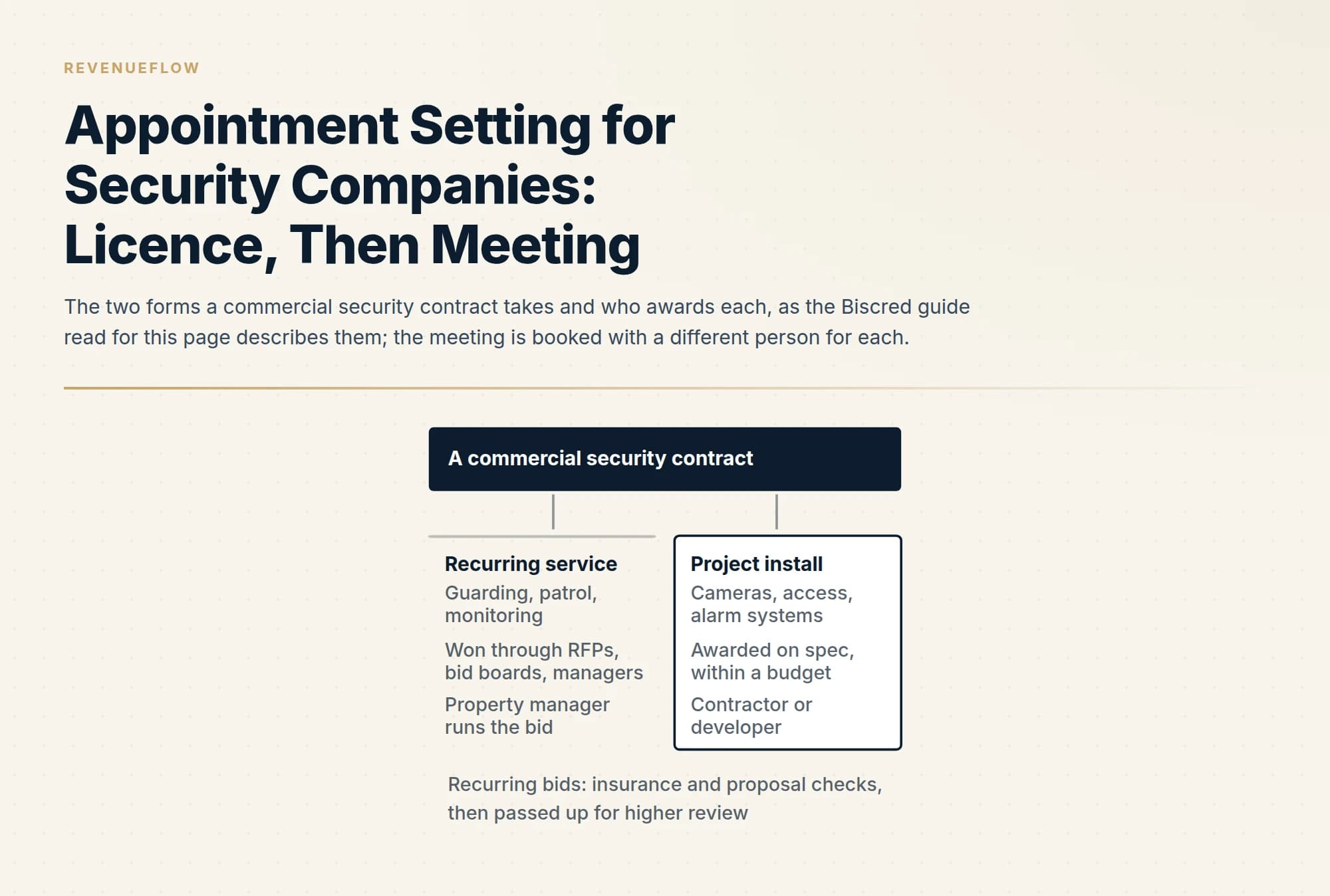
A physical security company books one of two meetings, with a property manager for recurring service or with a contractor for an install, and the buyer's first questions are the state licence, the liability certificate and officer training. Put those in the message, ask the contract term or the award date, and skip properties mid-term or outside the licensed states.
Key takeaways
- Biscred describes recurring security agreements won through RFPs, bid boards and project management firms and installs awarded by contractors on specification, timeline and cost, with property managers, developers and general contractors as the decision makers.
- California's private patrol operator fact sheet requires a licensing exam, DOJ and FBI background checks, a qualified manager and general liability insurance with minimum limits of one million dollars per occurrence, filed with the board.
- The Stateline report of 13 November 2015 recorded 41 states plus DC licensing security officers with requirements ranging from 48 training hours in Alaska to four in South Carolina, and 22 states with no training rule for unarmed guards.
- Abstrakt's callers qualify on whether the prospect has a firm now, how long the contract runs, coverage gaps, square footage and the patrol type; a property mid-term with no gap is the wrong meeting.
Reviewed and updated September 18, 2026
Appointment Setting for Security Companies: Licence, Then Meeting
A guard company wins a meeting with the property manager of a six-building office portfolio. The manager's first three questions are whether the company holds the state licence, what its liability certificate says and how many hours of training its officers have. The company has all three answers, but the meeting spends its first twenty minutes on them because the message that booked it never mentioned any of them. The incumbent, which has been on site for nine years, never has to answer those questions again.
This page is for the physical and managed security services company: guard and patrol firms, alarm and monitoring providers, and systems integrators selling to businesses and institutions. The search results for the phrase split between that reader and cybersecurity vendors, and the cyber side already has its own pages, cybersecurity lead generation among them, so this page serves only the physical and managed security seller and says so. Selling into security companies runs the other way and is covered by cold email for security services. Every fact below was fetched on 18 September 2026 from state regulators, the industry's associations and the vendors that book its meetings.
Who buys security services, and in what form
Biscred, a commercial real estate data vendor, published a guide on 14 August 2026 to winning commercial security contracts that describes the two forms a contract takes. Recurring service agreements, guarding, patrolling and monitoring, are won through requests for proposal, bidding boards or vendors consolidated through project management firms, with stakeholders evaluating proposals, checking insurance and proposal requirements and passing them up for higher review. Project-based work, such as a security system installation, is awarded by a general contractor or developer on the firm's ability to meet the specifications within a budget. Both forms, it says, face the same commercial real estate decision makers: project managers, developers, general contractors and property managers. It adds that a regional or national contract will likely go through many gatekeepers, making the sales cycle feel slow.
Abstrakt, an appointment vendor, wrote on 8 October 2025 that security is a trust-based, consultative sale, that facility managers, property owners and event coordinators are not making snap decisions, and that they need assurances about reliability, licensing, scalability and response times. Its definition of a qualified security lead is a property manager with multiple buildings that require night patrol service in your metropolitan region; a single request from a small shop outside your geography is not one.
The meeting a security company books is therefore one of two meetings. For recurring service it is with the property manager or facilities lead who will run or influence the bid. For an installation it is with the contractor or developer writing the specification. The vendors and the buyers agree on the qualifying questions, and Abstrakt lists the ones its callers ask: whether the prospect has a security firm now, how many years or months the contract runs, what gaps or concerns exist in current coverage, how much square footage or how many locations are covered, and what type of guard coverage or patrol is required.
The licence is the first qualification, on both sides
Security is one of the few services where the seller's own licence is the buyer's first question, and the licence regime differs by state. The California Bureau of Security and Investigative Services licenses the alarm, locksmith, private investigator, private security services and repossession industries, and its private patrol operator fact sheet sets out what a guard company must hold: a passed licensing examination, a criminal history background check through the state Department of Justice and the FBI for each applicant, partner or corporate officer, a designated qualified manager who runs the business day to day, and commercial general liability insurance with minimum limits of one million dollars for any one loss or occurrence, evidenced by a certificate of liability insurance filed with the Bureau. The Bureau's home page notes fee changes effective 1 October 2025. The Texas Department of Public Safety regulates the private security profession in that state and conducts fingerprint-based background checks on applicants; the Florida Department of Agriculture and Consumer Services runs private security licensing there.
The variation is the point, and the industry's own voices say so. A Stateline report published by Governing on 13 November 2015 recorded that forty-one states plus the District of Columbia license security officers but that requirements vary greatly, with Alaska mandating 48 hours of initial training and South Carolina four; that nine states did not license security officers at the state level; and that 22 states had no training requirements for unarmed guards. It quoted Steve Amitay of the National Association of Security Companies on about 90 bills a year on licensing and training, and a John Jay College professor calling the regime a hodgepodge. The report is a decade old and is cited here for the structure it describes, which the state pages above still show, rather than for its counts.
For appointment setting the consequence is direct. The licence number, the qualified manager, the insurance certificate and the officer training standard belong in the first message, because they are what the property manager will ask about and what the incumbent no longer has to prove. ASIS International, which describes itself as a global community of more than 34,000 security professionals, runs the Certified Protection Professional and Physical Security Professional certifications that property and facilities managers recognise; the Electronic Security Association publishes a state licensing guide and describes an initiative to introduce the SECURE Act in state legislatures. Those are the credentials a message can carry.
Timing: contract terms, bid boards and the insurance renewal
Security contracts run on terms, and Abstrakt's callers ask how many years or months the current one has left because a property mid-term cannot switch. Public and institutional buyers run the recurring service through solicitations: Arizona State University's business and finance site, for example, carries a page for unarmed security services under its purchasing section, and Biscred describes bidding boards and RFPs as the route for recurring agreements. A meeting with a public buyer is therefore about the next solicitation, and the useful question is when the current award expires.
There is a third clock. Biscred's guide, citing a Marsh McLennan Agency real estate risk report for 2026, states that insurers weigh a commercial property's lighting, cameras and security protocols in a crime score that affects rates and coverage, so an owner or property manager may be incentivised to update security to lower insurance costs. That is the insurer's report relayed by a data vendor and is recorded as such, but the mechanism is a timing signal a security company can use: a property's insurance renewal is a month in which its security arrangements are being priced by somebody else.
The rules that reach the message itself
Two sets of rules touch outreach from a security company. The licensing regime above is the first, and it reaches the message because a firm soliciting business in a state where it holds no licence is soliciting work it cannot lawfully perform; the state boards' pages are the reference, and this is not legal advice. The second is the general outreach law. The Federal Trade Commission's Telemarketing Sales Rule guide lists business-to-business solicitation calls among its exemptions, unless they involve the sale of nondurable office or cleaning supplies, and its CAN-SPAM guide requires accurate headers, an honest subject line, a physical address and an opt-out honoured within ten business days, holding both the company promoted and the company sending responsible. A security company's physical address and licence number sit naturally in the same footer.
What the buyers and the vendors say gets in the way
The objections are in the sources' own words. Abstrakt says decision makers are busy, bombarded with dozens of calls and emails each week, and that a good programme navigates around tire-kickers and information-shoppers. Biscred's guide, citing a 2025 market growth report, says 56 percent of the private security market share was held by the top five companies, that 45 percent of the market sits in dense urban centres, and that 70 percent of demand comes from commercial buyers; those are the report's figures relayed by the vendor. Its own observation is that winning bids is difficult for a company that wants to grow beyond referrals and incumbent contracts, and that a lucrative regional contract will pass through many gatekeepers.
Read as objections to a meeting request, those are three things. The buyer has an incumbent, often a large one, and the switch has to be worth the disruption. The buyer has heard from a dozen firms this week and none of them named the licence or the term. And the buyer cannot decide alone, so the meeting is the start of a process, which the request should say.
- Yes: State licence number and the licensing board it was issued by
- Yes: Named qualified manager and the officer training standard used
- Yes: Liability certificate at the state minimum or above
- Yes: Service form named: recurring guard or patrol, or a specified install
- Yes: A question about the current contract term or the next solicitation
- No: A claim about response times without the coverage area named
Channel reality, and when this is the wrong play
The vertical's appointment vendors are phone-led and say so. Abstrakt calls the phone still the most immediate and effective tool, uses email to demonstrate credibility with licences or case studies, and uses LinkedIn for rapport in commercial real estate and facilities management. That is the vertical's reality and it is described here as such. Our own motion is email and LinkedIn, one message per campaign, no bump sequences and no second LinkedIn message under an ignored one, and the reason it fits this vertical is that the credentials a phone call has to promise are the attachments a written message can carry.
Appointment setting is the wrong play when the property is mid-contract with no known gap, because the switch cost is the incumbent's advantage and no meeting changes the term. It is the wrong play in a state where the company holds no licence, because there is nothing lawful to sell. It is the wrong play for a public buyer with an open solicitation, because the proposal is the meeting. And it is the wrong play when the target is outside the serviceable region or the client base the company can staff, which is the single shop outside the metro area that Abstrakt's own qualification rejects. The comparison of vendors and models is in B2B appointment setting companies and appointment setting services and applies here unchanged.
To the property manager of a multi-building office portfolio
We hold the state private patrol licence and file a liability certificate at the required minimum with the board each year; both are attached. If your night patrol contract has less than a year to run, twenty minutes on what your buildings need after hours is worth it; if not, tell us the month and we will write then. 1
To the facilities director of a hospital
Our officers train to a published hour standard above what this state requires for unarmed guards, and the training log is available to your compliance office. Is unarmed coverage something you buy through a solicitation, and when does the current award expire? 2
To a general contractor on a new distribution centre
Your project listing shows a warehouse with a spring completion. We install and monitor access and camera systems to specification and can price against the spec before it is issued; who on your team owns the security section of it? 3
- 1Built on the licensing and insurance requirements the California fact sheet sets out, and on the contract-term question Abstrakt's callers ask first.
- 2Built on the training-hour variation Stateline described and the solicitation route public buyers use; the ask is the award date.
- 3Built on Biscred's description of project work awarded by a contractor on specification, timeline and cost; the ask is who writes the section.
Each carries a credential, names the service form, makes no results claim and asks a question the buyer alone can answer. One message per campaign; a new term-end date or a new solicitation is a new premise and a new campaign.
Running it
Build the list inside the licensed states and the staffable radius first, because everything outside them is unsellable however good the fit. Split it by service form, recurring versus install, since the buyer and the route differ. Attach the licence, the qualified manager, the insurance certificate and the training standard to every message. Ask the term or the award date before asking for a meeting. The general framework for what a vendor should deliver is in B2B appointment setting and applies without change.
If the constraint is building that licensed, dated list and getting the first message out, RevenueFlow books qualified security meetings on a pay-per-meeting basis, by email and LinkedIn, with the credential and term criteria agreed in writing before launch.
Licensing requirements per the California Bureau of Security and Investigative Services private patrol operator fact sheet and home page, the Texas Department of Public Safety and the Florida Department of Agriculture and Consumer Services; state variation per the Stateline report published by Governing on 13 November 2015; association descriptions per ASIS International and the Electronic Security Association; contract forms and market figures per Biscred, 14 August 2026; qualification questions per Abstrakt, 8 October 2025; outreach rules per the FTC's Telemarketing Sales Rule and CAN-SPAM guides. All fetched 18 September 2026. Confirm each state's current requirements on its board's own pages before relying on them.
Sources: Private Patrol Operator or Qualified Manager Factsheet, California BSIS, Bureau of Security and Investigative Services, Private Security, Texas Department of Public Safety, Private Security Licensing, Florida FDACS, Many States Barely Train Security Guards, Governing, ASIS International, Electronic Security Association, Unarmed security services, Arizona State University, How to Find and Win Commercial Security Contracts, Biscred, Appointment Setting for Security Services, Abstrakt, Complying with the Telemarketing Sales Rule, FTC, CAN-SPAM Act Compliance Guide, FTC
Frequently asked questions.
Frequently asked questions- Who does a security company book meetings with?
- It depends on the contract form. Biscred's guide describes recurring guard, patrol and monitoring agreements won through RFPs, bid boards or project management firms, where the property manager or facilities lead runs or influences the bid, and project installs awarded by a general contractor or developer on specification, timeline and cost. Abstrakt names facility managers, property owners and event coordinators as the buyers who need assurances on licensing and response times.
- What should a security company put in its first message?
- The things the buyer will otherwise ask in the meeting: the state licence number and board, the qualified manager, the liability certificate, which California's fact sheet requires at one million dollars per occurrence, the officer training standard, and the service form. Then one question about the current contract term or the next solicitation, because a property mid-term cannot switch whatever the message says.
- How do state licensing rules affect security sales outreach?
- A firm can only sell what it is licensed to perform, and licensing differs by state: the 2015 Stateline report counted 41 states plus DC with officer licensing, nine without, and training rules from 48 hours to none. Build the target list inside the licensed states and check each board's current page, since California, for example, changed its fees on 1 October 2025. This is a summary, not legal advice.
- When is appointment setting the wrong play for a security company?
- When the property is mid-contract with no known gap, when the company holds no licence in the target state, when a public buyer has an open solicitation that schedules its own meetings, and when the target sits outside the region and client base the company can actually staff, which is the single shop outside the metro area that the vendor's own qualification rejects.
About the author.

B2B cold email experts helping companies generate qualified leads through done-for-you outreach campaigns.
RevenueFlow Team
Explore more.
Ready to scale your outreach?
We build GTM engines that book real meetings. See the receipts.
Related articles.
Appointment Setting for 3PL Companies: Fit Before the Calendar
For 3PLs, warehousing operators and brokers wanting shipper meetings: the five fit gates, the bid calendar, contract terms, the trade's rules and three openers.
Appointment Setting for Food Distributors
How a foodservice distributor opens accounts its routes do not reach: independents, chains and institutions, the FDA traceability rule as the opener, the DSR handoff.
Merchant Services Cold Calling Scripts: The Honest Version
Six call scripts for merchant services agents and ISO reps, built around what the FTC alleged about this exact call: no affiliation claim, no rate before a statement.
LinkedIn Outreach for Machine Shops
How a job shop or CNC machine shop uses LinkedIn to win OEM work: the four buyer titles, the RFQ gate, the ISO, AS9100 and ITAR facts, and LinkedIn's own rules.
Lead Generation for Telecommunications Companies: Four Lead Sources
For carriers, ISPs, UCaaS providers and MSPs: the installed base, the advisor channel, dated outbound and the funded network map as lead sources, with FCC rules.
Sales Outsourcing for SaaS Companies: What to Hand Over
For SaaS companies weighing an outside sales team: what the industry's own survey found, what a third party cannot hold in a software sale, and what can go out.