Cold Calling for Accounting Firms: Rules, Timing and Fit
How cold calling works for accounting firms: the AICPA and state board solicitation rules, the IRS calendar as call timing, the incumbent objection and fit.
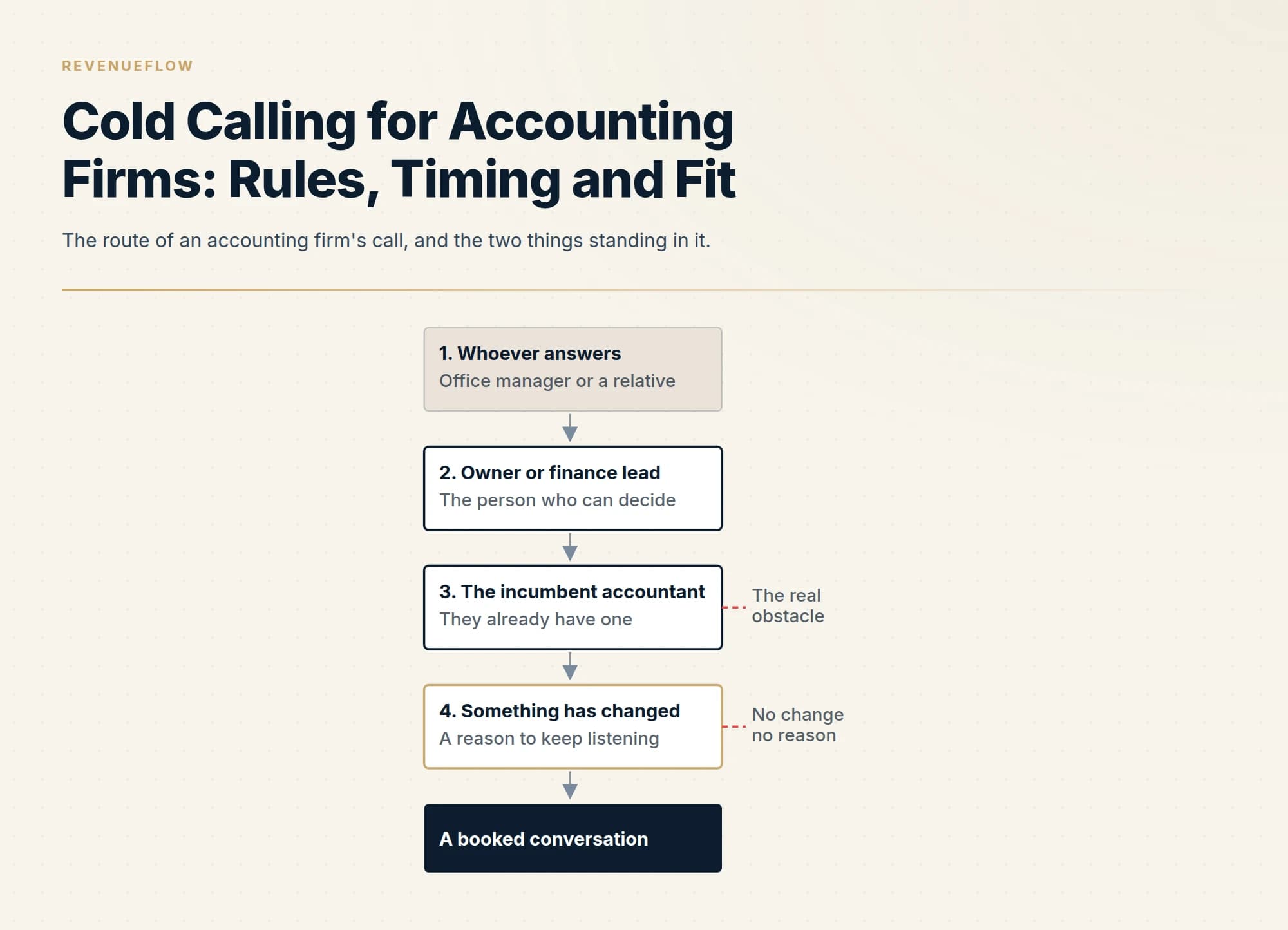
Cold calling can work for an accounting firm when the call names something that has changed at the business, because nearly every prospect already has an accountant. The AICPA code and state board rules regulate how a firm solicits: truthfully, without harassing conduct, and not again after a refusal. Call in the weeks after IRS deadlines.
Key takeaways
- AICPA rule 1.600.001 bars solicitation that is false, misleading or deceptive, and prohibits coercion, over-reaching or harassing conduct.
- Texas board rule 501.82 treats a telephone conversation as direct personal communication and makes persisting after a refusal a violation.
- IRS Publication 509 puts a partnership return on the 15th day of the third month after the tax year ends, with a six month extension, so the weeks after a deadline are the calling windows.
- The most common objection is an existing accountant, so the call should open on a changed circumstance or a specialist piece of work.
Reviewed and updated September 18, 2026
A partner at a small accounting firm blocks out a Tuesday morning in early March, opens a list of local businesses and starts dialling. By eleven she has reached four owners. All four were polite, all four said they already have an accountant, and two added that this was the worst week of the year to ask. The week, the list and the question were wrong.
This guide is for accounting firms, CPA practices and bookkeeping firms that want to call businesses to win clients. It covers what changes when the caller is an accountant: the professional rules that name a telephone conversation, the filing calendar that decides when a business will talk, who answers, the objection every call meets, and the cases where the phone is the wrong tool. It is a guide, so it carries one illustrative opener and no script collection. The general method, and the federal rules for any business call, sit on our pages about what cold calling is and which rules apply and where the B2B exemption stops.
Your call asks a business to replace someone
Most cold calls point at a gap. An accounting firm's call points at a relationship that already exists. The Growth Partnership, a consultancy that works with accounting firms, put it bluntly in a post dated June 30, 2025: "The business owner who just ignored your call? They probably already have an accountant." (The Growth Partnership, fetched September 18, 2026.)
That is the organising fact of this vertical. Our own page on accounting lead generation makes the longer argument that switching is rare and triggered by a change in circumstances, and we will not repeat it here. What it means for the phone is narrower. A call that asks an owner to review their accountant asks them to audit a working relationship for a stranger. A call that names something that has changed at their business gives them a reason to keep listening.
The route a call takes is short. At an owner-led business, the person who answers is rarely a trained screener. Our page on cold calling business owners describes that person as an office manager, a receptionist with other jobs, a family member or whoever was nearest, and explains why plain legibility works better there than gatekeeper technique. At a larger company the call is looking for a finance lead. Credfino's calling guide for accountants tells firms to identify decision makers such as chief financial officers, finance directors or business owners before dialling (Credfino, fetched September 18, 2026). In both cases the call then meets the incumbent, which is the obstacle the rest of the call has to deal with.
The profession has its own rules about this call
The federal telemarketing rules are the hubs' subject. What an accounting firm adds to them is a layer no software seller carries: a professional code, a state board and a Supreme Court case about exactly this activity. Nothing below is legal advice. It is what the pages say.
The AICPA code. The Code of Professional Conduct, in the edition marked as updated for all official releases through September 2026, contains the Advertising and Other Forms of Solicitation Rule, numbered 1.600.001. It reads: "A member in public practice shall not seek to obtain clients by advertising or other forms of solicitation in a manner that is false, misleading, or deceptive." The next sentence is the one a caller should know by heart: "Solicitation by the use of coercion, over-reaching, or harassing conduct is prohibited." (AICPA Code of Professional Conduct, fetched September 18, 2026.) The interpretation numbered 1.600.010 lists what counts as false, misleading or deceptive, including promotional efforts that create false or unjustified expectations of favorable results. It also says a member must not do through others what the member may not do directly, which matters to any firm that hires outside callers.
A state board rule. State boards of accountancy write their own versions, and some are more specific about the phone. The Texas State Board of Public Accountancy's advertising rule, 22 Texas Administrative Code section 501.82, defines direct personal communication as "Either a face-to-face meeting or a conversation by telephone." It bars any communication about professional services that is accompanied by coercion, duress, compulsion, intimidation, threats, overreaching, or vexatious or harassing conduct. It also makes it a violation to persist in contacting a prospective client who has made known a desire not to be contacted. (22 Tex. Admin. Code 501.82, as published by Cornell's Legal Information Institute, fetched September 18, 2026.) Texas is one example. Read the rule of the board that licenses you, and the rule of any state you call into.
Edenfield v. Fane. Florida once imposed a flat ban on CPAs engaging in "direct, in person, uninvited solicitation" of new clients. A CPA named Fane sued the Florida Board of Accountancy, and the Supreme Court decided the case on April 26, 1993. The syllabus prepared by the Court's Reporter of Decisions records the holding: as applied to CPA solicitation in the business context, the prohibition was inconsistent with the free speech guarantees of the First and Fourteenth Amendments. The syllabus also describes the person on the other end of such a conversation, in words worth quoting: "a CPA's typical prospective client is a sophisticated and experienced business executive who has an existing professional relation with a CPA". (Edenfield v. Fane, syllabus, Legal Information Institute, fetched September 18, 2026.)
Put the three together and the position is plain. The texts quoted here regulate the manner of a solicitation rather than the fact of one: truthful, not harassing, and finished when the person says stop.
| Text | What it says | What it means on a call |
|---|---|---|
| AICPA rule 1.600.001 | No false, misleading or deceptive solicitation. No coercion, over-reaching or harassing conduct. | Nothing false, misleading or deceptive. |
| Texas rule 501.82 | A telephone conversation is direct personal communication. Persisting after a stated wish not to be contacted is a violation. | When the owner says stop, the record says stop. |
| Edenfield v. Fane | A flat ban on CPA solicitation in the business context failed. | The texts here regulate manner, not the fact of calling. |
One boundary sits close to this vertical. An accountant calling an owner about the company's books is making a business call. The same accountant pitching that owner a personal tax return is offering something the person buys for their own use, and the FTC does not treat calls that solicit individuals at work for personal purchases as business-to-business. Many sole proprietors also answer on a mobile number, which brings in the statute that attaches to the number and the dialling technology. Both lines are drawn on our page about where the B2B exemption stops.
When a business will talk to an accountant
In this vertical the calendar is published by the IRS, and it applies to your prospects as much as to your own staff.
IRS Publication 509 for use in 2026 sets out the due dates. A partnership return on Form 1065 "is due on the 15th day of the 3rd month after the end of the partnership's tax year", and an S corporation return on Form 1120-S follows the same rule. Form 7004 and Form 4868 request an automatic 6-month extension. (IRS Publication 509, fetched September 18, 2026.) The publication adds that dates falling on a Saturday, Sunday or legal holiday move. Our page of cold calling scripts for accounting firms lays the rest of the dates out month by month; what matters for planning a calling list is the shape rather than the arithmetic.
The shape is two states, and the same business is a different prospect in each. In the fortnight before a filing date the owner is mid-transaction with the firm they have, and a call from a stranger competes with a deadline it cannot win against; your own people also have no capacity to take the meeting it might produce. In the weeks after, the owner has just watched the current firm work under pressure and knows whether the return was filed on time, whether the estimate arrived with notice, and whether anyone returned a call. That is the window our accounting lead generation page calls the one most firms miss. On the phone it means building the list in the quiet weeks, leaving it alone through the deadline, and calling once the returns are in.
The objection, and what practitioners say about it
Credfino's guide lists the objections an accountant should expect on a call, and the first is the owner saying they already have an accountant. It is usually true.
Practitioner advice in this vertical is sceptical of the cold version of the call and consistent about the fix. Build Your Firm, which sells marketing to accounting practices, writes that "It's just too difficult to provide enough information and create any trust from a cold call telemarketing pitch" and recommends a letter first and a call second that refers to it. The same page reports what firms said about outsourced calling programmes: "The people making the calls on behalf of the firm really don't know much about the firm". (Build Your Firm, undated, fetched September 18, 2026.) The Growth Partnership's version is research before the dial: whether the business recently expanded, is hiring or is relocating.
Both point the same way on the incumbent objection. Make the call about a circumstance the incumbent may not have covered, and ask a question the owner can answer in a sentence. A specialist piece of work is the easiest circumstance to raise, because it does not ask anyone to fire their accountant.
Three reasons to call that come from a source
Each of these is a checkable fact that gives a particular business a reason to hear from an accountant this month. The business names and the caller below are invented for illustration.
- A dated IRS notice that touches their trade. On September 15, 2026, in release IR-2026-110, the IRS announced an extension of tax relief for farmers and ranchers who sold or exchanged livestock because of drought. The release says Notice 2026-54 lists the qualifying areas, which include 49 states, and that eligible livestock generally must be replaced within a four-year period instead of the usual two-year period. (IRS newsroom, fetched September 18, 2026.) A firm with agricultural clients has a reason to call ranch businesses in a listed county.
- An extension deadline that has just passed. Publication 509 puts the extended due dates six months after the originals. A business that filed on extension has just finished a second round with its current firm.
- A visible expansion. The Growth Partnership's own example is a business that has just opened a second location, which raises multi-state questions the owner may never have faced.
Call to a ranch business in a county listed in Notice 2026-54
Good morning, this is Dana at Brackenmill Accounting, an accounting firm here in the county. 1
We are calling ranch businesses this week because on September 15 the IRS extended the drought relief for livestock sales. 2
One question: has anyone walked you through what that does to your replacement period? 3
If your accountant already has, that is a good sign and we will leave you to your day. 4
- 1Says who is calling and from what kind of firm, which is what the person who answers needs.
- 2The reason is a dated public fact from IRS release IR-2026-110, which the owner can check.
- 3A question about a decision, answerable in a sentence, with no claim about results.
- 4Accepts the incumbent instead of arguing with it, and ends the contact if the answer is yes.
When the phone is the wrong play for an accounting firm
When the caller is a partner. Our accounting lead generation page makes the point that the person who takes a first meeting is usually a fee earner. The same is true of the person dialling. An hour of partner time spent reaching four owners has a known alternative use, and the comparison is rarely kind to the phone.
When the caller is a stranger to the firm. Build Your Firm's report about outsourced programmes is the practitioners' own warning, and the AICPA interpretation makes the firm responsible for what is said on its behalf, because a member must not do through others what the member may not do directly. An outsourced caller who cannot answer a question about your service lines is a cost with a professional risk attached.
When the list is large and the accounts are small. Owner-led businesses are numerous and individually modest, which is the hardest shape for a channel that spends a person per attempt. Written outreach covers that volume and keeps a record of exactly what was claimed, which a regulated profession may value. We compare the two channels in how email and calling each fail.
In the fortnight before a filing date. The calendar above is a list of weeks to stay off the phone as much as weeks to be on it.
RevenueFlow does not make cold calls for clients. We run email and LinkedIn, one message per campaign, and we say so here because calling advice from a firm that sells another channel should come with its position stated.
The short version
An accounting firm's call asks a business to replace someone, so it has to open on something that has changed. The profession's own texts, from the AICPA code to a state rule like Texas 501.82, regulate how you solicit: truthfully, without harassing conduct, and not again once the person declines. The IRS calendar says when owners are busy with the firm they have and when they have just finished. Call after the deadlines, about a circumstance, and accept the incumbent when it is doing its job.
If you would rather reach the same list in writing, see what a first campaign looks like.
Frequently asked questions.
Frequently asked questions- Are CPAs allowed to cold call for clients?
- The texts we fetched regulate how a CPA solicits more than whether one may. The AICPA code bars false, misleading or deceptive solicitation and harassing conduct. In Edenfield v. Fane in 1993, the Supreme Court held that Florida's flat ban on CPA solicitation in the business context was inconsistent with free speech guarantees. State board rules differ, so read the rule of the board that licenses you. This is not legal advice.
- When is the best time for an accounting firm to call businesses?
- The weeks after a filing deadline. IRS Publication 509 puts a partnership return on the 15th day of the third month after the end of its tax year, with forms 7004 and 4868 requesting an automatic six month extension. After a deadline an owner remembers clearly how the current firm performed under pressure, and your own staff have the capacity to take a meeting.
- How should an accountant answer when the owner says they already have an accountant?
- Accept it, because it is usually true. Practitioner advice in this field is to research the business first and call about a circumstance, such as an expansion or a dated IRS notice that affects their trade. A specialist piece of work is the easiest thing to raise, since it does not ask the owner to end a working relationship.
- Should an accounting firm outsource its cold calling?
- Be careful. Build Your Firm reports that firms using outside calling programmes found the callers knew little about the firm, and the AICPA interpretation says a member must not do through others what the member may not do directly. The firm stays responsible for what is said in its name, so any outside caller needs a short list and tight instructions.
About the author.

B2B cold email experts helping companies generate qualified leads through done-for-you outreach campaigns.
RevenueFlow Team
Explore more.
Ready to scale your outreach?
We build GTM engines that book real meetings. See the receipts.
Related articles.
Cold Calling for PPC Agencies: What You Can See First
A paid media prospect is partly readable before the call and has already been told by the platform what to do when a stranger rings about its ads.
Cold Calling for Chemical Companies: Who Picks Up
A chemical cold call rarely arrives first. It reaches a formulator who has already been comparing suppliers on a screen, for one of three published reasons.
B2B Lead Lists for Travel Agencies: Registers and Gaps
The travel trade is written down in state consumer protection registers, not industry directories, and an exemption inside one decides who is missing from your file.
Cold Calling for Manufacturers: The Desk and the Floor
Cold calling for a manufacturer calling plants and OEMs: who answers the main line, the buyer's desk against the floor, the show calendar, the channel map, the limits.
Cold Calling for Consulting Firms: The Partner's Hour
Cold calling for a consulting firm: who it dials and who picks up, why partner-led economics argue against the phone, the client's fiscal year, and when to skip it.
LinkedIn Lead Generation for Financial Services Firms
A LinkedIn message from a regulated firm is a communication the rulebook already defines, and the definition turns on how many people receive it within thirty days.