Cold Email Checker: What a Copy Score Cannot Tell You
A copy checker scores your draft against a rule library. It catches real structural defects, and the score is silent on where the message will land.
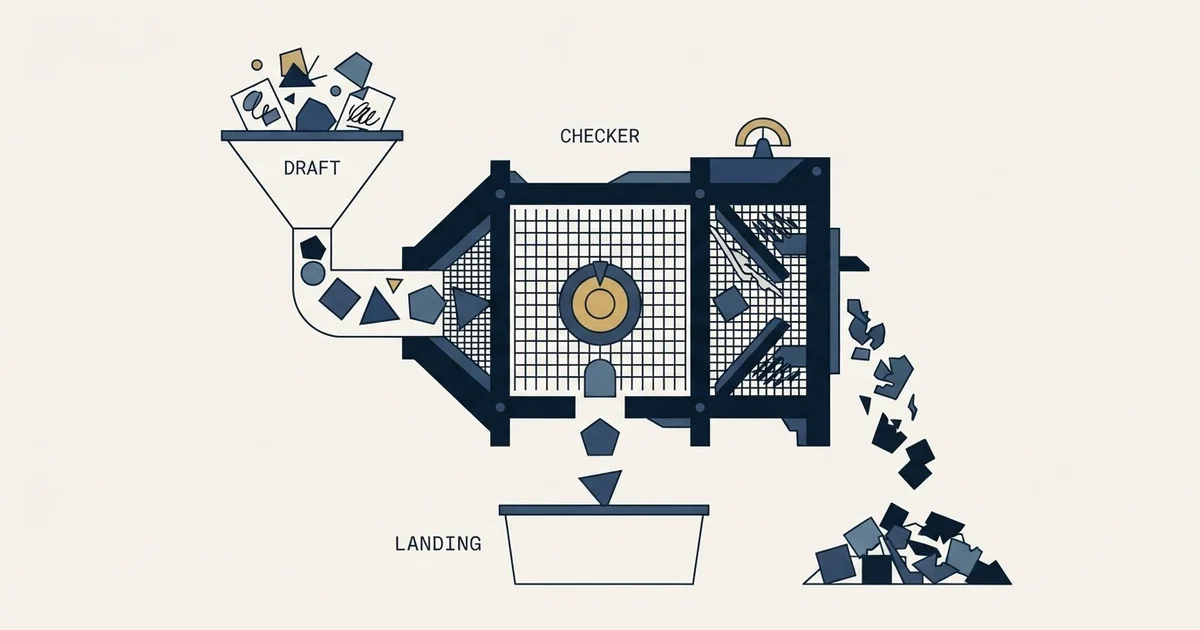
A cold email checker scores your draft against a rule library and returns flagged phrases. It reliably catches broken authentication, link and markup defects, a missing opt-out, and copy that has drifted into marketing register. It cannot see your sending domain's history, the list, or the recipient's own filter, so the score predicts nothing about placement.
Key takeaways
- A checker returns one rule engine's objection to your text, compared against a threshold that whoever configured the tool chose, so two tools scoring the same draft differently are both correct about their own setup.
- The findings worth acting on directly are broken authentication, an out of band link count, an image-only body, and a missing opt-out block.
- Swapping flagged words for synonyms while keeping the same promotional register moves the score and leaves the message no more likely to be delivered, while usually removing the specifics that earn a reply.
- Google's sender guidelines put the measurable target on spam rate reported in Postmaster Tools: keep it below 0.10% and avoid ever reaching 0.30%.
Reviewed and updated September 1, 2026
Cold Email Checker: What a Copy Score Can and Cannot Tell You
A draft goes into a free cold email checker and comes back with six flagged phrases and a mediocre score. Twenty minutes later the flags are gone, the score is green, and the email now opens with "I noticed your organisation is currently expanding its sales development function." The writer has traded a sentence a human would read for a sentence that satisfies a rule library, and the tool reported that as an improvement.
That trade is the main risk of running a copy checker, and it is worth understanding precisely, because these tools are free, fast, and genuinely useful for a narrow set of defects. The value is in knowing which part of the report to act on.
An email template spam checker is the same instrument under a different name, and the same limit applies: it reads the words in your draft, never the reputation of the domain sending them.
What you are actually shopping for
Search for a cold email checker and most of what comes back reads your message text and scores it. A smaller share of the category checks addresses instead, confirming whether a mailbox exists. Those are unrelated products that happen to share a name in the search results, and it is worth confirming which one a tool is before you paste anything into it. Everything below is about the first kind: paste a draft, get a number and a list of flagged tokens.
Most of them are free to use, which is roughly the right price for what they do, and it is also why the category is crowded with small tools nobody can tell apart. Pick one that will show you which individual tests fired rather than only a headline number, because the itemised list is where all the usable information is.
Mechanically these are rule engines. A library of narrow tests runs against the message, each test carrying a point value, and the total is compared against a threshold that whoever configured the tool chose. Spam score covers how that works and why the threshold is a configuration value rather than a property of your message, which is why the same email scores differently on two tools and both are correct about their own setup. Spam filter test separates this product from the other thing sold under a similar name, which samples a seed panel and reports where copies landed. This page is downstream of both, and treats the message-scoring half as what it is best at being: an editing tool.
What the flags genuinely catch

Dismissing the whole category would be wrong. There is a real list of defects a checker finds in seconds that a writer looking at their own draft for the fourth time will not.
Authentication that is broken or missing, where the tool also inspects your records rather than only your text. This is the highest-value item on any report a checker produces, because SPF, DKIM and DMARC are protocols with defined outcomes, so a pass at the tool is a pass at a real receiver too. The setup that keeps authentication passing is the fix, and it is worth doing on the tool's say-so without argument.
A link-to-text ratio that is out of band. Three links in a five-sentence cold email is a structural signal, and it is easy to arrive at without noticing when a signature, a calendar link and a case study all end up in the same message.
An image-only or markup-heavy body. Cold email that renders as a graphic has a specific problem, and a checker naming it saves a round trip.
A missing opt-out or suppression block. The tool is flagging an absence, and the absence is a compliance problem before it is a scoring problem.
Register drift on copy the writer has stopped being able to read. This is the underrated one. A rule library built from promotional bulk mail is, in effect, a detector for promotional register. When it fires heavily on a cold email, the useful reading is that the draft has drifted toward marketing voice, which is a real defect with a real cost. The flagged words themselves are usually beside the point. The number of them that fired is the signal.
What it structurally cannot see
The things that mostly decide where a cold email lands are not in the text of the message. The sending domain's history, the recipient organisation's own filtering configuration, the list's quality, and how recipients have engaged with previous mail from you are all outside the document being scored. A checker reading your draft has access to none of it.
Scaling outbound past what one domain can safely send raises the question of inbox infrastructure, and how flat-rate unlimited inboxes work explains what that pricing model actually includes.
Google's sender guidelines make the point in what they choose to publish: keep spam rates reported in Postmaster Tools below 0.10%, and avoid ever reaching 0.30%. That is a statement about recipient behaviour and domain history, and there is no way to test a draft against it. Spam complaint rate and sender reputation are the surfaces where that lives, and cold email spam rate benchmarks show what those readings look like across real campaigns. When inbox placement is genuinely broken, the diagnostic order in the cold email deliverability guide will find the cause faster than any number of passes through a copy checker.
This is also why running the same draft through two checkers produces two verdicts and no clarity. The tools hold different rule libraries and different thresholds, so a disagreement between them is a fact about their configurations. The useful move when it happens is to stop comparing the totals and look at which specific tests fired in both. A finding that appears twice is describing something about your message. A finding that appears once is describing one tool.
There is a second blind spot that is specific to cold outbound and easy to miss. A checker scores one rendering of one message. A campaign using spintax or merge fields renders differently for every recipient, so scoring one rendering certifies one rendering. Any defect that only appears in some combinations is invisible to the test by construction, which means the honest way to check variable copy is to enumerate the combinations yourself and read them, rather than to paste one and take the green tick.
The rewrite trap, worked

Here is the failure in full. The two drafts below are illustrative, and so are the score movements described alongside them: they are written to show the mechanism rather than copied from a run of a named tool.
The original, written by a person who had done the research:
Hi Sarah, saw you are hiring two SDRs in Manchester. We book qualified meetings for B2B teams and you pay per meeting, so there is no retainer to sign off. Worth fifteen minutes on Tuesday? If it is not relevant, reply stop and I will leave it there.
A rule engine has several objections to that. It reads a pricing claim, a time-bound call to action, and a couple of tokens that appear constantly in promotional mail. The score comes back middling. So the writer removes every flagged phrase:
Hello Sarah, I noticed your organisation is currently expanding its sales development function in the Manchester area. Our organisation provides services which may be of relevance in that context. Would you be open to a brief introductory conversation at a mutually convenient time?
The score improves. Everything that made the first version work is gone.
- Names the specific trigger: two SDRs, Manchester
- States the commercial shape in one clause
- Proposes a specific time, which is answerable
- Carries a plain opt-out a recipient can act on
- Reads like one person writing to another
- Trigger replaced by a generic observation
- Commercial shape removed entirely
- Call to action softened until there is nothing to answer
- Opt-out dropped to shed a flagged token
- Reads like a template, because it now is one
The mechanism is worth stating plainly. A flag list punishes specificity, because specificity in bulk promotional mail is what the rule library was built to catch. Specificity is also the entire reason a cold email gets answered. Optimising against the flags therefore removes the property you were trying to create, and does it in a direction the tool reports as progress. The opt-out line is the sharpest version of this: dropping it to shed a point trades a compliance obligation for a number produced by a system that will not be judging the message.
The correct reading of the first draft's score was that the copy carries a commercial claim and a direct ask. That is true. It is also intentional, and the score has no view on whether it was the right call.
Why the draft is worth editing hard anyway
None of this is an argument for caring less about the copy. We write one message per campaign, which means the copy carries the entire weight of the campaign: there is no later message to correct a bad opening, because a later approach to the same person is a separate campaign built on a separate premise. That is a genuine reason to edit a cold email harder than most people do.
It is an argument for editing rather than for score-chasing. The two produce different drafts. An editing pass asks whether a specific person would answer this. A scoring pass asks whether a rule library objects to it. When those disagree, the person is the one who books the meeting.
In practice an editing pass on a cold email does four things, none of which a checker rewards. It cuts the message to the one trigger that made this person worth contacting. It reduces the asks to a single answerable question. It replaces the sentences that sound like a company writing with sentences that sound like a person writing. And it removes anything the recipient would have to take on trust, since a claim they cannot check is dead weight whatever it scores. A draft that has been through that is usually shorter, more specific, and slightly worse on the tool's number.
- Yes: Authentication failures, fixed immediately and verified at the source
- Yes: Missing opt-out or suppression block, added back without negotiation
- Yes: Link count, image-only bodies and broken markup, corrected on sight
- Depends: A heavy flag count read as evidence the draft has drifted into marketing register
- No: Individual flagged words swapped for synonyms while the register stays the same
- No: Removing a specific detail, a price or a named time because it triggered a rule
- No: Treating a green score as a prediction of where the campaign will land
The order that works

- Step 1Write it for one person
Draft the message you would send if you were emailing a single named prospect, with the specific trigger and a direct ask.
- Step 2Run the checker once
Fix the structural findings: authentication, links, markup, the opt-out block. Note the flag count and ignore the individual words.
- Step 3Read the flag count as register
If the library fired heavily, reread the draft for marketing voice and rewrite toward plainer language rather than toward different tokens.
- Step 4Enumerate your variants
If the copy uses spintax or merge fields, read the combinations yourself. One scored rendering says nothing about the others.
- Step 5Get the placement answer from a send
Run a small real send and read complaint rate, bounce rate and replies. That is the surface the decision is actually made on.
A copy checker earns its place in step two and step three of that list. It is free, it takes a minute, and it reliably finds a handful of structural defects plus one useful register signal. Asking it for anything past that is asking a document reader to predict a decision made from data it has never seen. If placement is the actual worry, the fourteen-point deliverability audit works through the layers in the order that finds the cause fastest.
If you would rather the infrastructure question sat with somebody else, prepay one qualified meeting and we will write, send and run it. If we do not book it within 30 days, you get a full refund.
Pricing and features verified as of mid-2026. Verify current terms with the vendor before relying on them.
Frequently asked questions.
Frequently asked questions- Are cold email checkers accurate?
- They accurately report what their own rule library found, which is a narrower claim than it sounds. The total is compared against a threshold the tool's operator configured, so the same message scores differently on two tools and both readings are correct about their own setup. Neither is a prediction of where a receiving provider will actually put the message.
- Does a good spam score mean my email will reach the inbox?
- No. A clean score means one rule engine, reading the message in isolation, had no objection to it. Placement is decided largely by your sending domain's history, the recipient organisation's own filter configuration, and how people engaged with previous mail from you. None of that sits in the text being scored, so the tool is silent on it rather than reassuring.
- Should I remove the words a checker flags?
- Fix the structural findings and read the word list as a signal rather than a task. Swapping flagged tokens for synonyms while keeping the same register changes the score and changes nothing else. A heavy flag count usually means the draft has drifted toward promotional voice, and the fix for that is plainer writing rather than different vocabulary.
- What should I actually check before sending a cold email campaign?
- Authentication that validates and aligns, a link count and body structure that are not obviously broken, a working opt-out, and every rendered variant of the copy if you use spintax or merge fields. Then get the placement answer from a small real send and read complaint rate, bounce rate and replies, since those are the surfaces the decision is actually made on.
About the author.

Tim Carden is CMO / CTO at RevenueFlow, which builds and operates outbound revenue engines for B2B companies. Studied at McGill University.
Tim Carden · CMO / CTO
Connect on LinkedIn →Explore more.
Ready to scale your outreach?
We build GTM engines that book real meetings. See the receipts.
Related articles.
Email Warmup Pricing in 2026: What 20 Tools Charge, and What 10 Mailboxes Cost
Email warmup tools start at a median of $29 a month, but warming ten mailboxes costs from $7.50 to $1,190 depending on how the vendor prices a mailbox.
Warmup Inbox Pricing: Per Inbox, Annual Loads First
Warmup Inbox prices per inbox and its page opens on the annual switch. Both states for all three plans, the reply ceiling meter, the trial and how a fleet bill is built.
MailReach Pricing: The Headline Rate Is the Second Band
MailReach prices warmup on a slider with four mailbox bands and two billing states. Every band at both states, and why the printed rate is not the entry rate.
Mailwarm Pricing: The Page Opens on Its Yearly Tab
Mailwarm's pricing tabs open on yearly and the plans meter daily volume rather than mailboxes. Both tabs, the overage rate, the no-trial rule and the per-mailbox cost.
SMTP Ports: What 25, 465, 587 and 2525 Are Registered For
Three of the four ports in circulation are registered to mail and one is not. What the IANA registry and the RFCs say, and why none of it moves placement.
GMass Inbox Tester: The Public Seed List Cuts Both Ways
GMass publishes the fifteen seed addresses behind its free placement tester. That makes the test repeatable, and it also makes the absolute result pessimistic.