Competitive Battlecard: What Goes On It and Where It Lives
A battlecard that is accurate, current and two folders down did not participate in the deal. What belongs on a card, and where it has to sit to get opened mid-call.

A competitive battlecard is a short internal brief carrying one checkable fact about an alternative, the buyer it changes the answer for, and a line the seller can say. It has to open from the record where the deal already lives and be readable in about fifteen seconds, or it is read after the call rather than during it.
Key takeaways
- The standard library is one card per named rival, which is the alternative that turns up least. Buyers mostly weigh carrying on as they are, an internal person who absorbed the job, and a general-purpose tool that already works well enough, so the first three cards worth building are not about competitors at all.
- Klue's Fact, Impact, Act framework structures a single entry in three ordered levels: one checkable sentence leading the card, then who it changes the answer for, then the line to say. An entry that stops at the first level is trivia and one that starts at the third is a slogan.
- Crayon's guide reduces the content standard to accuracy, brevity and consistency, caps landmines at two to three high-impact questions, and states that sellers have neither the time nor the patience to read paragraphs. One bad claim costs the card its readership permanently.
- Placement is the half most templates leave out. A card has to be openable inside the sentence in which the competitor is named, which means the CRM record rather than a wiki, plus a visible date and one named owner with a trigger for refreshing it.
Reviewed and updated September 2, 2026
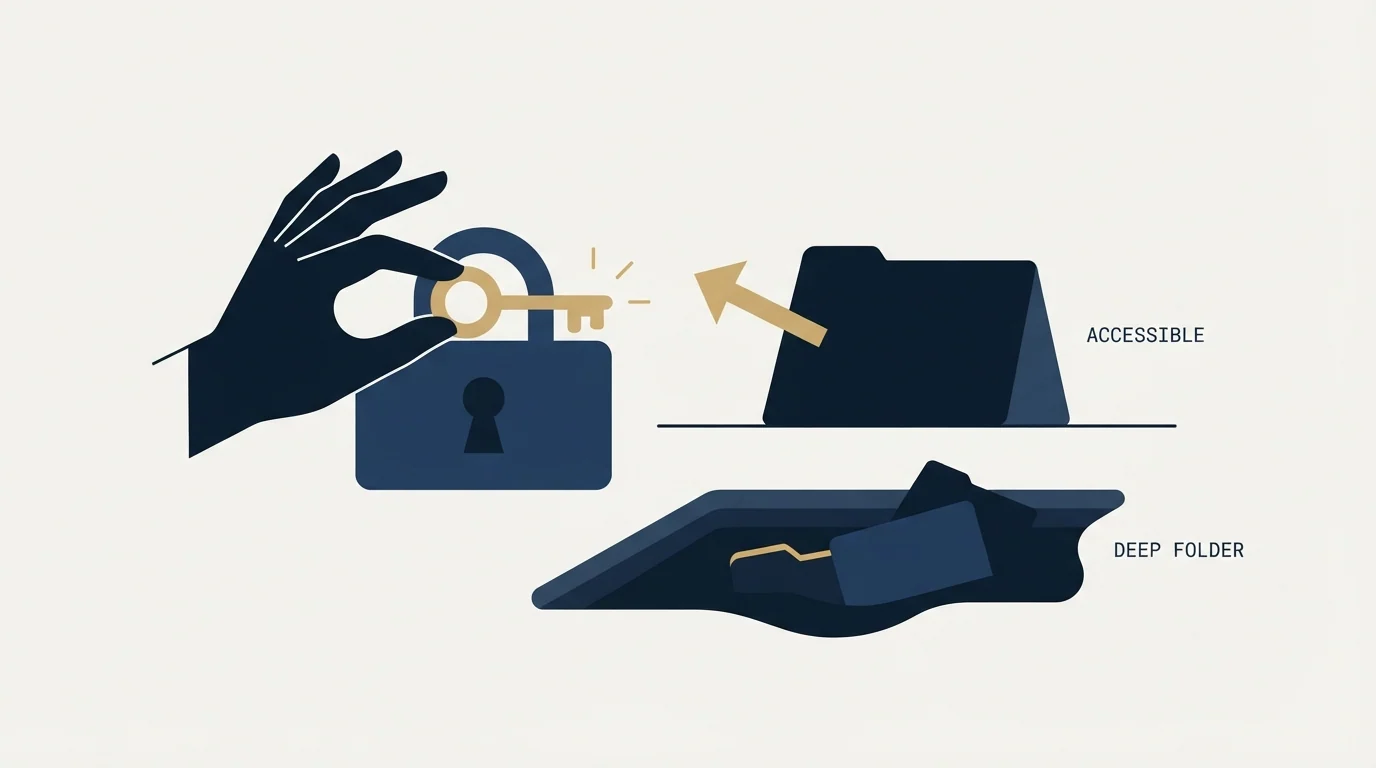
A rep is eleven minutes into a discovery call when the buyer says they are also looking at somebody else. The card that exists for exactly this moment is in a shared drive, two folders down, under a name nobody remembers. The rep says something reasonable, moves on, and writes the competitor into the CRM afterwards. The card was accurate, current and well researched, and it did not participate in the deal.
That gap is the whole subject. A competitive battlecard is a short internal brief that tells a seller what is true about an alternative, why it matters in this deal, and what to say next. Almost every published guide covers the first part in detail. The part that decides whether the card is worth building is where it lives and whether it is open at the moment the competitor's name is spoken out loud.
The artefact is written both ways, as one word and as sales battle cards, and the spacing carries no difference in what goes on it; where the two phrasings do diverge is scope, since a battle card library often includes objection and persona cards alongside the competitive ones described here.
Searched as a battle card template the thing on offer is usually a file with empty boxes, and the boxes are the easy half of the problem. A template can hand you a layout and a consistent order. What it cannot hand you is the checkable fact at the top of each entry, the buyer that fact changes the answer for, or the decision about which alternatives get a card at all, and those three are what the rest of this page is about.
The card is usually built for the rarest opponent
The artefact is called a competitor battlecard as often as a competitive one, and the two names carry the same scope: one card per alternative, built to be opened while somebody is still talking.
The standard shape is one card per named rival. Crayon's guide to sales battlecards uses Slack as its worked example and says a team in that position would create "one for Microsoft Teams, one for Mattermost, one for Rocket.Chat", which is the shape the published templates assume and the shape a new library tends to inherit.
It is also aimed at the alternative that turns up least. The buyer's own shortlist usually holds four things and only one of them is a company: carrying on as they are, an internal person or contractor who absorbed the job, a general-purpose tool that already works well enough, and occasionally a direct rival. The full argument for that set, and what each entry needs said to it, is in the competitive positioning strategy guide. A card library that starts at the fourth entry equips sellers for the deals they were already going to be in.
Crayon's page also carries the number usually cited to justify the practice at all: it states that "A whopping 68% of sales opportunities are competitive". Read carefully, that supports building cards. It says nothing about which alternative the cards should cover, and a deal lost to an unmoved status quo is competitive in exactly the sense that figure counts.
- Feature comparison against each competitor
- Pricing and packaging differences
- Objection lines for a head-to-head bake-off
- Updated when a rival ships something
- Covers the alternative that appears least often
- A card for doing nothing, naming a cost already being paid
- A card for the internal person, written so it can be forwarded to them
- A card for the spreadsheet, naming the volume at which it stops holding
- A card per named rival, for the deals that are genuinely head to head
- Updated when the buyer's situation changes, not only when a rival does
The three levels a card entry has to carry
Published battlecard example libraries are mostly galleries of finished cards, which show the layout and hide the reasoning, so what follows is a worked example of a single card entry rather than a gallery: one fact, the buyer it changes the answer for, and the line a seller can say.
Klue publishes the structure most worth copying, and it is deliberately small. Its Fact, Impact, Act framework, written up by Adam McQueen and dated June 27, 2023, breaks a single card entry into three ordered levels rather than a list of fields, and it is specific about where the first one goes: "The fact should lead your battlecard, either in the title of the card or the first sentence."
The fact is the competitive insight on its own, with no argument attached. One sentence, no adjectives, checkable, and sitting where a reader hits it before anything else.
The impact says why the fact matters here and for whom. This is the level that gets skipped, and skipping it is what produces the card that reads as trivia. A fact about a rival's pricing model is inert until somebody has written down which buyer it changes the answer for.
The act is the line the rep can say. Klue breaks a competitive talk track into three parts, "prompt, follow up, and validate", which is a useful discipline because it stops the act level collapsing into a slogan. A prompt is a question that puts the issue on the table without naming anybody.
- Step 1Fact
One checkable sentence about the alternative, leading the card or its title. No adjectives and no argument.
- Step 2Impact
Which buyer this changes the answer for, and in what situation a seller can use it. The level most often skipped.
- Step 3Act
The line to say, split into a prompt that raises the issue, a follow up that opens it, and a validating question.
Crayon's guide names the content categories that fill those levels out across a whole card, and the labels are its own rather than ours: why we win, competitor strengths, recent wins, recent field intel, and what it calls landmines and quick dismiss. Its definition of that last pair is worth taking literally, because it is a quantity as well as a category: "Landmines to plant are two to three high impact questions that highlight your competitor's gaps." Two or three, not a page of them.
The same page states the brevity rule in the bluntest available terms: "Sellers have neither the time nor the patience to read paragraphs." It reduces the whole standard to three words, "accuracy, brevity, consistency", and consistency there means one layout across every card so a seller knows where to look without reading.
The intel has to come from the buyer

A card is only as good as its source, and the default source is the worst one available. A closed-lost reason field was typed by the person with the most reason to explain the loss in terms that are not about them, on the day they understood it least. Build a card library on that and you get a confident document describing a market nobody outside the building recognises.
The buyer's own account is a different object, and collecting it is a separate practice with its own failure modes, most of them in the sampling rather than the interviewing. That practice is set out in the win/loss analysis guide, and it is the natural upstream input to a card library: the alternatives buyers actually weighed, in the words they used, including the ones that were not companies.
Accuracy matters here for a reason beyond correctness. Crayon's page puts it as a trust problem rather than a quality one: one piece of bad intel is enough to cost the card its readership, and a seller who has been embarrassed once by a stale claim stops opening the file.
Where the card lives decides whether it exists
This is the half the templates leave out, and Crayon's guide is unusually direct about it, describing what battlecards traditionally were: "built by marketing, buried in a shared drive, and forgotten by reps". Its recommendation is to put cards where sellers already are, bookmarked at the top of the team channels they work in, and embedded in the CRM, both at the opportunity level for a live deal and on a central competitive tab for training and pre-call research.
Ownership of that surface usually sits with enablement, a function that under the revenue enablement scope claim answers for every customer-facing team rather than for sellers alone.
The underlying test is simpler than any of those tactics. A card has to be openable inside the sentence in which the competitor is named. Anything that costs a detour, a search or a second login is a card that will be read after the call, when its only remaining use is regret.
Go-to-market enablement work before the first conversation covers the target definition and qualification bar that decide whether a rep ever reaches the moment a battlecard matters.
Two practical consequences follow. The card belongs in the surface where the deal is already recorded, which for most teams means the CRM record rather than the wiki. And the format has to survive being read in about fifteen seconds by somebody who is also listening to a person talk, which is a much harder constraint than being comprehensive.
- Yes: There is a card for doing nothing and one for the internal person
- Yes: Every entry leads with one checkable fact, not a claim
- Yes: Every fact is followed by who it changes the answer for
- Yes: Every entry ends in a line a rep can say out loud
- Yes: The card opens from the CRM record without a search
- Yes: One named person owns the refresh, with a trigger for it
- No: The card is comprehensive rather than readable in fifteen seconds
- No: The newest intel on it predates the last time pricing changed
Objection lines are borrowed from a library with its own rules
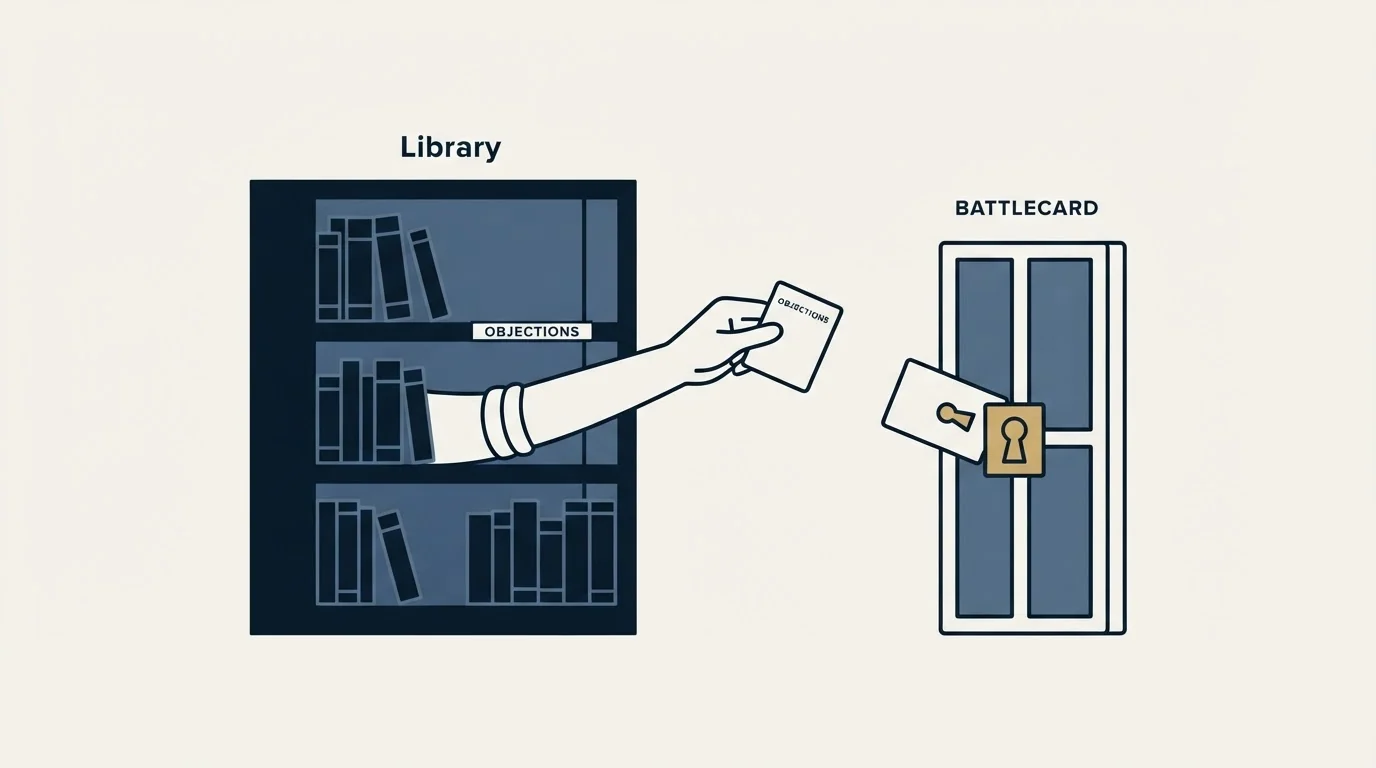
An objection section is the part of a card that grows fastest and rots quietest. The rule governing what belongs in it is borrowed rather than local. It is the same test that decides which entries earn a place in any objection library, which is whether the thing the buyer said contains a fact you did not already have. A great deal of what gets logged as an objection does not, and the full test, together with what to delete, is in the objection handlers guide.
Applied to a card, that keeps the objection section to the small number of statements that are genuinely about the alternative rather than about the conversation. Everything else belongs in call training, where it can be practised, rather than on a card, where it will be read as a script.
Decay, and the person who owns it
A card is a snapshot of a rival's public surface, and that surface moves. Pricing changes, a feature ships, a company is acquired, and the card keeps asserting whatever was true when somebody last looked. Because the failure is silent, a stale card and a current one are indistinguishable to the rep who opens it, which is precisely the situation in which a wrong claim gets said to a buyer.
The fix is ordinary ownership rather than tooling. One named person per card, a stated refresh trigger rather than a calendar interval (a pricing page changing, a funding announcement, a win or loss recorded against that alternative), and a visible date on the card itself so a reader can weigh it. A card with no date on it asks every reader to assume it is current.
Where this sits in the wider set of enablement decisions, and who owns it against the other three jobs that share the name, is worked through in the sales enablement strategy guide.
What a card is for in outbound, and what it is not
Our own use of this is narrower than a presales team's, and it is worth stating precisely because the temptation runs the other way.
A competitive card shapes outbound at the targeting stage. Knowing which incumbent a segment runs decides who is worth writing to and what premise the message can open on, which is a list decision before it is a copy decision. It does not become a rebuttal sequence. Our doctrine is one message per campaign, with no bumps and no thread replies, so there is no second touch in which a competitive argument can be developed, and a first message that argues against an incumbent by name is arguing with the reader's own past decision. The message shapes that work in a genuine displacement play, once a competitive position exists behind them, are collected in the competitor displacement templates.
The internal sentence a card is ultimately derived from is a different artifact again, written for your own people rather than for a buyer, and its shape is covered in the positioning statement entry.
The short version
A competitive battlecard is a short internal brief carrying one checkable fact, the buyer it matters to, and a line the seller can say. Build the library around the alternatives buyers actually weigh, which means the first cards are doing nothing, the internal person and the general-purpose tool, with named rivals covering the deals that are genuinely head to head.
Structure each entry as fact, then impact, then action, in that order. Keep landmines to the two or three questions that genuinely expose a gap. Source the facts from buyers rather than from closed-lost fields, because one bad claim costs the card its readership permanently.
Then solve the part the templates ignore. The card has to open from the record where the deal already lives, be readable in about fifteen seconds, carry a visible date, and have one named owner with a trigger for refreshing it. A comprehensive card nobody opens loses to a thin one that is already on the screen.
If the open question is which incumbent your segment is actually running, that is answered faster by writing to a properly defined list than by another round of desk research. Meetings are qualified against criteria agreed in writing before launch, so the segment and the alternative get named before anything sends. You can see what a campaign into that segment would look like.
Battlecard structure and content detail verified against Klue's Fact, Impact, Act article and Crayon's sales battlecards guide, both as fetched on 23 August 2026. Publishers revise these pages; confirm the current text before relying on it.
Frequently asked questions.
Frequently asked questions- What is a competitive battlecard?
- A short internal brief that tells a seller what is true about an alternative the buyer is weighing, why that matters in this deal, and what to say next. It is a deliverable for other people rather than an analytical document, which is why length and placement matter as much as the research behind it.
- What should go on a competitive battlecard?
- One checkable fact leading the card, the buyer or situation it changes the answer for, and a line the rep can say, in that order. Crayon's guide adds why we win, competitor strengths, recent wins, recent field intel, and two to three landmine questions that expose a genuine gap. Anything longer stops being read.
- How many battlecards should a team have?
- Enough to cover the alternatives buyers actually weigh, which usually means a card for doing nothing, one for the internal person or contractor, one for the general-purpose tool already in place, and one per named rival that genuinely appears in deals. Starting with the rivals equips sellers for the least common case.
- Why do battlecards not get used?
- Usually because opening one costs a detour. A card stored in a shared drive or a wiki is read after the call, when its only use is regret. The other common cause is decay: a stale card and a current one look identical to the rep opening it, so an out of date claim gets said to a buyer and the library loses its credibility.
About the author.

B2B cold email experts helping companies generate qualified leads through done-for-you outreach campaigns.
RevenueFlow Team
Explore more.
Ready to scale your outreach?
We build GTM engines that book real meetings. See the receipts.
Related articles.
Sales Enablement Charters: What the Published Ones Ask For
Six publishers set out what a sales enablement charter should contain. Five describe a document nobody can check, and one writes a definition with inspection in it.
Sales Kickoff Agendas: Five Published, Session by Session
Five publishers print a sales kickoff agenda. They agree on four blocks and disagree on session length, rehearsal and where the agenda comes from.
Win Rate Benchmarks: Which Figures State a Population
A catalogue of the published average sales win rates, sorted by whether the page names the population behind its own number. Most do not.
Sales Cycle Length Benchmarks: What Each Figure Counts
The published B2B sales cycle benchmarks, sorted by what each page says it counted. The same number means two different things in two of them.
Sales Comp Plan Design: What the Publishers Prescribe
Four publishers set out how to design a sales compensation plan. Here are their procedures, their components, and which of their ratios carry a population.
Cold Calling for Higher Education Vendors: Who Picks Up
Who a published campus number really reaches, what university purchasing pages permit a sales call to do, the quiet period around a bid, and when a campus can talk.