Email Bouncer: What Bouncer Costs and the Product Split
Bouncer sells verification as credits and deliverability testing as a subscription. Here is the full credit ladder, and the product split that catches buyers out.
Bouncer's pricing at usebouncer.com splits into three products. Verification credits cost $8 for 1,000 down to $2,000 for 1,000,000 and never expire, with 100 free credits to start. The Deliverability Kit is $25, $125 or $250 a month, and Bouncer Shield starts at $2 a month for 1,000 checks. None includes the others.
Key takeaways
- Bouncer's pricing page lists verification credits from $8 for 1,000 to $2,000 for 1,000,000, a fall from $8.00 to $2.00 per 1,000, with a 1,000-credit minimum and credits that never expire.
- The Deliverability Kit is a separate monthly subscription at $25, $125 or $250 for 250, 1,000 or 2,500 test emails, and it buys no verification credits.
- Bouncer Shield is priced on monthly checks from $2 for 1,000, and two middle rungs of its calculator render with no price.
- The verification calculator now shows a Monthly Subscription switch, $28 against $35 at 5,000 credits, while the FAQ still says Bouncer offers credits and not monthly plans.
Reviewed and updated September 21, 2026
Bouncer's pricing at usebouncer.com is shown in dollars, with various currencies accepted, and it splits into three separately priced products. Email verification is sold as credits that never expire, from $8 for 1,000 to $2,000 for 1,000,000, with 100 free credits and no credit card required to start. The Deliverability Kit is a monthly subscription: Starter $25, Standard $125, Pro $250 or a custom Enterprise tier. Bouncer Shield is another monthly subscription, priced on checks from $2 for 1,000. Reading those as one product is the most common way a team budgets this category wrong.
Most people typing "email bouncer" are looking for that vendor, which trades as Bouncer at usebouncer.com. If you arrived wanting the concept instead, meaning why messages fail to land at all, hard bounce vs soft bounce is the page for that and this one will not help you. Everything below is about the tool, read the way a B2B outbound team would read it.
usebouncer.com Pricing at a Glance
Three prices answer it, one per product. Verification credits cost $8 for 1,000, falling to $2,000 for 1,000,000, and never expire. The Deliverability Kit costs $25, $125 or $250 a month. Bouncer Shield starts at $2 a month for 1,000 checks. Buying one does not include the others, and the page confirms each can be bought on its own.
What Bouncer actually sells
The product menu on the Bouncer pricing page separates several products that are easy to read as one. Email Verification is the bulk list checker. Email Verification API is the same check wired into your own systems. Bouncer Shield is described as identifying "invalid, malicious, or fraudulent email addresses at the moment of entry", which is form-time verification rather than list cleaning. Bouncer AutoClean connects to a CRM and re-checks on its own. Toxicity Check is described as identifying "if your email list contains any toxic email addresses". Data Enrichment appends "publicly available company information". Deliverability Kit tests inbox placement, authentication and blocklists. Email Engagement Insights reports how active contacts are.
Two of those are separately priced subscriptions, one is a credit balance, and the rest attach to one or the other. That distinction is the whole of this article.
Email verification
- Credits, from $8 for 1,000
- Minimum purchase 1,000 credits
- Credits never expire
- New A Monthly Subscription switch in the calculator
Deliverability Kit
- Starter $25, Standard $125, Pro $250 a month
- Sold by test emails and monitored IPs or domains
- Inbox placement, blocklist, SPF, DKIM, DMARC, SpamAssassin
- Buys no verification credits
Bouncer Shield
- Monthly checks, from $2 at 1,000
- Real-time checking on your own forms
- Each shield works with its own domain
- Separate from verification credits
The verification credit ladder, published in full
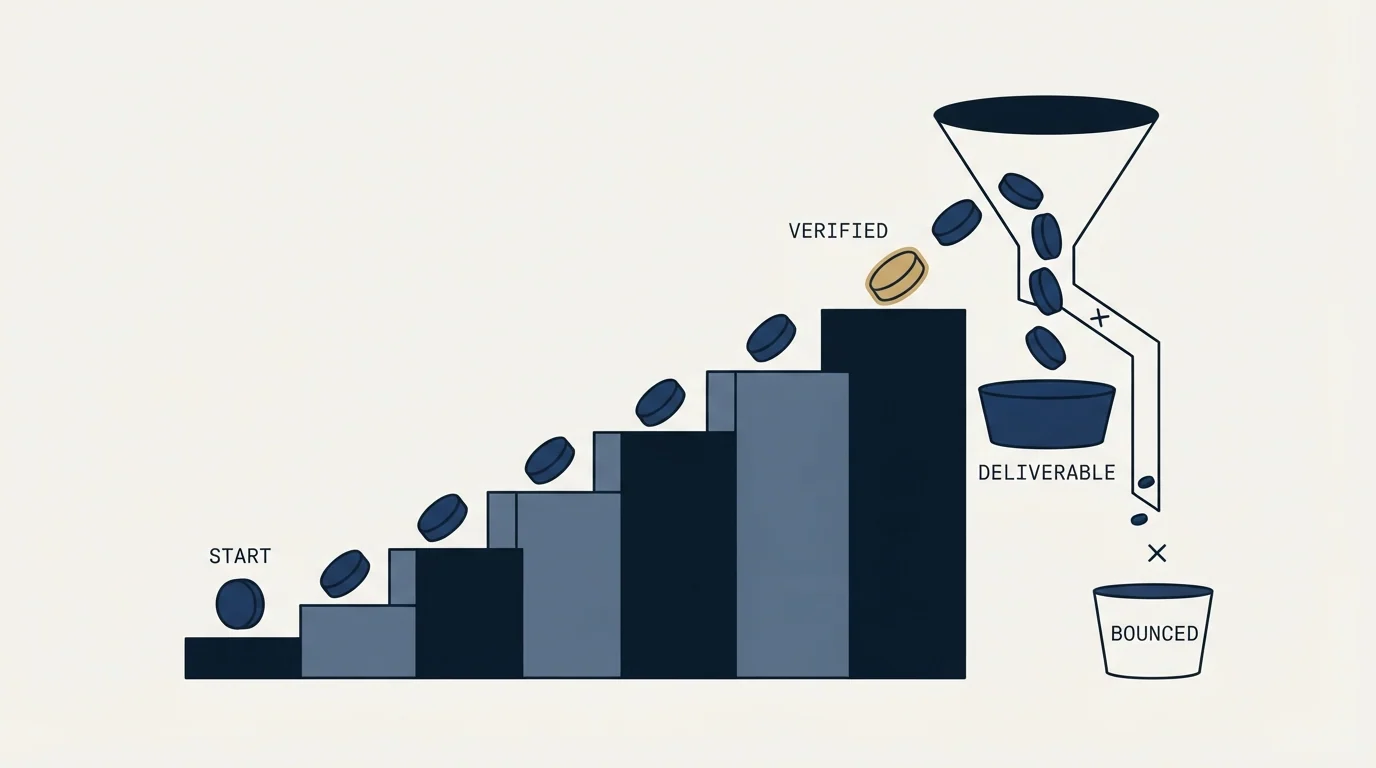
Bouncer renders its entire credit ladder into the page it serves, so every rung below can be read before you talk to anyone.
| Credits | Price | Cost per credit at that block size |
|---|---|---|
| 1,000 | $8 | $0.0080 |
| 5,000 | $35 | $0.0070 |
| 10,000 | $60 | $0.0060 |
| 50,000 | $250 | $0.0050 |
| 100,000 | $400 | $0.0040 |
| 250,000 | $750 | $0.0030 |
| 500,000 | $1,250 | $0.0025 |
| 1,000,000 | $2,000 | $0.0020 |
The right-hand column is arithmetic on the two published columns beside it, and it lands exactly where the page's own FAQ says it should: "you can start as low as $8, which gives you 1,000 email addresses you can verify", falling to "$2 / 1,000 when buying 1 million credits". The FAQ also confirms the 100,000 rung independently, at "100,000 credits cost $400". Above a million, the page routes you to a conversation.
Three terms attach to those credits and all three are worth having in writing. "Email verification credits never expire" appears twice on the page. The minimum transaction is stated as "Our minimum purchase size is 1,000 credits", so $8 is a real floor rather than a teaser. And on what you are charged for, the page states that Bouncer will never charge for duplicated email addresses within your list, nor for unknown results.
That last one is the commercially interesting term. Duplicates are the ordinary state of a merged B2B list, and unknown results are what a verifier returns when it cannot resolve the mailbox. Paying for neither means your credit burn tracks the answers you actually got.
The page's FAQ still explains why no monthly verification plan exists: "Why does Bouncer only offer email verification credits and not monthly plans?" The answer given is flexibility, so you are not paying for an allocation you do not use. The calculator above that FAQ now tells a different story. It carries a Pay as you go and Monthly Subscription switch, and on Monthly Subscription at 5,000 credits it showed a discount of $7.00 and a total of $28, against $35 paid as you go. The page does not say how subscription credits behave from month to month, so ask which terms the checkout applies before planning around either. How other verifiers package the same job is set out in the email verification tools comparison.
Bouncer's calculator now offers a monthly subscription beside its pay-as-you-go credits, and NeverBounce's own API mechanics show how a rival verifier automates checks while leaving spend and catchall judgment calls to the buyer.
Trying it is free. The page states "100 free credits for a start" and "No credit card required to start", and an auto-refill option exists for teams that would rather not think about topping up.
The Deliverability Kit is a different product
Here is the trap. The same pricing page carries a Starter tier at $25 per month, a Standard tier at $125 per month, a Pro tier at $250 per month and a custom Enterprise tier. None of those buy verification credits. They are the Deliverability Kit, whose menu entry reads "Test your inbox placement, verify your authentication, and monitor blocklists".
The tiers are sold on volume rather than on capability. Starter carries 250 test emails and 10 IPs or domains monitored, Standard carries 1,000 and 25, Pro carries 2,500 and 50, and Enterprise is unlimited on both. Every paid tier lists the identical five checks: inbox placement tests, IP and domain blocklist tests, SPF and DKIM tests, a DMARC test and a SpamAssassin test. Enterprise adds account structure rather than tests, with multi-organizational setup, custom agreements and a dedicated account manager.
Volume-banded ladders are why two summaries of the same vendor can disagree, and Mailjet's ladder read at one served volume shows what changes when the band moves.
The page settles the question explicitly. Asked "Can I purchase email verification and the deliverability kit separately?", it answers "Yes, you can. You can buy just one service independently or combine both".
So a team that budgets $25 a month for Bouncer and expects a clean list has bought the wrong thing, and a team that buys a million credits and expects blocklist monitoring has bought the wrong thing in the other direction. Work out which problem you have first. If the failure you are seeing is bounces, you want credits. If the failure is mail that is accepted and then never seen, you want placement testing, and our guides to inbox placement testing, SPF, DKIM and DMARC for cold email and blacklist checks and recovery cover that problem without a purchase.
Shield, AutoClean, Toxicity Check and enrichment
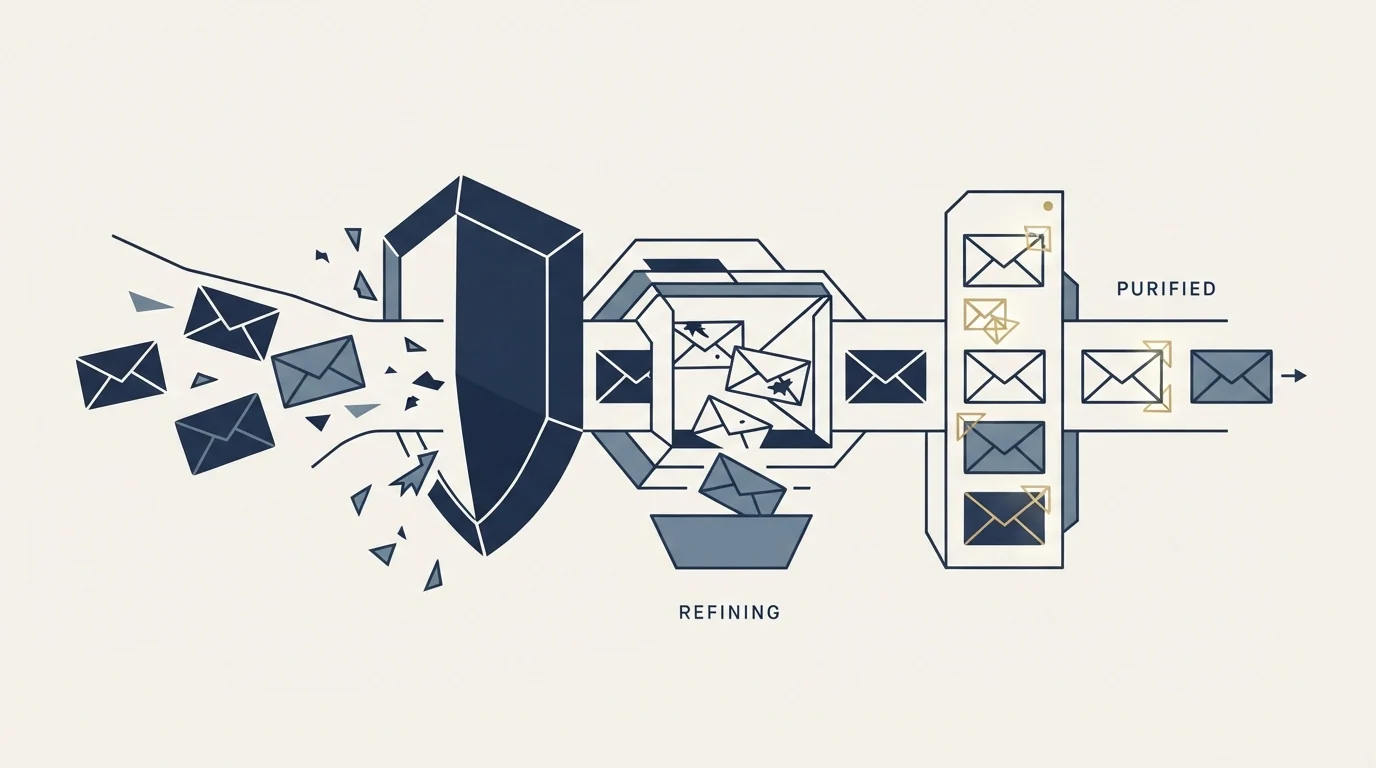
Bouncer Shield is the form-time product, sold as its own subscription on monthly check volume with a ladder that starts at $2 for 1,000 monthly checks and runs up to 1,000,000. Each shield works with a separate domain and configuration, styling is customisable, and hiding the "Powered by Bouncer" mark is a listed option. One caution from reading the page closely: two rungs in the middle of that Shield ladder render without a price attached in the served page, so confirm the exact figure for your volume in the app rather than reading it off the calculator.
Toxicity Check matters more than its name suggests for cold outbound. Addresses that damage a sender are not only the ones that bounce, and a spam trap sitting in a purchased or scraped list will accept mail cleanly while doing real reputational harm. A verifier confirming a mailbox exists has not told you the mailbox is safe to contact.
AutoClean is scheduled re-verification against a connected CRM, which addresses the fact that a verified list decays as people change jobs. Data Enrichment appends company information from public sources. Neither replaces the verification credits, and neither carries a price on the pricing page, so ask how they are billed before you build a process on them.
Where it saves a domain, and where it cannot

Verification protects one specific thing, which is your bounce rate, and through it the reputation of the domain you send from. That is a narrow job done well, and it is genuinely the cheapest insurance available in outbound.
What it cannot do is confirm a mailbox on a catch-all domain, because that kind of server answers yes to every address put to it. No verifier resolves that through the SMTP conversation, Bouncer included, and the honest handling is to treat those addresses as an unresolved segment and decide separately what risk you are willing to take with them.
On accuracy, Bouncer publishes a promise rather than a percentage. The menu carries a "Bouncer Guarantee" headed "Accuracy you can trust", and no figure is attached to it anywhere on the pricing page. That is a marketing line, and a percentage would not have been comparable to a rival's percentage anyway unless both were measured on the same list. The only measurement that answers the question is the bounce rate on your own sending after the list has gone through it.
A last practical note for buyers with a compliance question. The pricing page footer states the company is based in Wroclaw and that the service is hosted in the EU, which is the kind of detail that decides a procurement conversation in Europe faster than any feature comparison does. Local currencies are supported and the Shield subscription is listed as cancellable at any time.
Before any address we source reaches a campaign it passes through MillionVerifier, a fixed stage in our email-finding waterfall, which fixes the order the work runs in and says nothing about how any rival would score. The general principle transfers to whichever verifier you pick: run the cheap check across everything, and only let the expensive steps see what the cheap one could not settle.
Want the list built, verified and sent properly without assembling the stack yourself? Get a free campaign plan.
Pricing and features are taken from the vendors' own pages. Verify current terms with the vendor before relying on them.
Frequently asked questions.
Frequently asked questions- How much does Bouncer email verification cost in 2026?
- Bouncer's pricing page sells verification as credits that never expire: $8 for 1,000, $35 for 5,000, $60 for 10,000, $400 for 100,000 and $2,000 for 1,000,000, with a 1,000-credit minimum and 100 free credits to start. Above a million it routes you to sales. The page also says it never charges for duplicates or unknown results.
- Is the Bouncer Deliverability Kit included with verification credits?
- No. The pricing page sells it as a separate monthly subscription, Starter at $25, Standard at $125 and Pro at $250, sized by test emails and monitored IPs or domains, plus a custom Enterprise tier. Its FAQ confirms you can buy verification and the Deliverability Kit independently or together, and the Kit's tiers include no verification credits.
- Does Bouncer offer a monthly plan for email verification?
- The page gives two answers. Its FAQ asks why Bouncer offers only verification credits and not monthly plans, and answers that credits give flexibility. Its calculator now carries a Monthly Subscription switch that showed $28 against $35 at 5,000 credits. Ask which terms the checkout applies before planning around a subscription.
- Can Bouncer verify catch-all email addresses?
- Not with certainty, and no verifier can. A catch-all domain answers yes to every address put to it, so the SMTP check cannot confirm the individual mailbox. Treat those addresses as a separate, unresolved segment and decide what risk you will take with them, rather than reading the verifier's result as a pass.
About the author.

Tim Carden is CMO / CTO at RevenueFlow, which builds and operates outbound revenue engines for B2B companies. Studied at McGill University.
Tim Carden · CMO / CTO
Connect on LinkedIn →Explore more.
Ready to scale your outreach?
We build GTM engines that book real meetings. See the receipts.
Related articles.
ZeroBounce Pricing: The Three Things Buyers Miss
What the ZeroBounce pricing page actually publishes, which billing state it shows by default, and the credit rules that decide what a buyer really pays.
BriteVerify: What It Verifies and the Price to Ask For
BriteVerify checks email, phone and postal address under Validity, and publishes no rate card on any surface that returns a page. What that means for buyers.
Choosing a NeverBounce Alternative: Name Your Reason
Three reasons teams leave NeverBounce, each pointing at a different replacement, plus how to run a two-vendor split test on your own list that actually settles it.
NeverBounce Under ZoomInfo: What Buying Verification Changes
NeverBounce serves no pricing page to automated requests, so here is what its own surfaces do show, and what changes when your verifier belongs to a data platform.
Instantly.ai Review: What the Plans Include and Who It Suits
Instantly gives unlimited inboxes on every paid plan and meters contacts and send volume instead. What that changes, where each tier runs out, and who it fits.
Smartlead Review: Unlimited Mailboxes and What the Plans Cap
Smartlead includes unlimited mailboxes on every plan and bundles verification on the upper tiers. What rotation does, what it cannot do, and where the ceilings bite.