G2 Buyer Intent: Nine Signal Types, the Profile Gate
G2 Buyer Intent now spans four review sites, but it is an add-on gated behind a paid profile plan. The nine signals, the prerequisites, and the real limitation.
G2 Buyer Intent and Gartner Digital Markets intent are now one feed: G2 bought Capterra, Software Advice and GetApp from Gartner, and Buyer Intent includes research activity from all four sites. It reports company-level signals, is sold only as an add-on on G2's Professional and Enterprise plans, and has no published price.
Key takeaways
- Since G2 bought Capterra, Software Advice and GetApp from Gartner, their buyer research activity flows into G2 Buyer Intent, which G2 reports as up to 2x more signals and 36% more in-market accounts at no extra cost.
- G2 documents nine Buyer Intent signal types and states that your product's G2 plan determines which of them you receive.
- Buyer Intent is an add-on on the Professional and Enterprise plans only; the Starter plan, at $299 a month or $2,999 a year in year one, cannot buy it.
- G2's Activity Level sets the clock for outbound: keep Low accounts in scoring, send one message within a week at Medium, and send it now at High.
Reviewed and updated September 19, 2026
G2 Buyer Intent stopped being a G2-only product in 2026, and that changes the answer for anyone comparing G2 Buyer Intent data with Gartner Digital Markets intent signals for identifying in-market software buyers. A G2 newsroom post dated June 3, 2026 announces that buyer research activity from "G2, Capterra, Software Advice, and GetApp into a single unified view" now flows into one Buyer Intent experience, following what the same post describes as G2's acquisition of Capterra, Software Advice and GetApp from Gartner in early 2026, "now called G2 Digital Markets". The post reports "up to 2x more signals through the expanded dataset, including 36% more accounts actively in-market", delivered to existing customers "at no additional cost".
How does G2 Buyer Intent data compare to Gartner Digital Markets intent signals?
For identifying in-market software buyers, the two are now one dataset. G2 bought Capterra, Software Advice and GetApp from Gartner, and G2's Buyer Intent documentation states that Buyer Intent "includes research activity from G2, Capterra, Software Advice, and GetApp." On Gartner's side, the addresses for Digital Markets and for its intent-data offering both open Gartner's general Insights page.
What the deal changed for a buyer of the data is volume. G2's acquisition post, dated January 29, 2026, forecast "up to 3x more Buyer Intent signals"; the June post reports early data of up to 2x, with nearly one-third of those signals brand new, "representing buyers who were previously invisible". Plan against the measured figure. The signal types, plan gates and company-level resolution below are G2's, and now cover all four sites.
The live B2B intent data guide already makes the category argument for review-site intent, that it is much closer to purchase than a publisher co-op. This page covers what a buyer has to work through: which signals you receive, the prerequisites that disqualify many companies before a quote, and where the signal does not exist.
The ZoomInfo signal score explainer breaks down how surges are measured against a company's own baseline rather than absolute research volume.
The nine signals, and why your plan decides which ones you see
G2's product documentation lists Buyer Intent as nine distinct signal types, each triggered by a different page a buyer looked at.
Profile means someone viewed your G2 product page. Pricing means they viewed the pricing page on your profile, which the docs describe as indicating the buyer is evaluating your product against their budget. Compare means they viewed a comparison page containing your product and at least one competitor. Category means they viewed a category page that includes you, which the docs frame as early-stage research. Alternatives means they viewed an alternatives page for your product or a competitor's in your subscribed category.
Four more come from your own paid and owned surfaces rather than from organic browsing: Sponsored content when a buyer sees an advertisement for your product on G2, Licensed content when they open one of your licensed G2 reports, Reference page when they view one of your G2 reference pages, and Competitive when a buyer views a pricing, profile or compare page for a competing product in a shared category.
The sentence that governs all of it sits in the same documentation: "Your product's G2 plan determines the types of Buyer Intent signals you receive." The signal menu itself is tiered, and G2 says to check the Buyer Intent section of the plan table inside your own account.
The Competitive group is the newest. A separate G2 newsroom post introduces Competitive Intent Signals and states they are "available to all G2 Buyer Intent customers via LinkedIn, Slack, and the API", with HubSpot, Salesforce and Demandbase named as coming later.
| Signal | What the buyer viewed |
|---|---|
| Research on your own product | |
| Profile | Your G2 product profile |
| Pricing | The pricing page on your profile |
| Compare | A comparison page that includes your product |
| Research on your category | |
| Category | A category page that includes your product |
| Alternatives | An alternatives page for you or a competitor in your category |
| Competitive | A competitor's pricing, profile or compare page in a shared category |
| Your paid and licensed assets | |
| Sponsored content | An advertisement for your product on G2 |
| Licensed content | One of your licensed G2 reports |
| Reference page | One of your G2 reference pages |
What is included in a G2 vendor profile, and what do buyers look at on it?
A G2 vendor profile is the product page most signals start from. G2's plans page lists what it can hold: logo, description, supported languages, categories, packages and pricing, features, Q&A discussions, screenshots, a banner, positioning against competitors, integration lists, videos, downloads and an interactive demo. G2's Buyer Intent page names what buyers do there: product and category page views, competitor comparisons, pricing page engagement, and review consumption and contribution.
Optimising that presence for buyer visibility is mostly the same work as feeding the signal. The Free profile covers a basic profile, basic review collection and the 'Users Love Us' badge, earned, the plans page says, after collecting 20 reviews with an average rating of 4.0 stars. G2's documentation, describing the Pricing signal, says vendors should ensure pricing is added to the profile and consider creating a G2 Deal. No plan buys a ranking: the plans page states that "G2 is not a pay-to-play ranking system".
G2 product profile
Logo, description, categories and supported languages 1
Packages and pricing 2
Reviews, and the Users Love Us badge once it is earned 3
Screenshots, videos, downloads and an interactive demo 4
Positioning vs competitors and integration lists 5
- 1Every view of the profile is a Profile signal: most signals start here.
- 2A view here is a Pricing signal. G2's documentation says to add pricing and consider a G2 Deal.
- 3The badge is earned after 20 reviews with an average rating of 4.0 stars.
- 4Media and content fields from the Profile Management list on the plans page.
- 5Comparison and alternatives pages that include you produce Compare and Alternatives signals.
Buying Stage and Activity Level replaced the score
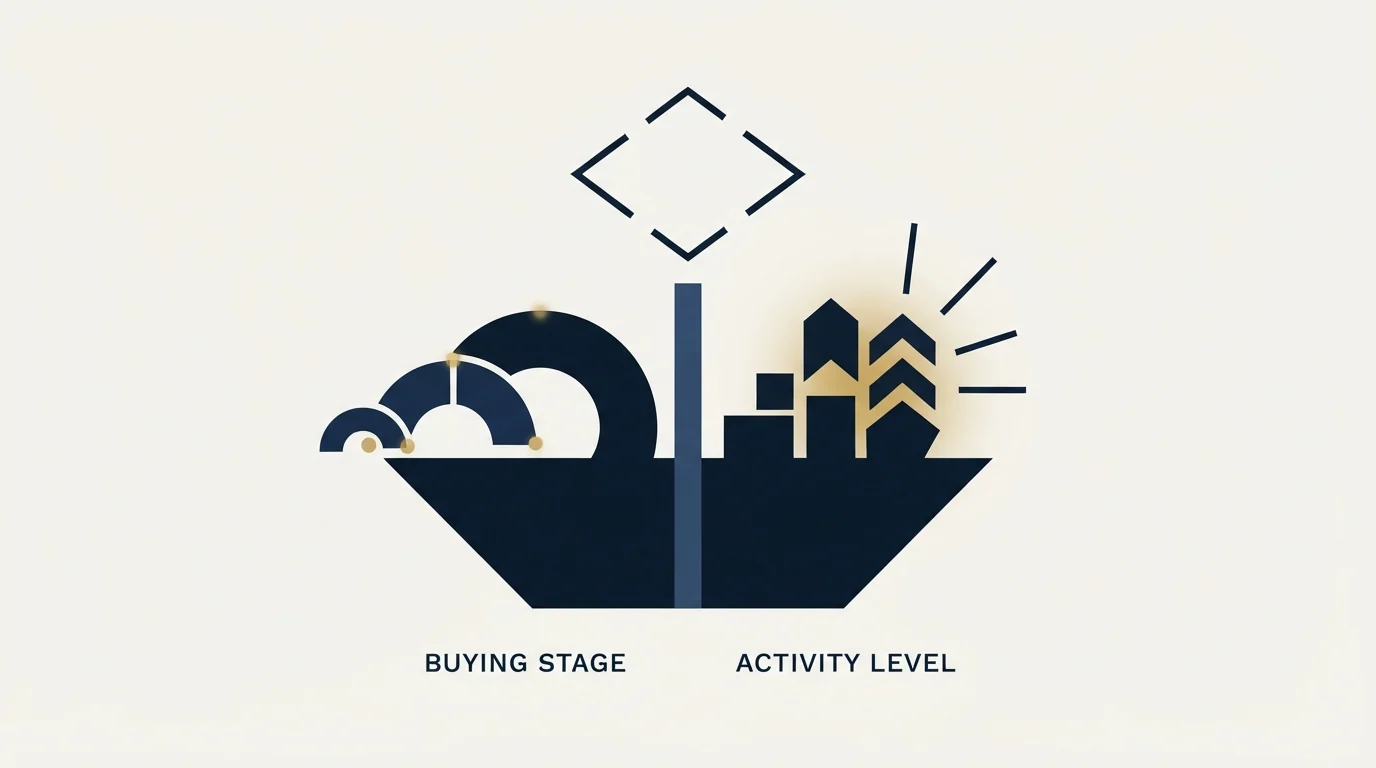
Anyone carrying a mental model of a single G2 intent score is several years out of date. The documentation states plainly: "As of June 2022, G2 reports Buying Stage and Activity Level in place of a singular Buyer Intent score."
Buying Stage is a three-value field, Awareness, Consideration and Decision, described as an evaluation of where the buyer sits in their journey based on page engagement and signal type. Activity Level is also three values, Low, Medium and High, computed from aggregate behaviour including time on page and total pages visited. Both fields are recalculated daily, and G2's own reference confirms "G2 updates Buying Stage and Activity Level daily".
Two three-value fields is a coarser instrument than a 0 to 100 score, which suits a routing rule, and a daily-updating field only helps if something on your side reads it daily. The connection shapes and decay speeds in intent signal APIs for outbound are the relevant reading before you design that routing.
The prerequisite that disqualifies most buyers
Two gates sit in front of this product, and both are published on G2's own plans page.
The first is the profile. G2's plans page states "we require all customers to activate Core", Core being the profile product. Buyer Intent measures traffic to and around your listing, so a company with no claimed, populated, review-carrying G2 profile has nothing generating signal in the first place. This is a genuine disqualifier, not a formality.
The second is the package tier. In the plans page's comparison table, the Buyer Intent row reads "Collect and activate buyer intent data from G2 Profile, Category, Comparison, and Competitor traffic", marked Add-on on Professional and Enterprise, with the Free and Starter columns blank, as is the ABM Integrations row beneath it.
A third constraint bites multi-product vendors: the documentation states that G2 sends Buyer Intent signals at product level, and that "each product that you want to receive Buyer Intent signals must have its own subscription". A company with four listed products is buying this four times.
G2 Buyer Intent pricing and the G2 plan tiers

G2's plans page and its Buyer Intent page publish no price for Buyer Intent. It is a quote-only add-on on the Professional and Enterprise plans, which are quote-only themselves. The only published figures belong to the Starter plan: $299 a month or $2,999 a year in the first year, rising to $599 a month or $6,000 a year in year two, and Starter cannot add Buyer Intent at all.
On the plans page, Core has four tiers. Free carries a basic profile and three users. Starter is published at $299/month or $2,999/year for small businesses defined as 1-100 employees, and Professional and Enterprise both say contact sales. The year-two footnote, "Year 2 pricing increases to $599/month or $6,000/year", appears in only one of the page's two renderings of the plan table, so a reader skimming the other sees $299 with no escalation attached.
The Starter plan adds single-profile review collection, $100 in gift card review credits, custom CTAs, an upgraded profile, branded banners and review campaigns, and report, milestone and annual badge licences to everything in Free.
Buyer Intent itself sits in the Add-ons section with no published price. What the plans page does publish is a seat effect: "Buyer Intent allows for 30 total users for customers on the Professional Package", against the 10 Professional otherwise carries; Enterprise runs unlimited users. The one free way in sits on G2's Buyer Intent page: a free, retroactive look at the companies researching your software and category over the past 30 days.
A worked total, labelled illustrative: a vendor on Professional with one product pays an unpublished licence plus an unpublished Buyer Intent add-on, before any advertising or review-generation effort. If those two came to, for illustration only, $30,000 a year, and the feed produced 200 in-market accounts a year, that is $150 per identified account before anyone works one. Both inputs are invented to show the arithmetic, only a quote and a pilot can fill them in, and any annual range quoted for this add-on comes from what buyers report paying, since no published price exists.
Teams comparing intent vendors against ABM platforms can see how AdRoll prices its bundled account identification and advertising suite in the RollWorks rebrand and pricing breakdown.
How the data gets to you
Buyer Intent data appears in my.G2 under Buyer Activity, filtered through a "Match Your Ideal Customer Profile" panel. G2 also publishes a Buyer Intent data dictionary for its API and warehouse feeds, with fields including company name and domain, employee range, industry, visit type, visit date, last seen, activity level and buying stage, and it documents native integrations for Salesforce, HubSpot, Marketo and Pipedrive, LinkedIn and Slack delivery for the competitive signals, and a G2 MCP server for agent workflows.
Profile visitor data is exportable. G2's newsroom post on the feature describes "company-level insights into who's actively exploring your product page", downloadable as a CSV whose fields include "visitor company, the company domain, and the company ID", plus visitor country, region, visit count and date of each visit.
A documented Bombora Company Surge integration pulls topic intent into my.G2, with "a minimum of 10 topics and a maximum of 25 topics". Running both is exactly the overlap the live guide warns about, so check what your other platforms already license before paying twice.
How to use G2 and Capterra signals in an outbound sales motion
Treat each signal as a timing instruction for an account you already want. G2's documentation attaches an action to each Activity Level: a nurture campaign at Low, outreach within a week at Medium, and immediate engagement at High. For an outbound team the useful part is the clock: a Low account stays in your lead scoring model until it moves, a Medium account gets one message inside the week, and a High account gets it now. Capterra, Software Advice and GetApp activity arrives in the same feed, so one routing rule covers all four sites.
Three details make that work. First, filter before you route: email notifications take a minimum total pageviews figure and a frequency, and G2's own example is that at a minimum of 10, daily, an organisation must trigger 10 signals in one day to be included. Intent Studio, in beta, sends signals from accounts matching a defined ICP straight to the integrations you select. Second, the signal names a company, so someone still has to find the right person. Third, use what it says: the insights table shows which competitors your product was directly compared to, and G2's advice at the Decision stage is to actively differentiate your product from your competitors, which is the job of the one message you send.
The limitation that decides everything

The signal only exists where your category is active on G2. That is the whole constraint, and it is not a coverage percentage you can negotiate up.
If your buyers research software on review sites, this is the highest-quality third-party intent available to you, because the person is comparing named vendors. If your category is thin on G2, your buyers never touch a review site, or you sell services, the feed will be sparse and no package tier will fix that. Check your own category and comparison pages on G2 before you talk to anyone.
Two further limits. The signal names the account and not the person, so it is a prioritisation layer rather than a list. And profile traffic generates most of it, so a thin or stale profile produces a thin feed whatever you pay for the add-on.
Teams turning that company-level signal into a named contact often reach for the RocketReach Chrome extension for contact lookup, though every reveal still spends the same credit balance as its web app.
For identifying individuals on your own website rather than on G2's, that is a separate category with its own mechanics and its own legal exposure. The person-level end of it is covered in RB2B review and alternatives.
Compliance, briefly and correctly
G2's own data reference lists visitor country and visitor region alongside company fields, so a record describes a company plus a coarse location for the individual behind the visit. A lawfully collected signal answers where the data came from; the sender still owes their own lawful basis, the country-by-country ePrivacy check and transparency in the first message, all set out in GDPR for B2B outbound.
Who should buy it

Software vendors with an established G2 presence, a category their buyers genuinely research, and someone who will act on a Decision-stage account inside a week. For them this is a strong buy, and the four-platform expansion makes it broader, especially in categories that were thin. Route Decision plus High straight to a person, feed Awareness accounts into your lead scoring model rather than a sequence, and count only what becomes a sales qualified opportunity.
Everyone else should fix the profile first, or spend the money on list quality and message testing instead. If you want the outbound motion proven before you add an intent line to the budget, get a free campaign plan and we will show you what your current list and message produce.
Pricing and features are taken from the vendors' own pages. Verify current terms with the vendor before relying on them.
Frequently asked questions.
Frequently asked questions- How does G2 Buyer Intent compare to Gartner Digital Markets intent data?
- They are now the same feed. G2 acquired Capterra, Software Advice and GetApp from Gartner in early 2026, and G2's documentation says Buyer Intent includes research activity from all four sites. G2's June 3, 2026 post reports up to 2x more signals and 36% more accounts actively in-market for existing customers, at no additional cost.
- How much does G2 Buyer Intent cost?
- G2 publishes no price for it. Buyer Intent is a quote-only add-on on the Professional and Enterprise plans, which are also quote-only. The published figures belong to the Starter plan, $299 a month or $2,999 a year in year one and $599 a month or $6,000 a year in year two, and Starter cannot add Buyer Intent.
- What is included in a G2 vendor profile?
- G2's plans page lists logo, description, supported languages, categories, packages and pricing, features, Q&A discussions, screenshots, a banner, positioning against competitors, integration lists, videos, downloads and an interactive demo. The Free profile covers a basic profile, basic review collection and the Users Love Us badge, earned after 20 reviews averaging 4.0 stars.
- How do you use G2 and Capterra signals in outbound?
- Use Activity Level as the clock. G2's documentation suggests outreach within a week at Medium and immediate engagement at High, so send one message inside the week to Medium accounts and send it now to High ones, while Low accounts stay in scoring. The signal names a company, so find the right person first, and make the message speak to the comparison the account is already making.
About the author.

B2B cold email experts helping companies generate qualified leads through done-for-you outreach campaigns.
RevenueFlow Team
Explore more.
Ready to scale your outreach?
We build GTM engines that book real meetings. See the receipts.
Related articles.
Seamless.AI Email Finder: How It Works, What a Credit Buys
How Seamless.AI's email finder resolves a contact in real time, what one Universal Credit buys, the Total AI score on every address, and what the Chrome extension reads.
Is Clay Free? The Free Plan, the Trial and Where Each Stops
Clay's free plan, its 14-day trial and the no-charge-on-a-miss rule are three different things. What each holds and where it stops, from clay.com on 19 September 2026.
Video Prospecting Tools by Job: What Each One Is For
Ten video prospecting tools sorted by the job each vendor's own page describes: record and share, personalise at volume, avatars, hosting and interactive demos.
Social Selling Tools by Job, and the Account-Risk Line
Fourteen social selling tools sorted into six jobs, split by whether each acts through your LinkedIn account or beside it, from the vendors' own pages.
Snitcher Pricing: The $49 Table Is the Annual Rate
Snitcher's visible price table is the annual-billing ladder. The ten bands at both billing states, the unique-company meter, and the rules on a help page.
Twain Pricing: Credits per Lead, Three Research Modes
Twain sells credits, not seats, and a lead costs 1 to 14 of them depending on the research mode. The two ladders, the four expiry clocks and the cap.