ZoomInfo Intent: What a Signal Score Actually Measures
ZoomInfo defines a signal score as recent research compared against a company's own baseline. That one clause changes how the whole product should be used.
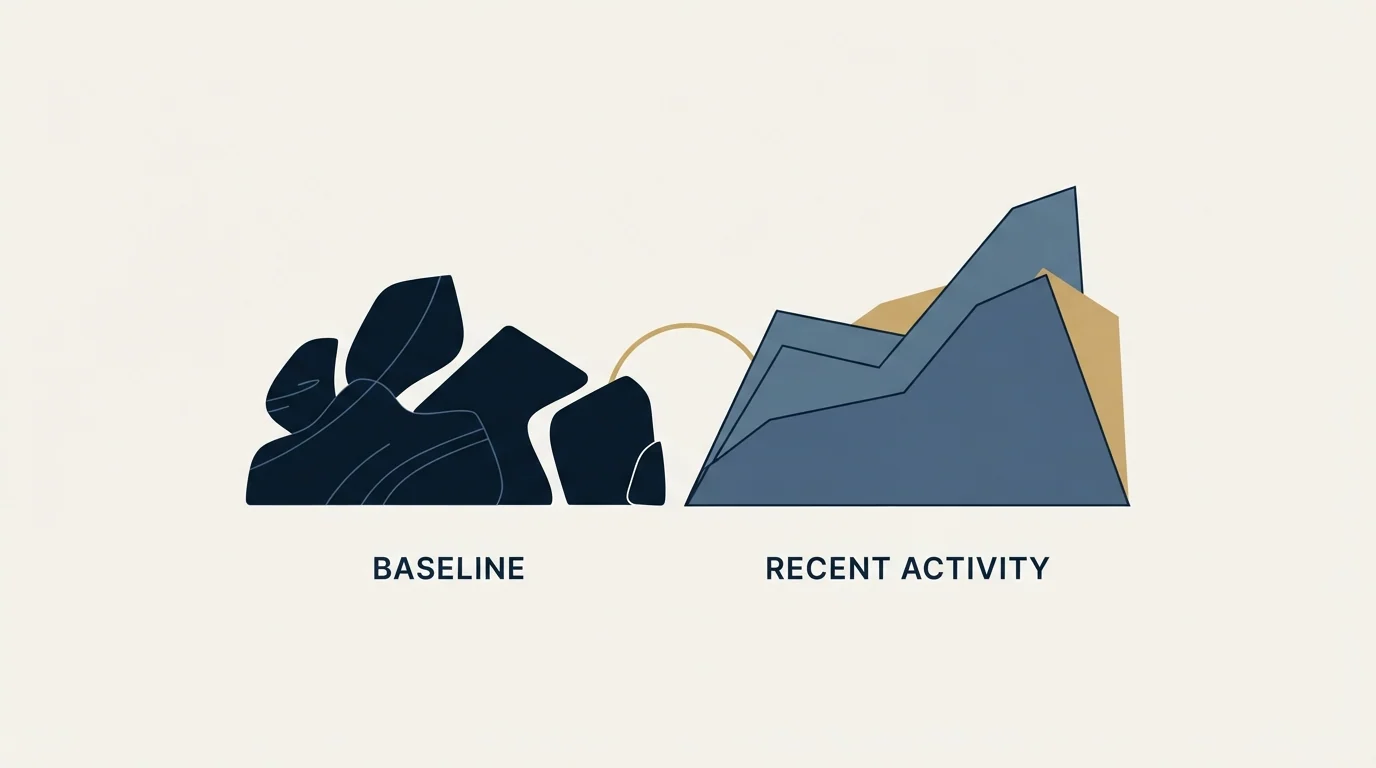
A ZoomInfo signal score measures how a company's recent content consumption compares against its own historical baseline, not how much it is researching in absolute terms. Signals attach to companies through IP-to-organisation matching, and audience strength reports the size of the researching group separately.
Key takeaways
- ZoomInfo's API documentation defines the signal score as a comparison of recent content consumption against that company's historical baseline, which makes it a change measure rather than a volume measure.
- Topics are keyword collections curated by ZoomInfo, so the buyer picks the topic and inherits the keyword set that decides which behaviour counts.
- The Search Intent endpoint consumes no credits, but every signal returned counts as a record and every successful response counts as a request credit.
- ZoomInfo's feature page describes a network of 210 million IP-to-org pairings sourced across US devices, so the signal is company level and US scoped by construction.
Reviewed and updated August 28, 2026
A rep opens the CRM on Monday and finds three accounts flagged as surging on a topic that matches what you sell. The obvious reading is that three companies are shopping right now. The accurate reading is narrower than that, and knowing exactly how much narrower is the difference between a targeted list and a wasted week.
ZoomInfo publishes the definitions in its own API documentation, which is a better place to start than the product page, because the API has to say precisely what each number is.
ZoomInfo Signals is the name the platform now uses for this layer, and Copilot surfaces it under the same word, so a signal and an intent score are the same instrument described at two altitudes.
ZoomInfo GTM Studio explains how these same signals get wired into automated workflows and plays that fire on buyer behaviour.
The three words that define the product
ZoomInfo's Search Intent endpoint documentation defines intent data as "online behavior-based activity across the internet that links prospective buyers (companies) to a topic," and names three terms.
A Topic is "a business subject or technology area mapped to a curated collection of keywords and search terms." Companies researching content that contains those keywords generate signals against that topic. You choose the topic. You do not choose the keyword collection behind it, and that collection is what actually decides which reading behaviour counts.
A Signal Score "indicates the level of a company's interest in a topic based on how recent content consumption compares to an historical baseline." Read that clause twice, because it is the single most consequential fact about the product. The score is a change measure. It compares this week against that company's own past behaviour.
Audience Strength "indicates the size of the group at the company that is conducting the research."
Everything useful and everything misleading about intent data follows from those three definitions.
A change measure behaves differently from a volume measure
Because the score compares recent consumption against a historical baseline, two companies with identical behaviour this week can score very differently.
A company that reads about your category constantly, because it is a large organisation with an analyst team and an active vendor-review habit, has a high baseline. Its genuinely new project has to clear that baseline before it registers. A company that has never read anything about your category and then reads four articles in a week clears its baseline instantly and scores loudly.
Neither reading is wrong. They answer the question the score is designed to answer, which is "has something changed here," and not the question most teams think they are asking, which is "is this account in market." Those diverge most at exactly the accounts you care about most, the large ones.
Audience Strength is the partial correction. A single curious person at a 5,000-person company and a buying committee of nine both produce a signal, and only the audience-size measure separates them. Reading the score without the audience measure beside it is where most poor targeting decisions get made.
- Step 1Topic
A business subject or technology area mapped by ZoomInfo to a curated collection of keywords and search terms.
- Step 2Observed research
Content consumption containing those keywords, attributed to a company rather than to a named person.
- Step 3Signal Score
How recent consumption compares against that company's own historical baseline, which makes it a measure of change rather than of volume.
- Step 4Audience Strength
The size of the group at the company doing the research, which is what separates one curious reader from a committee.
What the coverage claims say, and what they are scoped to
ZoomInfo's intent-data feature page states that its intent engine "triggers signals tracked from a network of 210 million IP to Org Pairings and more than 6 trillion new keyword-to-device pairings, all sourced monthly from over 90% of accessible devices across the U.S."
Three things are worth noticing in that sentence as published. The mechanism is IP-to-organisation matching, which is why the natural unit of the product is a company rather than a person. The scale claim is about pairings observed, not about companies covered, so it is not a coverage rate in the sense a buyer usually means. And the stated footprint is the United States, which matters if your ICP sits in Europe or APAC.
The same page describes Person-Level Intent, which ZoomInfo positions as showing "the specific people inside those accounts, their role, seniority, and place in the buying decision." That is the vendor's own description of a newer capability layered on top of the company-level signal. If person-level attribution is the reason you are buying, it is worth asking in the sales process exactly how a person is attributed and what the confidence looks like, because the underlying network described on the same page is an IP-to-organisation one.
The metering is records and requests, not credits
This is the part that surprises teams who budget intent as a credit line. ZoomInfo's Search Intent documentation states that the endpoint "does not consume any credits, but each Intent Signal returned in the results is counted as a Record and a successful response will count as a Request credit."
So a broad topic list that returns thousands of signals is cheap in credits and expensive in records. The documentation also caps the request itself: every Search Intent request must include at least one and up to 50 intent topics. Per-company lookups go through a separate Enrich Intent endpoint, and the allowed values for input parameters come from a Lookup Data endpoint rather than from a list you can guess.
The practical shape of a cost-controlled integration follows directly. Choose few topics rather than many, because each returned signal spends record allowance. Filter server side wherever the endpoint allows it. Pull on a schedule that matches how fast you can actually work the accounts, since a signal you cannot action this week costs the same as one you can.
If you are wiring this into a workflow rather than reading it in the ZoomInfo interface, the intent signal API roundup covers how the main providers expose this class of data and what connecting each one involves.
- A comparison of recent consumption against that company's historical baseline
- Attributed to a company through IP-to-organisation matching
- Driven by a keyword collection ZoomInfo curates for each topic
- Paired with an audience-size measure that is reported separately
- A ranking of how badly an account wants to buy
- Evidence that a named person is researching
- A signal generated by keywords you chose
- A number that stands alone without the audience measure
Validating a topic before you build a quarter on it
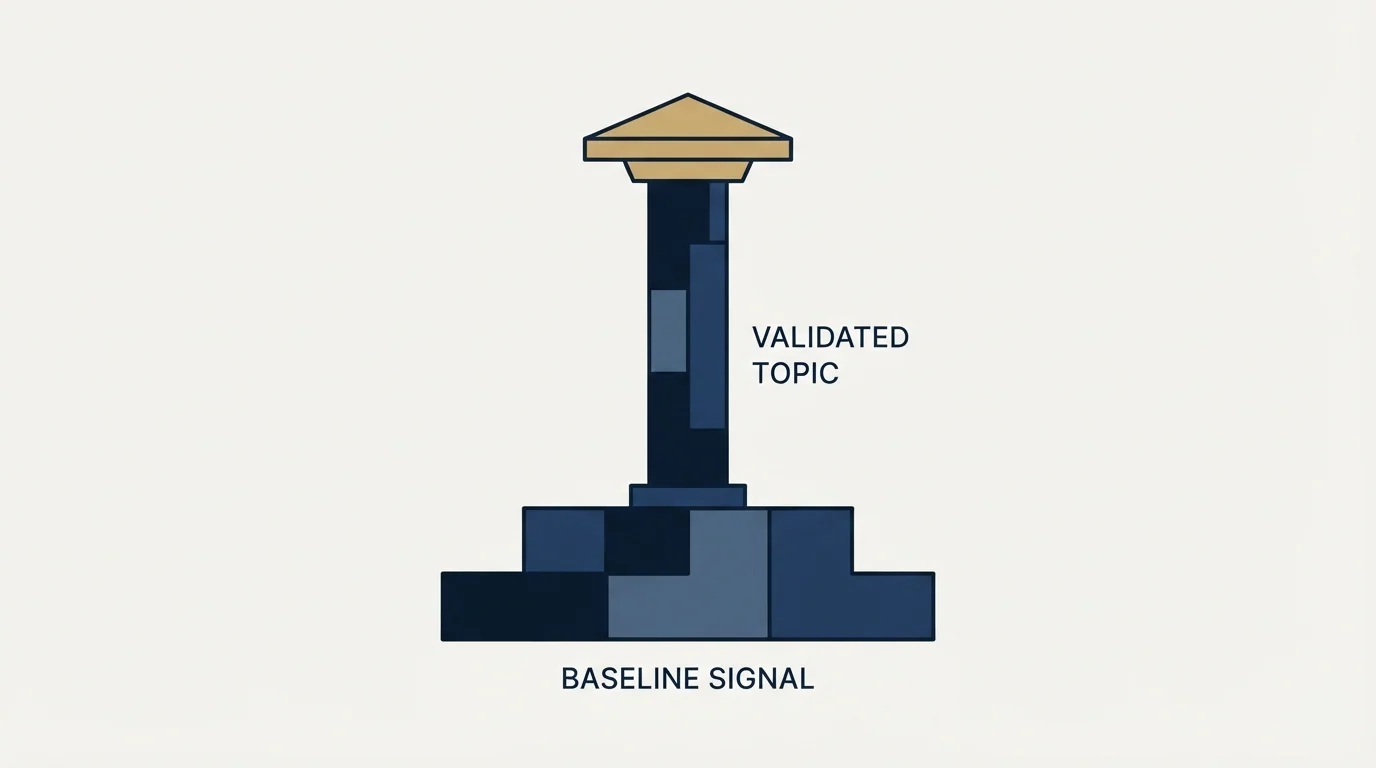
The topic is the only lever you control, and it is bought sight unseen unless you ask. Two checks cost nothing and settle most of the doubt.
The first is a backward test. Take accounts you closed in the last two quarters and ask whether they showed signal on the topic you plan to buy, in the weeks before they engaged. A topic that was silent across your own closed-won list is not describing your buying process, whatever it is describing.
The second is a false-positive read. Pull the current signal list for the topic and look for the account types that should not be there: your own vendors, your competitors, universities, agencies researching on behalf of a client, and anyone whose interest in the topic is professional curiosity rather than a purchase. Some proportion of those is normal. A list dominated by them means the keyword collection is broader than your category.
Both checks are more useful during a trial than after a contract, and both are questions a vendor can answer in a call rather than a procurement cycle.
Using a company-level signal without wasting the send
Intent earns its place as a list-shaping input and loses money as a personalisation input.
As a list input it is strong. It tells you which accounts in a target market have changed behaviour recently, which is a better ordering principle than alphabetical or than last quarter's territory split. Combine it with the firmographic and technographic filters you would have applied anyway, and you get a smaller list with a better reason behind each row.
Before feeding this cleaner account list into your CRM, it is worth checking how ZoomInfo's own data cleanup and routing suite handles deduplication and enrichment upstream.
As a personalisation input it is weak, and the failure is visible to the recipient. A message that says you noticed the reader researching a topic is claiming knowledge of an individual that a company-level, IP-derived signal does not support. Recipients who have not been researching anything read it as a guess, which is exactly what it is.
Our own operating rule is that a fresh signal justifies a fresh campaign rather than another message inside an old one. One message per campaign, no bumps and no thread replies, so an account that goes quiet and then surges months later gets a new campaign built on the new angle. That keeps the intent data doing the job it is good at, which is deciding who to contact and when, and keeps it out of the job it is bad at, which is pretending to know what one person read.
For the wider question of what intent data predicts across providers, the B2B intent data guide sets out the comparison. If the answer turns out to be that the intent module is not worth the platform it is attached to, the ZoomInfo alternatives comparison covers the rest of the market.
- Depends: You have seen the keyword collection behind each topic you plan to buy, or asked what is in it.
- Yes: Your ICP is inside the stated US footprint of the signal network.
- Yes: You read Audience Strength beside every Signal Score rather than ranking on score alone.
- Yes: You have counted expected signals per pull against your record allowance, not your credit balance.
- Yes: No copy claims that a named person was researching, because the signal is company level.
- Yes: A surging account triggers a new campaign with a new angle rather than another touch on an old one.
Where it fits in the stack
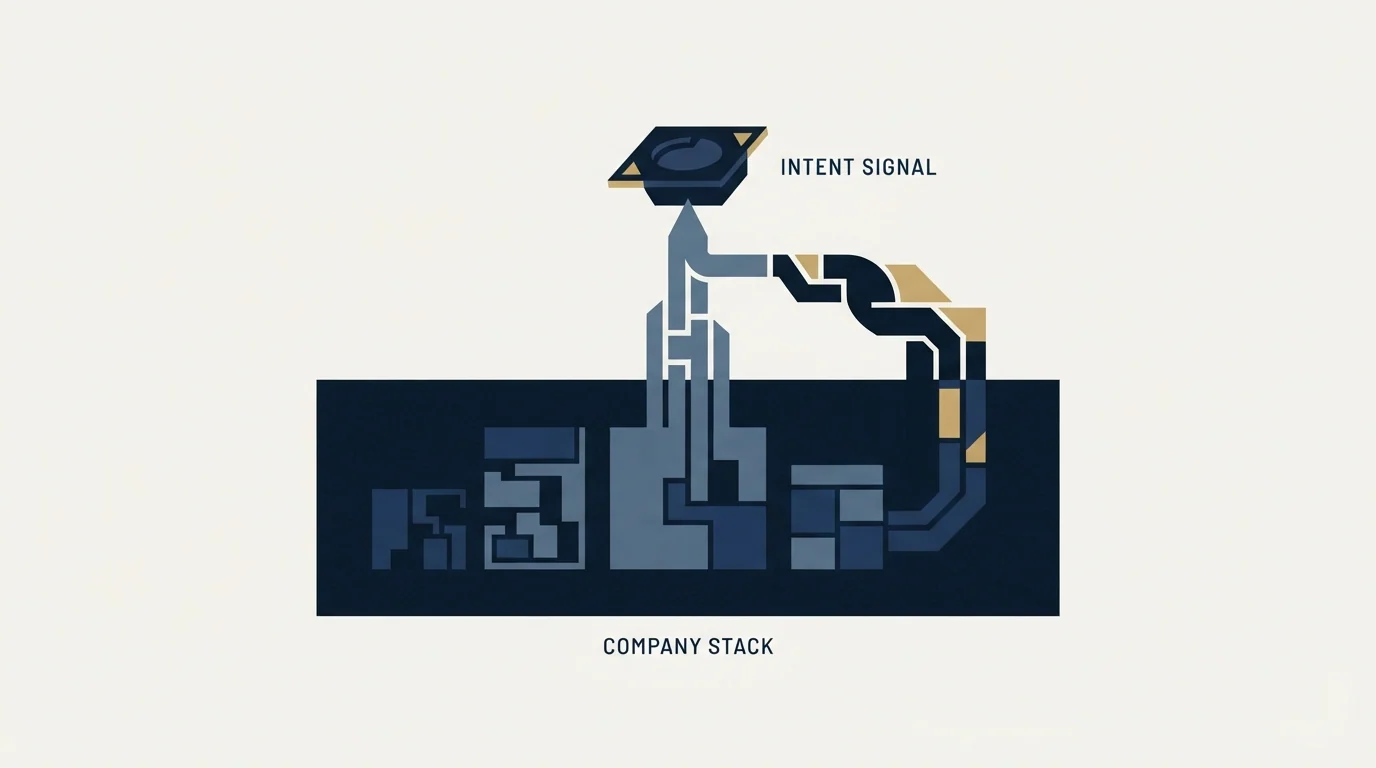
Intent sits above the data layer and below the campaign. It does not find contacts, it does not verify emails, and it does not decide messaging. Treating it as a source of prospects rather than as a sort order on prospects you already qualified is the fastest way to spend a year's budget on a report nobody reads.
Where intent data ends and pipeline management begins is the same boundary explored in CRM versus data enrichment tools.
The data layer underneath still has to hold up. If contact coverage or accuracy is the actual constraint, waterfall enrichment is a cheaper fix than a signals product, and it is the one that changes reply rates.
If you would rather have the list, the copy and the sending infrastructure built and run against signals like these than assemble it yourself, our free campaign build is the place to start.
Pricing and features verified as of mid-2026. Verify current terms with the vendor before relying on them.
Frequently asked questions.
Frequently asked questions- Does ZoomInfo intent data tell you which person is researching?
- The underlying signal is company level. ZoomInfo's documentation describes intent as behaviour that links prospective buyers, meaning companies, to a topic, and the network described on its feature page matches IP addresses to organisations. ZoomInfo separately sells a person-level layer on top of that. Ask how a person is attributed before you write copy that assumes it.
- How many intent topics can you query at once?
- ZoomInfo's Search Intent endpoint requires at least one and allows up to 50 intent topics in a single request. Allowed values for the input parameters come from a separate Lookup Data endpoint rather than from free text. For signals on one named company rather than across the database, ZoomInfo exposes a separate Enrich Intent endpoint.
- Does pulling intent signals burn ZoomInfo credits?
- Not credits, according to ZoomInfo's own documentation. The Search Intent endpoint consumes no credits, but each intent signal returned counts as a record against your record limit and each successful response counts as a request credit. A broad topic list is therefore cheap in credits and expensive in records, which is the budget line teams usually miss.
- Why do large accounts rarely show high intent scores?
- Because the score compares recent research against that company's own historical baseline. A large organisation that constantly reads about your category already has a high baseline, so a genuine new project has to clear it before the score moves. A smaller company with no prior reading clears its baseline immediately, which makes it look louder.
About the author.

B2B cold email experts helping companies generate qualified leads through done-for-you outreach campaigns.
RevenueFlow Team
Explore more.
Ready to scale your outreach?
We build GTM engines that book real meetings. See the receipts.
Related articles.
Video Prospecting Tools by Job: What Each One Is For
Ten video prospecting tools sorted by the job each vendor's own page describes: record and share, personalise at volume, avatars, hosting and interactive demos.
RevOps Tools: Nine Products and the Job Each Does
Nine revenue operations products sorted by the six jobs the category covers, with every product fact and price read off the vendor's own pages and dated.
Best CRM for Google Workspace: What Lives in Gmail
Working with Google Workspace covers four separate integrations, and most of the category ships as a browser extension. What five vendors publish about theirs.
Gong vs Chorus: The Decision Is Not the Recording
Chorus belongs to ZoomInfo and Gong belongs to itself. Neither publishes a rate, both record the same calls, and the ownership is what the choice turns on.
Social Selling Tools by Job, and the Account-Risk Line
Fourteen social selling tools sorted into six jobs, split by whether each acts through your LinkedIn account or beside it, from the vendors' own pages.
Is Clay Free? The Free Plan, the Trial and Where Each Stops
Clay's free plan, its 14-day trial and the no-charge-on-a-miss rule are three different things. What each holds and where it stops, from clay.com on 19 September 2026.