ZoomInfo GTM Studio: The Canvas and the Signals
A contact database company selling workflow orchestration. Three separate promises are bundled on one product page, and each one fails differently.
GTM Studio is ZoomInfo's workflow orchestration product, described on its product page as building and running go-to-market workflows triggered by buying signals. It bundles three separate claims: consolidating tools into one canvas, built-in waterfall enrichment, and plays that fire automatically on buyer behaviour.
Key takeaways
- The product page describes unifying CRM, marketing, sales and third-party data into one canvas so RevOps and marketers can launch without engineering support, which names the buyer as an organisation whose bottleneck is implementation capacity.
- Automation does not improve a signal, it applies it faster, so a weak signal produces more wasted contact rather than less and the false-positive rate on your own market is the number that decides value.
- Buying signals of very different quality share one label: a named form fill, an anonymous visit resolved by IP, and a third-party topic surge are not equivalent instruments and a play that treats them alike will behave as though they are.
- Consolidation is costed as a licence decision and paid for as a migration, so the questions that reveal the real number are which line items stop, who rebuilds the workflows, and what the exit costs while alternatives still exist.
Reviewed and updated September 1, 2026
ZoomInfo's product page for GTM Studio describes it in one line: "Build and run GTM workflows triggered by buying signals." That is a workflow orchestration product, and it is a notable thing for a contact database company to be selling, because it is a different business from the one ZoomInfo built.
The rest of the page is specific about what the product is meant to displace. It describes unifying your data connections into a live canvas, connecting CRM, marketing tools, sales systems and third-party data into one view, with the stated aim of removing tool sprawl and missed signals. It says plays launch with embedded data and built-in orchestration so that RevOps and marketers can launch "without engineering support". And it says the product can "Orchestrate outreach across email, calls, ads, and direct mail, all triggered automatically by real-time buyer behavior."
Read as a strategy statement, that is ZoomInfo moving from selling the data underneath a go-to-market motion to selling the layer that runs it.
Deciding whether to buy that orchestration layer outright or pair ZoomInfo's data with a dedicated engagement tool is worth weighing against the Salesloft vs ZoomInfo comparison.
ZoomInfo Workflows is the older automation surface underneath this pitch, and the questions are identical whichever one your account exposes: what fires the play, how often it fires, and who notices when the connector under it changes.
The three claims worth separating
Product pages of this kind bundle several distinct promises. Pulling them apart is the whole evaluation, because they carry very different risks.
The first claim is consolidation: one canvas replacing several tools. That is the claim most likely to be true in a demo and least likely to survive contact with an existing stack, for the ordinary reason that the tools being replaced have data, history and workflows in them that somebody depends on.
The second claim is enrichment. The page states that GTM Studio automatically fills in missing contact data with "built-in waterfall enrichment", and a video on the same page is titled "Waterfall Enrichment from 25+ vendors for free". A waterfall that queries many providers and takes the first good answer is a genuinely useful architecture, and it is the pattern we describe in our own writing on waterfall enrichment. The word doing the work in that video title is "free", and it is the one to ask about in a demo, because free-at-the-point-of-use inside a platform contract is a different arrangement from free.
The third claim is signal-triggered orchestration: plays that fire automatically on real-time buyer behaviour. This is the claim with the most upside and the most dependencies, and it deserves its own section.
- Depends on what your existing tools actually hold
- Migration cost is the real number
- Ask: what stays, and who maintains the seam
- Described as built in, and as covering 25+ vendors
- The word to test in a demo is free
- Ask: what is metered, and what happens at renewal
- Value depends entirely on signal quality
- Automation multiplies whatever the signal decides
- Ask: what exactly counts as a signal, and how often it fires
Signals are the part that decides whether this works
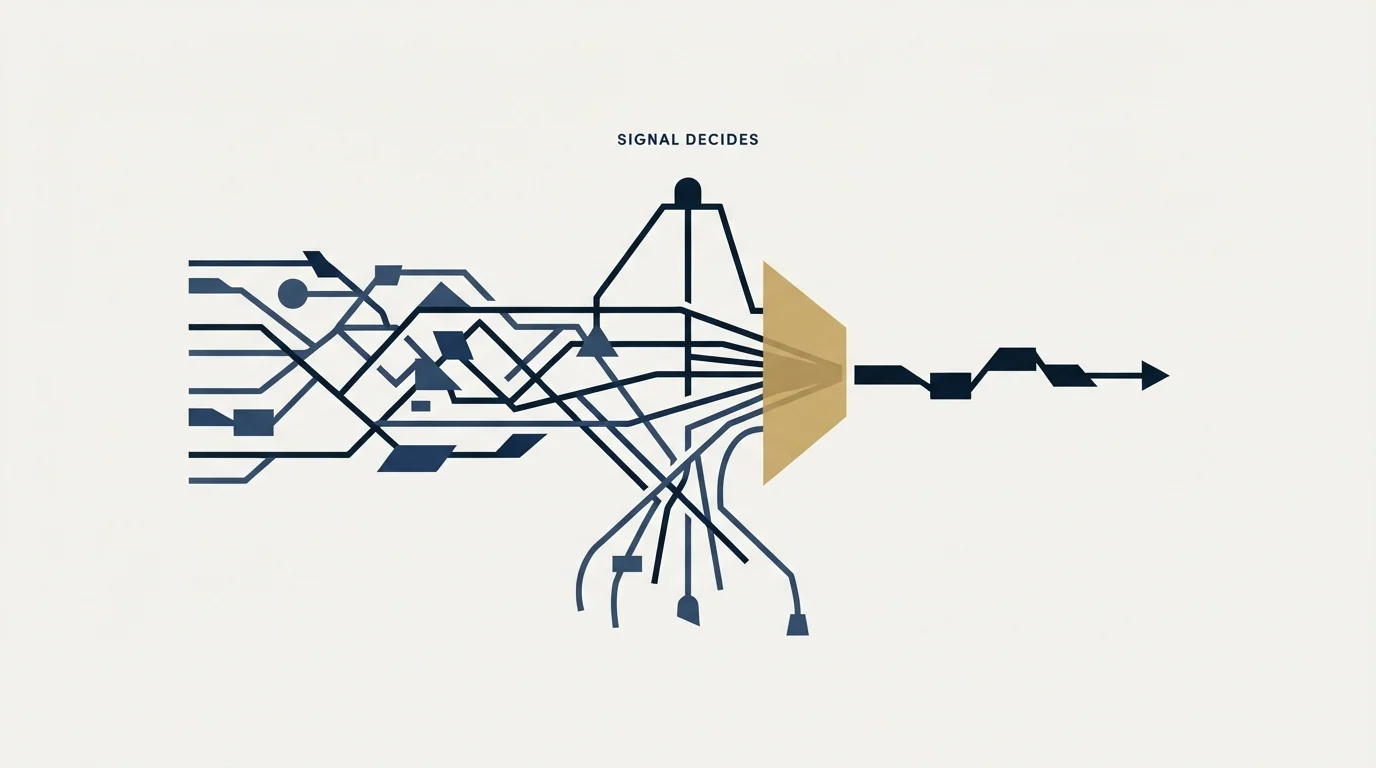
Every signal-triggered system rests on the same assumption: that the signal predicts something. Automation does not improve a signal, it applies it faster and more often, which means a weak signal produces more wasted contact rather than less.
This matters because the buying-signal category covers things of very different quality wearing one label. A named person filling in a form on your pricing page is a strong signal about intent. An anonymous visit resolved to a company by IP is a much weaker one, and a topic-surge score derived from third-party content consumption is weaker again, because it says something about an organisation's aggregate reading rather than about a person's intention to buy.
None of those are worthless. They are usefully different, and a play that fires the same outreach on all three treats them as equivalent. The practical question to put to any signal-triggered product is therefore not whether it can fire a play. It is which signals are available, what each one is derived from, and what the false-positive rate looks like on your market. The general shape of that assessment is in our B2B intent data guide and in intent signal APIs for outbound.
There is a second-order effect worth planning for. When plays fire automatically on a signal, the volume is set by how often the signal fires rather than by a person deciding. A threshold set slightly too loose does not produce slightly more outreach, it produces continuously more, and nobody approves each batch. Whatever the product's controls are for rate-limiting a play, find them before the play is live.
- Step 1Enumerate the signals
Get the list of what counts as a signal and what each one is derived from. First-party form fills, resolved anonymous visits and third-party topic surges are not the same instrument.
- Step 2Score a historical sample
Take companies the signal would have fired on last quarter and check what actually happened. This is the only test that uses your market rather than the vendor's.
- Step 3Fire one play manually
Run the play with a person approving each batch before automating it, so the first version of the message is read by someone.
- Step 4Set the rate limit before automating
An automatic trigger produces volume set by the signal's frequency. Find the throttle before the play is live, not after.
- Step 5Judge on qualified conversations
Measure plays on meetings that pass criteria written down before launch, never on plays fired or contacts touched.
The consolidation question, asked properly
The pitch that a single canvas removes tool sprawl is attractive in direct proportion to how much sprawl you have. It also has a predictable failure mode, which is that consolidation projects are usually costed as a licence decision and paid for as a migration.
Three questions make the real cost visible. What specifically stops being paid for, named as line items rather than as a category. Who rebuilds the workflows that currently run in the tools being replaced, and over what period. And what happens to the historical data in those tools, since reporting continuity across a migration is the thing teams discover they needed a quarter after the cutover.
There is a structural consideration too, and it is the one that should carry the most weight in a long-horizon decision. Consolidating your data, your enrichment and your orchestration into a single vendor makes that vendor harder to leave, and the leverage that creates shows up at renewal rather than at signature. That is not an argument against doing it. It is an argument for knowing the exit cost while you still have alternatives, and for keeping your own copy of the records that matter.
ZoomInfo's position in the market is itself part of the context here, and we have written about how the category has been repriced in 16 GTM software companies worth $170 billion.
- Yes: The list of available signals, and what each is derived from
- Yes: A historical sample scored against the signal on your own market
- Yes: What the free in free waterfall enrichment covers, and what is metered
- Yes: Named line items that stop being paid for after consolidation
- Yes: Who rebuilds existing workflows, and over what period
- Yes: Data portability and the exit cost, agreed while alternatives exist
- No: Automating a play before a person has read its output at volume
- No: Judging plays on volume fired rather than on qualified conversations
Who operates it after the launch

The page's promise that RevOps and marketers can launch without engineering support is the sharpest claim on it, and it is worth separating launch from operation, because the two have different staffing profiles.
Launching a play without engineering support is plausible. Canvas-and-connector products are genuinely good at the first build, and that is what a demo shows. Operating a portfolio of plays is a different job. Connectors break when a source system changes a field. Signals drift as the underlying data changes. Plays overlap, so the same company qualifies for three of them and receives three contacts in a week from an organisation that believes it sent one. Someone has to notice all of that, and noticing is not a launch activity.
The honest way to size this is to ask who owns the plays six months after go-live, by name and by allocated time. Products in this category are sold on the removal of a bottleneck and are maintained by the person who used to be the bottleneck. If that person does not exist, the plays degrade quietly, which is worse than failing loudly because the outreach keeps going out.
The overlap problem deserves particular attention because it is invisible from inside any single play. Each one is correct on its own terms. The aggregate is what the recipient experiences, and nothing in a play-level view shows it. Whatever the product offers as a global contact-frequency control, that is the setting to understand before the second play goes live rather than the tenth.
Where it fits, and what it does not change

GTM Studio is aimed at teams with enough systems, enough signal volume and enough RevOps capacity for orchestration to be the binding constraint. The page's own framing, that RevOps and marketers can launch without engineering support because ideas otherwise "die in ticket queues", names the buyer precisely: an organisation where the bottleneck is implementation capacity rather than ideas.
For a team without that shape, the product solves a problem it does not have. If you run one sending platform, one CRM and one enrichment source, the sprawl the canvas removes is not there, and the orchestration layer adds a system to maintain rather than removing several.
The other thing worth keeping straight is what orchestration does and does not decide. Firing the right play at the right moment is genuinely valuable, and it is downstream of two things it cannot fix: whether the companies are the right companies, and whether the message is worth reading when it arrives. A signal tells you when to send. It does not tell you what to say, and it does not make a poorly targeted list into a good one.
Our own practice sits deliberately on the simple end of that spectrum: a written definition of who we are contacting, one message per campaign rather than a sequence, a new campaign on a new angle when we want to reach a non-replier again, and meetings qualified against criteria agreed in writing before launch. Automation earns its place where it removes work from a motion that already produces the right conversations, which is the same test worth applying here.
For the rest of ZoomInfo's product surface, our roundup of alternatives to ZoomInfo covers where the database itself is strong and where it is not, and Apollo vs ZoomInfo on data accuracy sets out how to test the underlying data on your own market rather than on a published coverage figure.
If you want the conversations without building the machine that produces them, see what a first campaign looks like.
Product descriptions quoted here were verified against raw page bytes from zoominfo.com in mid-2026. The page publishes no pricing and routes to a demo request. Verify current terms and what is included with the vendor before relying on them.
Frequently asked questions.
Frequently asked questions- What is ZoomInfo GTM Studio?
- ZoomInfo's orchestration product. Its page describes building and running go-to-market workflows triggered by buying signals, unifying CRM, marketing and sales systems plus third-party data into one live canvas, with built-in waterfall enrichment and the ability to orchestrate outreach across email, calls, ads and direct mail from automatic triggers.
- How much does GTM Studio cost?
- The product page publishes no pricing and routes to a demo request. That makes the terms rather than the headline the thing to prepare for, and the specific item to test is what free means in the waterfall enrichment claim, since free at the point of use inside a platform contract is a different arrangement from free.
- Is signal-triggered outreach worth setting up?
- It depends entirely on signal quality, which is testable before you buy. Take companies the signal would have fired on last quarter and check what actually happened. That test uses your market rather than the vendor's, and it is the only one that tells you whether faster application of the signal helps or simply multiplies a false positive.
- Do I need an orchestration layer?
- Only if orchestration is the constraint. The product is built for teams with enough systems and signal volume that implementation capacity is the bottleneck. If you run one sending platform, one CRM and one enrichment source, the sprawl a canvas removes is not there and the layer adds a system to maintain rather than removing several.
About the author.

B2B cold email experts helping companies generate qualified leads through done-for-you outreach campaigns.
RevenueFlow Team
Explore more.
Ready to scale your outreach?
We build GTM engines that book real meetings. See the receipts.
Related articles.
RevOps Tools: Nine Products and the Job Each Does
Nine revenue operations products sorted by the six jobs the category covers, with every product fact and price read off the vendor's own pages and dated.
Is Clay Free? The Free Plan, the Trial and Where Each Stops
Clay's free plan, its 14-day trial and the no-charge-on-a-miss rule are three different things. What each holds and where it stops, from clay.com on 19 September 2026.
Video Prospecting Tools by Job: What Each One Is For
Ten video prospecting tools sorted by the job each vendor's own page describes: record and share, personalise at volume, avatars, hosting and interactive demos.
Seamless.AI Email Finder: How It Works, What a Credit Buys
How Seamless.AI's email finder resolves a contact in real time, what one Universal Credit buys, the Total AI score on every address, and what the Chrome extension reads.
Social Selling Tools by Job, and the Account-Risk Line
Fourteen social selling tools sorted into six jobs, split by whether each acts through your LinkedIn account or beside it, from the vendors' own pages.
Autobound Pricing: One-Time Credit Packs, Not Seats
Autobound's pricing page sells one-time credit packs for a signal data API, not seats. The six packs, the per-endpoint meter, and what a company costs.