GoHighLevel Pricing: The Plan Fee and the Meters
The plan fee is the smallest line on a HighLevel bill. What email, phone, AI and automation actually cost, read from the vendor's own help centre.

GoHighLevel pricing is $97, $297 and $497 a month for Starter, Unlimited and Agency Pro, or $970, $2,970 and $4,970 a year, plus a quoted Enterprise tier. Email, phone, AI and premium workflow steps are metered on top through a prepaid Agency Wallet: email is $0.675 per 1,000, phone matches Twilio's rates, premium workflow steps are $0.01 each.
Key takeaways
- The published ladder is $97, $297 and $497 a month, with annual figures of $970, $2,970 and $4,970 beside each card, a 14-day trial on every tier and no long-term contract.
- Metered usage draws on an Agency Wallet that automatically charges the agency card when the balance falls below a minimum you set, so it is a float rather than a spending cap.
- The help centre publishes email at $0.675 per 1,000 across all plans, phone at precisely the same amount as Twilio, and premium workflow actions at $0.01 per execution.
- Rebilling usage at cost starts on the $297 plan and adding a markup needs the $497 plan as part of SaaS Mode, so the Starter agency absorbs every metered cost itself.
Reviewed and updated September 18, 2026
GoHighLevel pricing starts at $97 a month on HighLevel's own pricing page, and for most agencies running the platform properly that is the smallest line on the bill. The platform fee is flat and the delivery is not. Sending, calling and premium automation are all metered, and none of those per-unit rates sits on that pricing page as fetched on 2 September 2026. The AI subscription rates and most of the resold-service rates do appear there; what the pricing page never shows is the per-unit layer, which is set out in the vendor's own help centre on a different host.
This page reads the meters. The plan ladder is here because you need it to understand the rest, and it is short on purpose.
GoHighLevel pricing: how much does it cost per month?
GoHighLevel pricing is $97 a month for Starter, $297 for Unlimited and $497 for Agency Pro, or $970, $2,970 and $4,970 a year on the annual figures the pricing page prints beside each card. Enterprise is quoted. Those are platform fees only: email, phone, AI and premium workflow steps are metered on top, through a prepaid Agency Wallet.
The subscription ladder, as published
HighLevel's pricing page shows monthly and annual figures side by side on every card under the line "Scale your business without a tax on growth.", so no billing toggle has to be resolved before a rate can be taken from it. Read on 2 September 2026, the cards give:
| Plan | Monthly | Annual | The line that matters |
|---|---|---|---|
| Starter | $97 | $970 | 3 sub-accounts |
| Unlimited | $297 | $2,970 | Unlimited sub-accounts, rebilling at no markup |
| Agency Pro | $497 | $4,970 | SaaS Mode, rebilling with markup |
| Enterprise | Quoted | Quoted | Contact their enterprise team |
That same page headlines "Start with a FREE 14-day trial on any plan below!" and "Unlimited contacts, unlimited Users." above the cards. Its own answers below them say the platform runs month to month with no long-term contract, that you can upgrade, downgrade or cancel from the dashboard, and that a mid-month upgrade is charged as the prorated difference.
The unit the ladder is built from is the sub-account, one client workspace inside one agency workspace, and the Starter card names its allowance as "3 Sub-Accounts". That is the whole shape of the tier decision, and the feature-by-feature comparison against a conventional sales CRM is worked through separately in Pipedrive against GoHighLevel.
The Agency Wallet, which is where the rest of the money goes
Usage does not appear on your subscription invoice. A separate mechanism carries it, and understanding that mechanism is the difference between a predictable bill and a surprising one.
Meters outside the subscription are the norm in this category, and Ontraport prices seats and SMS credits separately, on rates quoted at its smallest contact band.
The Agency Wallet is a prepaid balance the agency tops up, and metered services draw down against it. The vendor's own description of the top-up behaviour is worth reading exactly: "If the wallet balance falls below your minimum balance, HighLevel automatically charges the agency card on file to refill the wallet." So the wallet is not a spending cap. It is an auto-replenishing float, and the recharge amount and minimum balance are settings rather than limits.
The same help centre names the services that draw on it, in its own words: "Common wallet-funded services include the Phone System, Email System, Email Validation, AI usage, Autocomplete Addresses, and Workflow Premium Features." Every one of those is a per-unit charge on top of the plan fee.
What the meters cost

These are the per-unit rates that appear nowhere on gohighlevel.com/pricing as fetched on 2 September 2026; the AI Employee subscription rates below are the exception, since the pricing page prints them per sub-account. Each one below is quoted from HighLevel's help centre on the same date, and the guide's own framing is that the wallet exists because these charges are "based on what is actually used".
Rates hiding from a page reader take other forms too, and Navattic's four published rates are missed entirely by a scripted read of its own pricing page.
Email. The help centre states that "Email usage is $0.675 per 1,000 emails across all plans". The Email System, which it calls LC Email, works out of the box for every sub-account and removes the need to connect a separate provider. The rate does not change by tier; what changes by tier is whether you can pass it on.
Phone. The help centre states that "The pricing for LC Phone System is precisely the same amount as Twilio." That is an unusually clean disclosure, because it means the rate is knowable from a third party's published rate card rather than being opaque, and it varies by region and product exactly as Twilio's does. Numbers, SMS, MMS and calls all sit here.
AI. There are two ways to buy it and they price differently. HighLevel's AI pricing article sets out a pay-per-use column charging token cost only, with named per-unit exceptions: its rows read "Reviews AI $0.01/ review" and "Content AI $0.063/image and $0.0945/1,000 words", under the line "All prices are in USD.". The subscription route is the AI Employee, and the pricing guide publishes it at $50 a month per enabled location on the Growth plan and $97 a month per enabled location on the Unlimited plan, the second covering unlimited Conversation AI, Voice AI, Reviews AI and Content AI subject to fair use.
One line in that section deserves highlighting because it is the kind of thing that produces an unexpected invoice: "Phone System charges still apply to phone calls, even when Voice AI (Inbound) is covered under the AI Employee Unlimited subscription." Buying unlimited voice AI does not buy the telephony it runs on.
Automation. The pricing guide charges premium workflow triggers and actions at $0.01 per execution, and states that the agency is charged only for premium steps in sub-accounts beneath it rather than for free ones. It publishes a volume plan on top of that as a full ladder with its own overage rates:
| Workflow Pro tier, as the help centre publishes it | Monthly | Included executions | Overage |
|---|---|---|---|
| Free | $0 | 100 free lifetime executions | $0.01 per execution |
| Starter | $10 | 10,000 | $0.008 per execution |
| Growth | $25 | 30,000 | $0.006 per execution |
| Scale | $50 | 65,000 | $0.004 per execution |
That table is the pricing guide's own, and it adds that "Workflow Pro does not include ChatGPT or Workflow AI" executions, which stay pay as you go.
Put together, an illustrative month for one agency on the Unlimited plan reads as a subscription line and a set of wallet lines: 40,000 emails at the published $0.675 per 1,000 is $27, 5,000 premium workflow executions at $0.01 is $50, two locations on AI Employee Growth at $50 each is $100, and phone is whatever Twilio's rate card says for the numbers and minutes used. Those volumes are made up to show the shape; only the rates are the vendor's.
One agency, one month, Unlimited plan (illustrative)
Platform subscription, Unlimited: $297
Wallet: 40,000 emails at $0.675 per 1,000: $27 1
Wallet: phone numbers, SMS and calls at Twilio's rates 2
Wallet: 5,000 premium workflow executions at $0.01: $50 3
AI Employee Growth, 2 locations at $50: $100 4
- 1Email is $0.675 per 1,000 across all plans, per the help centre. The rate never changes by tier; whether you can pass it on does.
- 2The help centre states the LC Phone System is priced precisely the same amount as Twilio, so this line is read off Twilio's rate card for your regions.
- 3Premium workflow steps are $0.01 per execution pay as you go; a Workflow Pro tier from $10 a month lowers the overage rate.
- 4AI is bought per enabled location, at $50 (Growth) or $97 (Unlimited) a month, or per use at token cost. Phone charges still apply to Voice AI calls.
Rebilling, reselling, and the tier that decides your margin
The two words HighLevel uses for passing costs on are not interchangeable, and the tier gates differ.
Rebilling covers ongoing usage. The vendor states that "Rebilling without markup is available on the $297/mo Unlimited plan and $497/mo Agency Pro plan" and that "Rebilling with agency markup is available on the $497/mo Agency Pro plan and is part of SAAS mode." Read against the published ladder, that means the Starter agency absorbs every metered cost with no mechanism to pass it on at all, the middle agency passes costs through at cost, and only the top agency earns a margin on them. The same guide calls out AI Employee rebilling separately as requiring that top plan.
Reselling covers services packaged as a product rather than as usage. The help centre publishes them as a rate table, and its rows read "Branded Client Portal App $49/mo", "Dedicated IP Address $59/mo", "Email Validation $2.50 per 1,000 validations", "Online Listings $30/mo", "Premium Prospecting Tool $29/mo", SEO powered by Search Atlas at $79 a month, WhatsApp integration at $10 a month, "Ad Manager $0/mo", and domain purchases at a rate the guide says varies by domain and top-level domain. The same guide says the agency is charged the HighLevel price per sub-account with the feature enabled, and can recover it at that price or above.
WordPress hosting is sold as its own three-tier ladder that the guide says the agency must select before clients can use it, and it publishes the rows as "Standard: $10/mo for 1 WordPress site", "Utility: $220/mo for 25 WordPress sites" and "Truly Unlimited : $497/mo for unlimited WordPress sites", each with an annual figure beside it.
Rebilling: ongoing usage
- Phone, email and AI consumption
- Charged to the Agency Wallet first, then to the sub-account
- $297 plan At cost, no markup
- $497 plan With your markup, as part of SaaS Mode
- $97 plan No rebilling mechanism
Reselling: a packaged service
- Online Listings, WhatsApp, the Branded Client Portal App, hosting
- Charged per sub-account with the feature enabled
- The agency pays the HighLevel price and sets its own client price
- Configured in the agency reselling settings
The agency-level add-ons

A last group sits outside both mechanisms because the agency buys it for itself rather than for a client. The help centre's add-on table publishes "Premium Support $500/mo or $5000/yr", "Whitelabel Mobile App $497/mo or $1491/quarter", "Whitelabel Zap $50/mo", "HL Certificate Program $97/mo or $970/yr", "Advanced Account Setup $1000" and "HIPAA Compliance $297/mo".
Two facts about that last one belong in a buying decision rather than in a footnote. The help centre states that "HighLevel accounts are not HIPAA compliant by default." And it states that "Once purchased and enabled, HIPAA Compliance cannot be deactivated." An add-on you cannot switch off is a permanent addition to the monthly floor, so it is worth deciding before rather than after.
Reading it as a sales team rather than an agency
The ladder is built from sub-accounts and reselling, which is a precise statement about who the product is for. A company with no clients buys a three-workspace platform to use one workspace, and the features it will lean on hardest are the marketing ones rather than the pipeline ones. That does not make the platform bad and it does make the published price misleading in one specific direction: the $97 entry point buys a platform whose value is proportional to the number of client workspaces you run, and a single company has one.
The mechanics of running it as a resold product, including what an agency actually owes its clients when it puts its own logo on somebody else's software, are covered in white label SaaS reselling and the seams where white-label email marketing breaks. The metering patterns across AI agent products, which is where this category is heading, sit in white label AI agents.
One boundary is worth stating plainly because an all-in-one platform makes it easy to cross. A platform with email and SMS built in invites you to run cold prospecting from the same sending identity that carries client work and commercial correspondence. Cold sending belongs on separate domains and separate warmed mailboxes, isolated so that a bad week in prospecting cannot damage the deliverability of anything else, and the layers that need to be yours rather than a vendor's are set out in cold email infrastructure. Our own position is documented policy rather than a claim about results: we run email and LinkedIn, on our own sending infrastructure, one message per campaign, with no bumps and no thread replies.
The short version
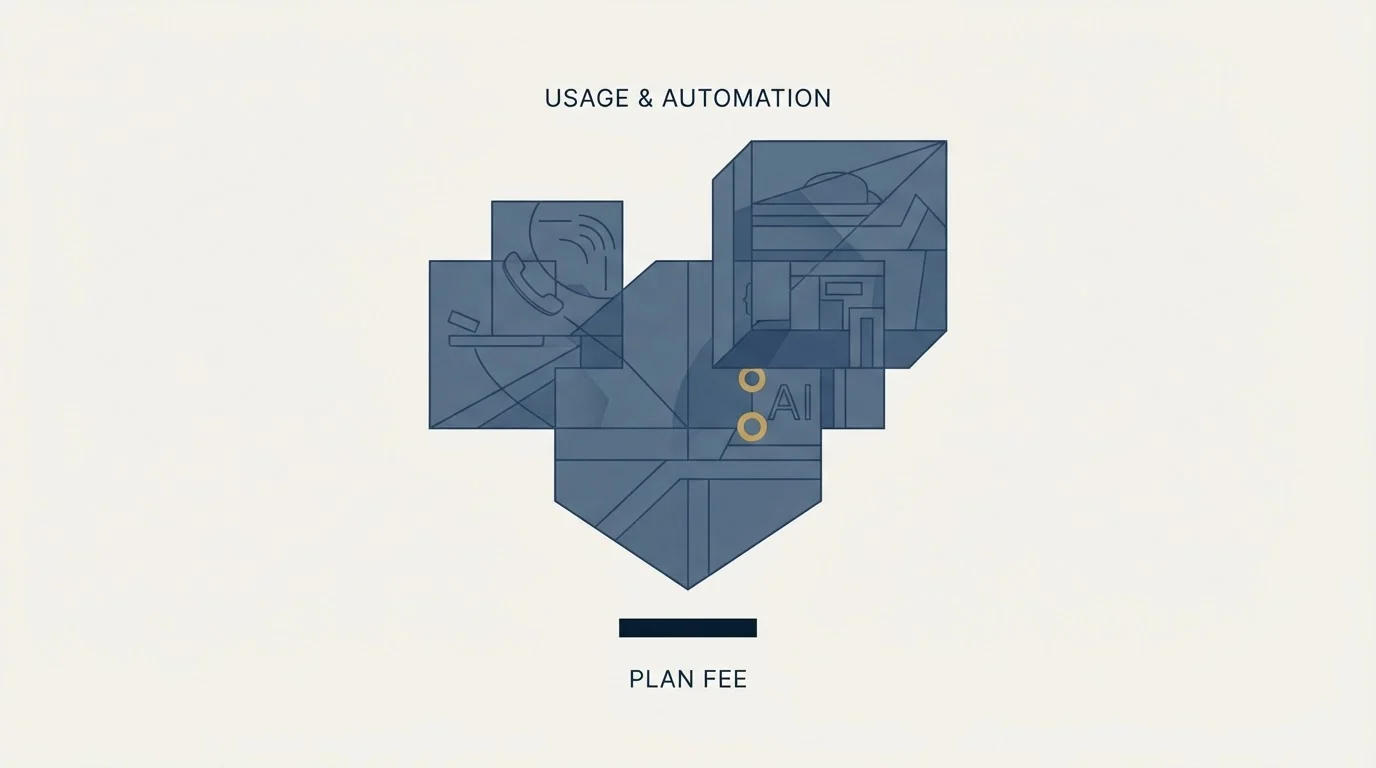
The plan fee is the part you can read in ten seconds and the smallest variable in the decision. The metered layer sits on a different host, in a help centre, and it prices email per thousand, phone at a third party's published rates, AI per unit or per location, and premium automation per execution against an auto-recharging wallet. Which tier you need is decided less by features than by whether you intend to pass those costs on, because the vendor puts the at-cost mechanism on the middle plan and the margin mechanism on the top one.
If you are pricing this platform because the pipeline is thin rather than because the tooling is wrong, the sequencing question comes first. See what a campaign built for your market produces before buying a platform to run one in.
Pricing and features are taken from the vendors' own pages. Verify current terms with the vendor before relying on them.
Sources: HighLevel pricing, HighLevel pricing guide, HighLevel AI product pricing
Frequently asked questions.
Frequently asked questions- How much does GoHighLevel cost per month?
- GoHighLevel's pricing page lists Starter at $97 a month or $970 a year, Unlimited at $297 or $2,970, and Agency Pro at $497 or $4,970, plus a quoted Enterprise plan. That is the platform fee only. Email, phone, AI and premium automation are metered on top and billed to a separate Agency Wallet, so the real monthly figure depends on what your client workspaces send and call.
- What is the Agency Wallet and can it cap my spend?
- It is a prepaid balance that metered services draw down against, and it is not a cap. HighLevel's help centre states that when the balance falls below the minimum you set, it automatically charges the agency card on file to refill the wallet. The recharge amount and the minimum are settings rather than limits, so usage does not stop when the balance runs low.
- Which GoHighLevel plan do I need to charge clients for their usage?
- Passing usage through at cost starts on the $297 Unlimited plan. Adding your own markup requires the $497 Agency Pro plan and is part of SaaS Mode, and AI Employee rebilling is called out as needing that same tier. On the $97 Starter plan there is no rebilling mechanism at all, so the agency absorbs every metered cost itself.
- Is there a GoHighLevel add-on that cannot be cancelled?
- One. HIPAA compliance is an account-wide add-on at $297 a month, and the help centre states that accounts are not HIPAA compliant by default and that once purchased and enabled it cannot be deactivated. That makes it a permanent addition to your monthly floor, so it is worth deciding before you enable it rather than after.
About the author.

B2B cold email experts helping companies generate qualified leads through done-for-you outreach campaigns.
RevenueFlow Team
Explore more.
Ready to scale your outreach?
We build GTM engines that book real meetings. See the receipts.
Related articles.
Ontraport Pricing: Three Plans and Five Other Meters
Ontraport now publishes three plans, not the four most pricing pages still quote. The rates are its annual state at the smallest contact band.
Is Clay Free? The Free Plan, the Trial and Where Each Stops
Clay's free plan, its 14-day trial and the no-charge-on-a-miss rule are three different things. What each holds and where it stops, from clay.com on 19 September 2026.
Seamless.AI Email Finder: How It Works, What a Credit Buys
How Seamless.AI's email finder resolves a contact in real time, what one Universal Credit buys, the Total AI score on every address, and what the Chrome extension reads.
Social Selling Tools by Job, and the Account-Risk Line
Fourteen social selling tools sorted into six jobs, split by whether each acts through your LinkedIn account or beside it, from the vendors' own pages.
Video Prospecting Tools by Job: What Each One Is For
Ten video prospecting tools sorted by the job each vendor's own page describes: record and share, personalise at volume, avatars, hosting and interactive demos.
What Cold Email and Sales Tools Actually Cost in 2026: Pricing Data From 386 Vendors
RevenueFlow's verified dataset of 386 sales tools puts the median starting price at $39.98 a month. Here is the spread by category, tier and billing model.