GTM Systems: What Has to Be Written Down Before Tools Help
A go-to-market system is the definitions and records that outlive your tools. The five records one has to hold, and the four handoffs where state is lost.

A GTM system is the set of definitions, records and handoff contracts that let a team decide who to sell to, act at volume, and later reconstruct what it did. It holds the target-set definition, the reason each account qualified, contact state, exclusion state and the outcome record. Tools store those records rather than replacing them.
Key takeaways
- A go-to-market system is defined by the state it can reconstruct, not by the number of tools it connects.
- Five records carry it: target-set definition, the reason each account qualified, contact state, exclusion state, and outcomes with their criteria.
- The reason an account qualified is the most frequently dropped record, and dropping it turns a targeted list into a generic one at the moment of writing.
- Give every fact one system of record and write the target-set definition outside a vendor interface, so it survives a change of tools.
Reviewed and updated September 2, 2026
A company runs nine go-to-market tools and can produce a dashboard for every one of them. Ask which accounts were contacted in the first quarter and why each one was on the list, and the answer takes three days and arrives as a spreadsheet somebody rebuilt from memory. Every tool worked. Nothing wrote down the thing that would have made the quarter reviewable.
That gap is what the phrase GTM systems is pointing at, and it is not a synonym for the tool stack. A go-to-market system is the set of definitions, records and handoff contracts that let a team make a decision, act on it at volume, and afterwards reconstruct what it decided and what happened. Tools are how the records get stored. The system is what the records have to be.
A system, as distinct from a stack
The stack question is which products you own. The system question is what state survives when a person leaves, a tool is replaced, or a quarter ends and somebody asks what happened.
Vendors increasingly sell that second question as a revenue operating system, and the phrase is worth translating before it is bought, because it names the records rather than another product to keep them in.
The phrase GTM technology, or GTM tech stack, is the first of those two questions: the licensed products that sit between a target list and a booked meeting, which is a procurement answer rather than an operating one.
Those come apart quickly. A team can hold a full modern stack and have no system, because the state that matters is spread across a data provider's saved search, a sending platform's campaign, one person's spreadsheet of exclusions, and a CRM whose reason-for-loss field is optional. Each of those is fine on its own. Together they cannot answer a question that spans them, and every question worth asking after a quarter spans them.
The reverse also happens. A team with two tools and a written definition of the target set, kept current, can answer more about its own quarter than the nine-tool team can. That is the whole reason to talk about a system rather than a stack, and the argument for keeping the tool count low is made properly in stop overengineering your GTM.
- Which products are licensed
- How they are integrated
- What each one costs per seat
- Who administers them
- Answered by a procurement list
- Which accounts were in the target set, and why
- What was sent, to whom, and when
- Which accounts are excluded and on whose instruction
- What came back, and how it was judged
- Answered by records that outlive the tools
The five records a working system holds
Strip the idea back to what has to exist somewhere, and it is a short list. Each item is a record rather than a report, meaning it is the thing a report would be built from.
The target-set definition. Written as filters a stranger could re-run: size band, sector list, the stack or situational signals, and the exclusions. If the definition lives only as a saved search inside one tool, the definition is that tool's, and it leaves when the contract does. The method for writing one that resolves to a count is in the ideal customer profile guide, and the choice of which cuts to use at all is market segmentation.
The reason each account is on the list. One field, carried on the row, saying what put this company in this quarter's set. A funding event, a new site, an integration they run, a role they are hiring for. This is the single most frequently dropped record in the whole system, and dropping it converts a targeted list into a generic one at the moment of writing, because the person writing the message cannot see what the person building the list knew.
The contact state. Who has been written to, from which domain, on which date, under which campaign. Not for reporting. For arithmetic: a list that has already been contacted is not available, and a system that cannot say which accounts are spent will keep proposing plans against a market it already used.
The exclusion state. Current customers, live opportunities, accounts another team is working, anyone who asked not to be contacted, and the client-supplied relationship list. Exclusions are the least glamorous record and the one whose absence produces the most expensive incident, because the failure is visible to someone outside the company.
The outcome record. What came back, how it was judged, and against which criteria. The criteria belong in the record too, agreed in writing before the campaign launched, which is the only version of that agreement that can settle an argument later.
- Step 1Definition to list
The filters have to travel, not just their output. A list without its definition cannot be rebuilt next quarter, so the next quarter starts from opinion.
- Step 2List to message
The reason the account qualified has to arrive with the row. When it does not, the message reverts to a generic pitch and the targeting work is discarded silently.
- Step 3Message to reply
What was sent, when, and from where. Without it, a reply cannot be attributed and a second contact cannot be prevented.
- Step 4Reply to definition
Outcomes and loss reasons have to reach the person who writes the filters, or month twelve runs the same logic as month one with a year of contrary evidence in a folder.
Why tools do not add up to a system

Integration is usually proposed as the fix, and it solves a smaller problem than the one described above. Connecting two tools moves data between them. It does not decide what the data means, and the meaning is where systems fail.
Three specific failures recur.
No system of record per fact. Two places hold employee count and they disagree. Two places hold campaign status and they disagree. Nobody decided which one wins, so every report is arguable and the argument is settled by whoever built the slide. The fix is a one-line decision per fact, written down: this field's truth lives here.
State that only exists as a screen. A tool that shows a live view of who is in a campaign but keeps no history means the answer to "what did we run in March" is gone in April. Anything you would want to review later has to be recorded as an event, not displayed as a state.
Definitions that live in an interface. Filters built inside a vendor's UI are hard to read, impossible to diff and invisible to anyone without a seat. Writing the definition down in plain language beside the saved search costs ten minutes and is the difference between a system you own and a configuration you rent.
None of the three is a tooling problem, and none of them is solved by adding a layer. That is the honest reading of why stack diagrams keep growing while the same questions stay unanswerable, and the layered view of what the tools themselves are for is set out in the seven-layer GTM stack.
Two policies with a systems consequence
Our own operating policy inside the outbound part of this system is one message per campaign, with no bumps and no thread replies. That is a doctrine choice, and it has a systems consequence worth naming: re-approaching an account that did not reply is a new campaign against a new reason, so the system has to hold both the previous contact state and the trigger that justifies the new approach. Neither record is needed by the industry-standard alternative of writing again underneath the first message, which is part of why that alternative is the default in most tooling.
The second policy with a systems consequence is that qualification criteria are agreed in writing before a campaign launches, and budget, timing and authority are never conditions for counting a meeting. Criteria agreed after the first disputed meeting are a negotiation. Criteria stored with the campaign record are a standard, and the difference shows up in the outcome record above.
Selling into large accounts strains those records further, and what changes when a committee replaces the buyer names the constraints that reshape the same go-to-market decisions.
Who owns it

A system with five records and no owner degrades to four records within a quarter, because the record that is nobody's job is the one that stops being filled in. The pattern that works is one named person for the systems layer rather than each function maintaining its own version, which is the role now widely called the GTM engineer and the reason that function displaced part of the traditional sales development model.
Ownership of the systems layer is not ownership of the decisions. The target-set definition is a commercial decision that belongs to whoever carries pipeline. What the systems owner owns is that the decision is written down in a form the rest of the machinery can read, and that it stays current.
- Depends: The target-set definition exists in writing outside any vendor UI
- Depends: Every row on a list carries the reason that account qualified
- Depends: You can name which accounts were contacted last quarter and when
- Depends: The exclusion list has a single source and a named owner
- Depends: Qualification criteria are stored with the campaign, dated before launch
- Depends: Loss reasons reach the person who writes the filters, on a schedule
Building it in the order that pays
The order matters more than the completeness, because a partial system built in the right order is useful immediately and a complete one built in the wrong order is a migration project that never finishes.
Start with the definition, because everything downstream is derived from it and it is free to write. Add the reason field next, since it costs one column and it is the record whose absence silently wastes the most work. Then contact and exclusion state together, because they are the same question asked forwards and backwards. The outcome record comes last, not because it matters least, but because it is worthless until the first three exist to attribute outcomes to.
A team that does those four things has a go-to-market system, whatever it is running. A team that buys the layer diagram first has a stack, and the questions above will still not have answers at the end of the quarter. The broader case for how the current operating model differs from the one most plans inherited is in old GTM versus new GTM.
The short version
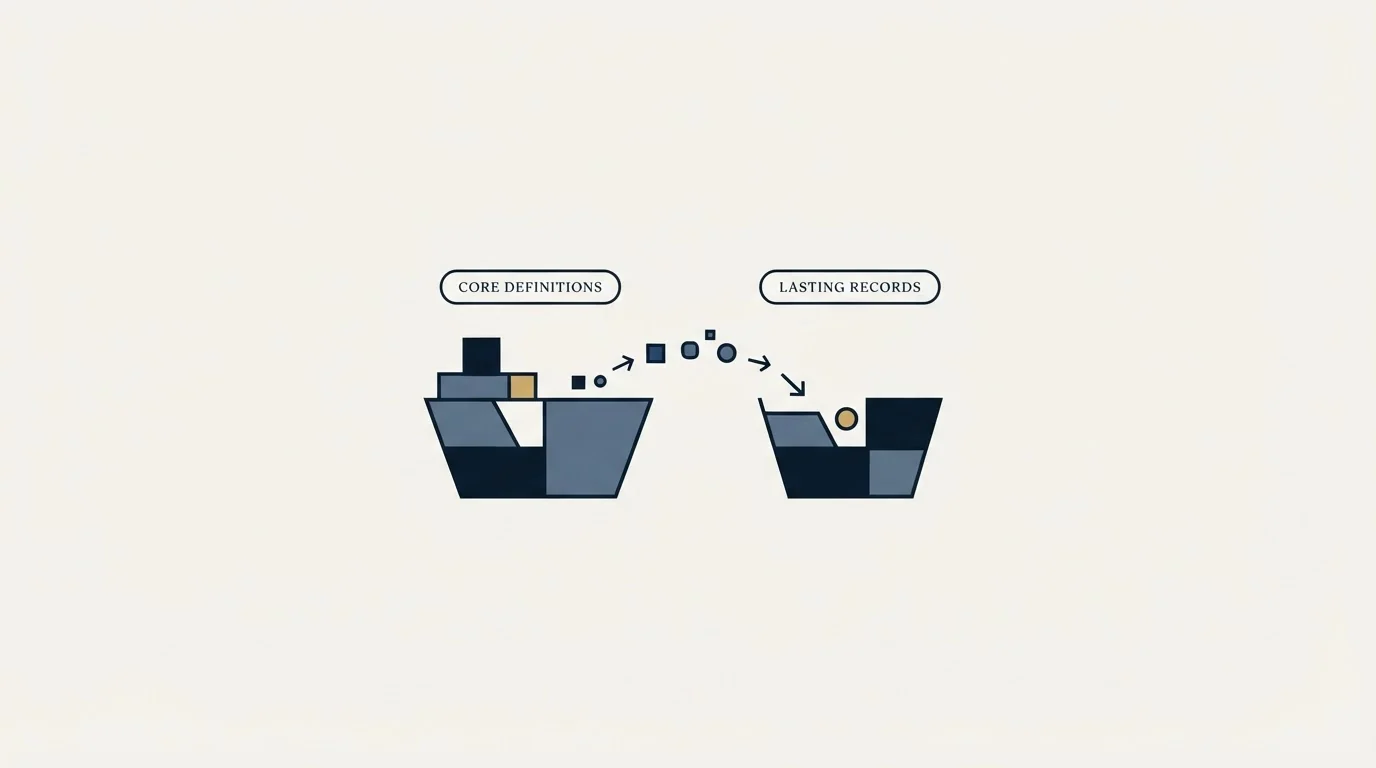
A GTM system is the definitions and records that outlive your tools: the target-set definition, the reason each account qualified, contact state, exclusion state, and the outcome record with its criteria. Integration moves data between products and does not decide what any of it means, which is why nine connected tools can still leave a quarter unreviewable. Write the definition down outside a vendor UI, carry the reason on the row, give each fact one system of record, and give the layer one owner.
If the missing piece is the running of the outbound half against a definition you already have, see what one campaign against it produces, with qualification criteria agreed in writing before anything sends.
Frequently asked questions.
Frequently asked questions- What is a GTM system?
- It is the set of definitions, records and handoffs a go-to-market team runs on: who is in the target set and why, what was sent and when, who is excluded, and what came back judged against criteria agreed before launch. Products store those records. The system is the records themselves and the rules about which one is authoritative for each fact.
- How is a GTM system different from a GTM tech stack?
- The stack is what you own and the system is what you can reconstruct. A team with nine integrated products may be unable to say which accounts were contacted last quarter and why, while a team with two products and a written target definition can answer both in minutes. Integration moves data between tools without deciding what any of it means.
- What breaks first when there is no system?
- The reason each account was targeted stops travelling with the row. The list still gets built and the messages still go out, so nothing looks broken, but the writer cannot see what the list builder knew and the copy reverts to a generic pitch. The second failure is exclusion state, which surfaces as an approach to a live customer.
- Who should own the go-to-market systems layer?
- One named person, commonly the role now called a GTM engineer, rather than each function maintaining its own version. That owner is responsible for the records being current and readable, not for the commercial decisions inside them. The target-set definition remains the property of whoever carries pipeline, written down in a form the machinery can read.
About the author.

B2B cold email experts helping companies generate qualified leads through done-for-you outreach campaigns.
RevenueFlow Team
Explore more.
Ready to scale your outreach?
We build GTM engines that book real meetings. See the receipts.
Related articles.
SDR Outsourcing for Logistics Companies: The Brokerage Line
What an outside sales development team may do in a freight company's name, the calling and email rules it inherits, and which arrangement survives a bid-shaped market.
SDR Outsourcing for Business Brokers: The Fee Timing
Whether a success-fee brokerage should rent sales development at all: the fee timing, the texts that limit what an outside person may say about value, and who signs.
Appointment Setting for Business Brokers: The Seller Meeting
What a bought meeting with a business owner has to be for a brokerage: the three-part qualification, the confidentiality rules, the licence line and the owner's reasons.
Command of the Sale: Force Management's Process Programme
Command of the Sale is Force Management's sales process and qualification programme, not its messaging one. What the vendor says it is, delivers and how it runs.
Cold Calling for PPC Agencies: What You Can See First
A paid media prospect is partly readable before the call and has already been told by the platform what to do when a stranger rings about its ads.
LinkedIn Outreach for Banks: A Regulated Message
How a bank's relationship managers use LinkedIn to reach business owners: what the FFIEC guidance, FINRA's notices and LinkedIn's own rules require, and where to stop.