ListKit Alternatives: Which Half of the Bundle You Replace
ListKit now sells a bundle, so an alternative is either one data provider or a whole stack. Which one you need depends on what you actually used.
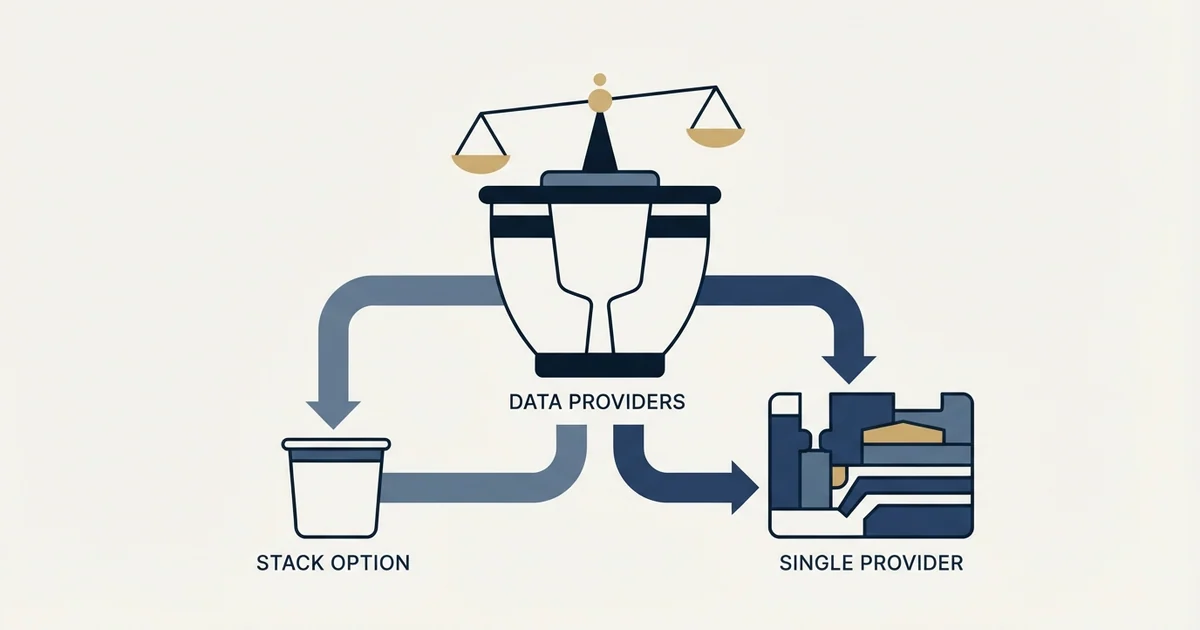
The best ListKit alternative depends on which half of ListKit you use. For contact data alone, UpLead starts at $99 a month for 170 credits and Lead411 at $49 for 1,000 exports. For the whole $597-a-month bundle, compare another bundle, such as Instantly's Starter at $94, or a stack you run yourself.
Key takeaways
- ListKit's pricing page sells one bundle, $597 a month for 1,000 cold emails a day, covering contact data, sending, inboxes, domains and AI-written copy.
- A data-only replacement is priced by its unit: UpLead's $99 buys 170 contacts, Lead411's $49 buys 1,000 exports, and Seamless.AI prices Pro through sales.
- Published contact counts such as 977M+ or 450M+ cannot be compared; a coverage test on a segment you know settles which database to buy.
- Before cancelling, settle in writing what happens to the domains ListKit registered for you, because their sending reputation is worth more than the fees.
Reviewed and updated September 22, 2026
Search for a ListKit alternative and every list returns the same names: Apollo, ZoomInfo, Cognism, Lusha, UpLead, Seamless. Those are B2B contact databases, and they are the right answer to a question ListKit stopped asking.
ZoomInfo's own form enrichment tool raises a separate trade-off, since fields it fills in become indistinguishable from what a visitor actually typed.
ListKit's own pricing page sells a single bundle at $597 per month for 1,000 cold emails a day, with a volume selector running to 10,000. The page heads that section "Simple pricing. Everything included." and describes the offer as "Pick your sending volume, and pay one price for the full cold email stack". The page lists the contact database alongside a sending engine with warmup, managed inboxes, an AI script writer, an onboarding call, a community and a course. It also states that "Domains are free" and puts the cost it covers at "around $300 /yr in domain fees, on us, for as long as you're subscribed".
So the word alternative is doing two different jobs depending on which half of that bundle you actually use, and the lists ranking for the term answer the first one.
What is the best ListKit alternative?
It depends on which half of ListKit you use. If you only export contacts, a data provider replaces it: UpLead from $99 a month for 170 credits, or Lead411 from $49 a month for 1,000 exports, tested on your own segment first. If you use the whole bundle, compare it with another bundle, such as Instantly's Starter at $94 a month, or with a stack you run yourself.
Which is better, ListKit or Seamless?
ListKit's pricing page sells one $597-a-month bundle of contact data, sending, inboxes and AI-written copy, while Seamless.AI's pricing page sells contact data on its own, with a free plan of 1 user and 50 credits and Pro plans priced through sales, so the better one is whichever matches the half of the job you actually need.
Work out which half you are replacing
Before comparing anything, answer one question: in the last month, did you use ListKit to export contacts, to send campaigns, or to do both?
If the answer is export only, you are shopping for a data provider and the standard lists apply. If the answer is both, a data provider replaces one component of what you were paying for and the remaining components land back on you as work. That gap is where switching decisions go wrong, because the sticker prices in the two columns are not comparable and look like they are.
If you are replacing the data
The category sells access in credits or exports, and the unit is where the real price lives. Two vendors publish enough on their own pages to compare directly.
UpLead's pricing page runs a free trial at "$0 / 7 days" with 5 credits, an Essentials tier at "$99 / month" with "170 Credits", and a Plus tier at "$199 / month" with 400 credits. Its own definition of the unit is on the page: "A credit unlocks a contact for download or CRM export", and more bluntly, "One credit = one contact." That makes the arithmetic direct, and it makes the entry tier small. A hundred and seventy contacts is a fortnight of one campaign at modest volume.
Lead411's pricing page carries a monthly ladder and an annual one side by side, under a line reading "Affordable Pricing with no hidden fees." Spark is "$ 49 / Month" for "1000 Exports / Month", Ignite is "$ 150 / Month" starting price for more, and the annual view prices Spark at "$ 490 / Year" for 12,000 exports. The top tier is quoted rather than shown, and the page adds that "Buyer Intent and Unlimited Data is available on Annual Subscriptions." Note the spacing in those figures, which is how the page renders them. Seamless.AI's pricing page, by contrast, prints no paid price at all: a free plan of 1 user and 50 credits, then Pro plans sold per user with annual credit packages through sales, where a credit is used each time it researches a contact.
Two things follow from putting those beside each other. Their entry-tier unit costs sit an order of magnitude apart, which usually means the two vendors are not selling the same record quality, the same coverage or the same refresh rate. And neither number tells you what matters, because coverage of your specific segment is the only variable that decides whether a database is worth anything to you.
For the larger platforms the comparison is a category question before it is a price question, and the corpus already works through it: Clay vs Apollo vs ZoomInfo separates the orchestration layer from the all-in-one from the enterprise database, and Apollo vs ZoomInfo takes the two most often shortlisted head to head.
The test that settles it, and it costs an afternoon

Every vendor in this category publishes a contact count, and no buyer can verify one. ListKit's page says "977M+" and calls its records "Triple-Verified", a phrase that names a process rather than a standard. Instantly's pricing page advertises a "Database of 450M+ B2B Leads". The counts are not measured on a comparable basis, they include long-dead records, and a bigger number is not evidence of better coverage of the three thousand companies you actually sell to.
The check that resolves it is the same one for every vendor on the list. Take a segment you know well enough to grade by hand, export a sample, and read it. Count how many companies you expected to see and did not. Count how many records name a person who has clearly moved. Then send to a slice of it and read the bounce rate, because a verification claim is settled by what bounces rather than by what the vendor calls its process.
Not evidence: headline contact counts, or a verification brand name
If you are replacing the whole stack
Here the honest comparison is against a set of prices rather than one, and there are two shapes of answer.
The first is another bundle. Instantly's pricing page sells bundles alongside the same capabilities separately, which makes it unusually easy to read the unbundling cost off one page. The page prices a Starter bundle at "$94 /monthly" for 5,000 emails monthly, 1,000 uploaded contacts and 1,500 credits, describing it as "Built for small teams just getting off the ground."; Scale is "$194 /monthly" on the same page for 100,000 emails monthly and 25,000 uploaded contacts. Buy the pieces instead and the same page prices the sending side as "Growth Plan $47/mo" with "Unlimited Email Accounts" and "Unlimited Email Warmup", and the data side as "Growth Credits $47/mo" for 1,500 credits.
One caution when reading that page or any other in the category. The Instantly page ships the monthly and the annual ladders in the same document, so the annual view of the same tier renders as "Starter $85 /monthly $94/month Save 10%". A figure lifted from that page without its billing basis silently changes what you are comparing.
The second shape is assembling it yourself, which is where a team running serious volume usually arrives. What that actually requires is five layers rather than a product, and the failure modes belong to the seams between them: cold email infrastructure sets out the layers and which one breaks first, and cold email outreach platforms takes the build-versus-buy decision at each volume tier.
The arithmetic, with invented numbers
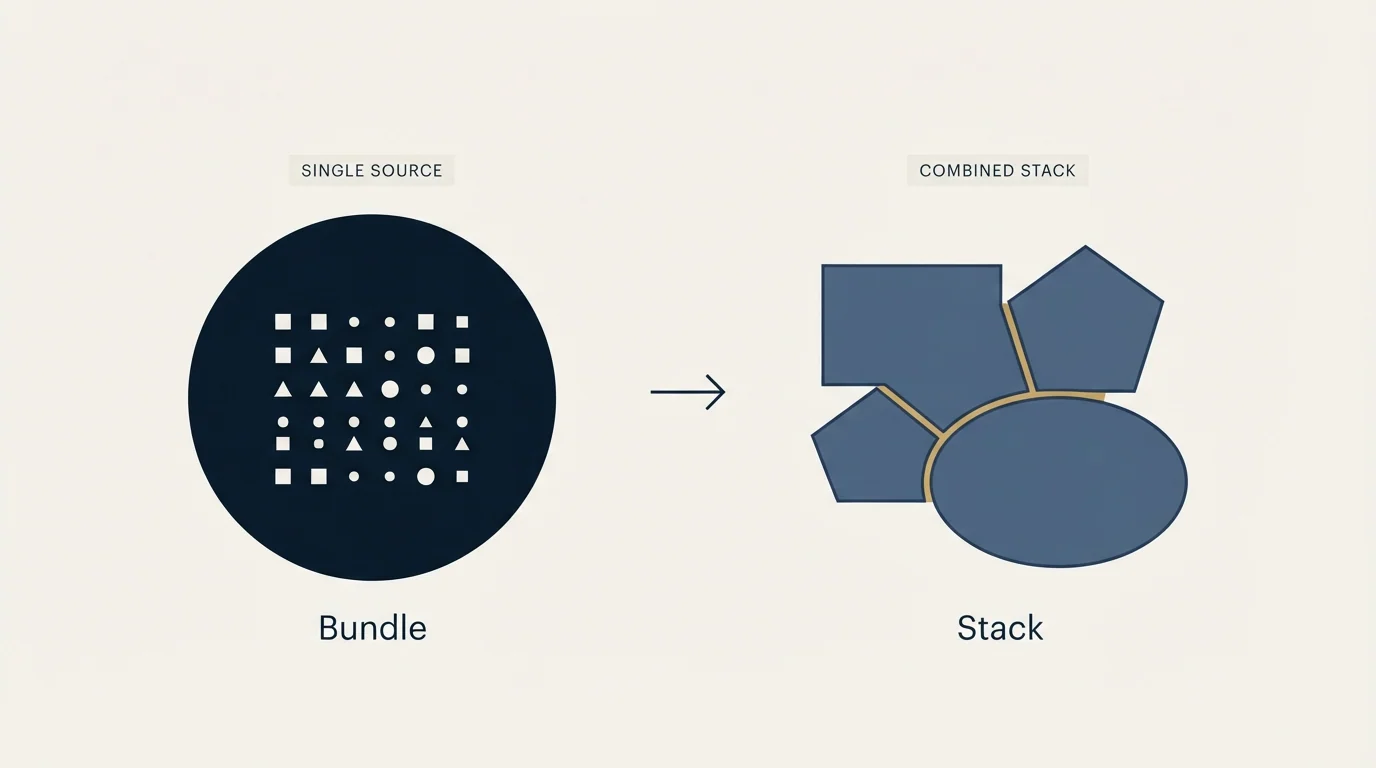
The following figures are illustrative and invented to show the shape of the comparison. They are not quotes and not benchmarks.
Suppose a team is paying a bundle price of six hundred a month and, on inspection, uses the database heavily, the sending engine daily and the AI copywriter never. Replacing it piecewise might come to a hundred for data, fifty for sending, eighty for inboxes and domains, and nothing for copy because a person already writes it. That lands near two hundred and thirty, which on these invented figures reads as a saving of about sixty percent.
Now price the part the arithmetic left out. Somebody has to provision domains, configure authentication on each one, run a warmup period before the first send, watch per-domain volumes, and triage a deliverability problem across three vendors who each believe it belongs to one of the others. If that person exists on your team and already knows how, the saving is real. If they do not, the bundle price was buying their absence, and the comparison above is not a comparison.
ListKit's own page runs a version of this comparison with its own figures. Its table of the old way prices the separate tools at "$1,041+/mo", while the paragraph above that table puts the same stack at 400 to 800 dollars a month across six tools. The two totals on one page do not agree, which is a fair summary of how much the answer depends on who does the adding up.
That is the same trade the vendor's own page argues, and the structural part of its argument survives scrutiny even where the totals are advocacy. Our reading of the current product and the claims worth checking yourself is in the ListKit review.
The domains question nobody asks until they cancel
ListKit's page states that it registers the domains you choose and covers the fees "for as long as you're subscribed". Those domains are the ones your sending reputation has been accumulating on.
So the switching question is not only about price. Establish, in writing and before you move, what happens to those domains when the subscription ends: whether they transfer to you, what the transfer costs, and how long it takes. A domain with warmed reputation is worth considerably more than a domain fee, and starting again on fresh domains means a warmup period before the first campaign sends at volume.
What none of the alternatives changes

Two things survive every switch on this list, and they are worth naming because a switching decision often gets made in the hope that they will not.
Deliverability is not a property a supplier can hand you. ListKit's page puts a claim of "98% Deliverability" beside its contact count, and every vendor in the category makes a version of that claim. Read all of them as statements about a setup rather than about your outcomes, because what you send, to whom and how often decides more of the result than the infrastructure does. Whether a switch actually helped is measured rather than promised, and the instrument is an inbox placement test run before and after.
The other constant is the sequence default. Sequences are the category default rather than one vendor's choice, and ListKit's page lists its sending platform as "Sequences + warm-up". We run one message per campaign and send it once. When someone who did not reply is approached again, that is a separate campaign re-sending the same message, never a follow-up in a thread. Any of these tools can be configured that way. None of them defaults to it, so the defaults are working against that choice whichever one you pick.
The short version
The alternatives lists ranking for this term answer the data question, and the current product is a bundle, so start by establishing which half you use. If it is the data, compare on your own coverage test rather than on published contact counts, and read the unit that price is quoted in. If it is the whole stack, compare against another bundle or against five layers you will own, and price the person who runs the seams before calling a piecewise total a saving. Settle the domains in writing before you cancel anything.
If you would rather not run any of it, get a free campaign plan and we will show you how the list, the infrastructure and the message are built.
Pricing and features are taken from the vendors' own pages. Verify current terms with the vendor before relying on them.
Frequently asked questions.
Frequently asked questions- What is the best ListKit alternative?
- It depends on which half you use. If you only export contacts, a data provider such as UpLead, from $99 a month for 170 credits, or Lead411, from $49 a month for 1,000 exports, replaces it. If you use the whole bundle, compare it with another bundle such as Instantly's Starter at $94 a month, or with a stack you run yourself, and price the person who runs it.
- Which is better, ListKit or Seamless?
- They sell different things. ListKit's pricing page sells one $597-a-month bundle of contact data, sending, inboxes and AI-written copy. Seamless.AI's pricing page sells contact data on its own, with a free plan of 1 user and 50 credits and Pro plans priced through sales. The better one is whichever matches the half of the job you actually need.
- How much does ListKit cost?
- ListKit's pricing page shows the full cold email stack at $597 a month for 1,000 cold emails a day, with a selector running up to 10,000 a day. The page says domains are free, with ListKit registering the names you pick and covering around $300 a year in domain fees for as long as you are subscribed.
- What should I check before cancelling ListKit?
- Check what happens to your sending domains. ListKit's page says it registers them and covers the fees while you are subscribed, and those domains carry the reputation your campaigns built. Get in writing whether they transfer to you, what that costs and how long it takes, because starting on fresh domains means a warmup period before sending at volume.
About the author.

B2B cold email experts helping companies generate qualified leads through done-for-you outreach campaigns.
RevenueFlow Team
Explore more.
Ready to scale your outreach?
We build GTM engines that book real meetings. See the receipts.
Related articles.
What Cold Email and Sales Tools Actually Cost in 2026: Pricing Data From 386 Vendors
RevenueFlow's verified dataset of 386 sales tools puts the median starting price at $39.98 a month. Here is the spread by category, tier and billing model.
Firmographic Data Providers: What Six of Them Publish
Six firmographic data providers read from their own pages: the fields each sells, the coverage each states, how the data is delivered, and who prints a price.
The Real Cost per 1,000 Emails, Verifications and Data Credits in 2026
Unit prices computed from verified vendor plans: $1.00 per 1,000 emails sent, $2.00 per 1,000 verifications and $19.60 per 1,000 enrichment credits.
Annual vs Monthly Billing: How Much Sales Tools Discount for Paying Yearly
Across 112 verified sales tools with both rates on record, the median discount for annual billing is 20.0%, and it only pays off after month 9.6.
Free Tiers and Trials in Sales Tools: What $0 Gets You Across 386 Vendors
37.0% of 386 verified sales tools have a permanent free plan. The median free data tier gives 50 credits and the median free sending plan 2,500 emails a month.
Zeliq Pricing: One Seat Rate and a Credit Meter
Zeliq prices one self-serve seat in dollars with a credit meter that never expires. Both billing states, the three credit rates, the top-up ladder and the Custom floor.